


Air duct cleaning Windsor services are essential for maintaining healthy indoor air quality and optimal HVAC performance in your home. The EPA has ranked indoor air pollution among the top 5 environmental dangers facing today's public, making professional duct cleaning more important than ever.
Quick Answer for Windsor Homeowners:
• Health Benefits: Removes dust, allergens, bacteria, and mold that contribute to respiratory issues
• Energy Savings: Clean ducts reduce strain on your HVAC system, lowering energy bills
• Recommended Frequency: Every 2-3 years (1-2 years with pets or allergies)
• Local Need: Windsor's location in Nova Scotia means homes contend with seasonal pollen and humid conditions
• Professional Process: Uses powerful truck-mounted vacuum systems and compressed air tools
Your home's ductwork acts as the lungs of your home - circulating air approximately 7 times per day through every room. You take about 20,000 breaths daily and spend 90% of your time indoors, making the quality of that circulated air crucial for your family's health.
In Windsor, Nova Scotia specifically, the abundance of pollen and allergy-producing airborne particles makes regular duct cleaning particularly important. Dirty air ducts can harbor dust, pet dander, bacteria, and even mold - all of which get blown throughout your home every time your heating or cooling system runs.
Did you know? Your home's air can be 2-5 times more polluted than the air outside, according to EPA studies. This makes professional duct cleaning a smart investment for both your health and your HVAC system's efficiency.

When you live in Windsor, air duct cleaning isn't just another home maintenance task – it's your family's ticket to breathing easier and living more comfortably. With Nova Scotia's notorious abundance of seasonal pollen and airborne allergens, your home's ductwork faces a constant battle against nature's microscopic invaders.
Every time your heating or cooling system runs, it's essentially playing a game of air hockey with dust, pet dander, and allergens throughout your home. Unfortunately, over time, your ducts become less like smooth hockey rinks and more like lint traps, collecting everything from dust mites and mold spores to the remnants of last spring's pollen explosion.
The good news? Professional air duct cleaning Windsor services can transform your home's air quality while giving your HVAC system the performance boost it deserves. Think of it as a spa day for your home's respiratory system – one that delivers allergy relief, improved energy efficiency, and odor removal that actually lasts.
For homeowners dealing with asthma symptoms or seasonal allergies, clean ducts can be genuinely life-changing. When your system isn't constantly recirculating accumulated irritants, you'll likely notice fewer sneezing fits and easier breathing throughout your home. If you're experiencing HVAC performance issues alongside air quality concerns, you might also want to explore air conditioner repair services to ensure your entire system is working optimally.
Here's a sobering thought: the EPA ranks indoor air pollution among the top 5 environmental dangers facing us today. When you consider that most of us spend about 90% of our time indoors, taking roughly 20,000 breaths daily, the quality of your home's air suddenly becomes a pretty big deal.
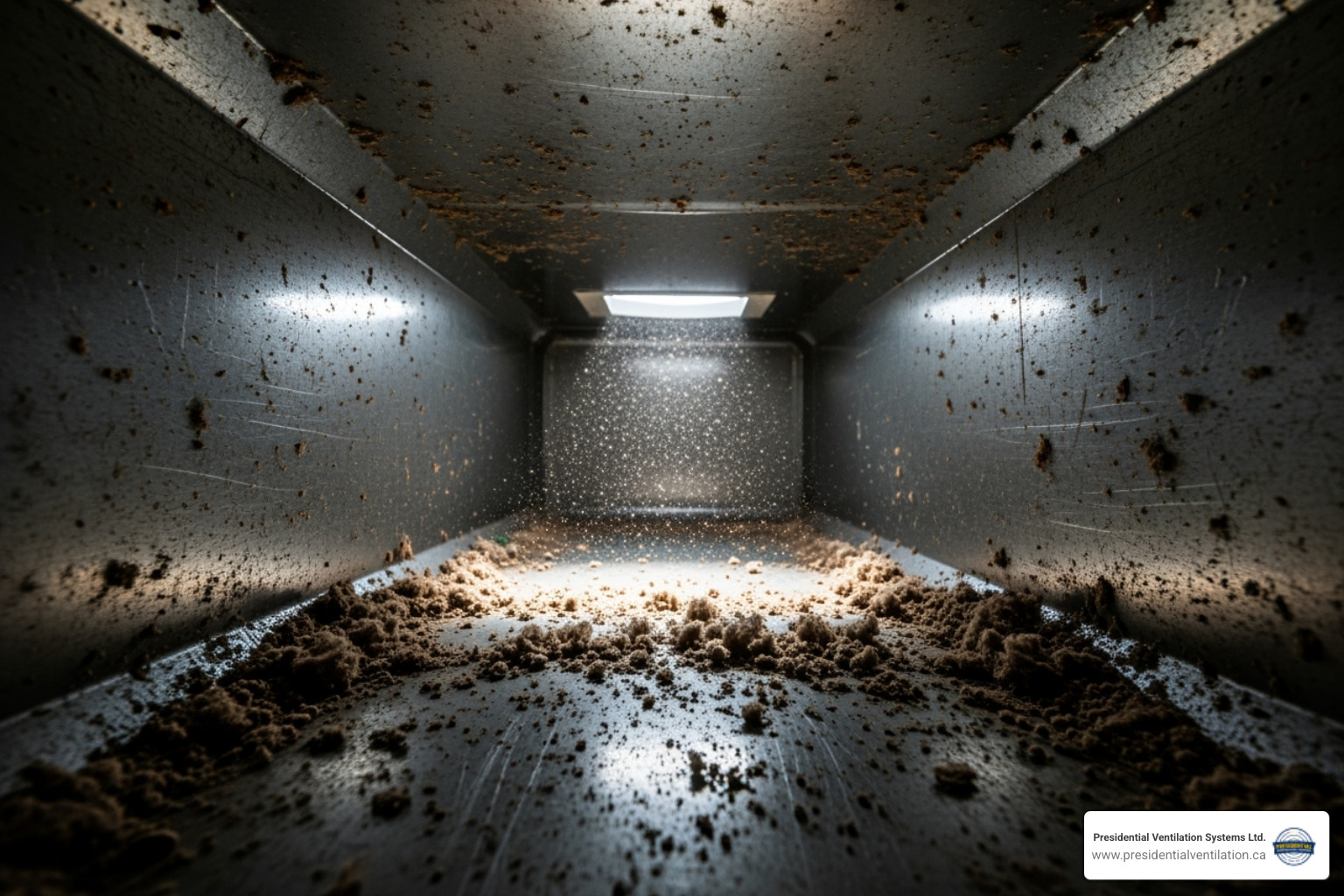
Your ducts can harbor an impressive collection of unwanted guests – dust mites, pet dander, mold spores, bacteria, and even viruses all love to set up camp in your ductwork. Every time your furnace kicks on, these microscopic troublemakers get a free ride throughout your living spaces, potentially contributing to respiratory and cardiovascular issues.
Professional duct cleaning acts like a deep clean for your home's circulatory system. By removing these accumulated contaminants, you're not just improving air quality – you're actively creating a healthier environment for your family. Many homeowners are amazed at how much cleaner their homes feel and smell after a thorough duct cleaning, with musty odors disappearing and allergy symptoms becoming noticeably less bothersome.
Think of your air ducts as the arteries of your home's comfort system. When they're clogged with debris, your poor HVAC system has to work overtime just to push air through – kind of like trying to breathe through a stuffy nose all day long.
Clean ducts mean maximized airflow and dramatically reduced strain on your furnace and air conditioning system. This translates directly into improved energy efficiency and more consistent temperature control throughout your home. No more playing hot-and-cold spot roulette as you move from room to room.
The beauty of professional duct cleaning extends far beyond immediate comfort. When your system doesn't have to fight against dust-clogged pathways, it operates more efficiently, consumes less energy, and enjoys significantly improved system longevity. You're essentially giving your HVAC system the gift of easier breathing, which it repays with lower energy bills and fewer mechanical issues down the road.
Clean ducts also mean your system can maintain proper airflow patterns, ensuring every room gets the heating or cooling it needs without overworking your equipment. It's a simple equation: less strain equals longer life and better performance for your entire comfort system.
Your home has a way of whispering to you when something's not quite right – and your HVAC system is no different. Learning to recognize these subtle (and sometimes not-so-subtle) signals can save you from bigger headaches down the road and keep your family breathing easy.
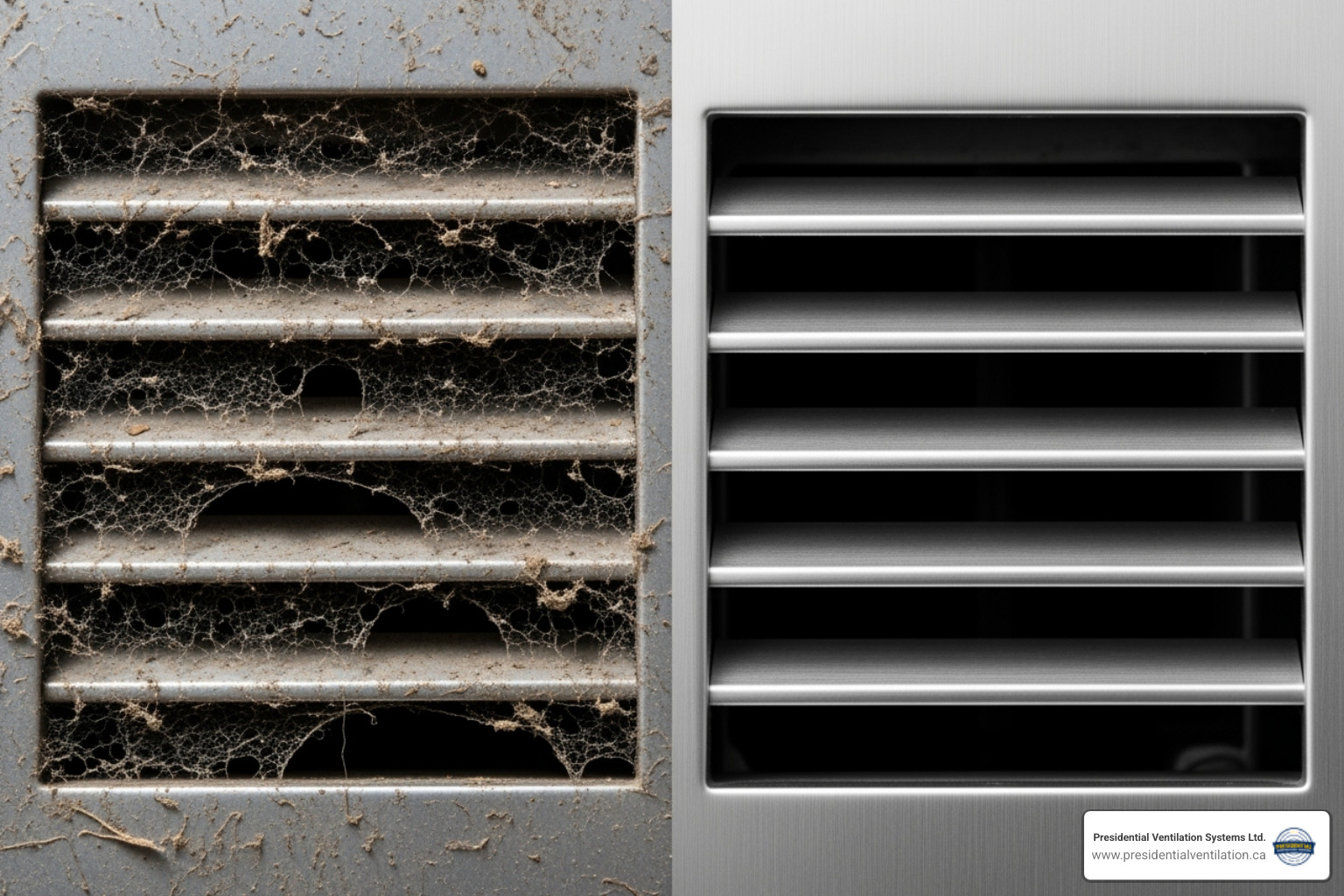
The most obvious red flag is visible dust buildup around your vents and registers. If you're constantly battling dust bunnies that seem to multiply faster than you can clean them, or if your furniture needs dusting just days after a thorough cleaning, your ductwork might be the culprit. It's like having a dust factory hidden in your walls!
Musty odors wafting from your vents when the system kicks on are another clear warning sign. That stale, unpleasant smell often points to mold or mildew growth lurking in your ducts – definitely not something you want as your daily air freshener.
Pay attention to how you and your family feel at home. If you're experiencing increased allergy symptoms, unexplained headaches, or persistent congestion that seems to improve when you leave the house, your indoor air quality might be taking a hit from dirty ducts. It's your body's way of telling you something's off.
Inconsistent airflow from room to room is another telltale sign. If one bedroom feels like the Arctic while another feels tropical, or if you notice weak air pressure from certain vents, debris buildup could be blocking proper circulation. And if you spot any signs of pest infestation like droppings or nesting materials near your vents, it's definitely time to call in the professionals.
While we generally recommend air duct cleaning Windsor services every 2-3 years for most homes, certain situations call for more immediate attention. Think of it as preventive medicine for your home's respiratory system.
Visible mold growth on duct surfaces or HVAC components is an urgent situation that requires professional intervention. Similarly, if you notice debris blowing out of your supply registers when the system runs, that's your ducts literally showing you what they've been holding onto.
Those unexplained headaches or persistent congestion that seem worse indoors often point directly to poor air quality from contaminated ductwork. If your air filters are getting clogged much faster than the manufacturer recommends, it's a sign that your system is working overtime to catch particles that shouldn't be there in the first place.
After new construction or major renovations, professional duct cleaning isn't just recommended – it's essential. This is when your ducts need the most help recovering from the construction chaos.
Here's something many homeowners don't realize: that beautiful renovation or new construction project creates a construction debris party in your ductwork. Drywall dust, sawdust, paint particles, and countless other fine particulates find their way into your HVAC system during building projects, even when contractors try to be careful.
These microscopic construction souvenirs don't just disappear – they settle into your ducts and get blown throughout your home every time your system runs. Without professional cleaning, you could be breathing construction dust for years after the last nail is hammered.
Air duct cleaning Windsor services after construction or renovation protect your investment and ensure you're breathing clean air from day one in your updated space. It's like giving your home's lungs a fresh start – because after all that hard work creating your dream space, you deserve to breathe easy in it.
When you choose air duct cleaning Windsor services from Presidential Ventilation Systems Ltd., you're getting more than just a quick vacuum job. You're investing in a thorough, professional process that's been refined over 30 years of experience. We know that your home is your sanctuary, so we treat it with the same care we'd want for our own families.
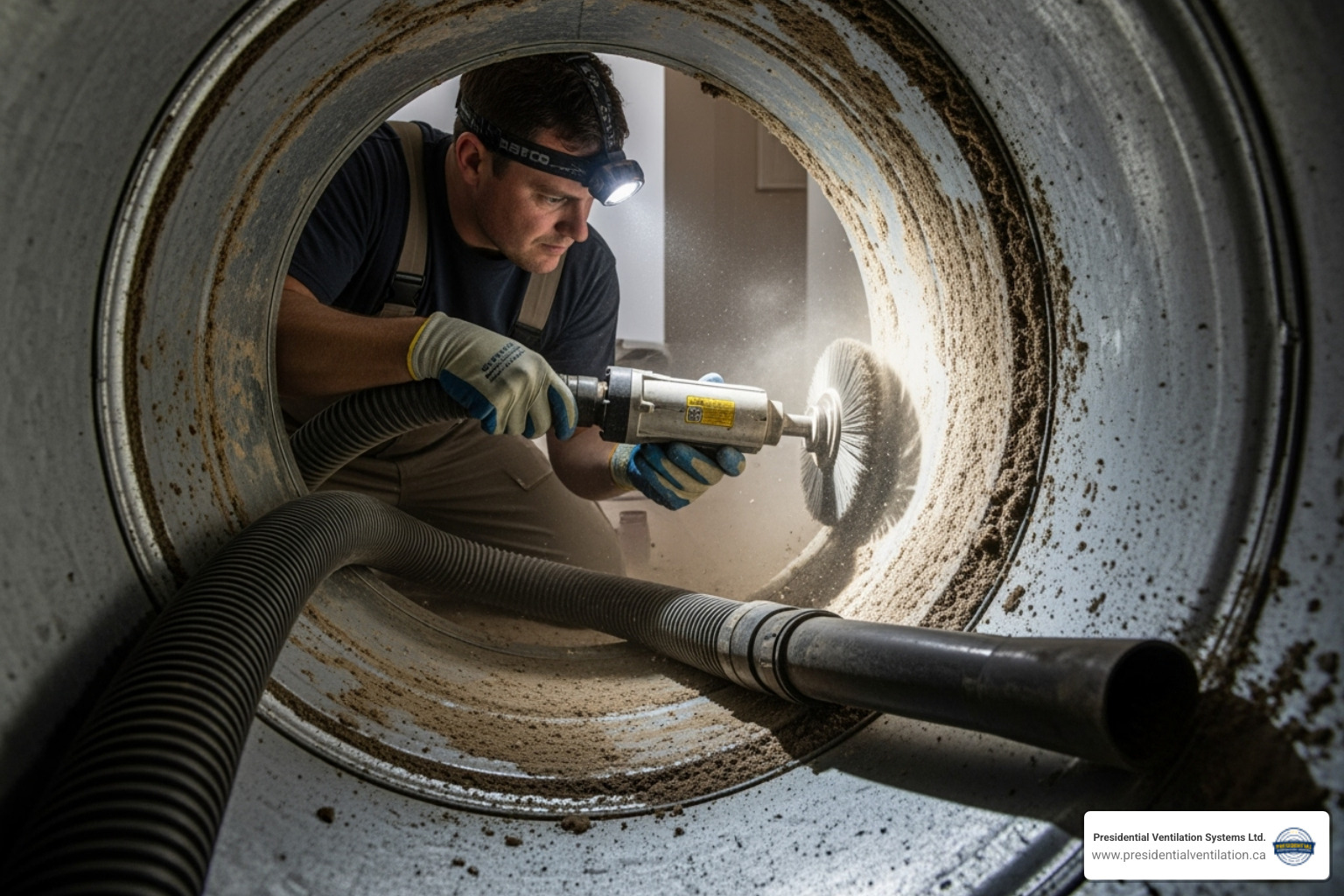
Everything starts with a comprehensive system inspection. Our experienced technicians walk through your home, mapping out your ductwork and checking for any potential issues. Think of it as a health check-up for your home's breathing system. We're looking for problem areas, assessing the level of contamination, and planning the most effective cleaning approach for your specific setup.
Before we even turn on our equipment, protecting your home becomes our top priority. We lay down protective coverings on your floors and furniture, and carefully seal off registers and vents. This isn't just about being neat - it's about containing everything we're about to remove from your ducts so it doesn't end up floating around your living spaces.
The real magic happens with our powerful vacuum systems. We connect industrial-strength, HEPA-filtered vacuum equipment (often truck-mounted for maximum power) directly to your main duct lines. This creates what we call "negative pressure" - essentially turning your entire duct system into a giant vacuum that pulls everything toward our collection system.
Next comes the deep cleaning phase. Our technicians use high-pressure air tools and specialized agitation devices like rotary brushes and flexible whips. These tools reach into every corner and crevice of your ductwork, dislodging years of accumulated dust, pet hair, and debris that's been hiding in there. Everything gets swept up immediately by that powerful vacuum system we mentioned.
We finish with a final walkthrough together. We'll show you what we've accomplished, make sure all your vents are properly reinstalled, and ensure your home looks exactly as it did when we arrived - except now your air ducts are spotless.
When our team pulls up to your Windsor home, you'll know right away that you're dealing with professionals. Our technicians arrive on time, introduce themselves, and take a few minutes to explain exactly what they'll be doing. We believe in keeping you informed every step of the way.
The arrival and prep phase sets the tone for everything that follows. We'll do a quick walkthrough with you, pointing out all the vents we'll be cleaning and making sure we have clear access to your furnace area. Those protective coverings go down next - we've learned that a little preparation saves a lot of cleanup later.
Once we connect our HEPA-filtered vacuum system, you'll hear the powerful hum of our equipment. That sound means we're creating the negative pressure needed to capture every particle we dislodge. It's like having a giant, incredibly efficient shop vacuum connected to your entire duct system.
The actual cleaning of your supply and return ducts is where our experience really shows. We work methodically through each vent, using the right tools for each situation. Some ducts need gentle brushing, others require more aggressive agitation to remove stubborn buildup. Our technicians know the difference and adjust their approach accordingly.
Furnace component cleaning rounds out the service. Your furnace fan, coils, and housing get the same thorough attention as your ducts. After all, there's no point in having clean ducts if your furnace is just going to blow dust right back into them.
We also offer sanitization options using EPA-approved, all-natural products. This is especially helpful if you've been dealing with persistent odors or if anyone in your family has respiratory sensitivities. It's that extra step that leaves your entire system not just clean, but fresh.
Most residential air duct cleaning Windsor services take about two hours for an average home. Larger homes or those that need extra attention might take a bit longer, but we'll let you know upfront what to expect. We work efficiently because we respect your time, but we never rush when it comes to doing the job right.
While we use the same careful approach for both residential and commercial properties, the scale and complexity can be quite different. Understanding these differences helps explain why commercial projects require specialized planning and equipment.
Residential duct cleaning focuses on your family's comfort and health. We're typically working with standard-sized ductwork, a single HVAC unit, and familiar layouts. The goal is to work efficiently while being respectful of your daily routine and living space.
Commercial air duct cleaning is a whole different animal. The system size and complexity alone can be overwhelming - think sprawling office buildings, multi-story condos, or industrial facilities with massive ventilation networks. These systems often have multiple air handlers, specialized exhaust systems, and ductwork that spans entire buildings.
Access requirements for commercial jobs can be challenging. We might need scissor lifts to reach high ducts, or work in tight mechanical rooms and crawl spaces. Sometimes we're accessing ductwork through ceiling tiles or specialized access panels that require careful removal and reinstallation.
Project duration reflects this complexity. While your home might take a couple of hours, a commercial building could require several days of work. We often coordinate with building managers to work during off-hours or weekends to minimize disruption to business operations.
The equipment we bring to commercial jobs is industrial-grade - more powerful vacuums, larger agitation tools, and specialized equipment designed to handle the volume of debris found in larger systems. We've invested in this commercial-grade equipment because regular residential tools simply aren't up to the task.
Most importantly, we understand that minimal operational disruption is crucial for businesses. We work closely with property managers and business owners to schedule our services at times that won't interfere with daily operations. Sometimes that means working nights or weekends, but we're committed to keeping your business running smoothly.
Whether we're cleaning the ducts in your cozy Windsor home or tackling a massive commercial facility, Presidential Ventilation Systems Ltd. brings the same commitment to quality and customer service that we've maintained for over three decades.
We know you have questions about air duct cleaning Windsor, and we're here to provide clear, honest answers. Over our years of service, these are the questions homeowners ask us most often - and we're happy to share what we've learned.
Here's the straightforward answer: most Windsor homes benefit from air duct cleaning every 2-3 years to maintain healthy indoor air quality. But like most things in life, it's not quite that simple - your home might need attention more or less frequently depending on your unique situation.
If you share your home with furry family members, especially those champion shedders, you'll likely want cleaning every 1-2 years. Pet dander has a sneaky way of accumulating in ductwork faster than you might expect. Similarly, if anyone in your household deals with allergies or respiratory sensitivities, more frequent cleaning can make a real difference in their daily comfort - sometimes annual cleaning is the sweet spot.
Post-renovation or after new construction is a special case entirely. All that construction dust needs to go somewhere, and unfortunately, your ducts often become an unintended storage space. We always recommend cleaning immediately after major projects to protect both your air quality and your HVAC system.
Here in Windsor, Nova Scotia, we deal with an abundance of pollen and seasonal allergens that can make regular cleaning especially valuable. The local climate factors mean that sticking to that 2-3 year schedule isn't just a suggestion - it's genuinely helpful for managing those seasonal challenges we all face.
The best approach? Pay attention to those warning signs we talked about earlier - visible dust buildup, musty odors, or increased allergy symptoms. Your home will tell you when it's time.
We completely understand this concern! Nobody wants their clean home turned into a dust storm, and frankly, we wouldn't want that either. The great news is that with professional air duct cleaning Windsor services, the answer is a confident "absolutely not."
We've perfected our approach over the years to ensure your home stays spotless throughout the process. Before we even start the real work, we seal off all your vents to prevent any dust from escaping into your living spaces. Think of it as creating a closed-loop system where all the dirt goes exactly where we want it to go - into our powerful vacuum equipment.
Our team comes prepared with protective drop cloths for work areas and shoe covers to prevent tracking anything through your home. The real magic happens with our contained vacuum systems - these HEPA-filtered powerhouses create negative pressure that immediately captures every bit of dislodged debris. Nothing escapes into your home's air.
Once we're finished, we don't just pack up and leave. Our thorough cleanup process ensures that any dust around the registers is wiped away and all our equipment is removed without leaving a trace. Many homeowners tell us their homes actually feel cleaner after we're done - and that's exactly how it should be.
While your dryer vent is separate from your main HVAC ductwork, it's worth discussing because many homeowners don't realize the serious risks involved. A clogged dryer vent isn't just an efficiency issue - it's a genuine safety concern.
The biggest worry is fire hazard prevention. Lint is incredibly flammable, and when it builds up in your dryer vent over time, the combination of heat and accumulated lint creates a recipe for house fires. It's not something we like to think about, but it's a very real danger that regular cleaning completely prevents.
Beyond safety, a clogged vent makes your dryer work much harder than it should. You'll notice clothes taking longer to dry, feeling unusually hot after cycles, or even detecting a burning smell. This extra strain doesn't just increase your energy bills - it can significantly shorten your dryer's lifespan, leading to premature breakdowns and expensive replacements.
Lint buildup around your dryer or vent opening is usually the first sign that cleaning is overdue. We typically recommend annual dryer vent cleaning to keep everything running safely and efficiently. You can learn more about the specific risks of dirty or clogged dryer vents on the Canada Mortgage and Housing Corporation website by clicking here.
Dryer vent cleaning is often offered alongside air duct cleaning Windsor services, making it convenient to address both your home's ventilation needs at once.
Take a deep breath. Feel that? That's the difference clean air makes in your home. When you choose professional air duct cleaning Windsor services, you're not just cleaning ducts – you're changing your entire living environment into a healthier, more comfortable space for everyone you love.

At Presidential Ventilation Systems Ltd., we've spent over 30 years helping families in Nova Scotia breathe easier. We understand that your home is your sanctuary, and the air you breathe inside it should be nothing short of excellent. That's why we bring our decades of HVAC expertise to every air duct cleaning Windsor job, treating your home with the same care we'd give our own.
The benefits of professional duct cleaning extend far beyond what meets the eye. You'll notice cleaner, fresher air flowing through your home, free from the dust, allergens, and odors that once made you reach for tissues or air fresheners. Your HVAC system will thank you too – running more efficiently, lasting longer, and keeping your energy bills in check. But perhaps most importantly, you'll have that wonderful peace of mind knowing your family is breathing the cleanest air possible.
Whether you're dealing with post-renovation dust, persistent allergy symptoms, or simply want to maintain your home's air quality, we're here to help. Our commitment goes beyond just cleaning – we're your partners in creating a healthier living environment that supports your family's well-being for years to come.
Ready to experience the difference clean air makes? We also offer comprehensive comfort solutions, including advanced ducted heat pump solutions in Windsor NS to keep your home comfortable year-round. Because when it comes to your family's comfort and health, you deserve nothing but the best.

Air duct cleaning Windsor services are essential for maintaining healthy indoor air quality and optimal HVAC performance in your home. The EPA has ranked indoor air pollution among the top 5 environmental dangers facing today's public, making professional duct cleaning more important than ever.
Quick Answer for Windsor Homeowners:
• Health Benefits: Removes dust, allergens, bacteria, and mold that contribute to respiratory issues
• Energy Savings: Clean ducts reduce strain on your HVAC system, lowering energy bills
• Recommended Frequency: Every 2-3 years (1-2 years with pets or allergies)
• Local Need: Windsor's location in Nova Scotia means homes contend with seasonal pollen and humid conditions
• Professional Process: Uses powerful truck-mounted vacuum systems and compressed air tools
Your home's ductwork acts as the lungs of your home - circulating air approximately 7 times per day through every room. You take about 20,000 breaths daily and spend 90% of your time indoors, making the quality of that circulated air crucial for your family's health.
In Windsor, Nova Scotia specifically, the abundance of pollen and allergy-producing airborne particles makes regular duct cleaning particularly important. Dirty air ducts can harbor dust, pet dander, bacteria, and even mold - all of which get blown throughout your home every time your heating or cooling system runs.
Did you know? Your home's air can be 2-5 times more polluted than the air outside, according to EPA studies. This makes professional duct cleaning a smart investment for both your health and your HVAC system's efficiency.
When you live in Windsor, air duct cleaning isn't just another home maintenance task – it's your family's ticket to breathing easier and living more comfortably. With Nova Scotia's notorious abundance of seasonal pollen and airborne allergens, your home's ductwork faces a constant battle against nature's microscopic invaders.
Every time your heating or cooling system runs, it's essentially playing a game of air hockey with dust, pet dander, and allergens throughout your home. Unfortunately, over time, your ducts become less like smooth hockey rinks and more like lint traps, collecting everything from dust mites and mold spores to the remnants of last spring's pollen explosion.
The good news? Professional air duct cleaning Windsor services can transform your home's air quality while giving your HVAC system the performance boost it deserves. Think of it as a spa day for your home's respiratory system – one that delivers allergy relief, improved energy efficiency, and odor removal that actually lasts.
For homeowners dealing with asthma symptoms or seasonal allergies, clean ducts can be genuinely life-changing. When your system isn't constantly recirculating accumulated irritants, you'll likely notice fewer sneezing fits and easier breathing throughout your home. If you're experiencing HVAC performance issues alongside air quality concerns, you might also want to explore air conditioner repair services to ensure your entire system is working optimally.
Here's a sobering thought: the EPA ranks indoor air pollution among the top 5 environmental dangers facing us today. When you consider that most of us spend about 90% of our time indoors, taking roughly 20,000 breaths daily, the quality of your home's air suddenly becomes a pretty big deal.
Your ducts can harbor an impressive collection of unwanted guests – dust mites, pet dander, mold spores, bacteria, and even viruses all love to set up camp in your ductwork. Every time your furnace kicks on, these microscopic troublemakers get a free ride throughout your living spaces, potentially contributing to respiratory and cardiovascular issues.
Professional duct cleaning acts like a deep clean for your home's circulatory system. By removing these accumulated contaminants, you're not just improving air quality – you're actively creating a healthier environment for your family. Many homeowners are amazed at how much cleaner their homes feel and smell after a thorough duct cleaning, with musty odors disappearing and allergy symptoms becoming noticeably less bothersome.
Think of your air ducts as the arteries of your home's comfort system. When they're clogged with debris, your poor HVAC system has to work overtime just to push air through – kind of like trying to breathe through a stuffy nose all day long.
Clean ducts mean maximized airflow and dramatically reduced strain on your furnace and air conditioning system. This translates directly into improved energy efficiency and more consistent temperature control throughout your home. No more playing hot-and-cold spot roulette as you move from room to room.
The beauty of professional duct cleaning extends far beyond immediate comfort. When your system doesn't have to fight against dust-clogged pathways, it operates more efficiently, consumes less energy, and enjoys significantly improved system longevity. You're essentially giving your HVAC system the gift of easier breathing, which it repays with lower energy bills and fewer mechanical issues down the road.
Clean ducts also mean your system can maintain proper airflow patterns, ensuring every room gets the heating or cooling it needs without overworking your equipment. It's a simple equation: less strain equals longer life and better performance for your entire comfort system.
Your home has a way of whispering to you when something's not quite right – and your HVAC system is no different. Learning to recognize these subtle (and sometimes not-so-subtle) signals can save you from bigger headaches down the road and keep your family breathing easy.
The most obvious red flag is visible dust buildup around your vents and registers. If you're constantly battling dust bunnies that seem to multiply faster than you can clean them, or if your furniture needs dusting just days after a thorough cleaning, your ductwork might be the culprit. It's like having a dust factory hidden in your walls!
Musty odors wafting from your vents when the system kicks on are another clear warning sign. That stale, unpleasant smell often points to mold or mildew growth lurking in your ducts – definitely not something you want as your daily air freshener.
Pay attention to how you and your family feel at home. If you're experiencing increased allergy symptoms, unexplained headaches, or persistent congestion that seems to improve when you leave the house, your indoor air quality might be taking a hit from dirty ducts. It's your body's way of telling you something's off.
Inconsistent airflow from room to room is another telltale sign. If one bedroom feels like the Arctic while another feels tropical, or if you notice weak air pressure from certain vents, debris buildup could be blocking proper circulation. And if you spot any signs of pest infestation like droppings or nesting materials near your vents, it's definitely time to call in the professionals.
While we generally recommend air duct cleaning Windsor services every 2-3 years for most homes, certain situations call for more immediate attention. Think of it as preventive medicine for your home's respiratory system.
Visible mold growth on duct surfaces or HVAC components is an urgent situation that requires professional intervention. Similarly, if you notice debris blowing out of your supply registers when the system runs, that's your ducts literally showing you what they've been holding onto.
Those unexplained headaches or persistent congestion that seem worse indoors often point directly to poor air quality from contaminated ductwork. If your air filters are getting clogged much faster than the manufacturer recommends, it's a sign that your system is working overtime to catch particles that shouldn't be there in the first place.
After new construction or major renovations, professional duct cleaning isn't just recommended – it's essential. This is when your ducts need the most help recovering from the construction chaos.
Here's something many homeowners don't realize: that beautiful renovation or new construction project creates a construction debris party in your ductwork. Drywall dust, sawdust, paint particles, and countless other fine particulates find their way into your HVAC system during building projects, even when contractors try to be careful.
These microscopic construction souvenirs don't just disappear – they settle into your ducts and get blown throughout your home every time your system runs. Without professional cleaning, you could be breathing construction dust for years after the last nail is hammered.
Air duct cleaning Windsor services after construction or renovation protect your investment and ensure you're breathing clean air from day one in your updated space. It's like giving your home's lungs a fresh start – because after all that hard work creating your dream space, you deserve to breathe easy in it.
When you choose air duct cleaning Windsor services from Presidential Ventilation Systems Ltd., you're getting more than just a quick vacuum job. You're investing in a thorough, professional process that's been refined over 30 years of experience. We know that your home is your sanctuary, so we treat it with the same care we'd want for our own families.
Everything starts with a comprehensive system inspection. Our experienced technicians walk through your home, mapping out your ductwork and checking for any potential issues. Think of it as a health check-up for your home's breathing system. We're looking for problem areas, assessing the level of contamination, and planning the most effective cleaning approach for your specific setup.
Before we even turn on our equipment, protecting your home becomes our top priority. We lay down protective coverings on your floors and furniture, and carefully seal off registers and vents. This isn't just about being neat - it's about containing everything we're about to remove from your ducts so it doesn't end up floating around your living spaces.
The real magic happens with our powerful vacuum systems. We connect industrial-strength, HEPA-filtered vacuum equipment (often truck-mounted for maximum power) directly to your main duct lines. This creates what we call "negative pressure" - essentially turning your entire duct system into a giant vacuum that pulls everything toward our collection system.
Next comes the deep cleaning phase. Our technicians use high-pressure air tools and specialized agitation devices like rotary brushes and flexible whips. These tools reach into every corner and crevice of your ductwork, dislodging years of accumulated dust, pet hair, and debris that's been hiding in there. Everything gets swept up immediately by that powerful vacuum system we mentioned.
We finish with a final walkthrough together. We'll show you what we've accomplished, make sure all your vents are properly reinstalled, and ensure your home looks exactly as it did when we arrived - except now your air ducts are spotless.
When our team pulls up to your Windsor home, you'll know right away that you're dealing with professionals. Our technicians arrive on time, introduce themselves, and take a few minutes to explain exactly what they'll be doing. We believe in keeping you informed every step of the way.
The arrival and prep phase sets the tone for everything that follows. We'll do a quick walkthrough with you, pointing out all the vents we'll be cleaning and making sure we have clear access to your furnace area. Those protective coverings go down next - we've learned that a little preparation saves a lot of cleanup later.
Once we connect our HEPA-filtered vacuum system, you'll hear the powerful hum of our equipment. That sound means we're creating the negative pressure needed to capture every particle we dislodge. It's like having a giant, incredibly efficient shop vacuum connected to your entire duct system.
The actual cleaning of your supply and return ducts is where our experience really shows. We work methodically through each vent, using the right tools for each situation. Some ducts need gentle brushing, others require more aggressive agitation to remove stubborn buildup. Our technicians know the difference and adjust their approach accordingly.
Furnace component cleaning rounds out the service. Your furnace fan, coils, and housing get the same thorough attention as your ducts. After all, there's no point in having clean ducts if your furnace is just going to blow dust right back into them.
We also offer sanitization options using EPA-approved, all-natural products. This is especially helpful if you've been dealing with persistent odors or if anyone in your family has respiratory sensitivities. It's that extra step that leaves your entire system not just clean, but fresh.
Most residential air duct cleaning Windsor services take about two hours for an average home. Larger homes or those that need extra attention might take a bit longer, but we'll let you know upfront what to expect. We work efficiently because we respect your time, but we never rush when it comes to doing the job right.
While we use the same careful approach for both residential and commercial properties, the scale and complexity can be quite different. Understanding these differences helps explain why commercial projects require specialized planning and equipment.
Residential duct cleaning focuses on your family's comfort and health. We're typically working with standard-sized ductwork, a single HVAC unit, and familiar layouts. The goal is to work efficiently while being respectful of your daily routine and living space.
Commercial air duct cleaning is a whole different animal. The system size and complexity alone can be overwhelming - think sprawling office buildings, multi-story condos, or industrial facilities with massive ventilation networks. These systems often have multiple air handlers, specialized exhaust systems, and ductwork that spans entire buildings.
Access requirements for commercial jobs can be challenging. We might need scissor lifts to reach high ducts, or work in tight mechanical rooms and crawl spaces. Sometimes we're accessing ductwork through ceiling tiles or specialized access panels that require careful removal and reinstallation.
Project duration reflects this complexity. While your home might take a couple of hours, a commercial building could require several days of work. We often coordinate with building managers to work during off-hours or weekends to minimize disruption to business operations.
The equipment we bring to commercial jobs is industrial-grade - more powerful vacuums, larger agitation tools, and specialized equipment designed to handle the volume of debris found in larger systems. We've invested in this commercial-grade equipment because regular residential tools simply aren't up to the task.
Most importantly, we understand that minimal operational disruption is crucial for businesses. We work closely with property managers and business owners to schedule our services at times that won't interfere with daily operations. Sometimes that means working nights or weekends, but we're committed to keeping your business running smoothly.
Whether we're cleaning the ducts in your cozy Windsor home or tackling a massive commercial facility, Presidential Ventilation Systems Ltd. brings the same commitment to quality and customer service that we've maintained for over three decades.
We know you have questions about air duct cleaning Windsor, and we're here to provide clear, honest answers. Over our years of service, these are the questions homeowners ask us most often - and we're happy to share what we've learned.
Here's the straightforward answer: most Windsor homes benefit from air duct cleaning every 2-3 years to maintain healthy indoor air quality. But like most things in life, it's not quite that simple - your home might need attention more or less frequently depending on your unique situation.
If you share your home with furry family members, especially those champion shedders, you'll likely want cleaning every 1-2 years. Pet dander has a sneaky way of accumulating in ductwork faster than you might expect. Similarly, if anyone in your household deals with allergies or respiratory sensitivities, more frequent cleaning can make a real difference in their daily comfort - sometimes annual cleaning is the sweet spot.
Post-renovation or after new construction is a special case entirely. All that construction dust needs to go somewhere, and unfortunately, your ducts often become an unintended storage space. We always recommend cleaning immediately after major projects to protect both your air quality and your HVAC system.
Here in Windsor, Nova Scotia, we deal with an abundance of pollen and seasonal allergens that can make regular cleaning especially valuable. The local climate factors mean that sticking to that 2-3 year schedule isn't just a suggestion - it's genuinely helpful for managing those seasonal challenges we all face.
The best approach? Pay attention to those warning signs we talked about earlier - visible dust buildup, musty odors, or increased allergy symptoms. Your home will tell you when it's time.
We completely understand this concern! Nobody wants their clean home turned into a dust storm, and frankly, we wouldn't want that either. The great news is that with professional air duct cleaning Windsor services, the answer is a confident "absolutely not."
We've perfected our approach over the years to ensure your home stays spotless throughout the process. Before we even start the real work, we seal off all your vents to prevent any dust from escaping into your living spaces. Think of it as creating a closed-loop system where all the dirt goes exactly where we want it to go - into our powerful vacuum equipment.
Our team comes prepared with protective drop cloths for work areas and shoe covers to prevent tracking anything through your home. The real magic happens with our contained vacuum systems - these HEPA-filtered powerhouses create negative pressure that immediately captures every bit of dislodged debris. Nothing escapes into your home's air.
Once we're finished, we don't just pack up and leave. Our thorough cleanup process ensures that any dust around the registers is wiped away and all our equipment is removed without leaving a trace. Many homeowners tell us their homes actually feel cleaner after we're done - and that's exactly how it should be.
While your dryer vent is separate from your main HVAC ductwork, it's worth discussing because many homeowners don't realize the serious risks involved. A clogged dryer vent isn't just an efficiency issue - it's a genuine safety concern.
The biggest worry is fire hazard prevention. Lint is incredibly flammable, and when it builds up in your dryer vent over time, the combination of heat and accumulated lint creates a recipe for house fires. It's not something we like to think about, but it's a very real danger that regular cleaning completely prevents.
Beyond safety, a clogged vent makes your dryer work much harder than it should. You'll notice clothes taking longer to dry, feeling unusually hot after cycles, or even detecting a burning smell. This extra strain doesn't just increase your energy bills - it can significantly shorten your dryer's lifespan, leading to premature breakdowns and expensive replacements.
Lint buildup around your dryer or vent opening is usually the first sign that cleaning is overdue. We typically recommend annual dryer vent cleaning to keep everything running safely and efficiently. You can learn more about the specific risks of dirty or clogged dryer vents on the Canada Mortgage and Housing Corporation website by clicking here.
Dryer vent cleaning is often offered alongside air duct cleaning Windsor services, making it convenient to address both your home's ventilation needs at once.
Take a deep breath. Feel that? That's the difference clean air makes in your home. When you choose professional air duct cleaning Windsor services, you're not just cleaning ducts – you're changing your entire living environment into a healthier, more comfortable space for everyone you love.
At Presidential Ventilation Systems Ltd., we've spent over 30 years helping families in Nova Scotia breathe easier. We understand that your home is your sanctuary, and the air you breathe inside it should be nothing short of excellent. That's why we bring our decades of HVAC expertise to every air duct cleaning Windsor job, treating your home with the same care we'd give our own.
The benefits of professional duct cleaning extend far beyond what meets the eye. You'll notice cleaner, fresher air flowing through your home, free from the dust, allergens, and odors that once made you reach for tissues or air fresheners. Your HVAC system will thank you too – running more efficiently, lasting longer, and keeping your energy bills in check. But perhaps most importantly, you'll have that wonderful peace of mind knowing your family is breathing the cleanest air possible.
Whether you're dealing with post-renovation dust, persistent allergy symptoms, or simply want to maintain your home's air quality, we're here to help. Our commitment goes beyond just cleaning – we're your partners in creating a healthier living environment that supports your family's well-being for years to come.
Ready to experience the difference clean air makes? We also offer comprehensive comfort solutions, including advanced ducted heat pump solutions in Windsor NS to keep your home comfortable year-round. Because when it comes to your family's comfort and health, you deserve nothing but the best.

You are planning an oil-to-heat-pump conversion, but you might be wondering why we require dedicated circuits for ductless mini splits in older homes instead of simply plugging the new unit into an existing wall outlet. It is a question our team at Presidential Ventilation Systems hears frequently during the estimate phase. Homeowners naturally want to save time and minimize disruptions to their drywall. Tying a new indoor air handler into a nearby bedroom or living room circuit seems like a fast, logical shortcut. However, the existing electrical infrastructure in aging properties was never designed to handle the continuous, heavy load of modern heating equipment.
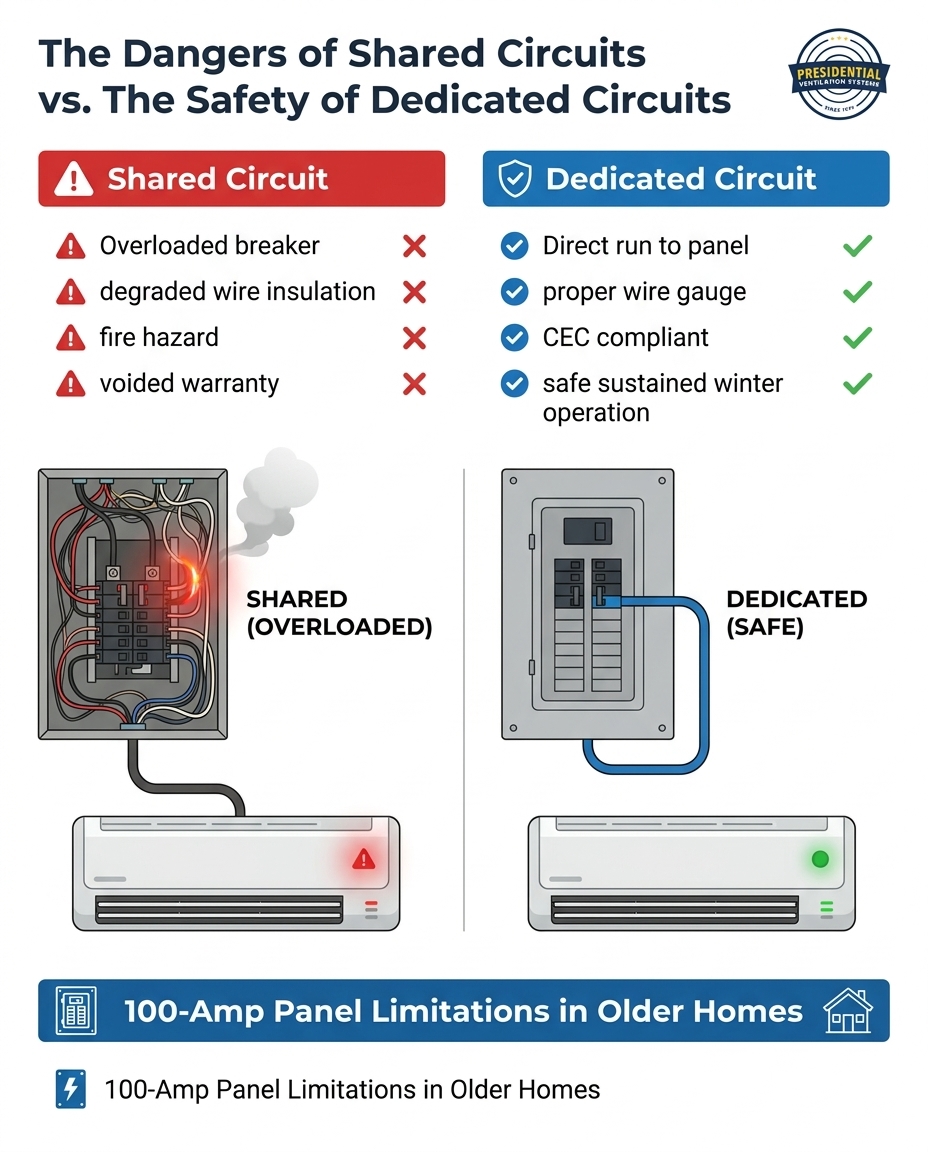
If you are exploring heat pump systems, understanding the electrical side of a ductless heat pump installation is just as critical as selecting the right hardware. The decision to run a dedicated electrical line straight back to your main electrical panel is not an arbitrary upsell. It is a strict safety standard. Without a dedicated circuit, you risk overloaded breakers, compromised wire insulation, and hidden fire hazards. In our 30+ years serving Mount Uniacke and the surrounding Nova Scotia communities, we have seen firsthand why taking shortcuts with existing wiring is a gamble no homeowner should take.
Common misconceptions about heat pump wiring:
• "It runs on electricity, so any outlet works." Standard wall outlets are wired for intermittent, low-draw devices, not continuous heating equipment.
• "My breaker hasn't tripped before, so it has room." A breaker that holds a television and a lamp will trip immediately when a compressor surges to life.
• "Smaller units do not need dedicated power." Even 110V mini splits require their own dedicated breaker to operate safely and meet code.
When our Red Seal electricians assess older Nova Scotia homes, it is very common to find properties still operating on 60-amp or 100-amp service panels. When these homes were built, the electrical demands of daily life were entirely different. A typical household ran a few incandescent lights, a refrigerator, and perhaps a small television. Today, we plug in computers, air fryers, electric vehicles, and high-efficiency heating systems. When you attempt to share a circuit, you are asking decades-old wiring to perform a job it was never engineered to do.
A shared circuit works by distributing available amperage across multiple outlets and fixtures on a single line. If you add a heat pump to a line that already powers your living room lights, a space heater, or a home entertainment center, you push the circuit far beyond its safe operational capacity. The immediate result is a frequently tripped breaker. While a tripped breaker is annoying, it is actually the safety mechanism doing its job. The real danger occurs when people ignore the tripping breaker, attempt to replace it with a larger one, or rely on degraded wiring that fails to trip the breaker in time.
• Microwave Oven — Typical Electrical Draw: High (Intermittent) — Duration of Load: 1 to 5 minutes — Circuit Requirement: Shared or Dedicated (Kitchen)
• Vacuum Cleaner — Typical Electrical Draw: Moderate — Duration of Load: 10 to 20 minutes — Circuit Requirement: Shared (General Lighting)
• Television / Electronics — Typical Electrical Draw: Low — Duration of Load: Hours — Circuit Requirement: Shared (General Lighting)
• Ductless Mini Split — Typical Electrical Draw: High (Continuous) — Duration of Load: Hours to Days — Circuit Requirement: Strictly Dedicated
Electrical safety comes down to matching the wire gauge and the breaker size to the specific draw of the appliance. If a heat pump draws 20 amps, it requires wiring thick enough to carry 20 amps without overheating, protected by a breaker designed to trip if the load exceeds that limit.
When you force a high-draw appliance onto an undersized, shared wire, the copper inside your walls gets hot. Over time, this sustained overheating degrades the plastic or rubber insulation surrounding the wire. Brittle, melted, or crumbling insulation exposes bare copper, creating a severe fire hazard hidden entirely behind your drywall. Taking shortcuts on electrical infrastructure compromises the safety of the entire household.
To truly understand why a dedicated circuit is necessary, we have to look at how a heat pump operates during freezing Maritime winters. Modern ductless mini splits are incredibly efficient, utilizing advanced inverter technology to modulate their output. However, efficiency does not mean they run on a trickle of electricity. When the temperature drops rapidly, these systems draw sustained amperage to keep your home comfortable.
During a deep freeze, your heat pump's compressor has to work at maximum capacity to extract ambient heat from the bitter outside air. This process requires a significant, continuous flow of electricity. Unlike a toaster or a hair dryer that runs for a few minutes and then shuts off, your heating system may run continuously for days during a severe winter storm. This sustained winter draw puts immense pressure on your electrical infrastructure.
How cold weather impacts electrical draw:
• Defrost cycles: The system periodically uses extra energy to melt ice buildup on the outdoor coil.
• Maximum compressor load: Extracting heat from -15°C air requires the compressor to run at its highest speed, drawing maximum running amps.
• Sustained operation: The system rarely cycles off during extreme cold, meaning the electrical wires have no time to cool down.
If your heat pump shares a circuit with other household items, the combined load during these extreme weather events will easily overwhelm older Nova Scotia homes. A dedicated circuit is the only way to ensure the system has the uninterrupted power it needs to keep your family warm when you need it most.
Beyond basic physics and safety, there is a legal and regulatory framework governing how heating equipment must be installed. The Canadian Electrical Code (CEC), also known as CSA C22.1, mandates specific standards for stationary heating appliances. Under these national regulations, hardwired heating equipment requires a dedicated circuit. Our in-house Red Seal tradespeople follow these codes strictly because they were written to prevent the exact circuit overloads and fire hazards we discussed earlier.
The electrical code also dictates how the system connects to the exterior of your home. A dedicated circuit is not just a wire running to the indoor unit; it involves an outdoor disconnect box mounted near the exterior compressor. This disconnect box provides a safe, immediate way for technicians to cut power to the unit during maintenance, repairs, or emergencies without having to run inside to the main breaker panel.
Ignoring these electrical codes during a major home upgrade carries significant consequences. If an unpermitted, non-compliant electrical installation causes a fire or property damage, your home insurance provider may deny your claim. Insurance companies expect major electrical modifications to be completed by licensed professionals following current CEC standards. Doing the job right the first time protects your property, your family, and your financial liability.
Improper electrical installation does not just pose a safety risk; it also threatens your long-term investment in the equipment itself. As a Daikin Comfort Pro, we know firsthand that major manufacturers like Daikin and Lennox explicitly require dedicated circuits in their official installation manuals. These engineering specifications are not suggestions—they are mandatory requirements for maintaining the validity of your manufacturer warranty.
The compressor is the heart of your heat pump and the most expensive component to replace. It is also highly vulnerable to electrical starvation. If a compressor operates on a shared circuit that experiences voltage drops or power fluctuations, it has to work much harder to maintain its internal magnetic fields. This causes the compressor motor to run hot, significantly reducing its lifespan.
Electrical issues that can void your warranty:
1. Voltage drops: Caused by undersized wiring or shared loads pulling power away from the heat pump.
2. Improper breaker sizing: Using a breaker that is too large for the wire, allowing the equipment to draw dangerous levels of current before tripping.
3. Lack of a disconnect box: Failing to install the required outdoor safety switch.
4. Non-compliant wiring methods: Splicing into existing room circuits instead of running a continuous line to the panel.
If your system fails prematurely and the manufacturer determines that voltage drops, power surges, or improper wiring caused the breakdown, they can—and often will—void the warranty. In our decades of experience, we have seen homeowners stuck with massive repair bills because a previous installer took an electrical shortcut. Doing the electrical work correctly the first time is the ultimate protection for your investment.
One of the most common homeowner headaches during a retrofit is dealing with multiple contractors. Often, an HVAC company will mount the indoor head, set the outdoor unit, run the refrigeration lines, and then tell the homeowner, "You will need to go hire a separate electrician to finish the wiring." This leaves you responsible for coordinating schedules, pulling separate permits, and managing communication between two different companies.
Because Presidential Ventilation Systems employs both HVAC and electrical professionals under one roof—with a team of approximately 70 skilled employees—we eliminate this frustration. Having both disciplines in-house ensures that your system is sized correctly from both a thermal and an electrical perspective. Our Red Seal tradespeople do not just view a heat pump as a refrigeration job; they view it as a comprehensive home infrastructure upgrade.
When you utilize our HVAC and electrical services, you experience a seamless process. One unified team handles the refrigeration lines, drills the necessary penetrations, runs the dedicated circuit back to the panel, and installs the outdoor disconnect box. This integrated approach provides peace of mind. There is a single point of accountability. If you ever have a question about how your system is running or how it is wired, you make one phone call to the team that built it, with no finger-pointing between separate contractors.
Understanding that you need a dedicated circuit is the first step, but what happens if your current electrical panel cannot support one? In older Nova Scotia homes, it is very common for our electricians to find a 100-amp panel that is completely full, lacking the physical space or the overall capacity for a new 220V breaker.
Before installing high-draw heating appliances, a professional must conduct a proper electrical load calculation. This calculation looks at the total square footage of your home, the existing major appliances (electric range, dryer, water heater), and the proposed new heating load. The goal is to determine if your current service can safely handle the additional demand without exceeding the main breaker's rating.
Solutions for a maxed-out electrical panel:
• Service Upgrades: Upgrading the entire home from a 100-amp service to a 200-amp service. This involves a new panel, a new meter base, and new service wires from the utility pole.
• Adding a Sub-Panel: If the main service has enough overall capacity but lacks physical breaker space, a smaller sub-panel can be installed next to the main panel to house the new circuits.
• Smart Load Management: In some cases, load-mizer devices can be installed to automatically manage power between high-draw appliances (like pausing the electric water heater while the heat pump runs at maximum capacity).
During this assessment, our team also looks for other aging infrastructure challenges. For example, if we encounter outdated wiring types during the upgrade, we can address the need for specialized aluminum wiring remediation to ensure the entire connection path is safe and code-compliant.
Yes, a mini split absolutely needs its own dedicated breaker. The Canadian Electrical Code (CEC) and all major equipment manufacturers require a dedicated circuit to prevent overloads. Sharing a breaker with other household items will lead to frequent tripping, potential fire hazards, and a voided equipment warranty.
No, you cannot plug a mini split into a regular household outlet. These systems require hardwiring directly to a dedicated circuit in your electrical panel. While most systems require a 220V connection, even smaller 110V units must be hardwired to their own dedicated line to operate safely.
It depends entirely on your current panel's capacity and your home's existing electrical load. A professional load calculation is required to determine if your current 100-amp or 200-amp service can handle the new equipment. If your panel is full or maxed out, a service upgrade or a sub-panel will be necessary.
If a heat pump is not on a dedicated circuit, you risk voiding your manufacturer warranty, constantly tripping breakers, and damaging the system's compressor due to voltage drops. More importantly, pulling continuous high amperage through shared, older wiring creates a severe fire hazard hidden behind your walls.
A licensed electrical professional must complete the high-voltage wiring, install the disconnect box, and make the final panel connections. Because Presidential Ventilation Systems employs in-house electrical and HVAC experts, our team handles the entire process from start to finish, ensuring total code compliance.
A dedicated circuit is a non-negotiable requirement for safety, code compliance, and the long-term longevity of your heating system. Proper electrical integration is just as important as choosing the right heat pump hardware. Taking shortcuts on the wiring in older properties puts your home at risk, voids warranties, and leads to premature equipment failure.
When you are planning a major home upgrade, it pays to seek a comprehensive assessment from a team that understands both the refrigeration and the electrical requirements. With 30+ years of local experience serving Mount Uniacke and beyond, we ensure that every aspect of your installation meets the highest safety standards. Rebates and incentive programs for these upgrades are frequently available, though programs and eligibility can change. We recommend confirming current programs with Presidential Ventilation Systems. Contact us today to request a free estimate and ensure your next heating upgrade is safe, reliable, and built to last.
When evaluating response times when selecting a commercial HVAC partner in Burnside, NS, many facility managers rely heavily on the promise of a "24/7 Service Level Agreement" (SLA). The assumption is that a signed contract guaranteeing a two-hour response time is an ironclad insurance policy against winter downtime. However, a written SLA means very little if the contractor lacks the physical manpower to deploy during simultaneous regional outages. A piece of paper cannot generate heat.
With freezing temperatures and harsh coastal weather in Nova Scotia, commercial building temperatures can plummet to freezing thresholds within 12 to 24 hours of a system failure. Depending on your building's insulation and the external wind chill, the margin for error is razor-thin. For Burnside commercial facilities, a delayed repair isn't just an inconvenience; it represents a catastrophic risk of frozen pipes, ruined inventory, and entirely halted production lines.
The gap between marketing and reality:
• The Promise: A technician will be dispatched to your facility within two hours, day or night.
• The Reality: During a deep freeze, small contractors are instantly overwhelmed. The technician who arrives may just be there to diagnose the issue before leaving to handle five other "emergency" calls.
• The Result: The SLA clock is paused, but your building remains freezing.
In our 30+ years of experience, we have seen how harsh coastal weather exposes the severe gap between marketing promises and operational reality. To truly protect your facility, you need reliable commercial heating services backed by actual logistical capability, not just aggressive sales language. The evaluation phase before signing a maintenance contract is your critical decision point to audit a prospective contractor's true infrastructure.
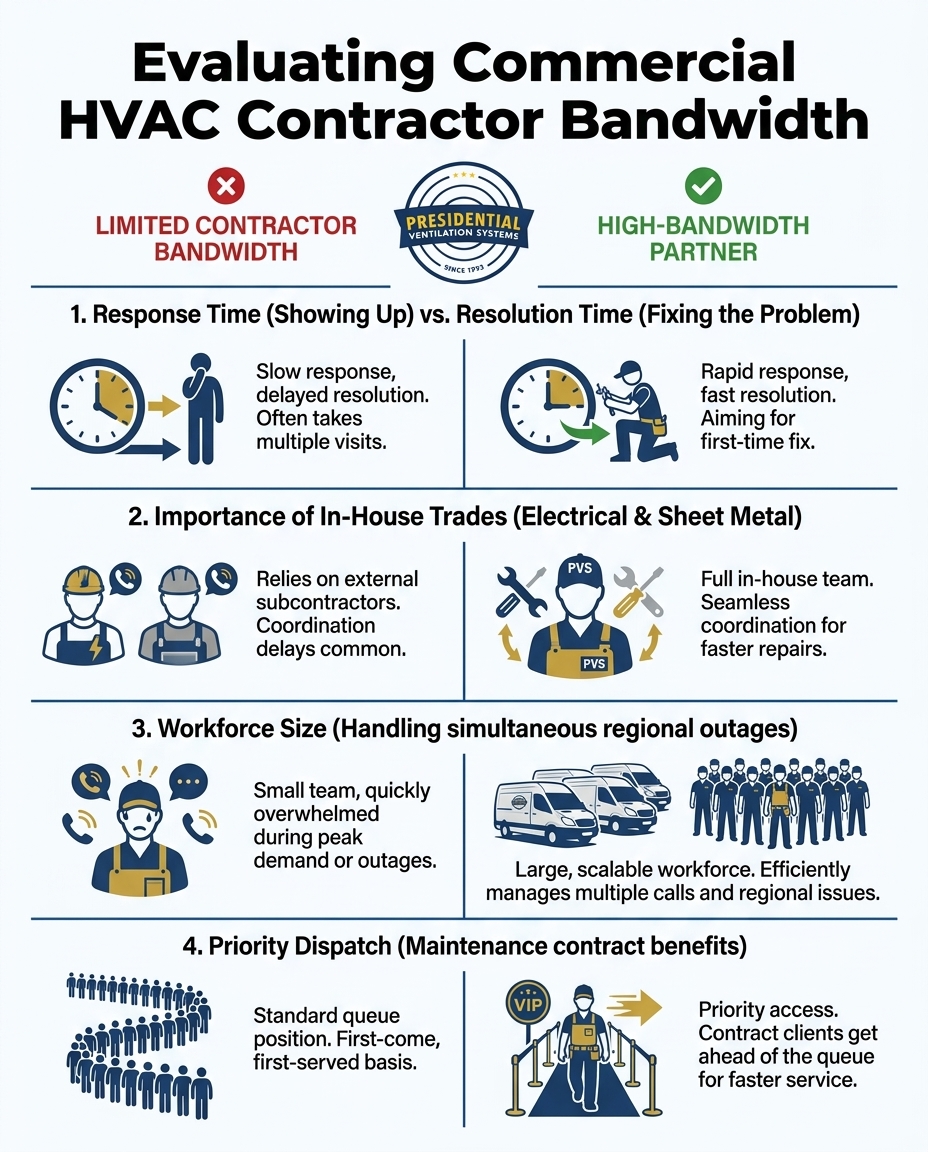
One of the most common pitfalls in commercial facility management is conflating "response time" with "resolution time." These are two entirely different metrics, and understanding the distinction is crucial for minimizing business downtime when a commercial HVAC system fails.
Response time is simply the metric most contractors sell. It measures how long it takes for a technician to physically arrive on-site after you place an emergency call. Resolution time, on the other hand, is the metric facility managers actually need. It measures the total time elapsed from the initial failure to the moment heating and operational status are fully restored.
During Nova Scotia winter emergencies, a fast response time is useless if the resolution time stretches into days. Resolution is heavily dependent on a contractor's local parts access, technical expertise, and cross-trade capabilities.
• Initial Dispatch — Response-Focused Contractor: Arrives quickly to "stop the clock" on the SLA. — Resolution-Focused Partner: Arrives quickly with common commercial replacement parts stocked on the truck.
• Diagnosis — Response-Focused Contractor: Identifies the problem but lacks authorization or parts to fix it immediately. — Resolution-Focused Partner: Diagnoses the issue and immediately begins the repair process.
• Parts Sourcing — Response-Focused Contractor: Waits for supply houses to open or orders parts from out of province. — Resolution-Focused Partner: Leverages established local supply chain relationships and extensive in-house inventory.
• Final Result — Response-Focused Contractor: Technician leaves; building remains cold for 48+ hours. — Resolution-Focused Partner: System restored; operations resume the same day.
A typical pattern we see is a technician arriving at a commercial facility at 2:00 a.m., confirming that a rooftop unit's blower motor has failed, and then leaving because they do not have the part or the secondary trades required to complete the installation. The contractor technically met their two-hour response SLA, but they did not solve the facility's problem.
The operational cost of downtime in Burnside's industrial parks compounds by the hour. Every minute your facility is without heat, you risk secondary damage to plumbing infrastructure and massive losses in workforce productivity. Evaluating a contractor based solely on their initial response time leaves your business dangerously exposed to prolonged resolution delays.
When a severe polar vortex hits the region, it does not just affect one building. It affects hundreds of commercial properties simultaneously. This logistical reality is the ultimate stress test for any HVAC service provider. When a deep freeze hits, every commercial facility calls at once, and contractors with small teams become instantly overwhelmed.
If a prospective partner only has five or ten technicians, their fast-response SLAs become physically impossible to honor during a regional weather event. They simply cannot be in fifty places at once. This is why evaluating workforce bandwidth—specifically, the total employee count and the number of technicians dedicated to commercial service—is a non-negotiable metric.
What we have learned over decades of serving this region is that true emergency protection requires a massive operational footprint. Our 70-employee workforce with Red Seal trades ensures dedicated emergency bandwidth, preventing the bottlenecks smaller companies face when dispatching throughout Burnside and surrounding service areas. A large headcount means that preventative maintenance schedules can continue uninterrupted while dedicated emergency response teams handle the sudden influx of no-heat calls.
Established commercial contractors operate sophisticated triage systems during extreme weather. Calls are prioritized based on the severity of the infrastructure risk and the presence of existing maintenance agreements.
How a robust workforce handles triage:
• Geographic Routing: Having a large, localized team in the Burnside area reduces transit times between industrial parks, increasing the number of facilities a single technician can stabilize in one shift.
• Dedicated Commercial Dispatch: Separating residential calls from complex commercial/industrial failures ensures that the most highly trained technicians are routed to the most critical infrastructure.
• Concurrent Operations: While one team handles a catastrophic boiler failure, another can address a frozen rooftop unit, ensuring no client is left stranded for days.
Commercial HVAC systems are complex, interconnected networks. A heating failure is rarely just a mechanical issue; it often involves high-voltage electrical faults or requires immediate ductwork modifications to bypass a failed component. This reality exposes another major flaw in evaluating contractors solely on their HVAC credentials.
The problem: Many commercial heating failures require specialized skills that standard HVAC technicians cannot legally or practically perform. If a system requires a new high-voltage disconnect or a custom transition fitting, an HVAC-only contractor must halt work.
The cause: Contractors without in-house electrical or sheet-metal teams are forced to rely on third-party subcontractors. During a winter storm, those subcontractors are also overwhelmed with their own emergency calls. This creates a cascading delay where your facility is left waiting days for an electrician to arrive just so the HVAC technician can finish their job.
The solution: Partnering with a comprehensive contractor that houses multiple Red Seal trades under one roof ensures seamless, continuous repair work. Because our 70-employee workforce with Red Seal trades includes in-house electrical capabilities and custom sheet metal fabrication, we eliminate subcontractor wait times entirely. When evaluating bids or service agreements, cross-trade capability should be one of your primary criteria.
The speed of a repair drastically increases when all required professionals work for the same company. There is direct communication between HVAC technicians and electricians on the same team, allowing them to coordinate arrivals and share diagnostic data instantly. Furthermore, the ability to immediately fabricate necessary sheet metal components in-house, rather than waiting on third-party supply chains, can turn a multi-day shutdown into a single-afternoon fix.
To ensure your Burnside commercial facilities are truly protected, you must move beyond reading marketing brochures and start auditing operational capabilities. Use this concrete framework to evaluate potential partners before signing a contract.
1. What is your total local employee headcount, and how many are dedicated to commercial service?
Why it matters: A company with 10 employees cannot physically handle a regional freeze. You need a partner with the sheer numbers to manage simultaneous emergencies without abandoning their preventative maintenance obligations.
2. Do you have in-house electricians and sheet-metal fabricators, or do you rely on subcontractors?
Why it matters: Complex commercial repairs almost always cross trade lines. Relying on subcontractors introduces massive delays. In-house trades guarantee continuous, uninterrupted repair work.
3. How do you prioritize emergency dispatch during widespread winter storms?
Why it matters: You need to know exactly where you stand in line. A transparent contractor will explain their triage system and confirm that contract clients receive priority routing.
4. What is your average resolution time for major heating failures, not just your initial response time?
Why it matters: Showing up in two hours is useless if the repair takes three days. Ask for their track record on actual problem resolution, including how they handle weekend parts sourcing.
5. Can you provide examples of how you manage parts inventory for commercial clients in the Burnside area?
Why it matters: Supply chain delays are a reality. A capable partner will stock common commercial components locally or keep specific parts on hand for the exact equipment listed in your maintenance agreement.
The evaluation phase should ultimately lead to securing a comprehensive commercial HVAC maintenance plan. Why? Because in the commercial HVAC industry, having an active maintenance contract dictates your emergency priority and the speed at which your problems are resolved.
Facilities with active preventative maintenance contracts universally receive priority dispatch over non-contract clients. When resources are stretched thin during Nova Scotia winter emergencies, contractors will always service their contract partners first. If you wait until your system fails to establish a relationship with a contractor, you will be placed at the bottom of a very long waiting list.
Furthermore, routine maintenance familiarizes the contractor with your facility's specific equipment. When an emergency call comes in, the dispatch team already knows the make, model, age, and service history of your rooftop units or boilers. The technician arrives with the correct parts already on the truck, drastically reducing both diagnostic and resolution times.
The best emergency response is preventing the failure in the first place through proactive, scheduled care. Routine inspections catch failing contactors, worn belts, and minor refrigerant leaks long before they cause a catastrophic shutdown. This provides immense financial and operational predictability, ensuring your building remains compliant with ASHRAE and BOMA facility management standards. The return on investment for maintaining equipment far outweighs the premium rates and lost revenue associated with emergency winter repairs.
What is a standard response time for commercial HVAC emergencies?
Most commercial SLAs promise an on-site response within 2 to 4 hours for critical emergencies. However, it is vital to remember that this metric only tracks when a technician arrives at your facility. True emergency readiness should be measured by resolution time—how quickly the contractor can actually source parts and restore heating to the building.
How do you evaluate a commercial HVAC contractor's true bandwidth?
You evaluate their bandwidth by looking at their total local employee headcount and their specific commercial dispatch capabilities. Ask how many dedicated commercial technicians they employ and inquire about their in-house trades. A contractor with 70+ employees and in-house electricians is far more capable of handling regional outages than a smaller operation.
Why do commercial HVAC repairs take so long during winter?
Delays usually stem from two factors: a lack of available workforce during simultaneous regional outages, and a reliance on third-party subcontractors for electrical or sheet-metal work. If a contractor has to wait for an external electrician or a delayed parts shipment, your repair will stall, regardless of how quickly the initial technician arrived.
What should be included in a commercial HVAC maintenance contract?
A robust contract should include comprehensive seasonal inspections, priority emergency dispatch, and guaranteed response times. It should also detail routine tasks like filter changes, belt tensioning, electrical connection testing, and combustion analysis to ensure compliance with facility management standards.
How does having in-house electrical support speed up HVAC repairs?
Many commercial heating failures involve high-voltage electrical components. If a contractor has in-house electricians, they can coordinate the repair immediately without halting work. This eliminates the days spent waiting for a third-party electrical subcontractor to become available.
True emergency protection requires a partner with actual operational bandwidth, not just a promised response time on a piece of paper. When evaluating response times, you must look at the contractor's total workforce, their in-house cross-trade capabilities, and their proven ability to achieve rapid resolution during severe weather.
With our 70-employee workforce with Red Seal trades, we have the infrastructure to keep your business running when it matters most. Schedule an evaluation before the Nova Scotia winter hits. Contact our team today to discuss commercial HVAC maintenance plans and ensure your Burnside facility is fully protected against unexpected downtime.