


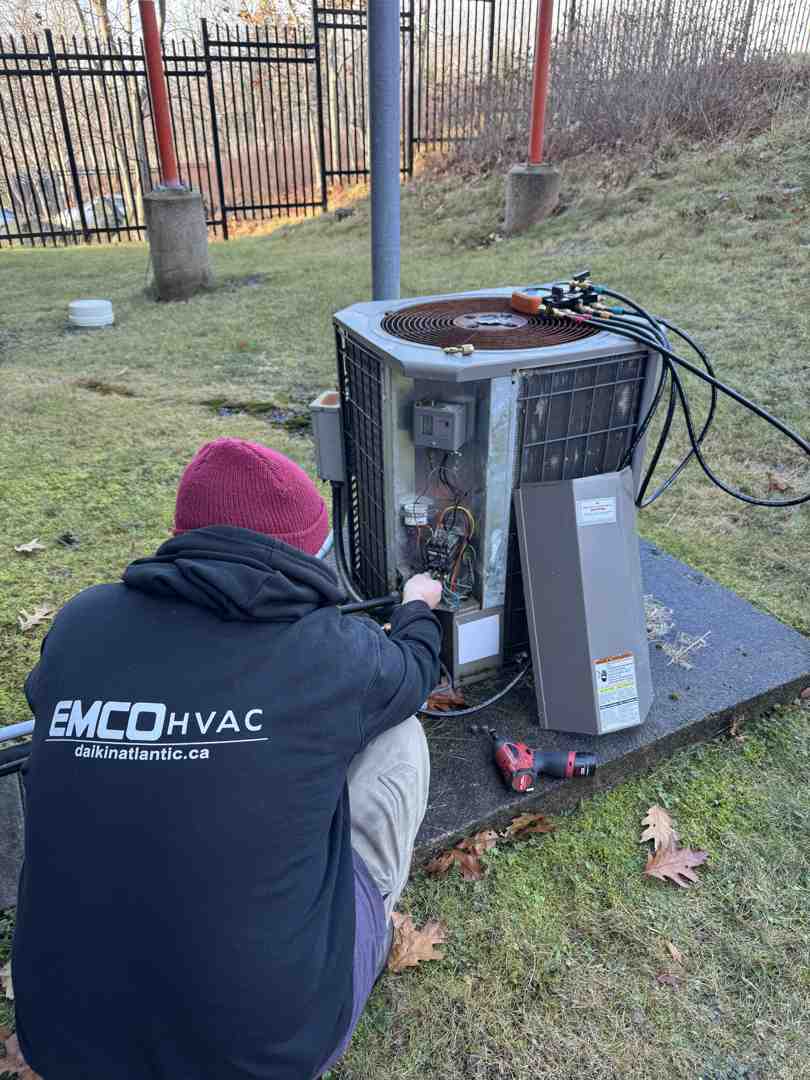
Heat pump maintenance in Dartmouth NS keeps your system running efficiently through coastal winters and humid summers. Regular professional tune-ups prevent breakdowns, lower energy bills, and extend your equipment's lifespan in our challenging maritime climate.
Quick Answer: Heat Pump Maintenance Essentials
• How Often: Bi-annual service (spring and fall) recommended
• What's Included: Filter inspection, coil cleaning, refrigerant check, thermostat calibration, electrical inspection, condensate drain check
• Key Benefits: Improved efficiency, lower bills, fewer breakdowns, maintained warranty coverage
• Dartmouth-Specific Needs: Salt air protection, snow/ice management, defrost cycle checks
• Professional Service: Heat Pump Tune-Up in Dartmouth
Dartmouth's coastal environment creates unique challenges for heat pumps. Salt air accelerates corrosion. Humidity affects performance. Winter snow and ice can block airflow and damage components. Without regular maintenance, these factors reduce efficiency and shorten your system's life. Many homeowners assume their heat pump only needs attention when something breaks. The truth is that preventative care saves money and ensures reliable comfort when you need it most.
Looking for comprehensive HVAC solutions? Explore our HVAC services in Dartmouth or schedule your heat pump maintenance today.
Living in Dartmouth, we know our homes face a wide range of weather conditions, from humid summer days to chilly, snowy winters. Our heat pumps work tirelessly year-round to keep us comfortable. Just like any hardworking appliance, a heat pump needs consistent care to perform its best. The benefits of regular heat pump maintenance in Dartmouth NS are truly undeniable, ensuring your system runs smoothly and efficiently for years to come.
First and foremost, regular maintenance significantly improves your system's energy efficiency. A well-maintained heat pump doesn't have to work as hard to heat or cool your home, which directly translates to lower utility bills. It's a small investment today that leads to substantial savings over time. We've seen how a comprehensive tune-up can improve your system’s energy efficiency, helping you save on utility bills while reducing your environmental footprint. To understand just how much you could save, you might want to explore how much a heat pump can save on your energy costs.
Beyond savings, regular upkeep is essential to prolonging the lifespan of your heat pump and maintaining its efficiency. Think of it like this: would you drive your car for years without an oil change? Probably not, unless you enjoy unexpected breakdowns and hefty repair bills! The same logic applies to your heat pump. Professional maintenance visits include a thorough inspection, checking for potential issues before they turn into costly repairs. This preventative approach helps extend the equipment lifespan, allowing you to enjoy reliable heating and cooling for many years. Regular maintenance can prevent major issues down the road, extending the lifespan of your system and saving you money. When it comes to the longevity of your system, ensuring heat pump reliability is key.
Regular maintenance also contributes to improved home comfort. When your heat pump is operating at peak performance, it delivers consistent heating and cooling throughout your home, eliminating uncomfortable hot and cold spots. This ensures proper operation at peak efficiency, which can lead to lower energy bills and consistent comfort.
Furthermore, a well-maintained heat pump can significantly improve indoor air quality. Many modern heat pumps come with built-in filtration systems that work to remove dust, allergens, and other pollutants from the air. During maintenance, these filters are inspected and cleaned or replaced, ensuring cleaner, healthier air circulates through your home. This is particularly important for those with allergies or respiratory sensitivities. We have more insights on how heat pumps enhance air quality.
Finally, regular maintenance helps maintain your manufacturer's warranty coverage. Many heat pump manufacturers stipulate that the system must be professionally serviced annually or bi-annually to keep the warranty valid. Neglecting maintenance could void your warranty, leaving you responsible for expensive repairs that would otherwise be covered. It's important to understand the warranty on your heat pump to ensure you're always covered.
One of the most compelling reasons for consistent heat pump maintenance in Dartmouth NS is the significant boost it provides to energy efficiency and the resulting savings. Modern heat pumps are incredibly efficient, capable of operating at up to 300% efficiency, meaning they produce three times more energy than they consume. However, without regular tune-ups, this efficiency can quickly degrade. Dust, dirt, and debris can accumulate on coils and filters, forcing your system to work harder and consume more energy to achieve the same level of comfort.
Our comprehensive maintenance services ensure that your system maintains its optimal performance. By keeping all components clean and properly calibrated, we help your heat pump deliver consistent performance, reducing energy consumption and leading to noticeable savings on your utility bills. This commitment to efficiency helps heat pumps improve home energy efficiency across Dartmouth. A small investment in maintenance today can lead to substantial savings over time, making your heat pump a truly long-term value for your home. If you're considering a new system or financing options for maintenance, we can provide transparent recommendations and discuss financing options custom to your needs.
Your heat pump is a significant investment in your home's comfort. Naturally, you want it to last as long as possible. This is where professional heat pump maintenance in Dartmouth NS truly shines. Regular maintenance is a form of preventative care that addresses minor issues before they escalate into major, costly problems.
During our maintenance visits, we carefully inspect every component, identifying and rectifying small wear and tear issues that, if left unattended, could lead to system failure. This proactive approach significantly reduces the wear and tear on your system's critical parts, minimizing the need for major repairs down the line. By ensuring everything is working in harmony, we help extend the lifespan of your residential heat pump, ensuring you get the most out of your investment. Avoiding premature replacement means delaying a significant expense and enjoying reliable comfort for more years. We believe that timely heat pump replacement is crucial when the time comes, but regular maintenance can push that date far into the future.
When you schedule a professional heat pump tune-up with us in Dartmouth, you're not just getting a quick glance at your system; you're investing in a comprehensive inspection and service designed to optimize performance and catch potential issues early. Our goal is to ensure your heat pump operates at its peak, providing reliable comfort throughout the year. For a thorough understanding of what goes into keeping your system in top shape, check out our heat pump tune-up Dartmouth NS services.
Our professional heat pump tune-up services typically include a multi-point inspection and a range of essential tasks:
• Filter Inspection & Replacement: We inspect your air filters and recommend replacement if they are dirty or clogged. Clean filters are crucial for airflow, efficiency, and indoor air quality.
• Coil Cleaning: Both the indoor evaporator and outdoor condenser coils are cleaned. Dirty coils impede heat transfer, forcing your system to work harder and consume more energy.
• Refrigerant Check & Pressure Test: We check refrigerant levels to ensure they are within manufacturer specifications. Low refrigerant can indicate a leak and severely impact your system's ability to heat and cool.
• Thermostat Calibration & Programming: We ensure your thermostat is accurately reading temperatures and programmed correctly for optimal comfort and energy savings.
• Electrical Inspection: All electrical connections are inspected for tightness and safety. Loose connections can be a fire hazard and lead to system malfunctions.
• Fan & Motor Lubrication: Moving parts, such as fan motors, are lubricated to reduce friction and wear, ensuring quiet and efficient operation.
• Drainage System Check: The condensate drain line is inspected and cleared to prevent blockages that can lead to water damage and mold growth.
• Performance Testing & Reporting: We test your system's heating and cooling cycles, measure airflow, and check system pressures and temperatures to ensure everything is operating correctly. We then provide a detailed report of our findings.
This comprehensive approach is part of our commitment to delivering top-notch heat pump service in Dartmouth. Regular maintenance is vital for the longevity and efficiency of your heat pump system, preventing minor issues from becoming costly problems.
Living in Dartmouth, we're no strangers to diverse weather conditions. Our coastal environment presents unique challenges for heat pumps. The salt in the air can accelerate corrosion on outdoor units. High humidity levels, especially in summer, can impact efficiency. And of course, our winters bring fluctuating temperatures, heavy snowfall, and ice, all of which can affect your system's performance.
That's why understanding how Dartmouth's climate impacts your heat pump maintenance needs is crucial. A heat pump works tirelessly year-round, moving heat in and out of your home. These constant demands mean that regular, season-specific care is not just a good idea—it's essential. We've learned that seasonal changes affect heat pump performance significantly, and proactive maintenance is the best defense.
For optimal performance and peace of mind, we highly recommend bi-annual maintenance for your heat pump. Think of it as preparing your system for the extreme demands of both summer and winter.
• Spring Tune-Up: Scheduling a spring tune-up prepares your system for summer cooling. We'll ensure your heat pump is ready to tackle those warm, humid Dartmouth days, providing efficient and effective cooling when you need it most. This pre-season check can also help ensure heat pump maintenance for a cooler summer.
• Fall Tune-Up: A fall tune-up is equally important, preparing your system for winter heating. This service ensures your heat pump can handle the chilly Nova Scotian winter, providing reliable warmth and preventing unexpected breakdowns when temperatures drop.
By having your heat pump serviced before the peak heating and cooling seasons, you're ensuring maximum efficiency, preventing potential issues, and extending the life of your system. This approach to year-round heat pump care is a smart choice for any Dartmouth homeowner.
Dartmouth winters can be tough on heat pumps. Heavy snowfall and freezing rain are common, and these conditions demand specific maintenance considerations to ensure your system continues to operate efficiently and safely.
One of the most critical aspects of winter heat pump maintenance in Dartmouth NS is snow and ice removal. The outdoor unit needs clear space around it to function properly. Snow and ice accumulation can block airflow, making it difficult for the unit to transfer heat, which significantly reduces efficiency and can even damage the compressor. It's vital to maintain adequate clearance around the outdoor unit to promote easy drainage and reduce snow and ice buildup. If you have a moment, take a look at this owner message for more on the importance of winter care.
Your heat pump is equipped with a defrost cycle designed to melt ice accumulation. However, in extreme cold or heavy precipitation, this cycle might not be enough. If you notice persistent ice buildup despite the defrost cycle, it's crucial to switch off the unit and seek professional assistance to prevent damage. Failure to clear the unit of snow and ice can even jeopardize your warranty. We’ve seen instances where prolonged ice buildup has caused significant damage, which could have been avoided with proactive care.
Ensuring proper airflow is paramount. Keep the area around your outdoor unit free from leaves, debris, and of course, snow. This allows your heat pump to work effectively without unnecessary strain, maintaining its efficiency and protecting its components from premature wear.
Even with regular heat pump maintenance in Dartmouth NS, sometimes issues can arise. Knowing the warning signs that your heat pump needs immediate attention can save you from more extensive repairs and prolonged discomfort. Ignoring these signals can lead to increased energy bills, reduced system lifespan, and even complete system failure. It's like your heat pump is trying to tell you something!
Here are some common signs that your heat pump is waving a red flag:
• Unusual Noises: Your heat pump should operate relatively quietly. If you start hearing strange sounds like grinding, clanking, hissing, buzzing, or persistent rattling, it's a clear indicator that something is amiss. These noises often point to worn-out components, motor issues, or even a refrigerant leak. For more on this, especially for ducted systems, check our tips on ducted heat pump noise in Dartmouth.
• Decreased Airflow: If you notice that less air is coming out of your vents, or if the airflow seems weaker than usual, it could be a sign of a clogged filter, a problem with the fan motor, or even issues within your ductwork.
• Inconsistent Temperatures: Are some rooms too hot while others are too cold? Uneven heating or cooling suggests your heat pump isn't distributing air effectively or that its components are struggling to maintain a consistent temperature. This can be due to airflow blockages, failing sensors, or compressor problems.
• Increased Energy Bills: If your energy bills suddenly spike without a corresponding increase in usage, your heat pump might be losing efficiency. This often happens when components are dirty, low on refrigerant, or malfunctioning, forcing the system to work harder.
• Frequent Cycling: A heat pump that turns on and off too frequently (short-cycling) is not operating efficiently. This can indicate a problem with the thermostat, a clogged filter, or even an oversized system. Frequent cycling wastes energy and puts unnecessary strain on the system, shortening its lifespan.
• Ice Buildup on Coils: While some frost is normal during the defrost cycle in winter, persistent or excessive ice buildup on the outdoor unit's coils, even when not in defrost mode, is a serious concern. It usually points to low refrigerant levels or airflow problems.
Recognizing these signs early is crucial for effective problem-solving. Delaying repairs can exacerbate the issue, leading to more complex and costly fixes. We encourage homeowners to be vigilant for these early signs of heat pump failure. If you're experiencing any of these symptoms, don't hesitate to reach out for heat pump repair in Dartmouth NS.
When it comes to selecting a partner for your heat pump maintenance in Dartmouth NS, you want a team that understands the unique needs of our local climate and homes. With over 30 years of experience serving the Halifax Regional Municipality since 1993, we bring a wealth of local expertise to every service call.
Our team comprises experienced and licensed technicians who are not only skilled in working with various heat pump systems but also understand the specific challenges posed by Dartmouth's coastal environment and diverse building styles. Whether you have a ductless mini-split or a comprehensive ducted heat pump system, we have the knowledge and tools to ensure it runs optimally. We pride ourselves on offering comprehensive HVAC services in Dartmouth NS, custom to your specific needs.
We believe in transparency and quality workmanship, which is why we're proud of our positive customer reviews and our long-standing reputation in the community. You can always check out our reviews to see what our satisfied customers have to say. Our commitment is to ensure your year-round comfort and system longevity.
Selecting the right provider for your heat pump maintenance in Dartmouth NS can make all the difference in your system's performance and lifespan. Here’s what you should look for:
• Comprehensive Maintenance Plans: A reputable provider will offer clear, detailed maintenance plans. These plans should outline exactly what services are included, ensuring you know what to expect from each visit. While we don't discuss specific pricing, it's worth noting that many companies offer tiered plans to suit different needs.
• Detailed Service Reports: After each maintenance visit, you should receive a thorough report detailing the work performed, any issues identified, and recommendations for future action. This transparency helps you stay informed about your system's health.
• Commitment to Quality: Look for a provider with a strong commitment to quality workmanship and customer satisfaction. This includes using appropriate tools, following manufacturer guidelines, and having a team of certified and experienced technicians. We strive to provide exceptional heat pump services in Dartmouth NS, always prioritizing quality.
• Experience with Various Systems: Your provider should be knowledgeable about different types of heat pump systems, including both ductless and ducted heat pump systems in Dartmouth NS. This ensures that no matter what kind of heat pump you have, they can service it effectively.
Choosing a maintenance partner you trust is paramount. We strive to be that partner for homeowners and businesses across Dartmouth, offering reliable, expert service with a focus on your comfort and peace of mind.
We often hear similar questions from homeowners in Dartmouth about their heat pump care. Here are some of the most common ones:
For most heat pump systems, we recommend professional maintenance at least twice a year, ideally in the spring and fall. This bi-annual schedule ensures your system is thoroughly checked and prepared for the demands of both the cooling season and the heating season. This proactive approach helps maintain efficiency, prevent breakdowns, and ensures your system is ready for Dartmouth's varying climate.
While professional maintenance is essential, there are a few simple tasks you can do yourself to help keep your heat pump running smoothly. Regularly inspecting and cleaning or replacing your air filters is the most important DIY task. Beyond that, keeping the area around your outdoor unit clear of debris, leaves, snow, and ice is crucial. However, for tasks like coil cleaning, refrigerant checks, and electrical inspections, it's always best to call a professional. Attempting complex maintenance without proper training can be dangerous and could damage your system or void your warranty.
Regular professional maintenance is often a requirement to keep your heat pump's manufacturer warranty valid. Many manufacturers stipulate that the system must be serviced annually or bi-annually by a qualified technician. Neglecting scheduled maintenance could lead to a voided warranty, meaning you would be responsible for the full cost of repairs that would otherwise be covered. Think of maintenance as an investment in protecting your heat pump and your wallet!
As we've explored, regular heat pump maintenance in Dartmouth NS is not just an option—it's a necessity for ensuring your system's efficiency, longevity, and your family's year-round comfort. From maximizing energy savings and extending your heat pump's lifespan to improving indoor air quality and preventing inconvenient breakdowns, the benefits of professional care are clear.
Dartmouth's unique coastal climate, with its salt air, humidity, and challenging winters, demands a proactive approach to heat pump care. By understanding what a professional tune-up entails, recognizing the warning signs of an issue, and choosing a trusted local provider like us, you're making a smart investment in your home.
With over 30 years of experience, Presidential Ventilation Systems is committed to providing top-tier HVAC services to the Dartmouth community. We're here to help you steer the demands of our local climate and ensure your heat pump delivers reliable performance when you need it most. Don't wait for a problem to arise; take a proactive step towards lasting comfort and efficiency.
Ready to experience the peace of mind that comes with a perfectly maintained heat pump? Contact us today. We're here to be your trusted partner for all your heat pump needs. Let's work together to schedule your professional heat pump maintenance in Dartmouth NS today!

Heat pump maintenance in Dartmouth NS keeps your system running efficiently through coastal winters and humid summers. Regular professional tune-ups prevent breakdowns, lower energy bills, and extend your equipment's lifespan in our challenging maritime climate.
Quick Answer: Heat Pump Maintenance Essentials
• How Often: Bi-annual service (spring and fall) recommended
• What's Included: Filter inspection, coil cleaning, refrigerant check, thermostat calibration, electrical inspection, condensate drain check
• Key Benefits: Improved efficiency, lower bills, fewer breakdowns, maintained warranty coverage
• Dartmouth-Specific Needs: Salt air protection, snow/ice management, defrost cycle checks
• Professional Service: Heat Pump Tune-Up in Dartmouth
Dartmouth's coastal environment creates unique challenges for heat pumps. Salt air accelerates corrosion. Humidity affects performance. Winter snow and ice can block airflow and damage components. Without regular maintenance, these factors reduce efficiency and shorten your system's life. Many homeowners assume their heat pump only needs attention when something breaks. The truth is that preventative care saves money and ensures reliable comfort when you need it most.
Looking for comprehensive HVAC solutions? Explore our HVAC services in Dartmouth or schedule your heat pump maintenance today.
Living in Dartmouth, we know our homes face a wide range of weather conditions, from humid summer days to chilly, snowy winters. Our heat pumps work tirelessly year-round to keep us comfortable. Just like any hardworking appliance, a heat pump needs consistent care to perform its best. The benefits of regular heat pump maintenance in Dartmouth NS are truly undeniable, ensuring your system runs smoothly and efficiently for years to come.
First and foremost, regular maintenance significantly improves your system's energy efficiency. A well-maintained heat pump doesn't have to work as hard to heat or cool your home, which directly translates to lower utility bills. It's a small investment today that leads to substantial savings over time. We've seen how a comprehensive tune-up can improve your system’s energy efficiency, helping you save on utility bills while reducing your environmental footprint. To understand just how much you could save, you might want to explore how much a heat pump can save on your energy costs.
Beyond savings, regular upkeep is essential to prolonging the lifespan of your heat pump and maintaining its efficiency. Think of it like this: would you drive your car for years without an oil change? Probably not, unless you enjoy unexpected breakdowns and hefty repair bills! The same logic applies to your heat pump. Professional maintenance visits include a thorough inspection, checking for potential issues before they turn into costly repairs. This preventative approach helps extend the equipment lifespan, allowing you to enjoy reliable heating and cooling for many years. Regular maintenance can prevent major issues down the road, extending the lifespan of your system and saving you money. When it comes to the longevity of your system, ensuring heat pump reliability is key.
Regular maintenance also contributes to improved home comfort. When your heat pump is operating at peak performance, it delivers consistent heating and cooling throughout your home, eliminating uncomfortable hot and cold spots. This ensures proper operation at peak efficiency, which can lead to lower energy bills and consistent comfort.
Furthermore, a well-maintained heat pump can significantly improve indoor air quality. Many modern heat pumps come with built-in filtration systems that work to remove dust, allergens, and other pollutants from the air. During maintenance, these filters are inspected and cleaned or replaced, ensuring cleaner, healthier air circulates through your home. This is particularly important for those with allergies or respiratory sensitivities. We have more insights on how heat pumps enhance air quality.
Finally, regular maintenance helps maintain your manufacturer's warranty coverage. Many heat pump manufacturers stipulate that the system must be professionally serviced annually or bi-annually to keep the warranty valid. Neglecting maintenance could void your warranty, leaving you responsible for expensive repairs that would otherwise be covered. It's important to understand the warranty on your heat pump to ensure you're always covered.
One of the most compelling reasons for consistent heat pump maintenance in Dartmouth NS is the significant boost it provides to energy efficiency and the resulting savings. Modern heat pumps are incredibly efficient, capable of operating at up to 300% efficiency, meaning they produce three times more energy than they consume. However, without regular tune-ups, this efficiency can quickly degrade. Dust, dirt, and debris can accumulate on coils and filters, forcing your system to work harder and consume more energy to achieve the same level of comfort.
Our comprehensive maintenance services ensure that your system maintains its optimal performance. By keeping all components clean and properly calibrated, we help your heat pump deliver consistent performance, reducing energy consumption and leading to noticeable savings on your utility bills. This commitment to efficiency helps heat pumps improve home energy efficiency across Dartmouth. A small investment in maintenance today can lead to substantial savings over time, making your heat pump a truly long-term value for your home. If you're considering a new system or financing options for maintenance, we can provide transparent recommendations and discuss financing options custom to your needs.
Your heat pump is a significant investment in your home's comfort. Naturally, you want it to last as long as possible. This is where professional heat pump maintenance in Dartmouth NS truly shines. Regular maintenance is a form of preventative care that addresses minor issues before they escalate into major, costly problems.
During our maintenance visits, we carefully inspect every component, identifying and rectifying small wear and tear issues that, if left unattended, could lead to system failure. This proactive approach significantly reduces the wear and tear on your system's critical parts, minimizing the need for major repairs down the line. By ensuring everything is working in harmony, we help extend the lifespan of your residential heat pump, ensuring you get the most out of your investment. Avoiding premature replacement means delaying a significant expense and enjoying reliable comfort for more years. We believe that timely heat pump replacement is crucial when the time comes, but regular maintenance can push that date far into the future.
When you schedule a professional heat pump tune-up with us in Dartmouth, you're not just getting a quick glance at your system; you're investing in a comprehensive inspection and service designed to optimize performance and catch potential issues early. Our goal is to ensure your heat pump operates at its peak, providing reliable comfort throughout the year. For a thorough understanding of what goes into keeping your system in top shape, check out our heat pump tune-up Dartmouth NS services.
Our professional heat pump tune-up services typically include a multi-point inspection and a range of essential tasks:
• Filter Inspection & Replacement: We inspect your air filters and recommend replacement if they are dirty or clogged. Clean filters are crucial for airflow, efficiency, and indoor air quality.
• Coil Cleaning: Both the indoor evaporator and outdoor condenser coils are cleaned. Dirty coils impede heat transfer, forcing your system to work harder and consume more energy.
• Refrigerant Check & Pressure Test: We check refrigerant levels to ensure they are within manufacturer specifications. Low refrigerant can indicate a leak and severely impact your system's ability to heat and cool.
• Thermostat Calibration & Programming: We ensure your thermostat is accurately reading temperatures and programmed correctly for optimal comfort and energy savings.
• Electrical Inspection: All electrical connections are inspected for tightness and safety. Loose connections can be a fire hazard and lead to system malfunctions.
• Fan & Motor Lubrication: Moving parts, such as fan motors, are lubricated to reduce friction and wear, ensuring quiet and efficient operation.
• Drainage System Check: The condensate drain line is inspected and cleared to prevent blockages that can lead to water damage and mold growth.
• Performance Testing & Reporting: We test your system's heating and cooling cycles, measure airflow, and check system pressures and temperatures to ensure everything is operating correctly. We then provide a detailed report of our findings.
This comprehensive approach is part of our commitment to delivering top-notch heat pump service in Dartmouth. Regular maintenance is vital for the longevity and efficiency of your heat pump system, preventing minor issues from becoming costly problems.
Living in Dartmouth, we're no strangers to diverse weather conditions. Our coastal environment presents unique challenges for heat pumps. The salt in the air can accelerate corrosion on outdoor units. High humidity levels, especially in summer, can impact efficiency. And of course, our winters bring fluctuating temperatures, heavy snowfall, and ice, all of which can affect your system's performance.
That's why understanding how Dartmouth's climate impacts your heat pump maintenance needs is crucial. A heat pump works tirelessly year-round, moving heat in and out of your home. These constant demands mean that regular, season-specific care is not just a good idea—it's essential. We've learned that seasonal changes affect heat pump performance significantly, and proactive maintenance is the best defense.
For optimal performance and peace of mind, we highly recommend bi-annual maintenance for your heat pump. Think of it as preparing your system for the extreme demands of both summer and winter.
• Spring Tune-Up: Scheduling a spring tune-up prepares your system for summer cooling. We'll ensure your heat pump is ready to tackle those warm, humid Dartmouth days, providing efficient and effective cooling when you need it most. This pre-season check can also help ensure heat pump maintenance for a cooler summer.
• Fall Tune-Up: A fall tune-up is equally important, preparing your system for winter heating. This service ensures your heat pump can handle the chilly Nova Scotian winter, providing reliable warmth and preventing unexpected breakdowns when temperatures drop.
By having your heat pump serviced before the peak heating and cooling seasons, you're ensuring maximum efficiency, preventing potential issues, and extending the life of your system. This approach to year-round heat pump care is a smart choice for any Dartmouth homeowner.
Dartmouth winters can be tough on heat pumps. Heavy snowfall and freezing rain are common, and these conditions demand specific maintenance considerations to ensure your system continues to operate efficiently and safely.
One of the most critical aspects of winter heat pump maintenance in Dartmouth NS is snow and ice removal. The outdoor unit needs clear space around it to function properly. Snow and ice accumulation can block airflow, making it difficult for the unit to transfer heat, which significantly reduces efficiency and can even damage the compressor. It's vital to maintain adequate clearance around the outdoor unit to promote easy drainage and reduce snow and ice buildup. If you have a moment, take a look at this owner message for more on the importance of winter care.
Your heat pump is equipped with a defrost cycle designed to melt ice accumulation. However, in extreme cold or heavy precipitation, this cycle might not be enough. If you notice persistent ice buildup despite the defrost cycle, it's crucial to switch off the unit and seek professional assistance to prevent damage. Failure to clear the unit of snow and ice can even jeopardize your warranty. We’ve seen instances where prolonged ice buildup has caused significant damage, which could have been avoided with proactive care.
Ensuring proper airflow is paramount. Keep the area around your outdoor unit free from leaves, debris, and of course, snow. This allows your heat pump to work effectively without unnecessary strain, maintaining its efficiency and protecting its components from premature wear.
Even with regular heat pump maintenance in Dartmouth NS, sometimes issues can arise. Knowing the warning signs that your heat pump needs immediate attention can save you from more extensive repairs and prolonged discomfort. Ignoring these signals can lead to increased energy bills, reduced system lifespan, and even complete system failure. It's like your heat pump is trying to tell you something!
Here are some common signs that your heat pump is waving a red flag:
• Unusual Noises: Your heat pump should operate relatively quietly. If you start hearing strange sounds like grinding, clanking, hissing, buzzing, or persistent rattling, it's a clear indicator that something is amiss. These noises often point to worn-out components, motor issues, or even a refrigerant leak. For more on this, especially for ducted systems, check our tips on ducted heat pump noise in Dartmouth.
• Decreased Airflow: If you notice that less air is coming out of your vents, or if the airflow seems weaker than usual, it could be a sign of a clogged filter, a problem with the fan motor, or even issues within your ductwork.
• Inconsistent Temperatures: Are some rooms too hot while others are too cold? Uneven heating or cooling suggests your heat pump isn't distributing air effectively or that its components are struggling to maintain a consistent temperature. This can be due to airflow blockages, failing sensors, or compressor problems.
• Increased Energy Bills: If your energy bills suddenly spike without a corresponding increase in usage, your heat pump might be losing efficiency. This often happens when components are dirty, low on refrigerant, or malfunctioning, forcing the system to work harder.
• Frequent Cycling: A heat pump that turns on and off too frequently (short-cycling) is not operating efficiently. This can indicate a problem with the thermostat, a clogged filter, or even an oversized system. Frequent cycling wastes energy and puts unnecessary strain on the system, shortening its lifespan.
• Ice Buildup on Coils: While some frost is normal during the defrost cycle in winter, persistent or excessive ice buildup on the outdoor unit's coils, even when not in defrost mode, is a serious concern. It usually points to low refrigerant levels or airflow problems.
Recognizing these signs early is crucial for effective problem-solving. Delaying repairs can exacerbate the issue, leading to more complex and costly fixes. We encourage homeowners to be vigilant for these early signs of heat pump failure. If you're experiencing any of these symptoms, don't hesitate to reach out for heat pump repair in Dartmouth NS.
When it comes to selecting a partner for your heat pump maintenance in Dartmouth NS, you want a team that understands the unique needs of our local climate and homes. With over 30 years of experience serving the Halifax Regional Municipality since 1993, we bring a wealth of local expertise to every service call.
Our team comprises experienced and licensed technicians who are not only skilled in working with various heat pump systems but also understand the specific challenges posed by Dartmouth's coastal environment and diverse building styles. Whether you have a ductless mini-split or a comprehensive ducted heat pump system, we have the knowledge and tools to ensure it runs optimally. We pride ourselves on offering comprehensive HVAC services in Dartmouth NS, custom to your specific needs.
We believe in transparency and quality workmanship, which is why we're proud of our positive customer reviews and our long-standing reputation in the community. You can always check out our reviews to see what our satisfied customers have to say. Our commitment is to ensure your year-round comfort and system longevity.
Selecting the right provider for your heat pump maintenance in Dartmouth NS can make all the difference in your system's performance and lifespan. Here’s what you should look for:
• Comprehensive Maintenance Plans: A reputable provider will offer clear, detailed maintenance plans. These plans should outline exactly what services are included, ensuring you know what to expect from each visit. While we don't discuss specific pricing, it's worth noting that many companies offer tiered plans to suit different needs.
• Detailed Service Reports: After each maintenance visit, you should receive a thorough report detailing the work performed, any issues identified, and recommendations for future action. This transparency helps you stay informed about your system's health.
• Commitment to Quality: Look for a provider with a strong commitment to quality workmanship and customer satisfaction. This includes using appropriate tools, following manufacturer guidelines, and having a team of certified and experienced technicians. We strive to provide exceptional heat pump services in Dartmouth NS, always prioritizing quality.
• Experience with Various Systems: Your provider should be knowledgeable about different types of heat pump systems, including both ductless and ducted heat pump systems in Dartmouth NS. This ensures that no matter what kind of heat pump you have, they can service it effectively.
Choosing a maintenance partner you trust is paramount. We strive to be that partner for homeowners and businesses across Dartmouth, offering reliable, expert service with a focus on your comfort and peace of mind.
We often hear similar questions from homeowners in Dartmouth about their heat pump care. Here are some of the most common ones:
For most heat pump systems, we recommend professional maintenance at least twice a year, ideally in the spring and fall. This bi-annual schedule ensures your system is thoroughly checked and prepared for the demands of both the cooling season and the heating season. This proactive approach helps maintain efficiency, prevent breakdowns, and ensures your system is ready for Dartmouth's varying climate.
While professional maintenance is essential, there are a few simple tasks you can do yourself to help keep your heat pump running smoothly. Regularly inspecting and cleaning or replacing your air filters is the most important DIY task. Beyond that, keeping the area around your outdoor unit clear of debris, leaves, snow, and ice is crucial. However, for tasks like coil cleaning, refrigerant checks, and electrical inspections, it's always best to call a professional. Attempting complex maintenance without proper training can be dangerous and could damage your system or void your warranty.
Regular professional maintenance is often a requirement to keep your heat pump's manufacturer warranty valid. Many manufacturers stipulate that the system must be serviced annually or bi-annually by a qualified technician. Neglecting scheduled maintenance could lead to a voided warranty, meaning you would be responsible for the full cost of repairs that would otherwise be covered. Think of maintenance as an investment in protecting your heat pump and your wallet!
As we've explored, regular heat pump maintenance in Dartmouth NS is not just an option—it's a necessity for ensuring your system's efficiency, longevity, and your family's year-round comfort. From maximizing energy savings and extending your heat pump's lifespan to improving indoor air quality and preventing inconvenient breakdowns, the benefits of professional care are clear.
Dartmouth's unique coastal climate, with its salt air, humidity, and challenging winters, demands a proactive approach to heat pump care. By understanding what a professional tune-up entails, recognizing the warning signs of an issue, and choosing a trusted local provider like us, you're making a smart investment in your home.
With over 30 years of experience, Presidential Ventilation Systems is committed to providing top-tier HVAC services to the Dartmouth community. We're here to help you steer the demands of our local climate and ensure your heat pump delivers reliable performance when you need it most. Don't wait for a problem to arise; take a proactive step towards lasting comfort and efficiency.
Ready to experience the peace of mind that comes with a perfectly maintained heat pump? Contact us today. We're here to be your trusted partner for all your heat pump needs. Let's work together to schedule your professional heat pump maintenance in Dartmouth NS today!
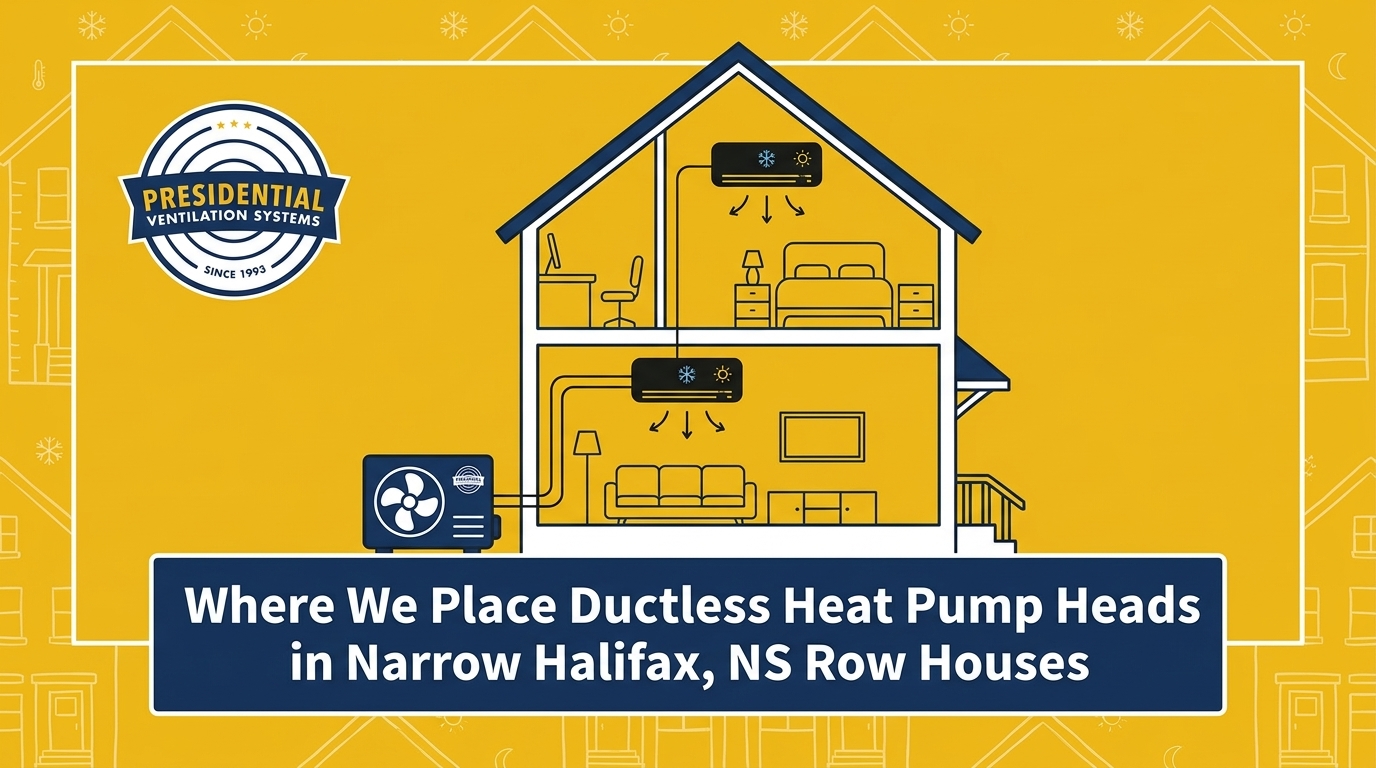
If you are wondering where we place ductless heat pump heads in narrow Halifax row houses, the answer usually begins with a familiar frustration: you turn up the thermostat because the back bedroom feels like an icebox, but within minutes, your front living room is sweltering. It is a frustrating cycle that plagues homeowners living in older, deeply rectangular properties. Achieving even temperature distribution in long, narrow historic Halifax row houses is a unique architectural challenge. When traditional heating methods fall short, many homeowners look to modern solutions, but standard ductless head placement often fails to push conditioned air all the way through multiple rooms in these "shotgun" style layouts.
As a trusted Nova Scotia contractor with over 30 years of experience, our team at Presidential Ventilation Systems knows the core issue is not the power of the equipment, but the geometry of the house. A standard wall-mounted unit blowing across a twelve-foot-wide room will hit the opposite wall and stop, leaving the rest of your home completely untouched by the warm or cool air. This highlights a critical decision point: selecting the exact wall and hallway orientations to maximize air throw without requiring a separate indoor head for every single small room.
Whether we are tackling residential retrofits, new construction, or commercial projects, when you are looking for comprehensive heating services, the physical layout of your property dictates the design. Getting a professional ductless heat pump installation from our experienced team means mapping out these structural hurdles before a single hole is drilled.
Historic Halifax row houses, particularly those Victorian and Edwardian properties found throughout the South End and North End, were simply not built with modern HVAC systems in mind. These homes feature brilliant craftsmanship, but their underlying structure complicates retrofits significantly. The most defining feature of a row house is the shared party wall. Because you share exterior walls with your neighbors on one or both sides, the available real estate for routing refrigerant lines, electrical wires, and drainage pipes is severely restricted.
Beyond the lack of exterior access, the interior construction poses its own set of risks. Most of these century-old homes utilize lath and plaster construction. Unlike modern drywall, lath and plaster is brittle, unpredictable, and easily damaged if technicians attempt to drill or mount heavy equipment without specialized knowledge of historic framing. You cannot simply attach a heavy indoor unit anywhere you please; it requires finding solid structural support without shattering the surrounding wall surface. Our Red Seal tradespeople are trained to navigate these delicate structures safely.
If you live within our Halifax service areas, you already know that our climate adds another layer of complexity. Halifax experiences damp, cold maritime winters and notably humid summers. In long, narrow homes, poor airflow traps this coastal moisture in back rooms and narrow corridors. If heat pump heads are placed incorrectly, this trapped, stagnant air quickly creates condensation issues, leading to dampness and potential mold growth along exterior walls.
Restricted routing paths: Traditional heat pump installations rely on running line sets down the outside of the house to connect the indoor head to the outdoor compressor. Shared party walls make this impossible on two sides of the home.
Structural delicacy: The 100-plus-year-old brick, stone, and timber framing behind these walls requires careful handling. Drilling through thick masonry or navigating around rough-hewn timber studs demands precision to maintain the structural integrity of the building.
Coastal humidity factors: When humid summer air enters a long corridor without proper mechanical circulation, it settles. A ductless unit placed in a front room will dehumidify that specific space, but the heavy, moist air in the back of the house remains trapped.
Preventing moisture buildup: Strategic airflow is your primary defense against condensation. By forcing conditioned air down the entire length of the property, you keep the air moving, which naturally regulates humidity levels and protects your historic interior finishes.
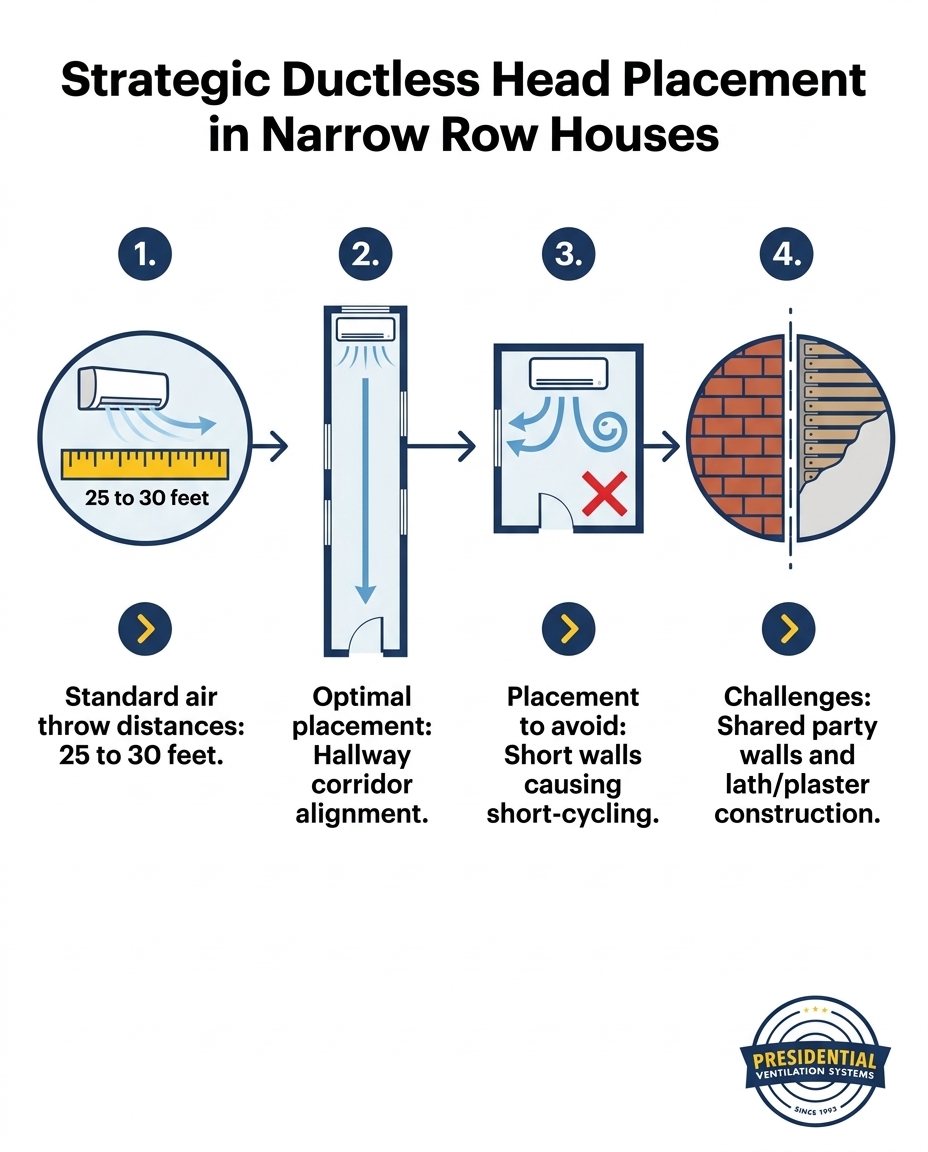
To properly condition a long, narrow footprint, we have to work with the architecture rather than fighting against it. Standard high-wall ductless units are incredibly powerful directional blowers. When unobstructed, a quality unit can throw air 25 to 30 feet across a room. Our technical strategy for narrow homes involves harnessing that distance to heat or cool multiple rooms simultaneously.
Instead of mounting a unit on a long wall so it blows across a narrow room, our installers align the indoor heads to blow straight down hallways and open corridors. This "corridor alignment" acts like a wind tunnel, pushing warm or cool air deep into the house. As the air travels down the hallway, it naturally disperses into adjoining bedrooms and living spaces, provided the doors remain open. This method significantly reduces the number of indoor units you need to purchase and maintain.
Multi-story row houses offer another unique opportunity: the stairwell. Stairwells are natural convection channels. Because heat rises and cool air falls, placing units strategically at the top or bottom of a stairwell can help distribute conditioned air across different levels of the home. Certain advanced equipment, like Lennox ductless systems and Daikin units, feature sophisticated louvers and fan controls that allow for precise directional airflow, making these long-throw strategies highly effective.
• Cross-Room Alignment — Airflow Behavior: Air hits the opposite wall quickly and stops. — Best Application in Narrow Homes: Only useful for isolated, closed-off rooms.
• Corridor Alignment — Airflow Behavior: Air travels 25-30 feet unobstructed. — Best Application in Narrow Homes: Ideal for open hallways feeding into side bedrooms.
• Stairwell Mounting — Airflow Behavior: Leverages natural rising heat and falling cool air. — Best Application in Narrow Homes: Perfect for multi-story historic properties.
Positioning at the extremes: We often look for mounting locations at the absolute furthest ends of a long footprint. By pointing the unit inward from the front or back of the house, the air has the maximum possible runway to travel before hitting an obstruction.
Reducing equipment clutter: Hallway throws prevent the need for a separate head in every small room. This not only saves on initial equipment costs but also preserves the historic aesthetic of your individual living spaces.
Leveraging multi-story layouts: Placing a cooling-focused unit at the top of a stairwell allows heavy, cold air to cascade down the stairs, cooling the upper landing and the floor below simultaneously.
Overcoming bottlenecks: Narrow, winding Victorian staircases can sometimes block airflow. Our professionals map these bottlenecks to ensure the unit is angled correctly to push air past corners and tight landings.
Retrofitting modern mechanical systems into heritage properties requires a delicate balance between achieving modern comfort and protecting the home's historic character. When shared party walls block access to the exterior, technicians must find creative, safe ways to route line sets through the interior of the home without ruining the visual appeal of your living spaces.
This process begins with mapping out the structural realities before a single tool is lifted. We look for hidden chases, unused chimney flues, or deep closets that can conceal refrigerant lines and wiring as they travel from the indoor head to the outdoor compressor. In our 30+ years of Nova Scotia HVAC, electrical, ventilation, and sheet-metal experience, our team of approximately 70 employees has learned exactly how to navigate these hidden spaces while preserving the integrity of lath and plaster walls.
Sometimes, these installations coincide with larger updates. One local homeowner reached out to us last summer during a major home renovation. They needed to replace an old heating system and outdated ductwork while staying within a strict budget. Our team was able to map out a new heat pump system that fit the structural realities of their older home, utilizing interior routing to bypass exterior wall limitations, and kept them informed through excellent post-install communication. If you are planning a similar project, reviewing the best ductless heat pumps for older homes is a great first step.
The risks of improper drilling: Lath and plaster is held together by mechanical "keys" where the plaster oozes between wooden strips. Aggressive drilling or heavy vibrations can break these keys, causing large sections of the wall to crumble and detach.
Securing heavy units: Indoor ductless heads are heavy. Technicians must locate the original, often irregularly spaced wooden studs behind the plaster to ensure the mounting bracket is safely and permanently anchored.
Creative line set hiding: When interior routing is required, line sets can be run through custom-built soffits, behind crown molding, or through the back of built-in cabinetry to keep them completely out of sight.
Maintaining visual appeal: The goal is always to make the modern equipment look as unobtrusive as possible, ensuring that the Victorian or Edwardian interior details remain the focal point of the room.
One of the most overlooked aspects of upgrading an older home is the electrical infrastructure. Ductless systems require dedicated electrical circuits to operate safely and efficiently. In homes built over a century ago, the existing electrical panels are rarely equipped to handle this sudden increase in demand. Finding safe routes for new wiring through narrow, obstructed wall cavities is a major hurdle.
This is where Presidential Ventilation Systems' comprehensive expertise makes a massive difference. Because we operate both in-house HVAC and electrical divisions, we do not just look at where the air needs to go; we simultaneously map out the safest, most code-compliant routes for the high-voltage wiring. Our Red Seal tradespeople coordinate directly, avoiding the disjointed, frustrating process of hiring and managing separate contractors for a single project.
We saw a classic example of this last summer when a homeowner was converting from an aging oil burner to a central heat pump system. During the initial assessment, it became clear their existing electrical panel couldn't handle the new load. Because we have in-house electricians, our team resolved the electrical panel upgrade alongside the central heat pump installation seamlessly, leaving the customer with a great working system and zero logistical headaches.
Streamlined project management: Having both trades under one roof means the electrician knows exactly what the HVAC technician needs, and vice versa. There are no delays waiting for a third party to finish their portion of the work.
Managing older panels: Upgrading from fossil fuels to heat pumps almost always requires an electrical service upgrade. Our professionals calculate the total load to ensure your historic home remains safe and fully compliant with current electrical codes.
Running wire through obstructions: Historic homes are full of fire blocking, solid timber beams, and narrow cavities. Safely routing new, dedicated circuits requires specialized tools and a deep understanding of heritage framing.
Code compliance: Meeting modern electrical codes in a 100-year-old property requires careful planning, ensuring all new wiring is properly protected and grounded without compromising the building's historic fabric.
Knowing where to place a ductless head is only half the battle; knowing where not to place it is equally critical. Poor placement in a narrow home will throttle the system's efficiency, drive up your energy bills, and leave you uncomfortable. Based on our 30+ years of Nova Scotia HVAC and electrical experience, we identify specific red zones during every assessment.
Strategic placement zones to avoid in older homes:
• Directly facing a close opposite wall: Placing a unit on the long wall of a narrow room causes the air to bounce straight back into the unit's return sensor.
• Above heat-producing appliances: Mounting units over stoves, ovens, or older incandescent light fixtures tricks the thermostat into thinking the whole room is warmer than it actually is.
• Tucked into tight, obstructed corners: Blocking the sides or bottom of the unit restricts return airflow, preventing the system from accurately reading the room's temperature.
• Directly above sensitive electronics: While rare, condensation leaks can happen. You should never place an indoor head directly above a television, computer setup, or valuable antique furniture.
• In areas with restricted drainage access: If the unit is placed somewhere that prevents gravity drainage for the condensation line, an internal condensate pump must be used, which adds noise and a potential point of failure.
When a unit is placed on a short wall in a narrow room, it suffers from a condition known as "short-cycling." The unit blasts conditioned air, which immediately bounces off the wall three feet away and is sucked right back into the unit. The internal thermostat registers this returned air, assumes the entire room has reached the desired temperature, and shuts off prematurely. The result is a system that turns on and off constantly, wearing out components while leaving the rest of the room entirely unconditioned.
Tricking the thermostat: Short-cycling prevents the system from running long enough to properly dehumidify the air or push temperatures into the far corners of the space, creating massive dead zones.
Impact on lifespan: Constantly starting and stopping puts immense strain on the compressor. Avoiding short-cycling through proper placement is one of the best ways to extend the lifespan of your equipment.
Restricted return airflow: A unit needs to pull in as much air as it pushes out. Tucking it behind a bulky armoire or high up in a vaulted, dead-end corner restricts this airflow, trapping moisture in the surrounding drywall or plaster.
Condensation line routing: Every ductless head produces water as it dehumidifies. The placement must allow for a safe, continuous downward slope for the drain line, routing that moisture safely out of your historic home.
Upgrading the mechanical systems in an older home is a significant investment, but various provincial and federal rebates can help offset the costs. However, qualifying for these incentives usually requires strict adherence to program guidelines. Proper installation by certified professionals is almost always a mandatory requirement to qualify for heat pump rebates. DIY installations or work done by uncertified individuals will typically void your eligibility entirely.
It is important to note that rebate programs, funding tiers, and eligibility requirements can change frequently. Homeowners should always confirm current programs with Presidential Ventilation Systems during the initial assessment. Because older homes often require comprehensive upgrades, you can sometimes bundle related work into your rebate applications. For example, combining an oil-to-heat-pump conversion with the necessary electrical panel upgrade may open doors for specific energy efficiency incentives.
Navigating the paperwork and technical requirements for these programs can be daunting. Working with an established contractor like Presidential Ventilation Systems, which employs approximately 70 people, means you have access to a dedicated administrative team that understands the rebate landscape. We help ensure that your equipment matches the required efficiency ratings and that all installation documentation is properly submitted, making the financial side of your historic home upgrade as smooth as the physical installation.
Heating and cooling a narrow row house requires strategic placement and a deep understanding of airflow dynamics, not just throwing more equipment at the problem. By utilizing long hallway throws, leveraging stairwells, and avoiding short-cycling traps, you can achieve even, consistent comfort throughout your entire home without compromising its historic charm.
There is immense peace of mind that comes from understanding exactly how and why a professional placement strategy works. You do not have to guess if the back bedroom will finally be warm this winter; the system is engineered to ensure it will be. Because every heritage property is unique, a careful, customized approach to both the HVAC and electrical routing is essential.
If you are tired of dealing with severe temperature imbalances in your older home, we encourage you to reach out. Request a free estimate from our team of Red Seal tradespeople. With 30+ years of local experience, we can map out a ductless heat pump installation that fits your home's exact structural realities perfectly.
How do you heat a long narrow house with a mini split?
Our team heats a long, narrow house by aligning the indoor unit to blow straight down the longest available corridor, usually a main hallway. This strategy uses the unit's 25-to-30-foot air throw to push conditioned air deep into the house, allowing it to disperse naturally into adjoining rooms rather than getting trapped in a single space.
Where should a mini split not be placed in an older home?
A mini split should never be placed on a wall directly facing a close opposite wall, as this causes the air to bounce back and short-cycle the system. You must also avoid placing units directly above heat-producing appliances, in tight corners that restrict return airflow, or on delicate lath and plaster walls without locating proper structural support.
Can one ductless heat pump heat a whole row house in Halifax?
While a single outdoor compressor can often power a whole row house, you will typically need more than one indoor head to achieve even comfort across multiple floors or closed-off sections. A professional assessment by our technicians is required to determine the exact number of zones needed based on your home's layout, insulation levels, and square footage.
How do you hide heat pump lines on a historic property with shared walls?
When shared party walls prevent exterior routing, our technicians hide line sets by routing them through the interior of the home. This involves utilizing hidden spaces like unused chimney flues, deep closets, custom-built soffits, or running lines behind crown molding to preserve the historic aesthetic.
Do I need an electrical panel upgrade for a ductless heat pump in an older home?
In many cases, yes. Older historic homes often have outdated electrical panels that cannot safely handle the dedicated circuits required by modern heat pumps. An assessment by one of our qualified in-house electricians will determine if your current service can support the new load or if an upgrade is necessary for safety and code compliance.

Are you struggling with identifying the source of vibration noises in your heat pump before winter, wondering if that loud hum is normal or a sign of trouble? You are not alone. When the temperature drops and the first real chill sets in, outdoor units have to work significantly harder to extract warmth from the freezing air. This sudden shift in operation often brings new, unfamiliar sounds to the surface, causing understandable anxiety for homeowners who rely on these systems to keep their families warm.
The core problem you face is distinguishing between safe, normal cold-weather operation and dangerous mechanical issues that require immediate attention. Ignoring a serious problem could leave you without heat during the worst weather, but panicking over a normal defrost cycle causes unnecessary stress. Knowing when to simply let the system run and when to call for a professional diagnostic before winter weather causes a total breakdown is essential for protecting your equipment.
In our 30+ years serving Nova Scotia, our team has seen exactly how harsh our maritime climate impacts both the mechanical and electrical components of heat pump systems. During Nova Scotia late autumn and pre-winter cold snaps, we receive countless calls from homeowners concerned about outdoor unit vibrations. The good news is that by learning a few descriptive cues, you can better understand what your equipment is doing and make informed decisions about your home comfort.
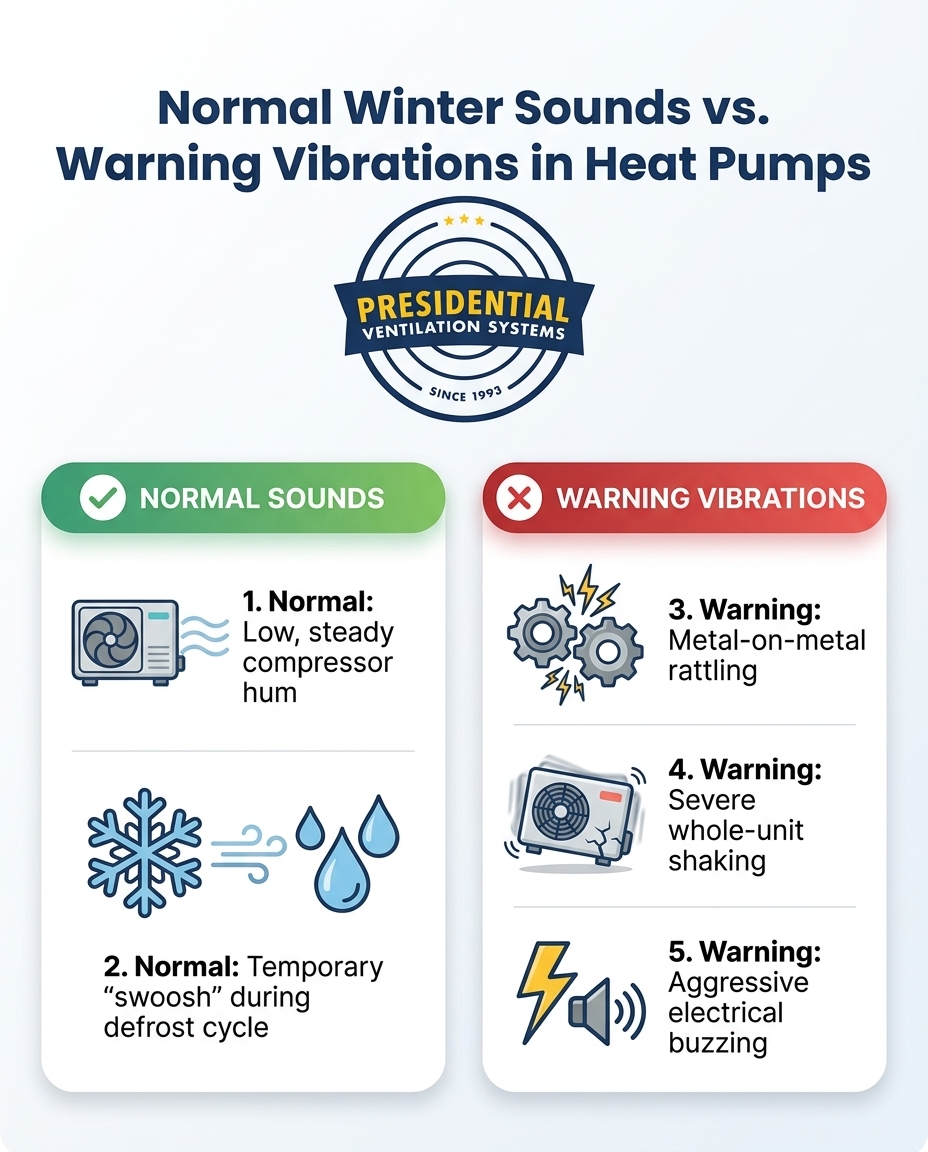
Before assuming your equipment is failing, it helps to understand how modern cold-climate heat pumps, such as Daikin and Lennox cold-climate systems, actually operate. These units utilize advanced variable-speed compressors. Unlike older, single-stage units that simply turn on and off, variable-speed compressors ramp up and down based on heating demand. When the temperature plummets, the compressor naturally changes pitch, running at a higher capacity and producing a louder, steady hum. This is entirely normal.
Another common sound that startles homeowners is the defrost cycle. As your unit extracts heat from cold air, frost naturally builds up on the outdoor coils. To clear this frost, the system temporarily reverses the flow of refrigerant. You might hear a sudden "swoosh" or a loud whooshing noise, followed by a deeper humming sound and even see steam rising from the outdoor unit. This cycle usually lasts only a few minutes before the system returns to normal heating mode.
However, because the system runs at a higher capacity in cold weather, it often exposes underlying mechanical wear that simply wasn't audible during the summer cooling season. To help you tell the difference, here is a breakdown of normal sounds versus warning signs:
• Low, steady compressor hum — Likely Cause: Variable-speed compressor ramping up in cold weather. — Action Required: None. This is normal operation.
• Temporary "swoosh" or whoosh — Likely Cause: System entering the defrost cycle to melt coil frost. — Action Required: None. Wait 5-15 minutes for the cycle to end.
• Metal-on-metal rattling — Likely Cause: Loose access panels, screws, or failing internal components. — Action Required: Requires professional inspection.
• Severe whole-unit shaking — Likely Cause: Unbalanced fan blade (often ice-related) or failing motor. — Action Required: Turn off unit and call a technician.
• Aggressive electrical buzzing — Likely Cause: Failing contactor or struggling capacitor. — Action Required: Requires professional electrical/HVAC diagnostic.
If you hear the warning signs listed above, relying on a proactive heat pump maintenance plan ensures a professional catches these issues before they escalate into costly mid-winter breakdowns.
One of the most common causes of severe vibration in our region is directly tied to the weather. Weave in Nova Scotia's wet, freezing maritime climate, and you have the perfect recipe for rapid ice accumulation. Our rapid temperature drops and high humidity levels increase the frequency of defrost cycles, but they also bring freezing rain and sleet that can coat the outdoor unit.
When freezing rain or heavy, wet snow enters the top of the outdoor chassis, it can freeze directly onto the fan blades. The physics of an unbalanced fan blade are unforgiving: even a small, uneven amount of ice throws the entire assembly out of balance. Because the fan spins at high speeds, this slight imbalance translates into violent shaking and loud, aggressive vibration noises that can echo throughout the house. If left running, this violent shaking can quickly destroy the motor bearings or cause the fan to strike the protective metal grate.
It is important to differentiate between an ice-induced imbalance and an internal motor bearing failure. Ice buildup is usually visible from the outside, whereas a failing motor will vibrate even when the blades are completely clear. Whether you have a central system or ductless heat pumps, observing the unit safely is your best first step during Nova Scotia late autumn and pre-winter cold snaps.
1. Perform a visual inspection: Look through the top grate of the outdoor unit with a flashlight. Check for uneven chunks of ice clinging to the fan blades or heavy buildup around the internal coils.
2. Check for clearance: Ensure there is no snow drift or debris blocking the sides or base of the unit, which can prevent proper drainage during the defrost cycle.
3. Never chip or hack at ice: Do not use screwdrivers, shovels, or hot water to remove ice from the fan or coils. You risk puncturing the fragile refrigerant lines or bending the aluminum fins, causing severe permanent damage.
4. Turn off the unit if shaking is severe: If the unit is visibly rocking or shaking violently, turn it off at the thermostat to prevent mechanical damage and call for professional service.
Not all vibrations are caused by external factors like ice. Purely mechanical wear and tear is a major culprit for loud noises, especially as systems age. Inside the outdoor unit, the fan motor relies on sealed bearings to spin smoothly. Over time, these motor bearings wear out. What starts as a faint, almost unnoticeable hum in the summer can escalate to a loud, vibrating grind in cold weather as the metal contracts and the motor works harder.
Furthermore, seasonal temperature fluctuations cause the metal chassis of the unit to expand and contract continually. Over several seasons, this movement can cause access panels, internal mounting screws, and rubber anti-vibration pads to loosen or degrade. When the variable-speed compressor ramps up to meet the heating demand of Daikin and Lennox cold-climate systems, these loose components rattle against each other, creating a harsh, metallic vibration.
The resonance effect: One thing we see often is that these vibrations don't just stay outside. The outdoor unit is connected to your indoor air handler via copper refrigerant lines. When the outdoor chassis vibrates heavily, that physical shaking travels down the copper lines, causing the walls or floors inside your home to hum or buzz loudly.
Getting a rapid, accurate diagnosis is critical before a minor vibration turns into a seized motor. One Nova Scotia homeowner reached out to us in the fall when their mini splits were vibrating and not heating properly, having been previously misdiagnosed by another company. Our technician diagnosed the actual mechanical issue within minutes, arranged for the necessary warranty parts, and resolved the problem entirely. Addressing common heat pump issues early prevents a domino effect of mechanical failures.
A common knowledge gap for many homeowners is the intersection of electrical and mechanical systems. Not all vibrations are mechanical in nature; electrical components can create loud, aggressive buzzing or vibrating sounds that easily mimic a failing motor or loose panel.
Inside the electrical panel of your outdoor unit sits a component called a contactor. The contactor acts as a heavy-duty switch that controls the flow of high-voltage electricity to the compressor and fan. It uses a magnetic coil to pull the switch closed. As the contactor ages, dirt, bugs, or pitting on the electrical contacts can prevent it from closing smoothly. When this happens, the magnetic coil struggles, creating a loud, aggressive electrical chattering or buzzing sound that vibrates the entire access panel.
Similarly, a failing run capacitor—which stores electricity to help start and run the motors—can cause serious acoustic symptoms. If the capacitor is weak, the compressor motor will struggle to start, drawing excessive amperage and producing a deep, vibrating hum before the system eventually trips an internal overload and shuts down.
The danger of ignoring electrical hums: Ignoring these electrical vibrations is incredibly risky. A failing contactor can weld itself shut, causing the system to run continuously until it burns out. A weak capacitor forces the compressor to work dangerously hard, which can lead to blown fuses, damaged wiring, or a completely destroyed compressor.
During a routine fall visit, another local customer had us out because their heat pump required a thorough inspection and deep cleaning. The service technician performed a comprehensive check, tested both the electrical and mechanical systems, and provided detailed care information. Catching a weak electrical component during routine maintenance on ducted heat pump systems is far better than dealing with a burned-out compressor in January. This is exactly why having Red Seal HVAC and electrical tradespeople who understand both the mechanical and electrical sides of the system is so vital.
When a homeowner hears a rattling panel or a buzzing component, the temptation to grab a screwdriver and fix it themselves is strong. However, while checking for visible ice or clearing away exterior debris is perfectly safe, opening the unit to tighten screws, inspect motors, or test electrical parts is incredibly dangerous.
The mechanical risks: Tightening random internal components without understanding the system layout can lead to disastrous results. The internal cabinet houses delicate aluminum fins and highly pressurized copper refrigerant coils. A slipped screwdriver or an over-tightened mounting bracket can easily puncture a coil, instantly venting all your refrigerant and turning a minor vibration fix into a major, expensive repair. Furthermore, misaligning fan assemblies by improperly tightening motor mounts will cause the fan to strike the housing the next time it turns on.
The electrical risks: The electrical dangers are even more severe. The outdoor unit runs on 240-volt high-voltage electricity. Even if you turn the power off at the main breaker, components like the capacitor hold lethal electrical charges for a significant amount of time. Touching the wrong terminal can result in a severe or fatal shock.
As a multi-trade contractor with 30+ years of experience, Presidential Ventilation Systems brings a unique diagnostic perspective to every service call. Our Red Seal HVAC and electrical tradespeople prioritize professional safety over DIY guesswork. Diagnosing the root cause of a vibration requires specialized multimeters, acoustic knowledge, and multi-trade expertise to ensure your system operates safely, efficiently, and quietly throughout its lifespan.
Yes, a low, steady hum or slight vibration is completely normal as the variable-speed compressor works harder in freezing temperatures. Because the system has to extract heat from very cold air, it runs at a higher capacity than it does in the summer. However, aggressive shaking, loud metal-on-metal rattling, or violent vibrations are not normal and indicate a mechanical or electrical problem.
Loud vibrations are typically caused by an unbalanced fan blade (often due to ice buildup), worn motor bearings, loose internal access panels, or failing electrical contactors. As components age and experience seasonal temperature fluctuations, anti-vibration pads can degrade, causing the entire metal chassis to rattle. A professional diagnostic is required to pinpoint the exact source of the noise.
Never attempt to stop internal vibrations yourself by opening the cabinet or tightening internal screws. You can safely clear away any external snow, ice, or debris from the outside of the unit to ensure proper airflow. For any internal mechanical or electrical faults, rely on a licensed technician to diagnose and repair the system safely.
A failing compressor often produces a loud, metal-on-metal grinding noise, a high-pitched screech, or a hard clunking sound when starting up or shutting down. You might also hear a deep, struggling hum if the compressor is trying to start but is being held back by a weak electrical capacitor. If you hear these sounds, turn the unit off to prevent further damage.
Yes, absolutely. Uneven ice accumulation on the fan blades throws the entire fan assembly out of balance, leading to severe shaking that mimics a failing motor. This is especially common in maritime climates where freezing rain and high humidity frequently coat the outdoor unit before or during a cold snap.
Call a professional if the vibration is new, excessively loud, sounds like metal grinding, or is accompanied by a loss of heating performance inside the home. It is always better to have a strange noise investigated early rather than waiting for the system to completely break down during a winter freeze.
Knowing the difference between a normal operational hum and a dangerous mechanical rattle saves homeowners from stressful, freezing winter breakdowns. While a steady hum simply means your system is working hard to keep you warm, severe shaking, grinding, or buzzing requires immediate professional attention. Identifying the source of vibration noises in your heat pump before winter ensures your equipment is ready to handle whatever the maritime climate throws at it.
Don't wait until the first major snowstorm to find out if that rattling noise is a failing motor bearing or a weak capacitor. Enjoy the peace of having a quiet, reliable system when the deep freeze hits. If you are concerned about unusual noises coming from your outdoor unit during Nova Scotia late autumn and pre-winter cold snaps, reach out to Presidential Ventilation Systems to schedule a professional diagnostic inspection or maintenance visit with our local experts.