


Electrical in Truro NS is easier to find than you might thinkthe area is home to numerous licensed contractors offering everything from basic repairs to complete system upgrades. Whether you need residential wiring, commercial installations, or specialized services like generator panels and EV charger setup, Truro's electrical professionals cover it all.
Quick Answer: Finding Electrical Services in Truro, NS
• Residential Services: Panel upgrades, rewiring, lighting installation, outlet additions, basement wiring
• Commercial & Industrial: Business electrical systems, warehouse wiring, institutional projects, petroleum station work
• Specialized Installations: Generator panels, EV chargers, heat pump wiring, solar power readiness, smart home automation
• Key Credentials: Red Seal Certification, provincial licensing, liability insurance, WCB coverage
• Service Areas: Truro, Colchester County, and surrounding communities including Millbrook, Lower Truro, and Debert
Your home's electrical system is the backbone of modern living. It powers everything from your morning coffee to your heating system, yet it often goes unnoticed until something goes wrong. In Truro and Colchester County, where homes range from historic properties to new builds, having access to qualified electrical professionals is essential for safety, efficiency, and peace of mind.
Looking for more home services in the area? Check out our full range of services, or contact us directly to discuss your electrical needs.
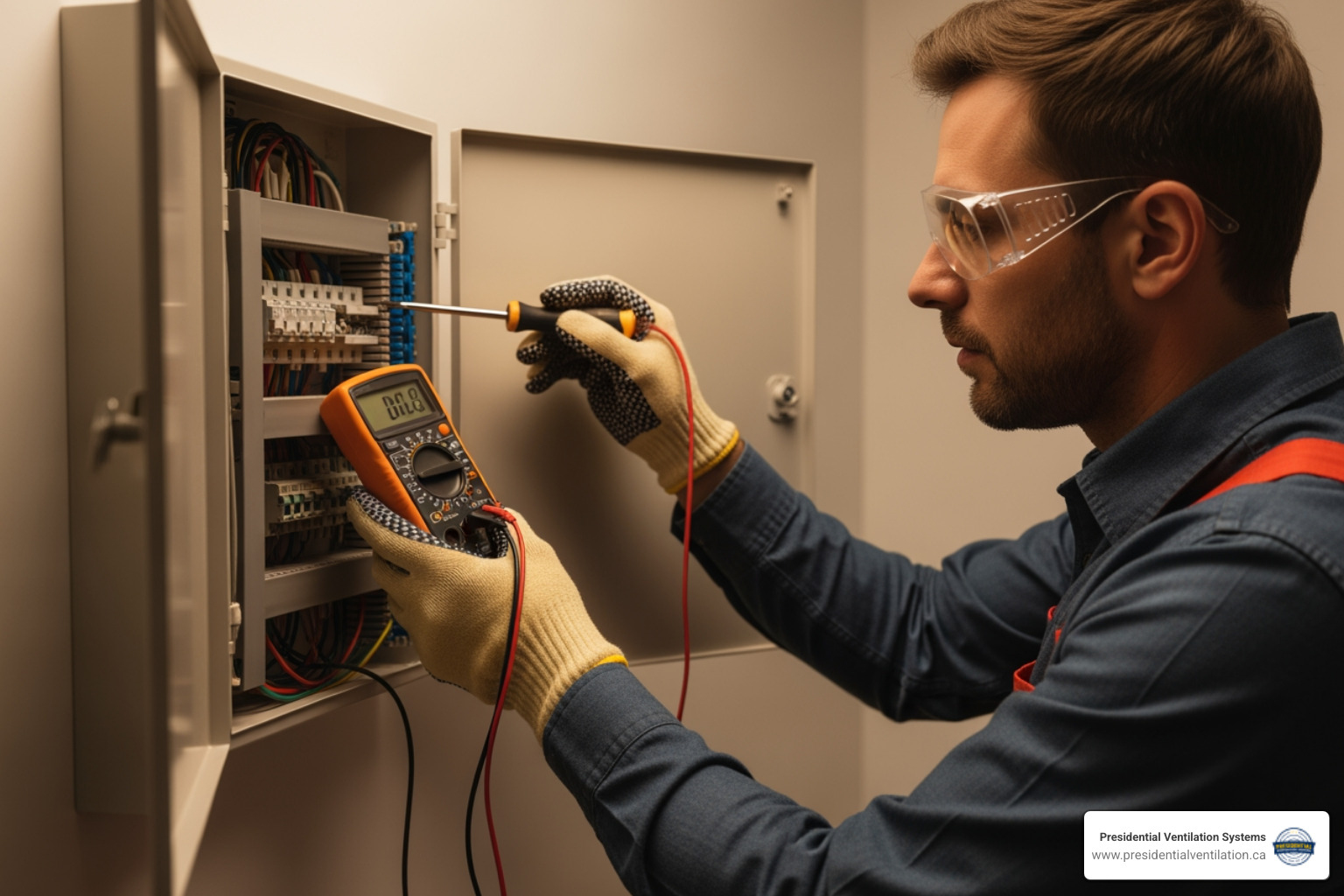
Ensuring the safe wiring of your Truro home is paramount. Professional electricians play a crucial role in maintaining and upgrading these vital systems. The importance of safe wiring cannot be overstated; it protects your family and your property from potential hazards.
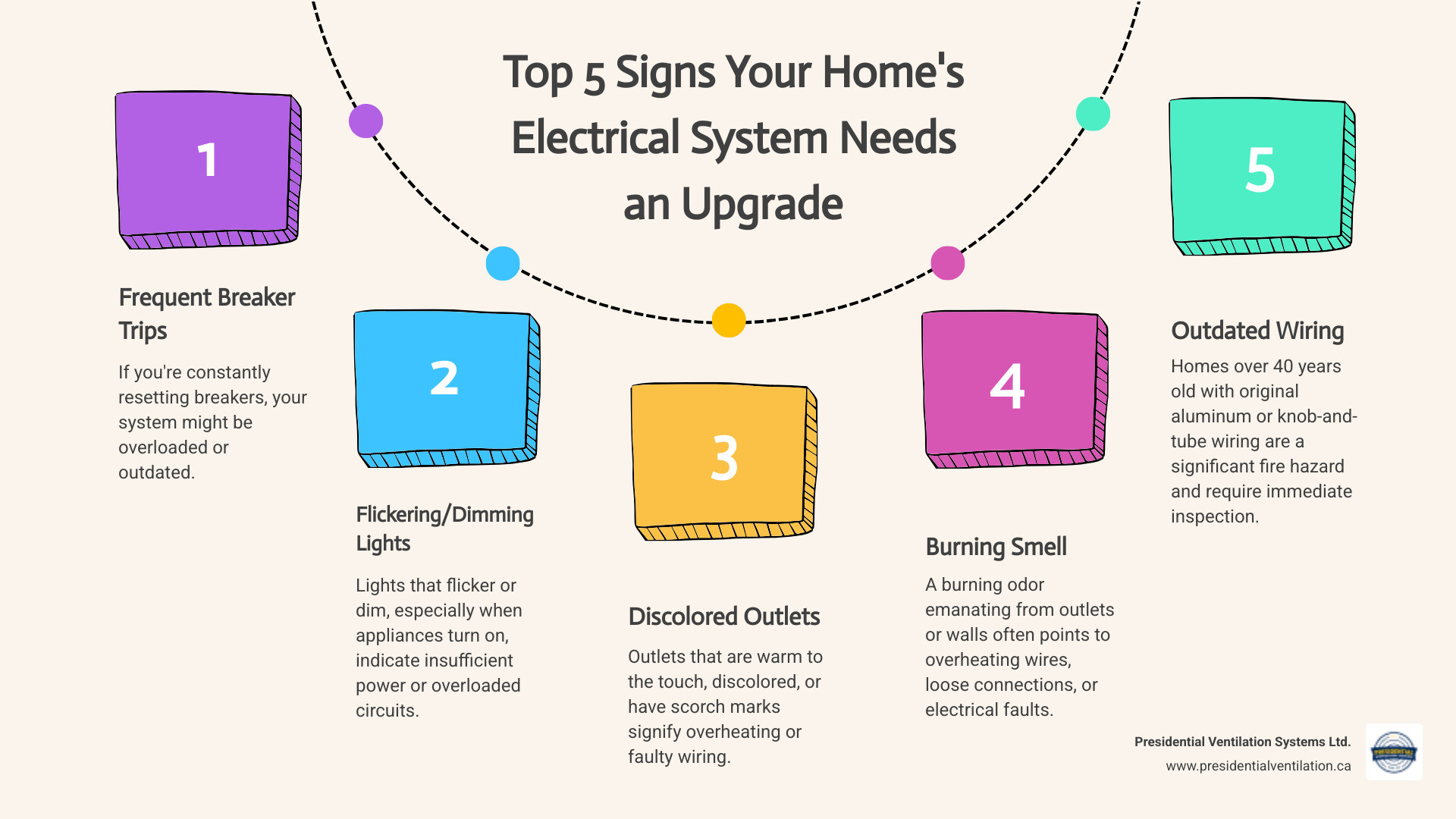
Is your home's electrical system trying to tell you something? Here are some signs it might be time for an upgrade:
• Frequent Circuit Breaker Trips: If you're constantly resetting breakers, your system might be overloaded or outdated.
• Flickering or Dimming Lights: This could indicate inconsistent power delivery or an overloaded circuit.
• Discolored Outlets or Switches: Burn marks or discoloration are serious warning signs of overheating.
• Burning Smell from Outlets or Appliances: Never ignore a burning smell; it often signals an electrical problem.
• Your Home is Over 20 Years Old: Older homes may not have the capacity for modern electrical demands and could benefit from an inspection or upgrade.
When you're looking for electrical in Truro NS, you'll find a wide array of services designed to meet every need, from the simplest repair to the most complex installation. Our team of skilled electricians is equipped to handle comprehensive electrical solutions for both residential and commercial properties.
For homeowners, residential electrical services cover everything that keeps your home powered and safe. This includes new construction wiring, ensuring your brand-new home has a robust and efficient electrical foundation. For existing homes, renovation and addition wiring seamlessly integrates new spaces into your current electrical system, whether you're building an extension or remodeling a single room. Service panel upgrades are also a common and important service, boosting your home's electrical capacity and safety. We also provide rewiring services for older homes to bring them up to current safety standards, and various lighting installation options to brighten and improve your living spaces.
Commercial electrical services are custom to the unique demands of businesses. This can range from setting up electrical systems for new commercial buildings to performing tenant fit-ups and lighting retrofits for existing businesses. Our expertise ensures that commercial operations run smoothly and safely, adhering to all industry standards.
Electricians in the Truro area often specialize to better serve the diverse needs of the community. For homes, this means expert home wiring, ensuring every outlet, switch, and fixture operates flawlessly and safely. For businesses, comprehensive business electrical needs are met, from complex data and network wiring to robust power systems for machinery.
Beyond residential and commercial, some contractors also extend their expertise to industrial services, handling the heavy-duty electrical demands of manufacturing plants and large facilities. There's even specialized support for agricultural wiring, catering to the specific requirements of farms in Colchester County. Our team is well-versed in addressing the unique demands of these various sectors, ensuring every project in Colchester County and beyond is powered correctly.
Home and business upgrades often go hand-in-hand with electrical renovations. Our team is proficient in modernizing your electrical infrastructure. This includes upgrading circuit breaker panels to handle increased electrical loads and improve safety. We can also add new outlets where you need them most, reducing reliance on extension cords and enhancing convenience.
For those undertaking larger projects, we offer specialized basement wiring services, changing unfinished spaces into functional living areas. Kitchen and bath remodels frequently require significant electrical updates, from new appliance circuits to specialized lighting and GFCI outlets, all of which we handle with precision and care. For more detailed information on how we can assist with your electrical needs, you can find more info about electrical services.
Choosing the right professional for your electrical in Truro NS needs is a critical decision that impacts the safety and efficiency of your home or business. It's not just about getting the job done; it's about ensuring it's done correctly, safely, and in compliance with all regulations.
The importance of qualifications cannot be overstated. A certified and experienced electrician brings not only technical skill but also an understanding of electrical codes and safety protocols. Vetting contractors thoroughly helps ensure you're hiring a reputable professional who adheres to high standards. Ensuring safety and compliance should always be a top priority.
To help you make an informed decision, here are some key questions to ask a potential electrician:
• Are you a Red Seal Certified electrician?
• Are you provincially licensed to perform electrical work in Nova Scotia?
• Do you carry comprehensive liability insurance?
• Is your company in good standing with the Workers' Compensation Board (WCB)?
• What is your experience with projects similar to mine?
• Can you provide references or a portfolio of your completed work?
• How do you ensure your work adheres to the Canadian Electrical Code?
• Do you offer a warranty on your services?
When seeking electrical in Truro NS, verifying credentials is a non-negotiable step. Look for electricians who hold a Red Seal Certification, which signifies a high standard of skill and expertise across Canada. Provincial licensing is also crucial, ensuring the electrician is legally authorized to perform work in Nova Scotia.
Equally important are liability insurance and Workers' Compensation Board (WCB) coverage. Liability insurance protects you in case of accidental damage to your property, while WCB coverage ensures that workers are protected in the event of an on-the-job injury. Finally, always confirm that the electrician adheres strictly to the Canadian Electrical Code, which sets the national safety standards for electrical installations. Our team consists of such qualified professionals, ensuring peace of mind with every project.
Beyond certifications, the experience and reputation of an electrical contractor are invaluable. When evaluating potential electricians, consider how long they have been operating in Colchester County and the surrounding areas. A long history of service often demonstrates deep local knowledge and an understanding of common building types and regional regulations.
Look for customer testimonials and reviews that speak to their reliability and quality of work. A portfolio of completed projects can provide insight into their capabilities and craftsmanship. It's also wise to consider their specializations—do they have specific expertise in residential, commercial, or industrial projects that align with your needs? Our team brings over 30 years of experience to every project, coupled with a strong local reputation.
As technology advances and our lives become more connected, so do the demands on our home electrical systems. Modern electrical in Truro NS services are increasingly focused on future-proofing your home, enhancing energy efficiency, adding value, and improving overall convenience.
Upgrading your electrical system is an investment that pays dividends in the long run. It ensures your home can comfortably support new appliances and smart home devices, reduces your energy footprint, and makes your property more attractive to potential buyers. Plus, who doesn't love the convenience of a fully powered, seamlessly integrated home?
Safety and reliability are paramount for any home electrical system. One increasingly popular upgrade is generator panel installation. This provides a dedicated connection for a portable generator, offering backup power options during outages and ensuring your essential home systems remain operational. We can install a generator panel so power outages are a thing of the past.
Whole-home surge protection is another vital addition, safeguarding all your electronics and appliances from damaging power surges, whether from lightning strikes or utility fluctuations. For fundamental safety, ensuring proper smoke and CO2 detector wiring is crucial. These devices provide important protection for your household, and professional wiring ensures they are always powered and functioning correctly.
The future of home electrical systems is here, and Truro electricians are at the forefront of these innovations. EV charger installation is becoming a must-have for electric vehicle owners, providing convenient and efficient charging right at home. As part of our comprehensive electrical services, we can help you prepare your home for this modern convenience.
Solar power readiness involves preparing your home's electrical panel and wiring for future solar panel integration, allowing you to harness renewable energy. Smart home automation wiring lays the groundwork for a truly connected home, enabling you to control lighting, climate, security, and entertainment systems with ease. Finally, LED lighting retrofits are an excellent way to boost energy efficiency and reduce electricity consumption, offering brighter, longer-lasting illumination while saving you money. We also specialize in heat pump wiring, ensuring your energy-efficient heating and cooling system is installed safely and optimally.
Upgrading your electrical panel is a smart move for several reasons. Primarily, it increases your home's capacity, allowing it to handle the growing number of modern appliances and electronics we rely on daily. Think about new kitchen gadgets, home office equipment, or even an electric vehicle charger—they all demand more power. An upgrade also significantly improves safety by replacing outdated components that might be prone to overheating or failure. If your home is over twenty years old, or if you frequently find yourself resetting circuit breakers, an upgrade is often a necessary step for renovations or installing high-power items like EV chargers or heat pumps. It ensures your system can safely and efficiently meet your current and future electrical needs.
Hiring a local electrician for your electrical in Truro NS needs comes with numerous advantages. Local professionals have a strong understanding of regional building codes and permitting processes, ensuring your project complies with all local regulations. They are also familiar with the common housing types and electrical systems found in the area, which can lead to more efficient troubleshooting and custom solutions. Furthermore, local electricians can often provide more responsive service, from initial consultations and project planning to faster response times for ongoing needs within Truro and Colchester County. Supporting local businesses also strengthens your community!
There are several tell-tale signs that your home may be due for a rewiring. One of the most common indicators is frequently tripping breakers, which suggests your circuits are overloaded or your wiring is struggling to keep up with demand. Flickering or dimming lights, especially when appliances turn on, can also point to an issue with your home's wiring. Discoloured outlets or switches, or a burning smell emanating from them, are serious red flags that indicate overheating and potential fire hazards. Lastly, if your home is over 40 years old and still retains its original aluminum or knob-and-tube wiring, it's highly recommended to have a professional inspection. These older wiring types are often considered safety risks and may not be able to safely handle modern electrical loads.
Navigating electrical in Truro NS can seem daunting, but with the right guidance, it’s a straightforward process. We've explored the wide range of common electrical services, from essential residential and commercial work to specialized installations for modern living. We've also highlighted the critical importance of choosing certified professionals who prioritize safety and compliance.
Investing in electrical upgrades not only improves the safety and efficiency of your home but also prepares it for future technologies and increases its overall value. For comprehensive and professional electrical solutions in the Truro area, trust the experts at Presidential Ventilation Systems Ltd. We are committed to delivering top-notch service that ensures your electrical systems are safe, reliable, and perfectly suited to your needs. For more information about our electrical services, please visit our website: More info about electrical services.


Electrical in Truro NS is easier to find than you might thinkthe area is home to numerous licensed contractors offering everything from basic repairs to complete system upgrades. Whether you need residential wiring, commercial installations, or specialized services like generator panels and EV charger setup, Truro's electrical professionals cover it all.
Quick Answer: Finding Electrical Services in Truro, NS
• Residential Services: Panel upgrades, rewiring, lighting installation, outlet additions, basement wiring
• Commercial & Industrial: Business electrical systems, warehouse wiring, institutional projects, petroleum station work
• Specialized Installations: Generator panels, EV chargers, heat pump wiring, solar power readiness, smart home automation
• Key Credentials: Red Seal Certification, provincial licensing, liability insurance, WCB coverage
• Service Areas: Truro, Colchester County, and surrounding communities including Millbrook, Lower Truro, and Debert
Your home's electrical system is the backbone of modern living. It powers everything from your morning coffee to your heating system, yet it often goes unnoticed until something goes wrong. In Truro and Colchester County, where homes range from historic properties to new builds, having access to qualified electrical professionals is essential for safety, efficiency, and peace of mind.
Looking for more home services in the area? Check out our full range of services, or contact us directly to discuss your electrical needs.
Ensuring the safe wiring of your Truro home is paramount. Professional electricians play a crucial role in maintaining and upgrading these vital systems. The importance of safe wiring cannot be overstated; it protects your family and your property from potential hazards.
Is your home's electrical system trying to tell you something? Here are some signs it might be time for an upgrade:
• Frequent Circuit Breaker Trips: If you're constantly resetting breakers, your system might be overloaded or outdated.
• Flickering or Dimming Lights: This could indicate inconsistent power delivery or an overloaded circuit.
• Discolored Outlets or Switches: Burn marks or discoloration are serious warning signs of overheating.
• Burning Smell from Outlets or Appliances: Never ignore a burning smell; it often signals an electrical problem.
• Your Home is Over 20 Years Old: Older homes may not have the capacity for modern electrical demands and could benefit from an inspection or upgrade.
When you're looking for electrical in Truro NS, you'll find a wide array of services designed to meet every need, from the simplest repair to the most complex installation. Our team of skilled electricians is equipped to handle comprehensive electrical solutions for both residential and commercial properties.
For homeowners, residential electrical services cover everything that keeps your home powered and safe. This includes new construction wiring, ensuring your brand-new home has a robust and efficient electrical foundation. For existing homes, renovation and addition wiring seamlessly integrates new spaces into your current electrical system, whether you're building an extension or remodeling a single room. Service panel upgrades are also a common and important service, boosting your home's electrical capacity and safety. We also provide rewiring services for older homes to bring them up to current safety standards, and various lighting installation options to brighten and improve your living spaces.
Commercial electrical services are custom to the unique demands of businesses. This can range from setting up electrical systems for new commercial buildings to performing tenant fit-ups and lighting retrofits for existing businesses. Our expertise ensures that commercial operations run smoothly and safely, adhering to all industry standards.
Electricians in the Truro area often specialize to better serve the diverse needs of the community. For homes, this means expert home wiring, ensuring every outlet, switch, and fixture operates flawlessly and safely. For businesses, comprehensive business electrical needs are met, from complex data and network wiring to robust power systems for machinery.
Beyond residential and commercial, some contractors also extend their expertise to industrial services, handling the heavy-duty electrical demands of manufacturing plants and large facilities. There's even specialized support for agricultural wiring, catering to the specific requirements of farms in Colchester County. Our team is well-versed in addressing the unique demands of these various sectors, ensuring every project in Colchester County and beyond is powered correctly.
Home and business upgrades often go hand-in-hand with electrical renovations. Our team is proficient in modernizing your electrical infrastructure. This includes upgrading circuit breaker panels to handle increased electrical loads and improve safety. We can also add new outlets where you need them most, reducing reliance on extension cords and enhancing convenience.
For those undertaking larger projects, we offer specialized basement wiring services, changing unfinished spaces into functional living areas. Kitchen and bath remodels frequently require significant electrical updates, from new appliance circuits to specialized lighting and GFCI outlets, all of which we handle with precision and care. For more detailed information on how we can assist with your electrical needs, you can find more info about electrical services.
Choosing the right professional for your electrical in Truro NS needs is a critical decision that impacts the safety and efficiency of your home or business. It's not just about getting the job done; it's about ensuring it's done correctly, safely, and in compliance with all regulations.
The importance of qualifications cannot be overstated. A certified and experienced electrician brings not only technical skill but also an understanding of electrical codes and safety protocols. Vetting contractors thoroughly helps ensure you're hiring a reputable professional who adheres to high standards. Ensuring safety and compliance should always be a top priority.
To help you make an informed decision, here are some key questions to ask a potential electrician:
• Are you a Red Seal Certified electrician?
• Are you provincially licensed to perform electrical work in Nova Scotia?
• Do you carry comprehensive liability insurance?
• Is your company in good standing with the Workers' Compensation Board (WCB)?
• What is your experience with projects similar to mine?
• Can you provide references or a portfolio of your completed work?
• How do you ensure your work adheres to the Canadian Electrical Code?
• Do you offer a warranty on your services?
When seeking electrical in Truro NS, verifying credentials is a non-negotiable step. Look for electricians who hold a Red Seal Certification, which signifies a high standard of skill and expertise across Canada. Provincial licensing is also crucial, ensuring the electrician is legally authorized to perform work in Nova Scotia.
Equally important are liability insurance and Workers' Compensation Board (WCB) coverage. Liability insurance protects you in case of accidental damage to your property, while WCB coverage ensures that workers are protected in the event of an on-the-job injury. Finally, always confirm that the electrician adheres strictly to the Canadian Electrical Code, which sets the national safety standards for electrical installations. Our team consists of such qualified professionals, ensuring peace of mind with every project.
Beyond certifications, the experience and reputation of an electrical contractor are invaluable. When evaluating potential electricians, consider how long they have been operating in Colchester County and the surrounding areas. A long history of service often demonstrates deep local knowledge and an understanding of common building types and regional regulations.
Look for customer testimonials and reviews that speak to their reliability and quality of work. A portfolio of completed projects can provide insight into their capabilities and craftsmanship. It's also wise to consider their specializations—do they have specific expertise in residential, commercial, or industrial projects that align with your needs? Our team brings over 30 years of experience to every project, coupled with a strong local reputation.
As technology advances and our lives become more connected, so do the demands on our home electrical systems. Modern electrical in Truro NS services are increasingly focused on future-proofing your home, enhancing energy efficiency, adding value, and improving overall convenience.
Upgrading your electrical system is an investment that pays dividends in the long run. It ensures your home can comfortably support new appliances and smart home devices, reduces your energy footprint, and makes your property more attractive to potential buyers. Plus, who doesn't love the convenience of a fully powered, seamlessly integrated home?
Safety and reliability are paramount for any home electrical system. One increasingly popular upgrade is generator panel installation. This provides a dedicated connection for a portable generator, offering backup power options during outages and ensuring your essential home systems remain operational. We can install a generator panel so power outages are a thing of the past.
Whole-home surge protection is another vital addition, safeguarding all your electronics and appliances from damaging power surges, whether from lightning strikes or utility fluctuations. For fundamental safety, ensuring proper smoke and CO2 detector wiring is crucial. These devices provide important protection for your household, and professional wiring ensures they are always powered and functioning correctly.
The future of home electrical systems is here, and Truro electricians are at the forefront of these innovations. EV charger installation is becoming a must-have for electric vehicle owners, providing convenient and efficient charging right at home. As part of our comprehensive electrical services, we can help you prepare your home for this modern convenience.
Solar power readiness involves preparing your home's electrical panel and wiring for future solar panel integration, allowing you to harness renewable energy. Smart home automation wiring lays the groundwork for a truly connected home, enabling you to control lighting, climate, security, and entertainment systems with ease. Finally, LED lighting retrofits are an excellent way to boost energy efficiency and reduce electricity consumption, offering brighter, longer-lasting illumination while saving you money. We also specialize in heat pump wiring, ensuring your energy-efficient heating and cooling system is installed safely and optimally.
Upgrading your electrical panel is a smart move for several reasons. Primarily, it increases your home's capacity, allowing it to handle the growing number of modern appliances and electronics we rely on daily. Think about new kitchen gadgets, home office equipment, or even an electric vehicle charger—they all demand more power. An upgrade also significantly improves safety by replacing outdated components that might be prone to overheating or failure. If your home is over twenty years old, or if you frequently find yourself resetting circuit breakers, an upgrade is often a necessary step for renovations or installing high-power items like EV chargers or heat pumps. It ensures your system can safely and efficiently meet your current and future electrical needs.
Hiring a local electrician for your electrical in Truro NS needs comes with numerous advantages. Local professionals have a strong understanding of regional building codes and permitting processes, ensuring your project complies with all local regulations. They are also familiar with the common housing types and electrical systems found in the area, which can lead to more efficient troubleshooting and custom solutions. Furthermore, local electricians can often provide more responsive service, from initial consultations and project planning to faster response times for ongoing needs within Truro and Colchester County. Supporting local businesses also strengthens your community!
There are several tell-tale signs that your home may be due for a rewiring. One of the most common indicators is frequently tripping breakers, which suggests your circuits are overloaded or your wiring is struggling to keep up with demand. Flickering or dimming lights, especially when appliances turn on, can also point to an issue with your home's wiring. Discoloured outlets or switches, or a burning smell emanating from them, are serious red flags that indicate overheating and potential fire hazards. Lastly, if your home is over 40 years old and still retains its original aluminum or knob-and-tube wiring, it's highly recommended to have a professional inspection. These older wiring types are often considered safety risks and may not be able to safely handle modern electrical loads.
Navigating electrical in Truro NS can seem daunting, but with the right guidance, it’s a straightforward process. We've explored the wide range of common electrical services, from essential residential and commercial work to specialized installations for modern living. We've also highlighted the critical importance of choosing certified professionals who prioritize safety and compliance.
Investing in electrical upgrades not only improves the safety and efficiency of your home but also prepares it for future technologies and increases its overall value. For comprehensive and professional electrical solutions in the Truro area, trust the experts at Presidential Ventilation Systems Ltd. We are committed to delivering top-notch service that ensures your electrical systems are safe, reliable, and perfectly suited to your needs. For more information about our electrical services, please visit our website: More info about electrical services.
When evaluating response times when selecting a commercial HVAC partner in Burnside, NS, many facility managers rely heavily on the promise of a "24/7 Service Level Agreement" (SLA). The assumption is that a signed contract guaranteeing a two-hour response time is an ironclad insurance policy against winter downtime. However, a written SLA means very little if the contractor lacks the physical manpower to deploy during simultaneous regional outages. A piece of paper cannot generate heat.
With freezing temperatures and harsh coastal weather in Nova Scotia, commercial building temperatures can plummet to freezing thresholds within 12 to 24 hours of a system failure. Depending on your building's insulation and the external wind chill, the margin for error is razor-thin. For Burnside commercial facilities, a delayed repair isn't just an inconvenience; it represents a catastrophic risk of frozen pipes, ruined inventory, and entirely halted production lines.
The gap between marketing and reality:
• The Promise: A technician will be dispatched to your facility within two hours, day or night.
• The Reality: During a deep freeze, small contractors are instantly overwhelmed. The technician who arrives may just be there to diagnose the issue before leaving to handle five other "emergency" calls.
• The Result: The SLA clock is paused, but your building remains freezing.
In our 30+ years of experience, we have seen how harsh coastal weather exposes the severe gap between marketing promises and operational reality. To truly protect your facility, you need reliable commercial heating services backed by actual logistical capability, not just aggressive sales language. The evaluation phase before signing a maintenance contract is your critical decision point to audit a prospective contractor's true infrastructure.
One of the most common pitfalls in commercial facility management is conflating "response time" with "resolution time." These are two entirely different metrics, and understanding the distinction is crucial for minimizing business downtime when a commercial HVAC system fails.
Response time is simply the metric most contractors sell. It measures how long it takes for a technician to physically arrive on-site after you place an emergency call. Resolution time, on the other hand, is the metric facility managers actually need. It measures the total time elapsed from the initial failure to the moment heating and operational status are fully restored.
During Nova Scotia winter emergencies, a fast response time is useless if the resolution time stretches into days. Resolution is heavily dependent on a contractor's local parts access, technical expertise, and cross-trade capabilities.
• Initial Dispatch — Response-Focused Contractor: Arrives quickly to "stop the clock" on the SLA. — Resolution-Focused Partner: Arrives quickly with common commercial replacement parts stocked on the truck.
• Diagnosis — Response-Focused Contractor: Identifies the problem but lacks authorization or parts to fix it immediately. — Resolution-Focused Partner: Diagnoses the issue and immediately begins the repair process.
• Parts Sourcing — Response-Focused Contractor: Waits for supply houses to open or orders parts from out of province. — Resolution-Focused Partner: Leverages established local supply chain relationships and extensive in-house inventory.
• Final Result — Response-Focused Contractor: Technician leaves; building remains cold for 48+ hours. — Resolution-Focused Partner: System restored; operations resume the same day.
A typical pattern we see is a technician arriving at a commercial facility at 2:00 a.m., confirming that a rooftop unit's blower motor has failed, and then leaving because they do not have the part or the secondary trades required to complete the installation. The contractor technically met their two-hour response SLA, but they did not solve the facility's problem.
The operational cost of downtime in Burnside's industrial parks compounds by the hour. Every minute your facility is without heat, you risk secondary damage to plumbing infrastructure and massive losses in workforce productivity. Evaluating a contractor based solely on their initial response time leaves your business dangerously exposed to prolonged resolution delays.
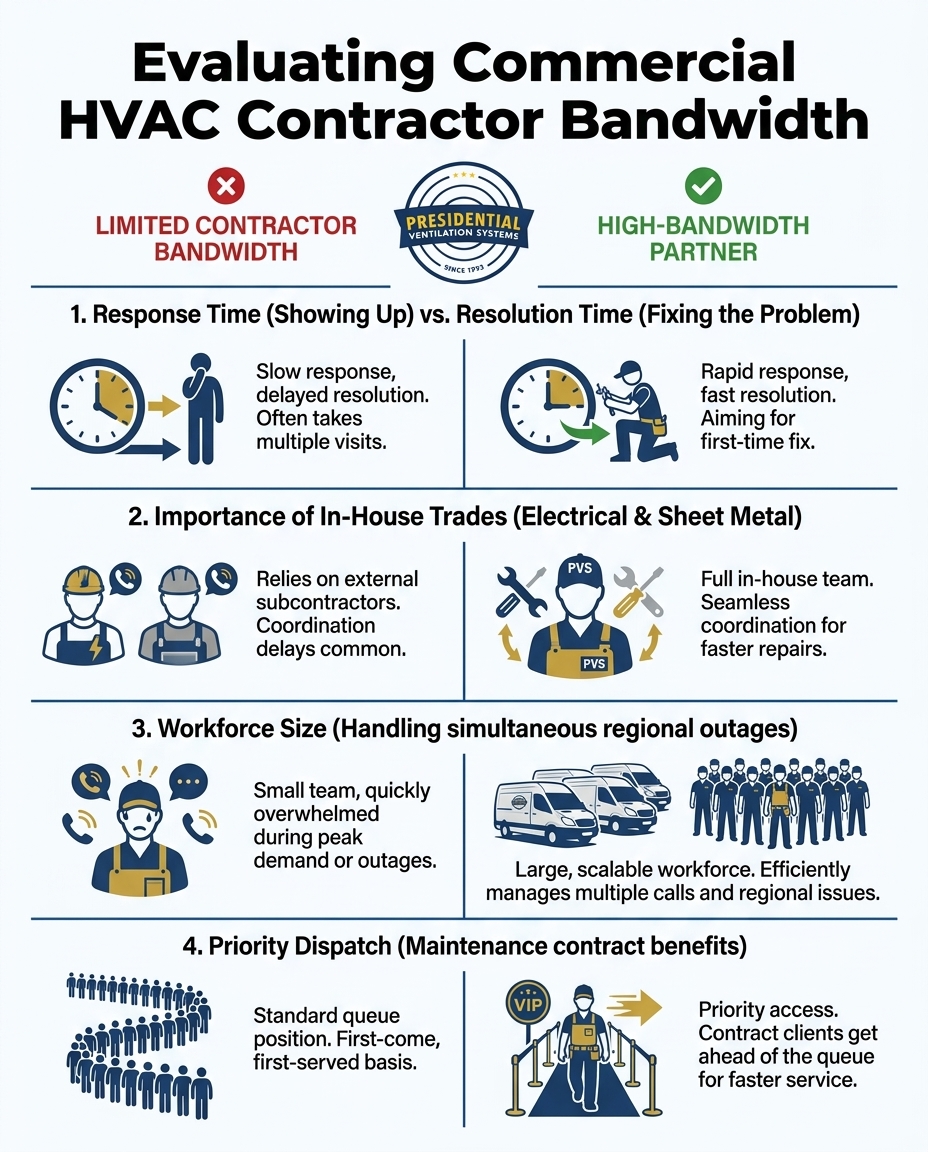
When a severe polar vortex hits the region, it does not just affect one building. It affects hundreds of commercial properties simultaneously. This logistical reality is the ultimate stress test for any HVAC service provider. When a deep freeze hits, every commercial facility calls at once, and contractors with small teams become instantly overwhelmed.
If a prospective partner only has five or ten technicians, their fast-response SLAs become physically impossible to honor during a regional weather event. They simply cannot be in fifty places at once. This is why evaluating workforce bandwidth—specifically, the total employee count and the number of technicians dedicated to commercial service—is a non-negotiable metric.
What we have learned over decades of serving this region is that true emergency protection requires a massive operational footprint. Our 70-employee workforce with Red Seal trades ensures dedicated emergency bandwidth, preventing the bottlenecks smaller companies face when dispatching throughout Burnside and surrounding service areas. A large headcount means that preventative maintenance schedules can continue uninterrupted while dedicated emergency response teams handle the sudden influx of no-heat calls.
Established commercial contractors operate sophisticated triage systems during extreme weather. Calls are prioritized based on the severity of the infrastructure risk and the presence of existing maintenance agreements.
How a robust workforce handles triage:
• Geographic Routing: Having a large, localized team in the Burnside area reduces transit times between industrial parks, increasing the number of facilities a single technician can stabilize in one shift.
• Dedicated Commercial Dispatch: Separating residential calls from complex commercial/industrial failures ensures that the most highly trained technicians are routed to the most critical infrastructure.
• Concurrent Operations: While one team handles a catastrophic boiler failure, another can address a frozen rooftop unit, ensuring no client is left stranded for days.
Commercial HVAC systems are complex, interconnected networks. A heating failure is rarely just a mechanical issue; it often involves high-voltage electrical faults or requires immediate ductwork modifications to bypass a failed component. This reality exposes another major flaw in evaluating contractors solely on their HVAC credentials.
The problem: Many commercial heating failures require specialized skills that standard HVAC technicians cannot legally or practically perform. If a system requires a new high-voltage disconnect or a custom transition fitting, an HVAC-only contractor must halt work.
The cause: Contractors without in-house electrical or sheet-metal teams are forced to rely on third-party subcontractors. During a winter storm, those subcontractors are also overwhelmed with their own emergency calls. This creates a cascading delay where your facility is left waiting days for an electrician to arrive just so the HVAC technician can finish their job.
The solution: Partnering with a comprehensive contractor that houses multiple Red Seal trades under one roof ensures seamless, continuous repair work. Because our 70-employee workforce with Red Seal trades includes in-house electrical capabilities and custom sheet metal fabrication, we eliminate subcontractor wait times entirely. When evaluating bids or service agreements, cross-trade capability should be one of your primary criteria.
The speed of a repair drastically increases when all required professionals work for the same company. There is direct communication between HVAC technicians and electricians on the same team, allowing them to coordinate arrivals and share diagnostic data instantly. Furthermore, the ability to immediately fabricate necessary sheet metal components in-house, rather than waiting on third-party supply chains, can turn a multi-day shutdown into a single-afternoon fix.
To ensure your Burnside commercial facilities are truly protected, you must move beyond reading marketing brochures and start auditing operational capabilities. Use this concrete framework to evaluate potential partners before signing a contract.
1. What is your total local employee headcount, and how many are dedicated to commercial service?
Why it matters: A company with 10 employees cannot physically handle a regional freeze. You need a partner with the sheer numbers to manage simultaneous emergencies without abandoning their preventative maintenance obligations.
2. Do you have in-house electricians and sheet-metal fabricators, or do you rely on subcontractors?
Why it matters: Complex commercial repairs almost always cross trade lines. Relying on subcontractors introduces massive delays. In-house trades guarantee continuous, uninterrupted repair work.
3. How do you prioritize emergency dispatch during widespread winter storms?
Why it matters: You need to know exactly where you stand in line. A transparent contractor will explain their triage system and confirm that contract clients receive priority routing.
4. What is your average resolution time for major heating failures, not just your initial response time?
Why it matters: Showing up in two hours is useless if the repair takes three days. Ask for their track record on actual problem resolution, including how they handle weekend parts sourcing.
5. Can you provide examples of how you manage parts inventory for commercial clients in the Burnside area?
Why it matters: Supply chain delays are a reality. A capable partner will stock common commercial components locally or keep specific parts on hand for the exact equipment listed in your maintenance agreement.
The evaluation phase should ultimately lead to securing a comprehensive commercial HVAC maintenance plan. Why? Because in the commercial HVAC industry, having an active maintenance contract dictates your emergency priority and the speed at which your problems are resolved.
Facilities with active preventative maintenance contracts universally receive priority dispatch over non-contract clients. When resources are stretched thin during Nova Scotia winter emergencies, contractors will always service their contract partners first. If you wait until your system fails to establish a relationship with a contractor, you will be placed at the bottom of a very long waiting list.
Furthermore, routine maintenance familiarizes the contractor with your facility's specific equipment. When an emergency call comes in, the dispatch team already knows the make, model, age, and service history of your rooftop units or boilers. The technician arrives with the correct parts already on the truck, drastically reducing both diagnostic and resolution times.
The best emergency response is preventing the failure in the first place through proactive, scheduled care. Routine inspections catch failing contactors, worn belts, and minor refrigerant leaks long before they cause a catastrophic shutdown. This provides immense financial and operational predictability, ensuring your building remains compliant with ASHRAE and BOMA facility management standards. The return on investment for maintaining equipment far outweighs the premium rates and lost revenue associated with emergency winter repairs.
What is a standard response time for commercial HVAC emergencies?
Most commercial SLAs promise an on-site response within 2 to 4 hours for critical emergencies. However, it is vital to remember that this metric only tracks when a technician arrives at your facility. True emergency readiness should be measured by resolution time—how quickly the contractor can actually source parts and restore heating to the building.
How do you evaluate a commercial HVAC contractor's true bandwidth?
You evaluate their bandwidth by looking at their total local employee headcount and their specific commercial dispatch capabilities. Ask how many dedicated commercial technicians they employ and inquire about their in-house trades. A contractor with 70+ employees and in-house electricians is far more capable of handling regional outages than a smaller operation.
Why do commercial HVAC repairs take so long during winter?
Delays usually stem from two factors: a lack of available workforce during simultaneous regional outages, and a reliance on third-party subcontractors for electrical or sheet-metal work. If a contractor has to wait for an external electrician or a delayed parts shipment, your repair will stall, regardless of how quickly the initial technician arrived.
What should be included in a commercial HVAC maintenance contract?
A robust contract should include comprehensive seasonal inspections, priority emergency dispatch, and guaranteed response times. It should also detail routine tasks like filter changes, belt tensioning, electrical connection testing, and combustion analysis to ensure compliance with facility management standards.
How does having in-house electrical support speed up HVAC repairs?
Many commercial heating failures involve high-voltage electrical components. If a contractor has in-house electricians, they can coordinate the repair immediately without halting work. This eliminates the days spent waiting for a third-party electrical subcontractor to become available.
True emergency protection requires a partner with actual operational bandwidth, not just a promised response time on a piece of paper. When evaluating response times, you must look at the contractor's total workforce, their in-house cross-trade capabilities, and their proven ability to achieve rapid resolution during severe weather.
With our 70-employee workforce with Red Seal trades, we have the infrastructure to keep your business running when it matters most. Schedule an evaluation before the Nova Scotia winter hits. Contact our team today to discuss commercial HVAC maintenance plans and ensure your Burnside facility is fully protected against unexpected downtime.

Winter in Nova Scotia is relentless. Over our 30+ years serving Mount Uniacke and the surrounding province, our team at Presidential Ventilation Systems has seen firsthand that pouring proper concrete pads for heat pumps in frost-prone Nova Scotia soils is an absolute necessity before the deep freeze arrives. Before the first major snowstorm hits, many homeowners do not realize the hidden danger lurking right beneath their outdoor HVAC equipment. The seasonal reality is that aggressive temperature fluctuations wreak havoc on improperly installed systems. A pattern we see often is that when an outdoor unit is placed on a basic plastic pad directly over raw dirt, it inevitably tilts, sinks, and strains critical electrical and refrigerant lines as the ground shifts beneath it.
The decision point for homeowners is clear: protecting your investment requires choosing professional excavation, proper gravel drainage, and solid concrete foundations over fast industry shortcuts. A system is only as reliable as the ground it sits on, and our technicians know that ignoring the foundation inevitably leads to mechanical failures just when you need heating the most.
If you are looking to upgrade your home comfort, learning about reliable heat pumps and scheduling a professional ductless heat pump installation is the best place to start.
The underlying issue: Nova Scotia freeze-thaw cycles are particularly brutal on surface-level objects. As the ground freezes, thaws, and refreezes throughout the winter, the soil expands and contracts violently. Without a professionally poured foundation, the equipment is entirely at the mercy of the earth's movement, turning a high-efficiency heating system into a liability.
When our Red Seal tradespeople arrive at a residential or commercial site to diagnose a tilted unit, we always explain the geotechnical science behind the ground itself. The earth does not just get cold; it undergoes a physical transformation that exerts massive force on anything resting on the surface. Understanding this process is the first step in recognizing why standard installation shortcuts fail so frequently in our specific climate.
The basic physics: Water expands by approximately 9% when it freezes. While that percentage might sound small, the sheer force it generates is immense. When the moisture trapped in the ground freezes, it has nowhere to go but up, creating a powerful upward pressure known as frost heave. This expansion can lift heavy boulders, crack asphalt, and easily push an unanchored HVAC unit out of alignment.
The surface impact: Because the top layers of soil freeze first, the upward force is concentrated directly beneath surface-level objects. A lightweight plastic pad offers zero structural resistance to this 9% expansion. As the ice lenses form beneath the soil, they push unevenly, causing one side of the equipment to rise higher than the other. When the ice melts during a mid-winter thaw, the ground collapses back down, leaving the unit permanently tilted.
The maritime factor: Our region's specific moisture-heavy soils maximize the destructive nature of these cycles. Clay and loam mixtures act like a sponge, holding onto autumn rain and melting snow rather than allowing it to drain away deeply. This high moisture retention means there is significantly more water available to freeze and expand directly beneath your equipment.
The cycle of destruction: Nova Scotia freeze-thaw cycles are characterized by frequent temperature swings above and below the freezing mark. We do not just freeze once in December and thaw in April; the ground thaws and refreezes repeatedly throughout the season. Every single cycle compounds the shifting effect, making soils highly susceptible to violent heaving. Any object without proper sub-grade preparation will inevitably be pushed out of alignment by spring.
A shifting outdoor unit is not just a cosmetic issue; it triggers a cascade of mechanical failures that can destroy the system from the inside out. Moving from mechanical strain to potential warranty voids, the consequences of a poor foundation are severe and costly.
The winter defrost cycle: During normal winter operation, outdoor units accumulate frost on their coils. The system periodically enters a defrost mode, temporarily melting this ice so the water can drain out of the bottom chassis. This is a critical function for maintaining efficiency and preventing the fan blades from becoming encased in solid ice.
The pooling problem: A frequent issue we encounter during winter HVAC repairs is poor drainage caused by frost heave. When a unit tilts, it prevents proper defrost drainage. Instead of flowing out of the designated weep holes, the water pools in the lower corner of the tilted chassis. As soon as the defrost cycle ends, that pooled water freezes solid. Over several weeks, this ice buildup can expand into the fan blades, crush the delicate aluminum fins, and cause catastrophic internal damage to Daikin and Lennox heat pump installations.
The physical tension: Your outdoor unit is connected to your indoor system via a set of copper refrigerant lines and electrical wiring. These connections are designed to remain stationary. When the unit sinks or shifts unevenly, it places severe mechanical strain on these copper lines. Over time, this stretching can cause the copper to kink, crack, or rupture at the flare joints, leading to a complete loss of refrigerant and a system breakdown.
The warranty reality: Manufacturer guidelines strictly require units to remain perfectly level to ensure proper compressor lubrication and drainage. If a compressor fails because it was running on a 15-degree tilt, or if a refrigerant line snaps due to ground shifting, failing to maintain a level unit due to poor foundation preparation can void manufacturer warranties. Before choosing the best ductless heat pump, ensure the contractor is committed to protecting that investment with a proper base.
Dropping a plastic pad directly on raw dirt is a fast, common industry shortcut. It takes minutes to execute and costs very little in materials. However, this method completely fails to address sub-surface moisture and frost heave, leaving the homeowner vulnerable to all the mechanical failures discussed above.
The structural failure: Lightweight plastic pads offer no structural resistance to the upward pressure of expanding frozen soil. They simply ride the wave of the heaving dirt. Because they are often placed directly on topsoil without removing the organic material, they actually trap moisture right at the surface, creating the perfect environment for aggressive freezing and shifting.
The quality standard: With a team of approximately 70 employees handling everything from residential oil-to-heat-pump conversions to large commercial new construction projects, our refusal to use this shortcut is a strict quality standard. Diagnosing winter HVAC failures year after year has proven that cutting corners on the foundation always costs the homeowner more in the long run. We rely on Red Seal methodology and commercial-grade preparation to protect your investment, ensuring the system remains stable for its entire lifespan.
• Plastic Pad on Dirt — Moisture Control: Traps surface water beneath the unit. — Frost Heave Resistance: None. Shifts immediately with soil expansion. — Long-Term Stability: High risk of tilting, sinking, and line strain.
• Concrete on Gravel Base — Moisture Control: Promotes rapid deep drainage away from the surface. — Frost Heave Resistance: High. Weight and rigid structure resist upward pressure. — Long-Term Stability: Permanent, level support protecting the warranty.

Preparing the ground before concrete is even poured is the most important phase of the project. The following is an overview of our professional methodology, not a DIY guide. Excavation, structural preparation, and electrical panel integration require licensed professionals to ensure safety, proper load bearing, and code compliance.
1. Removing the organic layer: The mandatory first step is excavating the topsoil. Organic material holds water like a sponge and compresses easily under weight. We dig down to remove this moisture-holding material, creating a clean, stable sub-grade.
2. Establishing the drainage base: Once excavated, the void is filled with crushed gravel. This creates a porous drainage layer that allows water to escape deep into the earth rather than pooling and freezing directly under the pad.
1. Creating a frost buffer: The gravel layer acts as a buffer against deep frost heave. Because gravel does not retain water the way loam and clay do, it does not expand violently when the temperature drops. This effectively neutralizes the Nova Scotia freeze-thaw cycles directly beneath the equipment.
2. Professional compaction: The gravel must be mechanically compacted. Proper gravel compaction prevents future settling when the spring thaw arrives, ensuring the base remains solid and unyielding year-round.
With the moisture mitigated and the drainage base established, the final foundation step is the concrete pour. The weight and rigidity of concrete are necessary for long-term stability, acting as an anchor against minor ground shifts.
The advantage of mass: The sheer weight of a properly poured concrete pad resists the upward force of the freezing earth. Unlike a hollow plastic shell, a solid slab of concrete distributes the weight of the heavy outdoor unit evenly across the compacted gravel base. Before pouring, our installers ensure the form is perfectly level, guaranteeing a flat surface for the unit to operate on for decades.
• Rigid support: Provides unbending support across the entire footprint of the equipment.
• Heave resistance: Resists the upward force of frost heave far better than lightweight alternatives.
• Drainage optimization: Ensures optimal defrost drainage by remaining perfectly level year after year.
• Line protection: Protects sensitive electrical and refrigerant lines from stretching, shifting, or breaking.
• Warranty compliance: Maintains compliance with strict manufacturer warranties that require a perpetually level operating surface.
This level of commercial-grade preparation is standard practice for a reliable residential installation. As a Daikin Comfort Pro contractor with decades of field experience, we know that skipping this step is a disservice to the homeowner.
Because Presidential Ventilation Systems provides comprehensive electrical, ventilation, and sheet-metal services alongside HVAC, we look at every system holistically. A shifting pad does not just threaten the refrigerant lines; it directly threatens your home's high-voltage electrical supply.
Safeguarding the power supply: An outdoor unit requires a dedicated exterior electrical disconnect and thick wiring whips. When a unit sinks into the mud or tilts backward, it pulls on these electrical connections. A stable concrete pad protects the exterior electrical disconnect and wiring from being stretched, torn, or exposed to the elements, preventing dangerous shorts and complete system failures.
Winter accessibility: Proper clearance and a stable base make winter maintenance, such as clearing snow around the unit, safer and easier. You can shovel around a raised concrete pad without worrying about striking the unit or severing a wire hidden in the dirt. Furthermore, a rock-solid foundation simplifies annual professional servicing, allowing our technicians to easily access panels and measure refrigerant levels accurately.
While provincial rebates may be available for efficiency upgrades and oil-to-heat-pump conversions, protecting that financial investment starts from the ground up. Programs and eligibility can change, but the physical requirement for a stable foundation never does. To keep your system running efficiently, staying proactive with a heat pump maintenance plan ensures that your perfectly leveled heat pump continues to perform flawlessly.
Yes, our team highly recommends a concrete pad in cold climates to combat frost heave. The rigid structure and heavy mass of concrete, when poured over a proper gravel drainage base, prevent the unit from shifting during violent freeze-thaw cycles. Without this solid foundation, the equipment is prone to sinking, tilting, and suffering severe mechanical damage.
In our experience, a unit is likely tilting because it was installed on a lightweight plastic pad directly over topsoil. As the ground absorbs moisture and freezes, it expands unevenly, pushing the pad upward. When the ground thaws, the soil settles unevenly, causing the pad to sink into the mud and permanently tilt the equipment.
Placing a unit directly on loose gravel without a concrete or heavy composite pad is not recommended. While gravel provides excellent drainage, it can shift, wash out during heavy rains, or become unlevel due to the vibration of the running compressor. A solid concrete pad poured over the compacted gravel is required to distribute the weight evenly and maintain a perfectly flat surface.
A concrete pad for residential HVAC equipment should typically be at least 3 to 4 inches thick. This thickness provides the necessary structural integrity and weight to resist cracking and ground movement. The pad must also be paired with an appropriately excavated and compacted gravel base to ensure long-term stability.
No, snow stands do not replace the need for a concrete pad; they work together. A snow stand elevates the unit 12 to 18 inches to keep it above average snowfall and allow for defrost drainage, but the stand itself must be bolted to a solid, level concrete foundation. If the stand is placed on shifting dirt, the entire assembly will still tilt and strain the connections.
Understanding why the foundation matters is the very first step to a reliable, long-lasting installation. The mechanics of frost heave are undeniable, and relying on cheap plastic pads is a gamble that homeowners inevitably lose. By prioritizing professional excavation, proper drainage, and poured concrete, you safeguard the delicate electrical and refrigerant lines that keep your home comfortable.
Choosing a contractor who utilizes rigorous, commercial-grade preparation methods ensures your system will survive harsh winters without voiding the manufacturer's warranty. With 30+ years of local HVAC, electrical, and ventilation experience, Presidential Ventilation Systems refuses to cut corners on the foundation. Reach out to our team today for a professional assessment or a free estimate, and let us get your next project started correctly from the ground up.