


The damp, biting cold of a Nova Scotia winter is already settling in, making a reliable heating system an absolute necessity for your home's safety. If you are dealing with a sudden, complete system failure, understanding exactly how we execute same-day heat pump replacements during freezing Maritime temperatures is critical. When a heat pump dies in January or February, waiting days for a replacement is simply not an option. You are immediately faced with the concrete problem of rapid home heat loss and the very real threat of frozen pipes. The critical decision point becomes finding a contractor capable of the specific staging and multi-trade team coordination required to rip out a dead system and install a new one before your home drops below freezing. If you are facing a sudden breakdown, learn more about our heat pump systems and ductless heat pump replacement solutions.
When your primary heating system fails in the middle of a freezing Nova Scotia winter, the clock immediately starts ticking. Nova Scotia's unique climate features high humidity combined with rapid, aggressive temperature fluctuations. This damp cold penetrates building materials much faster than dry cold, accelerating indoor heat loss. Understanding the physical realities of this heat loss explains why a rapid, same-day response is not just a convenience, but a structural necessity for your property.
Once a heat pump stops producing warm air, a standard home's internal temperature can plummet below 10 degrees Celsius within a mere 24 hours. As the ambient temperature inside the house drops, the risk profile shifts from personal discomfort to severe property damage. The primary danger zone involves your indoor plumbing infrastructure. Water lines running through exterior walls, basements, and crawlspaces are the first to freeze. When water freezes, it expands, causing copper and PEX pipes to split. The ensuing water damage from a burst pipe often requires extensive renovations, making the initial heating failure seem minor in comparison. The 24-hour window following a breakdown is the critical timeframe for taking decisive action.
Many homeowners attempt to bridge the gap during a heating failure by purchasing multiple temporary space heaters. While this might keep a single bedroom tolerable, it is an inadequate and highly expensive stopgap for whole-home heating. Space heaters cannot circulate warm air into the hidden cavities of your home where plumbing resides. Furthermore, running multiple high-wattage space heaters simultaneously overloads residential electrical panels, creating significant fire hazards and frequent breaker trips. Restoring your central or primary ductless heat is the only safe, effective way to protect your entire property.
• Portable Space Heaters — Coverage Area: Single small room only — Safety Risks: High fire risk, overloaded circuits — Effectiveness in Freezing Weather: Inadequate for protecting home plumbing
• Wood/Pellet Stoves — Coverage Area: Localized main living area — Safety Risks: Requires constant monitoring and fuel — Effectiveness in Freezing Weather: Leaves distant rooms and basements vulnerable
• New Heat Pump System — Coverage Area: Whole-home or multi-zone coverage — Safety Risks: Safe, dedicated electrical circuits — Effectiveness in Freezing Weather: Maintains consistent, safe ambient temperatures
Executing a true same-day replacement requires far more than just rushing a unit to your driveway. Modern heat pump installations are complex projects that demand both mechanical (HVAC) and electrical expertise. In our 30+ years of experience serving Nova Scotia, we have seen that relying on third-party electrical subcontractors is the number one cause of installation delays across the industry. When a company has to wait for a separate electrical contractor to fit your emergency into their schedule, a one-day job easily stretches into a three-day freezing ordeal.
The traditional multi-day wait for an electrician is entirely bypassed by our operational model. With approximately 70 employees and multiple skilled trades operating under one roof, we eliminate the scheduling bottlenecks that paralyze other contractors. When you call our team, you are not waiting for two different companies to coordinate their calendars. A single call dispatches a complete, unified team ready to handle every aspect of the project from start to finish.
Speed must never come at the expense of safety, especially when dealing with high-voltage electricity and pressurized refrigerants. Having in-house Red Seal HVAC and electrical tradespeople ensures that every phase of your emergency replacement meets strict Nova Scotia building codes. Licensed professionals guarantee that the work is done safely, legally, and flawlessly, maintaining the highest quality standards even under intense emergency time constraints.
• Unified Dispatch: HVAC technicians and electricians arrive together, eliminating standby time.
• Code Compliance: All electrical tie-ins and mechanical mountings are performed by Red Seal certified experts.
• Seamless Communication: In-house teams communicate directly, preventing the missteps common with outsourced labor.
• Guaranteed Accountability: One company handles the entire warranty and installation process, leaving no room for finger-pointing.
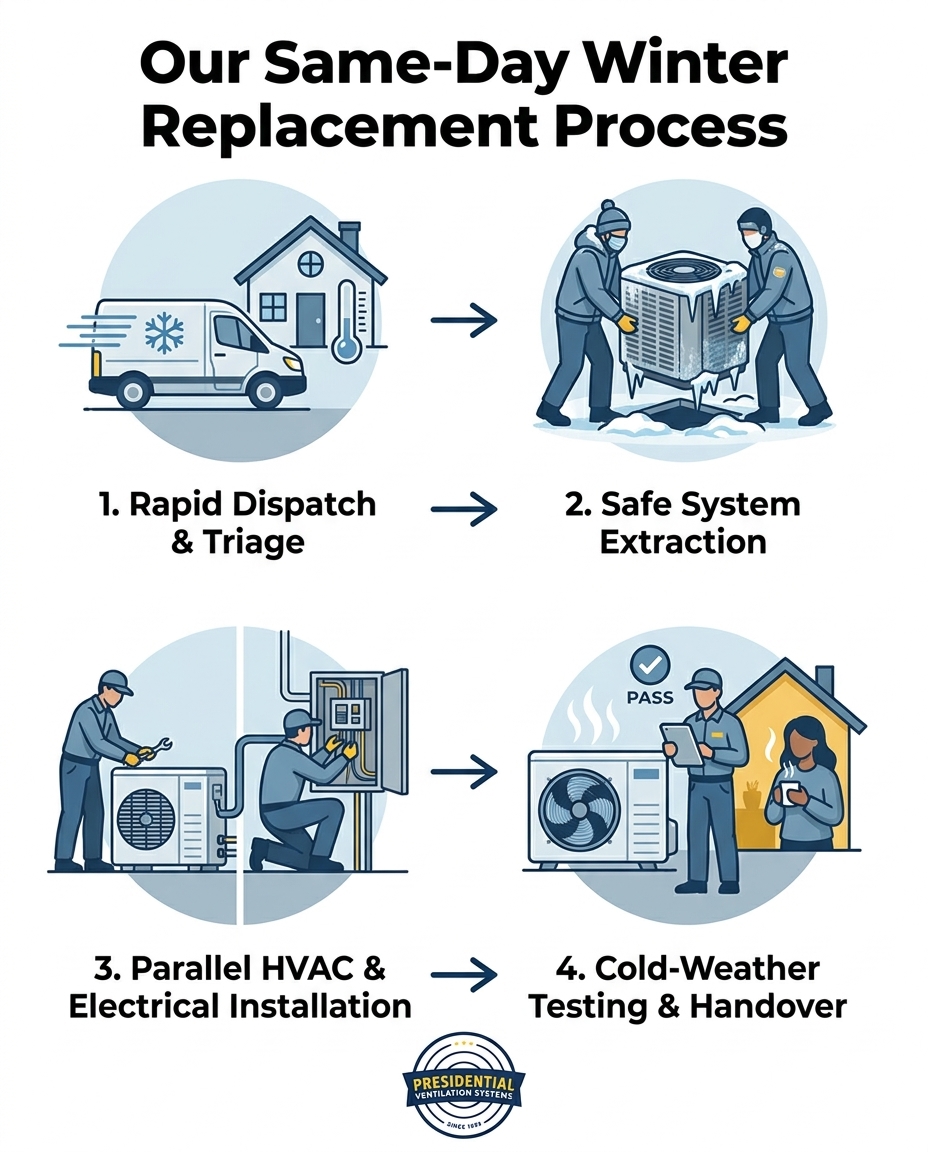
The moment an emergency call comes in, our methodology kicks into gear. True same-day replacement begins before the technicians even pull into your driveway. It requires precision staging, accurate diagnostics, and a warehouse infrastructure capable of supporting immediate deployment.
The first step is a rapid but thorough initial diagnostic phase. We must confirm that the system is truly dead and not simply in need of a 24/7 central heat pump repair. If a component like a compressor has catastrophically failed and replacement is the only safe, viable option, the technician immediately sizes the replacement unit accurately based on your home's specific heating load requirements.
While the technician is completing the assessment on-site, our warehouse logistics team is already in motion. Maintaining a robust local inventory is crucial. As a Daikin Comfort Pro, we have immediate access to premium Daikin and Lennox units. The warehouse team pulls the exact required unit, pre-stages the necessary materials—including insulated line sets, electrical whips, and mounting brackets—and loads the secondary dispatch vehicles.
1. Initial Diagnostic: Technician confirms catastrophic failure and rules out simple repairs.
2. System Sizing: Immediate calculation of the correct tonnage and BTUs for the replacement unit.
3. Inventory Pull: Warehouse team secures the specific heat pump model from local stock.
4. Material Staging: All required copper, wiring, and mounting hardware are loaded for immediate transport.
5. Simultaneous Dispatch: The installation crew, including both mechanical and electrical trades, is deployed to the home.
Removing the old unit safely is a critical phase of the operation. Working outdoors in ice, snow, and biting wind requires specific safety protocols. The extraction must be done swiftly to prepare the site for the new installation, but it must also adhere to strict environmental and safety regulations.
Environmental compliance is mandatory, regardless of the weather. Before any lines are cut, the old refrigerant must be safely recovered. Handling pressurized systems in the cold presents specific challenges, as refrigerant pressures drop significantly in freezing Maritime winter storms. Our technicians utilize specialized recovery machines designed to extract the chemical safely, ensuring nothing is vented into the atmosphere.
Once the system is depressurized, the physical removal begins. This involves removing outdated line sets, disconnecting old control wiring, and physically hauling away the dead compressor and indoor heads. The outdoor pad must be completely cleared of ice or snow buildup to ensure a level, stable foundation for the new equipment. The wall penetrations are also inspected and prepped, ensuring they are clear and ready to accept the new, properly insulated line sets without allowing winter drafts into the home.
The core of our same-day promise lies in the synchronized, parallel workflow of our multi-trade team. This is where the Presidential Advantage truly shines. While the HVAC technicians are managing the mechanical side of the installation, the electricians are simultaneously handling the electrical panel and high-voltage connections. One local homeowner reached out in the dead of winter when their primary heating system failed completely. Because we dispatched both mechanical and electrical teams simultaneously, we successfully completed the winter installation quickly and professionally within a single day, restoring heat before the home's plumbing was ever at risk.
The mechanical team begins by securing the new outdoor unit. In Nova Scotia, it is critical that the compressor is mounted on a stand above the anticipated snow line to prevent ice accumulation from blocking airflow during defrost cycles. Concurrently, the indoor heads are mounted, and the team begins flaring and connecting the new copper line sets. These lines must be heavily insulated to prevent heat loss as the refrigerant travels between the indoor and outdoor units.
While the mechanical connections are being made, our in-house Red Seal electricians are hard at work. They ensure the electrical panel can safely handle the load of the new system, wiring the dedicated circuits and installing the required outdoor disconnect switch. Nova Scotia building codes mandate strict electrical safety checks for heat pump installations. Because our electricians are on staff, this electrical tie-in happens exactly when the HVAC team needs it, cutting the standard installation time in half and preventing hours of idle waiting.
With the physical installation complete, the final phase is system commissioning. This is the rigorous testing process that ensures the new heat pump will perform flawlessly against the freezing Nova Scotia winter. We do not leave the property until we have verified that the home is actively warming up.
Before any refrigerant is released into the new lines, the system undergoes a high-pressure nitrogen test to check for microscopic leaks, followed by a deep vacuum process to remove all moisture from the copper piping. Once a perfect seal is confirmed, the system is charged. Cold-weather commissioning involves verifying the refrigerant charge in low ambient temperatures and manually triggering the defrost cycles to ensure the outdoor unit can effectively shed ice during winter storms.
The final step is handing the system over to you. The lead technician will walk you through the operation of your new heat pump, ensuring you are comfortable with the controls.
1. Thermostat Operation: Demonstrating how to set schedules, adjust temperatures, and use the remote controls effectively.
2. Airflow Direction: Explaining how to adjust the vanes for optimal winter heat distribution.
3. Winter Maintenance: Providing clear instructions on keeping the outdoor unit clear of snowdrifts and ice buildup.
4. Filter Cleaning: Showing you how to easily remove and wash the indoor filters to maintain efficiency.
5. Temperature Verification: Measuring the ambient air output to confirm the home is actively recovering its heat.
A sudden winter heat pump failure is an unexpected and stressful event. Beyond the physical cold, there is the immediate anxiety regarding the logistics of an unplanned replacement. While speed is the absolute priority to protect your home, we understand that navigating the administrative and financial aspects is just as important for your peace of mind.
Even in an emergency, homeowners should explore available provincial and federal rebate programs. High-efficiency systems often qualify for significant incentives. It is important to note that professional installation by a licensed contractor is strictly required for rebate eligibility. While programs and eligibility requirements can change frequently, our team will help you understand the current landscape and provide the necessary documentation to support your applications. Always confirm current programs with our office during your initial consultation.
To help manage the upfront investment of an unexpected winter breakdown, flexible payment options may be available. Utilizing emergency heat pump financing can ease the immediate financial burden, allowing you to install a reliable, high-efficiency system without draining your emergency savings all at once. Because financing terms and eligibility vary, we encourage you to speak directly with our team to confirm the options that best suit your situation.
Can a heat pump be replaced in the winter?
Yes, a heat pump can absolutely be replaced during the winter months. Professional HVAC teams utilize specialized equipment to safely recover refrigerant and perform installations even in sub-freezing temperatures. The key is working with a contractor who has the resources to execute the replacement quickly before the home loses too much heat.
How long does it take to replace a heat pump?
A standard heat pump replacement typically takes between 4 to 8 hours, depending on the complexity of the system and the weather conditions. When a contractor utilizes a parallel workflow with in-house mechanical and electrical teams, the process is highly streamlined. This coordination ensures the entire rip-and-replace process can be completed in a single day.
What happens if my heat pump dies in the winter?
If your heat pump dies in the winter, your home's internal temperature will begin dropping rapidly, putting your plumbing at severe risk of freezing and bursting. It is critical to contact an emergency HVAC provider immediately to assess the system. Relying on temporary space heaters is not a safe or effective long-term solution for protecting your property.
Can you install a mini split in the freezing cold?
Yes, ductless mini splits can be installed in freezing conditions by experienced technicians. The process requires careful handling of the copper line sets and specialized vacuum procedures to ensure no moisture is trapped in the system. Proper cold-weather commissioning is essential to verify that the unit is operating correctly before the technicians leave.
Do I need to hire a separate electrician for a heat pump replacement?
If you hire a multi-trade contractor with in-house Red Seal electricians, you do not need to hire a separate electrical company. This in-house capability is crucial during an emergency, as it eliminates the multi-day delays often caused by waiting for third-party subcontractors to arrive and wire the system.
A dead heating system doesn't have to mean days of freezing temperatures and the looming threat of burst pipes. When you have the right team on your side, restoring comfort and safety to your property is a streamlined, highly coordinated process. Our in-house roster of Red Seal HVAC and electrical experts ensures that how we execute same-day heat pump replacements during freezing Maritime temperatures remains the standard for reliability. We provide a clear, reassuring breakdown of the exact staging and team coordination process that proves a same-day replacement is safe, efficient, and handled entirely by a single multi-trade contractor. Contact Presidential Ventilation Systems today for an immediate assessment and a free estimate to secure your home's heat.

The damp, biting cold of a Nova Scotia winter is already settling in, making a reliable heating system an absolute necessity for your home's safety. If you are dealing with a sudden, complete system failure, understanding exactly how we execute same-day heat pump replacements during freezing Maritime temperatures is critical. When a heat pump dies in January or February, waiting days for a replacement is simply not an option. You are immediately faced with the concrete problem of rapid home heat loss and the very real threat of frozen pipes. The critical decision point becomes finding a contractor capable of the specific staging and multi-trade team coordination required to rip out a dead system and install a new one before your home drops below freezing. If you are facing a sudden breakdown, learn more about our heat pump systems and ductless heat pump replacement solutions.
When your primary heating system fails in the middle of a freezing Nova Scotia winter, the clock immediately starts ticking. Nova Scotia's unique climate features high humidity combined with rapid, aggressive temperature fluctuations. This damp cold penetrates building materials much faster than dry cold, accelerating indoor heat loss. Understanding the physical realities of this heat loss explains why a rapid, same-day response is not just a convenience, but a structural necessity for your property.
Once a heat pump stops producing warm air, a standard home's internal temperature can plummet below 10 degrees Celsius within a mere 24 hours. As the ambient temperature inside the house drops, the risk profile shifts from personal discomfort to severe property damage. The primary danger zone involves your indoor plumbing infrastructure. Water lines running through exterior walls, basements, and crawlspaces are the first to freeze. When water freezes, it expands, causing copper and PEX pipes to split. The ensuing water damage from a burst pipe often requires extensive renovations, making the initial heating failure seem minor in comparison. The 24-hour window following a breakdown is the critical timeframe for taking decisive action.
Many homeowners attempt to bridge the gap during a heating failure by purchasing multiple temporary space heaters. While this might keep a single bedroom tolerable, it is an inadequate and highly expensive stopgap for whole-home heating. Space heaters cannot circulate warm air into the hidden cavities of your home where plumbing resides. Furthermore, running multiple high-wattage space heaters simultaneously overloads residential electrical panels, creating significant fire hazards and frequent breaker trips. Restoring your central or primary ductless heat is the only safe, effective way to protect your entire property.
• Portable Space Heaters — Coverage Area: Single small room only — Safety Risks: High fire risk, overloaded circuits — Effectiveness in Freezing Weather: Inadequate for protecting home plumbing
• Wood/Pellet Stoves — Coverage Area: Localized main living area — Safety Risks: Requires constant monitoring and fuel — Effectiveness in Freezing Weather: Leaves distant rooms and basements vulnerable
• New Heat Pump System — Coverage Area: Whole-home or multi-zone coverage — Safety Risks: Safe, dedicated electrical circuits — Effectiveness in Freezing Weather: Maintains consistent, safe ambient temperatures
Executing a true same-day replacement requires far more than just rushing a unit to your driveway. Modern heat pump installations are complex projects that demand both mechanical (HVAC) and electrical expertise. In our 30+ years of experience serving Nova Scotia, we have seen that relying on third-party electrical subcontractors is the number one cause of installation delays across the industry. When a company has to wait for a separate electrical contractor to fit your emergency into their schedule, a one-day job easily stretches into a three-day freezing ordeal.
The traditional multi-day wait for an electrician is entirely bypassed by our operational model. With approximately 70 employees and multiple skilled trades operating under one roof, we eliminate the scheduling bottlenecks that paralyze other contractors. When you call our team, you are not waiting for two different companies to coordinate their calendars. A single call dispatches a complete, unified team ready to handle every aspect of the project from start to finish.
Speed must never come at the expense of safety, especially when dealing with high-voltage electricity and pressurized refrigerants. Having in-house Red Seal HVAC and electrical tradespeople ensures that every phase of your emergency replacement meets strict Nova Scotia building codes. Licensed professionals guarantee that the work is done safely, legally, and flawlessly, maintaining the highest quality standards even under intense emergency time constraints.
• Unified Dispatch: HVAC technicians and electricians arrive together, eliminating standby time.
• Code Compliance: All electrical tie-ins and mechanical mountings are performed by Red Seal certified experts.
• Seamless Communication: In-house teams communicate directly, preventing the missteps common with outsourced labor.
• Guaranteed Accountability: One company handles the entire warranty and installation process, leaving no room for finger-pointing.
The moment an emergency call comes in, our methodology kicks into gear. True same-day replacement begins before the technicians even pull into your driveway. It requires precision staging, accurate diagnostics, and a warehouse infrastructure capable of supporting immediate deployment.
The first step is a rapid but thorough initial diagnostic phase. We must confirm that the system is truly dead and not simply in need of a 24/7 central heat pump repair. If a component like a compressor has catastrophically failed and replacement is the only safe, viable option, the technician immediately sizes the replacement unit accurately based on your home's specific heating load requirements.
While the technician is completing the assessment on-site, our warehouse logistics team is already in motion. Maintaining a robust local inventory is crucial. As a Daikin Comfort Pro, we have immediate access to premium Daikin and Lennox units. The warehouse team pulls the exact required unit, pre-stages the necessary materials—including insulated line sets, electrical whips, and mounting brackets—and loads the secondary dispatch vehicles.
1. Initial Diagnostic: Technician confirms catastrophic failure and rules out simple repairs.
2. System Sizing: Immediate calculation of the correct tonnage and BTUs for the replacement unit.
3. Inventory Pull: Warehouse team secures the specific heat pump model from local stock.
4. Material Staging: All required copper, wiring, and mounting hardware are loaded for immediate transport.
5. Simultaneous Dispatch: The installation crew, including both mechanical and electrical trades, is deployed to the home.
Removing the old unit safely is a critical phase of the operation. Working outdoors in ice, snow, and biting wind requires specific safety protocols. The extraction must be done swiftly to prepare the site for the new installation, but it must also adhere to strict environmental and safety regulations.
Environmental compliance is mandatory, regardless of the weather. Before any lines are cut, the old refrigerant must be safely recovered. Handling pressurized systems in the cold presents specific challenges, as refrigerant pressures drop significantly in freezing Maritime winter storms. Our technicians utilize specialized recovery machines designed to extract the chemical safely, ensuring nothing is vented into the atmosphere.
Once the system is depressurized, the physical removal begins. This involves removing outdated line sets, disconnecting old control wiring, and physically hauling away the dead compressor and indoor heads. The outdoor pad must be completely cleared of ice or snow buildup to ensure a level, stable foundation for the new equipment. The wall penetrations are also inspected and prepped, ensuring they are clear and ready to accept the new, properly insulated line sets without allowing winter drafts into the home.
The core of our same-day promise lies in the synchronized, parallel workflow of our multi-trade team. This is where the Presidential Advantage truly shines. While the HVAC technicians are managing the mechanical side of the installation, the electricians are simultaneously handling the electrical panel and high-voltage connections. One local homeowner reached out in the dead of winter when their primary heating system failed completely. Because we dispatched both mechanical and electrical teams simultaneously, we successfully completed the winter installation quickly and professionally within a single day, restoring heat before the home's plumbing was ever at risk.
The mechanical team begins by securing the new outdoor unit. In Nova Scotia, it is critical that the compressor is mounted on a stand above the anticipated snow line to prevent ice accumulation from blocking airflow during defrost cycles. Concurrently, the indoor heads are mounted, and the team begins flaring and connecting the new copper line sets. These lines must be heavily insulated to prevent heat loss as the refrigerant travels between the indoor and outdoor units.
While the mechanical connections are being made, our in-house Red Seal electricians are hard at work. They ensure the electrical panel can safely handle the load of the new system, wiring the dedicated circuits and installing the required outdoor disconnect switch. Nova Scotia building codes mandate strict electrical safety checks for heat pump installations. Because our electricians are on staff, this electrical tie-in happens exactly when the HVAC team needs it, cutting the standard installation time in half and preventing hours of idle waiting.
With the physical installation complete, the final phase is system commissioning. This is the rigorous testing process that ensures the new heat pump will perform flawlessly against the freezing Nova Scotia winter. We do not leave the property until we have verified that the home is actively warming up.
Before any refrigerant is released into the new lines, the system undergoes a high-pressure nitrogen test to check for microscopic leaks, followed by a deep vacuum process to remove all moisture from the copper piping. Once a perfect seal is confirmed, the system is charged. Cold-weather commissioning involves verifying the refrigerant charge in low ambient temperatures and manually triggering the defrost cycles to ensure the outdoor unit can effectively shed ice during winter storms.
The final step is handing the system over to you. The lead technician will walk you through the operation of your new heat pump, ensuring you are comfortable with the controls.
1. Thermostat Operation: Demonstrating how to set schedules, adjust temperatures, and use the remote controls effectively.
2. Airflow Direction: Explaining how to adjust the vanes for optimal winter heat distribution.
3. Winter Maintenance: Providing clear instructions on keeping the outdoor unit clear of snowdrifts and ice buildup.
4. Filter Cleaning: Showing you how to easily remove and wash the indoor filters to maintain efficiency.
5. Temperature Verification: Measuring the ambient air output to confirm the home is actively recovering its heat.
A sudden winter heat pump failure is an unexpected and stressful event. Beyond the physical cold, there is the immediate anxiety regarding the logistics of an unplanned replacement. While speed is the absolute priority to protect your home, we understand that navigating the administrative and financial aspects is just as important for your peace of mind.
Even in an emergency, homeowners should explore available provincial and federal rebate programs. High-efficiency systems often qualify for significant incentives. It is important to note that professional installation by a licensed contractor is strictly required for rebate eligibility. While programs and eligibility requirements can change frequently, our team will help you understand the current landscape and provide the necessary documentation to support your applications. Always confirm current programs with our office during your initial consultation.
To help manage the upfront investment of an unexpected winter breakdown, flexible payment options may be available. Utilizing emergency heat pump financing can ease the immediate financial burden, allowing you to install a reliable, high-efficiency system without draining your emergency savings all at once. Because financing terms and eligibility vary, we encourage you to speak directly with our team to confirm the options that best suit your situation.
Can a heat pump be replaced in the winter?
Yes, a heat pump can absolutely be replaced during the winter months. Professional HVAC teams utilize specialized equipment to safely recover refrigerant and perform installations even in sub-freezing temperatures. The key is working with a contractor who has the resources to execute the replacement quickly before the home loses too much heat.
How long does it take to replace a heat pump?
A standard heat pump replacement typically takes between 4 to 8 hours, depending on the complexity of the system and the weather conditions. When a contractor utilizes a parallel workflow with in-house mechanical and electrical teams, the process is highly streamlined. This coordination ensures the entire rip-and-replace process can be completed in a single day.
What happens if my heat pump dies in the winter?
If your heat pump dies in the winter, your home's internal temperature will begin dropping rapidly, putting your plumbing at severe risk of freezing and bursting. It is critical to contact an emergency HVAC provider immediately to assess the system. Relying on temporary space heaters is not a safe or effective long-term solution for protecting your property.
Can you install a mini split in the freezing cold?
Yes, ductless mini splits can be installed in freezing conditions by experienced technicians. The process requires careful handling of the copper line sets and specialized vacuum procedures to ensure no moisture is trapped in the system. Proper cold-weather commissioning is essential to verify that the unit is operating correctly before the technicians leave.
Do I need to hire a separate electrician for a heat pump replacement?
If you hire a multi-trade contractor with in-house Red Seal electricians, you do not need to hire a separate electrical company. This in-house capability is crucial during an emergency, as it eliminates the multi-day delays often caused by waiting for third-party subcontractors to arrive and wire the system.
A dead heating system doesn't have to mean days of freezing temperatures and the looming threat of burst pipes. When you have the right team on your side, restoring comfort and safety to your property is a streamlined, highly coordinated process. Our in-house roster of Red Seal HVAC and electrical experts ensures that how we execute same-day heat pump replacements during freezing Maritime temperatures remains the standard for reliability. We provide a clear, reassuring breakdown of the exact staging and team coordination process that proves a same-day replacement is safe, efficient, and handled entirely by a single multi-trade contractor. Contact Presidential Ventilation Systems today for an immediate assessment and a free estimate to secure your home's heat.

Winter in Nova Scotia arrives fast, bringing freezing temperatures that immediately test your commercial building's infrastructure. It is a familiar frustration for many facility managers: the temperature drops, the heating kicks on, and suddenly, a main breaker trips, taking a section of your building offline. The culprit is rarely a broken system, but rather a hidden synchronization issue on your roof. If you want to keep your facility online, managing defrost cycles on multiple commercial rooftop heat pumps to prevent power spikes is a critical step that requires proactive attention.
During sudden Nova Scotia winter cold snaps, outdoor temperatures plummet below the balance point of your rooftop units. Ice begins to form on the outdoor coils, prompting the systems to initiate their built-in defrost cycles. The concrete problem arises when several units enter this mode at the exact same time. This simultaneous action demands a massive surge of electricity that easily overwhelms the building's electrical capacity.
For facility managers and building owners, simply resetting the breaker is not a long-term strategy. You face an important decision point: you must proactively manage peak electrical loads across the roof by properly staggering these cycles. This is not a standard maintenance task; it requires a coordinated approach between HVAC mechanics and electrical systems to ensure your commercial heat pumps operate efficiently without threatening your facility's power supply.
To understand why a tripped breaker happens, we have to look at exactly what occurs mechanically during a defrost cycle. When frost accumulates on the outdoor coil, the heat pump must clear it to maintain airflow and efficiency. To melt this outdoor ice, the system temporarily reverses its operation, essentially shifting back into air conditioning mode. It pulls heat from inside the building and sends it outside to thaw the frozen coil.
Because blowing cold air into a commercial workspace during winter is unacceptable, the system simultaneously engages its auxiliary electric heat strips. These strips warm the air before it reaches the vents, keeping the indoor climate comfortable. This is a standard feature on most ducted heat pump systems in commercial applications. However, this perfectly normal operation creates a simultaneous auxiliary power draw that places a tremendous temporary demand on your electrical panel.
The core issue lies in the difference between how a heat pump normally operates and how auxiliary heat functions. A compressor moves existing heat from one place to another, which is a highly efficient process that draws relatively low amperage. Electric heat strips, on the other hand, rely on resistive heating—they create heat by forcing electricity through high-resistance wires. This sudden shift completely changes the electrical profile of the rooftop unit.
The technical difference at a glance:
• Heat Pump Compressor — Heating Method: Thermodynamic heat transfer — Electrical Demand: Low to moderate amperage — Primary Function: Primary, highly efficient daily heating
• Auxiliary Heat Strips — Heating Method: Electrical resistance — Electrical Demand: Massive amperage spike — Primary Function: Temporary comfort during defrost mode
This massive amperage draw means that during a defrost cycle, a single rooftop unit can temporarily consume significantly more electricity than it does during hours of standard heating operation. The system is not broken; it is simply doing exactly what it was engineered to do under freezing conditions.
The physics of frost buildup go beyond just cold air. Frost accumulation is driven heavily by the moisture content present in the atmosphere. In our region, the unique mix of freezing winter temperatures and high coastal humidity creates the perfect storm for rapid, heavy frost on commercial coils.
In drier inland regions, a heat pump might run for hours in freezing temperatures before accumulating enough frost to trigger a defrost cycle. However, coastal humidity means the air holds significantly more water vapor. When that moisture-laden air is pulled across a freezing metal coil on an exposed commercial roof, the water vapor rapidly condenses and freezes.
Environmental factors that accelerate coastal frosting:
• High relative humidity: More suspended moisture in the air means more water available to freeze upon contact with the coil.
• Rapid temperature fluctuations: Sudden drops in ambient temperature cause dew points to shift quickly, increasing condensation.
• Rooftop wind exposure: High winds on commercial roofs constantly feed fresh, humid air over the coils, speeding up the icing process.
This specific climate reality necessitates far more frequent and prolonged defrost cycles than you would see elsewhere. Your commercial systems have to work overtime to keep their coils clear of thick coastal ice, which directly increases the frequency of those high-amperage auxiliary heat cycles.
Most commercial facilities are not cooled and heated by a single unit. A typical commercial setup involves multiple rooftop units, each serving different zones of the building—such as the warehouse, office spaces, retail floors, and server rooms. Because these units are exposed to the exact same outdoor weather conditions, they often react to the environment in unison.
When a uniform drop in outdoor temperature hits the roof, multiple independent units reach their frost thresholds at roughly the same time. If their internal timers are not actively managed, they will trigger their defrost cycles simultaneously. This creates a dangerous cascade effect across your electrical infrastructure.
The sequence of a facility power spike:
1. The outdoor temperature drops sharply, and coastal humidity coats all rooftop coils in frost.
2. Multiple units detect the restricted airflow or reach their set time intervals concurrently.
3. Several units reverse their reversing valves and engage their auxiliary resistive heat strips at the exact same moment.
4. The massive amperage draw of one unit's auxiliary heat is multiplied by three, four, or five units across the roof.
5. The combined peak electrical load exceeds the facility's main breaker capacity, resulting in a total power trip.
This cascade effect leads to sudden facility downtime, disrupted operations, and the immediate need to assess whether you require heavy electrical work, such as breaker panel upgrades, or if the issue can be resolved through intelligent system configuration.

The most effective way to prevent these massive power spikes is through professional load sequencing. By staggering the defrost timers across your commercial roof, you ensure that only one or two units can enter defrost mode at any given time. This flattens the peak electrical load, keeping the facility's total power draw safely below the main breaker's trip threshold.
It is vital to note that configuring commercial electrical loads and adjusting these specific timers requires a licensed professional. Commercial rooftop units operate on high-voltage electricity, and interacting with their internal control boards carries severe safety risks. Never attempt to adjust these settings yourself.
For standard rooftop units, technicians interact directly with the time-temperature defrost boards located inside each unit's control cabinet. These boards monitor the temperature of the coil and dictate how often the unit is allowed to check for frost. A licensed technician will adjust the pin settings or digital parameters on individual boards to offset their cycles.
For example, instead of all units checking for frost every 60 minutes, a professional might configure Unit A for 30-minute intervals, Unit B for 60-minute intervals, and Unit C for 90-minute intervals. This deliberate staggering prevents the units from syncing up and pulling auxiliary power concurrently, even during severe cold snaps.
Modern commercial facilities often utilize advanced Building Automation Systems (BAS) to monitor and control their HVAC equipment centrally. A properly programmed BAS can monitor the total electrical load of the building in real-time. If the system detects that the building is nearing its peak load capacity, it can dynamically prevent additional rooftop units from engaging their auxiliary heat until the first unit finishes its defrost cycle. This level of dynamic sequencing provides the ultimate protection against unexpected breaker trips.
In our 30+ years working on commercial projects, we have seen firsthand the danger of siloed approaches to facility maintenance. If you hire an HVAC-only contractor to investigate a tripped breaker, they might simply verify that the heat pump is producing heat, check the refrigerant charge, and declare the system healthy. Conversely, if you bring in a standard electrician, they will see the massive amperage draw, assume the building is underpowered, and suggest a highly extensive electrical panel upgrade.
Neither approach solves the root cause efficiently. Treating the HVAC system and the electrical panel as a single coordinated ecosystem is the only way to resolve this issue. The heating demand and the building's electrical load capacity are permanently linked.
This is why having approximately 70 employees and skilled Red Seal tradespeople across multiple disciplines matters. A contractor who handles both the HVAC mechanics and the electrical systems natively can diagnose the configuration error, stagger the timers, and verify the electrical load without pointing fingers at another trade. What we've learned diagnosing these complex commercial issues is that true reliability comes from understanding the whole picture—preventing power spikes before they ever have the chance to halt your operations.
Commercial heat pumps trip breakers in the winter primarily because they enter defrost mode to melt ice off their outdoor coils. During this cycle, they activate auxiliary electric heat strips to keep indoor air warm. If multiple units on a roof enter this high-amperage mode simultaneously, the combined electrical draw can easily exceed the main breaker's capacity.
A heat pump uses significantly more power in defrost mode because it relies on resistive heating. While normal heating uses a highly efficient compressor to move heat, the auxiliary heat strips used during defrost create heat through electrical resistance. This process can draw two to three times the amperage of standard compressor operation.
Yes, multiple commercial heat pumps can run safely on a single electrical panel, provided the panel is sized correctly and the equipment is professionally configured. The key to safety is load management. By staggering the defrost timers, professionals ensure the units do not draw their peak auxiliary loads at the exact same time.
Peak electrical loads are managed through a process called load sequencing. A licensed professional will adjust the time-temperature boards on each unit to offset their defrost intervals, or they will program a Building Automation System (BAS) to dynamically control when auxiliary heat is allowed to engage.
The most obvious sign of synced defrost timers is a main breaker tripping specifically during sudden drops in outdoor temperature or heavy winter precipitation. You might also notice a sudden, temporary dimming of facility lights right before a breaker trips, indicating a massive, simultaneous call for auxiliary power across the roof.
Winter cold snaps will inevitably test your facility's electrical capacity. The high coastal humidity and freezing temperatures will force your rooftop units into frequent defrost cycles. However, unexpected downtime and tripped breakers do not have to be a normal part of your winter operations. Proactive timer staggering and professional load management can flatten your peak electrical demand and protect your infrastructure.
Do not wait until a sudden freeze takes your building offline. Taking action now ensures your systems are properly sequenced for the months ahead. Schedule a professional assessment and secure a comprehensive commercial HVAC maintenance plan before the harshest weather arrives, ensuring your facility remains warm, efficient, and fully powered all winter long.

Are you constantly wiping condensation off your windows on chilly January mornings, or waking up with a scratchy throat because your indoor air feels bone dry? When evaluating sensible vs enthalpy heat recovery cores for Nova Scotia's specific humidity profile, many homeowners find themselves frustrated by generic ventilation advice that simply doesn't apply to the East Coast. Tightly sealed modern homes tend to trap moisture, while older, draftier homes often leak it away too quickly. Balancing this delicate indoor climate during a freezing Maritime winter requires more than just picking a box off a shelf.
The critical decision point for builders and homeowners comes down to choosing between a sensible heat recovery core (typically found in an HRV) and an enthalpy core (found in an ERV). While standard guidelines often recommend one over the other based purely on cold temperatures, our coastal climate demands a much more nuanced approach to managing indoor moisture. If you want to dive deeper into the basics of these units, you can explore how HRV systems function, but here we will break down exactly which core type is right for your specific home environment.
To make the right choice for your home, you first need to understand how these systems handle the air you breathe. A sensible heat recovery core—the standard technology behind most traditional Heat Recovery Ventilators—deals strictly with "sensible heat." In physics, sensible heat is the energy you can actually measure with a thermometer. These cores transfer temperature energy from your stale exhaust air to your incoming fresh air, but they do not mix the moisture.
As warm, damp indoor air passes through the exhaust side of the core, it warms up the cold, fresh air coming in from outside. The two air streams cross paths inside a series of narrow, separated channels (often made of aluminum or specialized plastics), never physically mixing. The heat is transferred, but the indoor humidity is expelled directly outside. If you are tired of dealing with excessive indoor moisture, you can book an HRV consultation online to see if this core type is the right fit.
This separation makes sensible cores incredibly effective for homes struggling with high indoor humidity. Natural Resources Canada (NRCan) guidelines frequently highlight these systems for basic ventilation needs in cold climates because they provide excellent condensation clearance.
Sensible cores are essentially moisture-removal engines during the winter. When you expel humid indoor air and replace it with cold outdoor air, you are fundamentally changing your home's moisture balance. Cold air simply cannot hold as much water vapor as warm air. When that cold, dry outdoor air is brought inside and heated up by your primary heating system, its relative humidity plummets.
Why this matters for your home:
• Tightly sealed construction: Modern homes generate a massive amount of internal moisture from cooking, showering, and simply breathing. Without a way to escape, this moisture builds up.
• Continuous clearance: By constantly swapping moist indoor air for dry outdoor air, a sensible core naturally lowers your indoor relative humidity.
• Window protection: Lowering the indoor humidity prevents warm, moist air from condensing and freezing on cold window panes, protecting your sills from water damage and mold.
While sensible cores focus only on temperature, enthalpy cores (the heart of an Energy Recovery Ventilator, or ERV) handle both temperature and moisture. Enthalpy refers to "latent heat," which is the energy contained within water vapor itself. These cores are designed to transfer both sensible heat (temperature) and latent heat (humidity) between the two air streams.
Inside an enthalpy core, the dividing walls between the incoming and outgoing air streams are made from a specialized, permeable membrane. This material allows water vapor molecules to pass from the more humid air stream into the drier one, while still blocking larger contaminants, odors, and exhaust gases. In the winter, this means a significant portion of the moisture in your outgoing stale air is captured and transferred back into the incoming fresh air.
The primary benefit here is maintaining indoor comfort. By retaining moisture, enthalpy cores help prevent your home from suffering through overly dry indoor air during the coldest parts of the year. It is important to address a common misconception: enthalpy cores do not "create" or generate moisture. They cannot add humidity that isn't already there; they merely retain a percentage of the moisture your household naturally produces.
Managing indoor air quality is a delicate balancing act. Health Canada and building science experts generally recommend maintaining indoor relative humidity between 30% and 50% during the winter months. If it drops below 30%, you experience static shocks, dry skin, and shrinking hardwood floors. If it climbs above 50% during a deep freeze, you invite trouble.
Retaining too much moisture during a severe cold snap can quickly lead to window condensation if the system isn't properly monitored. An enthalpy core is fantastic for keeping a home comfortable, but if your home already produces more moisture than it can handle, retaining that humidity might push you over the edge into condensation problems.
If you read a generic ventilation manual, the advice is usually straightforward: use an HRV in cold climates and an ERV in hot, humid climates. But living on the East Coast means we don't fit neatly into those boxes. Nova Scotia features a highly unique coastal humidity profile that throws standard manufacturer guidelines out the window.
The Problem: Generic advice assumes that cold winter air is always bone-dry. In inland provinces, a -15°C day usually means zero humidity. But in the Maritimes, we experience damp shoulder seasons, rapid freeze-thaw cycles, and winter air that is often heavy with moisture even when the temperature drops. This damp cold fundamentally alters the physics of moisture transfer in your home.
The Cause: Sudden coastal temperature swings—where it can be -10°C on Tuesday and +5°C with driving rain on Wednesday—wreak havoc on standard ventilation strategies. High outdoor relative humidity at low temperatures impacts how these cores operate, particularly when it comes to freezing. When moist exhaust air meets freezing incoming air inside the core, condensation forms. If it's cold enough, that condensation turns to ice, blocking airflow. If you are already seeing the effects of this, troubleshooting winter condensation with HRVs is a good next step.
The Solution: Because our outdoor air isn't always dry, an enthalpy core might be preferred in certain Nova Scotia homes to manage the rapid shifts in humidity, while a sensible core might be heavily favored in others to combat the dampness of the shoulder seasons. Both core types have defrost cycles—usually by shutting off the fresh air intake and recirculating warm indoor air to melt the ice—but how often they need to defrost depends heavily on our local weather patterns.
To truly understand which core fits your home, we need to look at a direct, side-by-side comparison tailored specifically to Maritime winter performance.
• Moisture Clearance — Sensible Core (Traditional HRV): Excellent. Aggressively expels indoor moisture during damp shoulder seasons. — Enthalpy Core (Traditional ERV): Moderate. Retains a portion of indoor moisture, keeping the home from drying out.
• Frost Resistance — Sensible Core (Traditional HRV): Prone to freezing in deep cold due to high condensation inside the core. Requires frequent defrosting. — Enthalpy Core (Traditional ERV): More resistant to freezing because moisture is transferred as vapor, not liquid condensation.
• Indoor Comfort — Sensible Core (Traditional HRV): Can lead to dry skin, static electricity, and dry nasal passages in drafty homes. — Enthalpy Core (Traditional ERV): Maintains a more consistent, comfortable indoor humidity level during cold snaps.
• Best Home Fit — Sensible Core (Traditional HRV): Airtight new builds, large families, homes with existing condensation issues. — Enthalpy Core (Traditional ERV): Older homes with air leaks, homes with wood heat, homes suffering from extreme winter dryness.
A sensible core is the obvious choice if your home is fighting a constant battle against moisture. Homes with high occupancy, excessive indoor moisture generation (frequent cooking, multiple showers without strong exhaust fans), or a history of weeping windows benefit immensely from the aggressive drying power of a sensible core. Tightly sealed new construction homes, which trap every ounce of vapor, almost always require this level of moisture expulsion.
Conversely, an enthalpy core makes sense for homes that suffer from extreme dryness in winter. Older homes with significant air leakage often lose their indoor moisture rapidly to the outdoors. If you heat your home with a wood stove, which notoriously dries out indoor air, an enthalpy core helps capture and recycle the little moisture you have left, keeping your living space comfortable without needing standalone humidifiers.

Manufacturers provide detailed selection charts based on broad, generalized climate zones. But those charts don't account for the micro-climates we navigate every day. The weather in a coastal community facing the Atlantic is drastically different from a sheltered valley just twenty minutes inland. As a local Maritime HVAC expert with 30+ years serving Nova Scotia, Presidential Ventilation Systems understands the exact humidity profiles of our region and recommends cores based on real-world regional performance rather than generic guidelines.
A true professional assessment looks far beyond the square footage of your house. We evaluate the home's building envelope, test for air tightness, inspect existing ductwork, and discuss your family's daily habits. Recommending a specific model or equipment solely based on square footage without this localized, professional assessment often leads to poor air quality and lingering condensation issues. Regional expertise is absolutely required to balance energy recovery with condensation prevention safely and effectively.
A ventilation core does not operate in isolation; it is just one component of your home's respiratory system. It must work seamlessly with your primary heat source, whether that's a central heat pump, a furnace, or baseboard heating. Integrating an HRV or ERV with your existing heating services ensures proper air distribution throughout every room and avoids creating dangerous pressure imbalances.
If a ventilation system pulls more air out than it brings in, it creates negative pressure, which can draw cold drafts through your walls or even pull harmful exhaust gases back down your chimney. Proper installation requires careful balancing, and retrofitting these systems into older homes often involves electrical considerations, such as wiring interlock controls to your air handler. This is why working with a contractor who has comprehensive in-house trades—including licensed electricians and HVAC technicians—ensures the system operates exactly as intended.
One of the most overlooked aspects of ventilation is how the air actually gets to and from the core.
• The problem with flexible ducting: Generic, flexible ducting is prone to sagging, creating dips where condensation can pool. Its ribbed interior also creates friction, slowing down airflow and hindering the performance of high-efficiency cores.
• The rigid solution: Smooth, rigid ductwork ensures that the specific humidity and temperature transfers happen efficiently without restriction.
• Professional integration: Relying on custom sheet metal fabrication and ductwork guarantees that your ventilation system is perfectly sized and routed for your specific home layout.
The short answer is that an HRV (Heat Recovery Ventilator) transfers only temperature between exhaust and fresh air streams, while an ERV (Energy Recovery Ventilator) transfers both temperature and moisture. HRVs are highly effective at clearing out excess indoor humidity, making them great for tightly sealed homes. ERVs help retain indoor moisture, which is beneficial for homes that suffer from extreme dryness during the winter months.
There is no single "best" core; it depends entirely on your home's tightness and your family's moisture generation. A sensible core (HRV) is typically best for newer, airtight homes in Nova Scotia that trap moisture and risk window condensation. An enthalpy core (ERV) is often recommended for older, draftier homes that lose moisture quickly and become uncomfortably dry during cold snaps.
An enthalpy core utilizes a specialized permeable membrane that allows water vapor molecules to pass through it. As warm, moist indoor air is exhausted outside, the core captures a percentage of that moisture and transfers it into the incoming cold, dry fresh air. This continuous recycling process prevents your home's relative humidity from dropping to uncomfortable levels.
Yes, winter moisture recovery is the primary function of an enthalpy core. During cold weather, outdoor air holds very little moisture. By recovering the humidity generated indoors (from cooking, bathing, and breathing) before it is exhausted outside, the core helps maintain a balanced, comfortable indoor climate without the need for excessive standalone humidification.
If your window condensation is caused by high indoor humidity and a lack of fresh air exchange, a sensible core is highly effective at resolving the issue. By continuously exhausting damp indoor air and replacing it with drier outdoor air, it naturally lowers your home's relative humidity. However, severe condensation may also require addressing poor window insulation or excessive moisture sources in the home.
Rapid temperature drops can cause the condensation inside an HRV core to freeze, blocking airflow. When this happens, the unit enters a defrost cycle, usually by shutting off the cold fresh air intake and circulating warm indoor air through the core to melt the ice. In Nova Scotia's damp, freezing coastal climate, systems may enter defrost mode more frequently, making proper core selection and professional balancing vital for uninterrupted performance.
Choosing between sensible and enthalpy cores ultimately comes down to understanding the physics of moisture transfer and managing your home's specific humidity levels against our unpredictable coastal climate. While the science can seem complex, you don't have to make this technical decision alone. Relying on generic charts or guesswork can lead to lingering condensation, uncomfortable dry air, or inefficient system performance.
With 30+ years serving Nova Scotia, our team has the hands-on experience and in-house trades required to evaluate your home's envelope, ductwork, and specific air quality challenges. If you are building a new home, planning a retrofit, or simply tired of wiping down sweaty windows every winter morning, reach out to Presidential Ventilation Systems. We invite you to request a free estimate and get a professional assessment of your home's unique ventilation needs.