


Are you tired of wearing sweaters on the main floor while sweating in your upstairs bedrooms? At Presidential Ventilation Systems Ltd., our team frequently talks to homeowners in Mount Uniacke and across the province who are dealing with this exact issue. Navigating summer heat pump settings for two-story Nova Scotia homes can feel like a frustrating puzzle. You turn the system on, hoping for relief, only to find the living room turning into an icebox while the second floor remains uncomfortably warm. This is a common challenge for multi-level homeowners, and standard cooling advice often fails to address the root cause.
Finding the right balance requires a different approach to your thermostat and airflow settings. If you need help optimizing your heat pumps or want to explore a targeted ductless heat pump strategy, we can help.
To fix the problem of uneven cooling, you first have to understand why it happens. In our experience servicing homes throughout the region, the primary culprit is a physical phenomenon known as the "stack effect." In simple terms, heat naturally rises. As the sun beats down on your roof and upper floor, the hot air inside your home expands and moves upward, while the heavier, cooler air sinks to the lowest level.
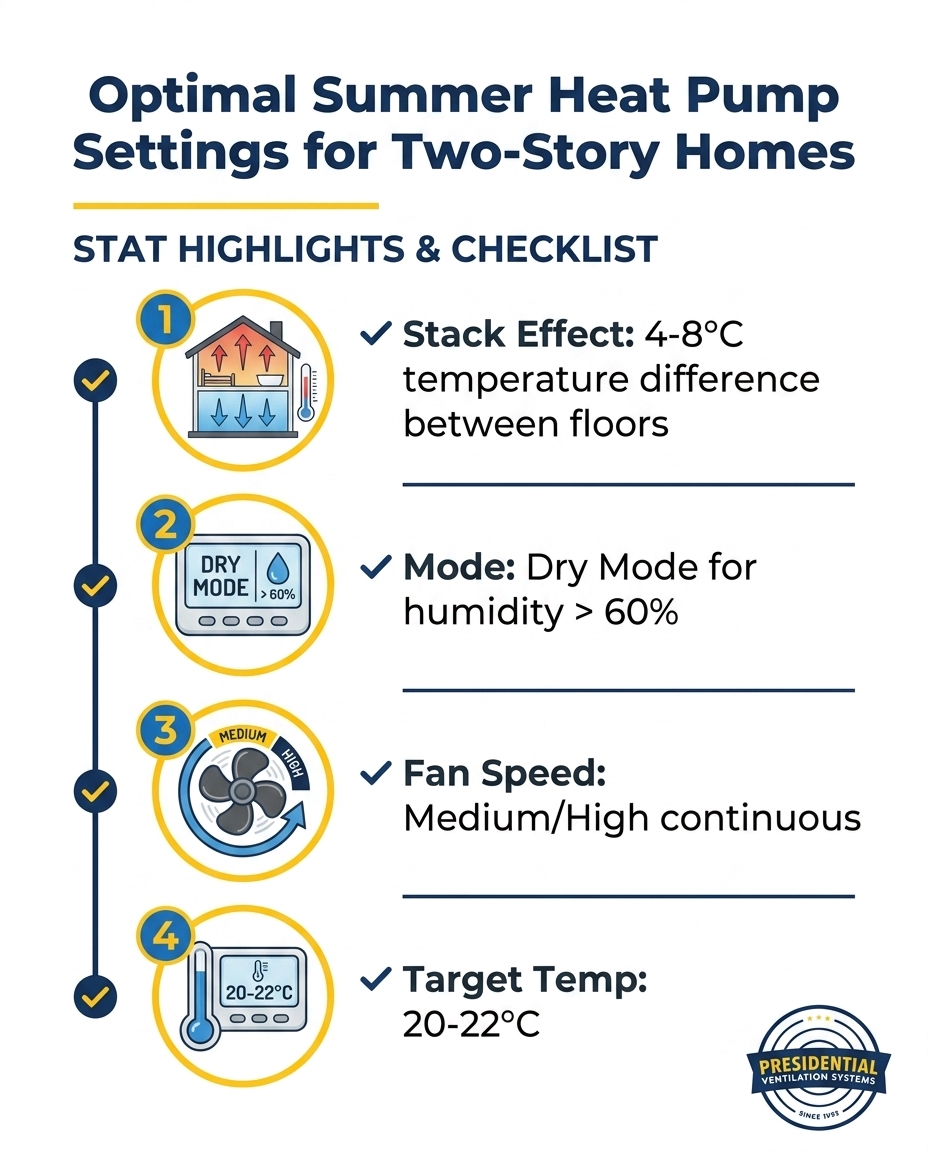
Because your main heat pump indoor unit is typically installed on the ground floor, it registers the temperature of that sinking cold air. Once the main floor reaches your target temperature, the system shuts off. Meanwhile, a typical 4 to 8 degree temperature differential has formed between the main floor and the upstairs bedrooms, leaving the upper level completely unconditioned.
This dynamic becomes much worse during a Nova Scotia humid summer. With high coastal humidity levels often exceeding 70 to 80 percent, the moisture trapped in the upper floors makes the air feel significantly hotter and stickier than the thermostat actually reads. Simply dropping the main floor thermostat temperature won't push enough cold air upstairs; it will only freeze out anyone sitting in the living room while the humidity upstairs remains untouched.
• 22°C — Actual Upstairs Temperature: 26°C — Perceived Upstairs Temp (With 75% Humidity): Feels like 29°C
• 20°C — Actual Upstairs Temperature: 25°C — Perceived Upstairs Temp (With 75% Humidity): Feels like 27°C
• 18°C — Actual Upstairs Temperature: 24°C — Perceived Upstairs Temp (With 75% Humidity): Feels like 26°C
The takeaway: You cannot overcome the stack effect with temperature adjustments alone. You have to manage the airflow and the moisture.
If you want to balance the temperatures across both floors without driving up your energy bills, you need to adjust how your system operates. When our technicians perform seasonal tune-ups, we always recommend these highly effective summer heat pump settings for two-story homes:
• Mode: Switch from "Cool" to "Dry" mode during high humidity days. This prioritizes moisture removal over sheer temperature drops.
• Fan Speed: Set the fan to Medium or High instead of "Auto." Continuous air circulation is mandatory for mixing the air between floors.
• Temperature: Keep the set point moderate, ideally between 20°C and 22°C. Drastically low settings will not cool the upstairs faster.
• Vents and Doors: Keep interior bedroom doors open during the day to promote better airflow and prevent hot air from getting trapped in isolated zones.
Implementing these four adjustments will immediately change how your system conditions the air, making the entire house feel more comfortable.
Many homeowners assume that "Cool Mode" is the only option for summer comfort. While it works well during dry heat waves, our team frequently reminds customers that it is often the wrong choice for a Maritime climate. Cool Mode focuses strictly on dropping the air temperature until the thermostat is satisfied. Once the room hits the target temperature, the compressor shuts off, often before it has had a chance to remove the excess humidity from the air.
This is where "Dry Mode" becomes your secret weapon. When you select Dry Mode, the system runs the compressor at lower, more consistent speeds. Instead of blasting freezing air into the room, it pulls the indoor air across the cold evaporator coil just enough to extract the moisture, draining it outside. By lowering the humidity, you reduce the perceived temperature. The air feels crisp and comfortable, making the upstairs tolerable without having to freeze out the downstairs.
Improper mode usage is a pattern we see often and is the root cause of many common summer heat pump problems. One local homeowner recently reached out to us during early fall with concerns about an existing heat pump system not installed by us. Our technician explained the system's pros and cons, specifically highlighting how running it in the wrong mode was driving up their bills and failing to dehumidify the space. By offering advice on more efficient running—like utilizing Dry Mode—the customer found immediate relief and a better understanding of their system.
Knowing when to toggle between these settings is key to maintaining comfort during a Nova Scotia humid summer.
• Use Cool Mode: During intense, dry heat waves where the primary goal is rapid temperature reduction.
• Use Dry Mode: During muggy, overcast, or highly humid summer days where the air feels heavy and sticky, even if the actual temperature isn't extreme.
The second most critical adjustment we recommend for summer heat pump settings for two-story homes is your fan speed. The default setting on almost every thermostat is "Auto." In Auto mode, the indoor fan only blows air when the outdoor compressor is actively cooling. The moment the main floor reaches the target temperature, the fan stops.
When the fan stops, the air immediately begins to stratify—the hot air rises to the second floor, and the cold air settles on the main floor. To break this cycle, you must manipulate your fan settings to continuously force cooler air upstairs.
1. Turn off Auto mode: Switch your fan setting to "On" or select a continuous speed on your remote.
2. Select Medium or High speed: A low fan speed doesn't have the velocity to push conditioned air up a stairwell. Medium or high speeds create the necessary air pressure to circulate the air throughout the house.
3. Keep interior doors open: Closed bedroom doors act as dams, blocking the flow of conditioned air. Keep them open as much as possible to allow the continuous fan to mix the air across the entire upper level.
4. Monitor the difference: Within a few hours of running the fan continuously, you should notice the temperature gap between the floors beginning to narrow.
We've seen countless homeowners worry about the cost of running the fan constantly. The truth is, the indoor blower motor uses very little electricity compared to the outdoor compressor. The cost of running the fan is minimal, and it often saves you money by preventing the compressor from having to turn on as frequently.
When the upstairs is sweltering, the natural reaction is to walk over to the main floor thermostat and crank the temperature down to 16°C. This is one of the worst things you can do to your system.
The Problem: Setting the thermostat drastically low does not make the heat pump blow colder air; it only forces the compressor to run continuously in a desperate attempt to reach an impossible goal. Because the cold air is heavy, it pools around the indoor unit. The thermostat eventually reads 16°C, but the upstairs is still hot.
The Cause: When a heat pump runs non-stop at maximum capacity, the indoor coil gets incredibly cold. If the airflow is restricted or the system is low on refrigerant, the condensation on the coil can freeze into a solid block of ice. Once the coil freezes, the system stops cooling entirely. When it finally thaws, it can cause severe water damage to your walls or flooring.
The Solution: Keep your temperature settings reasonable (20°C to 22°C) and rely on your fan speeds and Dry Mode to manage comfort. Overworking the system shortens its lifespan and places unnecessary strain on your home's electrical system. This is why routine heat pump maintenance is so critical. Another customer called us when their heat pump required an inspection and deep clean after a tough season. Our technician provided a thorough service and valuable product information about how forcing the system to run constantly had strained the unit. The heat pump was inspected, cleaned, and tested to their satisfaction, preventing a major breakdown just by addressing the strain on the system.
Sometimes, despite using the perfect summer heat pump settings for two-story homes, a single main-floor unit simply cannot overcome the home's layout. If your stairwell is narrow, or if your upper floor gets direct afternoon sun, one unit may never push enough conditioned air to the second story.
In these cases, whether you are dealing with new residential construction, a commercial space, or a retrofitted older home, upgrading to a multi-zone ductless system is the most effective solution. By installing a dedicated indoor head in the primary upstairs bedroom or hallway, you can provide direct cooling to the second story without freezing the main floor. This creates true zoned comfort, allowing you to control the climate exactly where you need it.
Upgrading to highly efficient multi-zone systems often qualifies for local rebates through Efficiency Nova Scotia. If you are transitioning from an older oil system to a whole-home heat pump, you may also need to consider electrical panel upgrades to handle the new equipment safely.
As Maritime climate experts, our team at Presidential Ventilation Systems understands exactly why standard HVAC setups fail in multi-level homes. We design systems that actually work for local homeowners, ensuring that your equipment is properly sized and strategically placed to combat the stack effect.
The best setting for a heat pump in the summer is typically between 20°C and 22°C, paired with a continuous medium or high fan speed. During humid days, switching from Cool Mode to Dry Mode will help remove excess moisture from the air. This combination keeps the home comfortable without putting unnecessary strain on the compressor.
Your upstairs is hot because of the stack effect, where hot air naturally rises and cold air sinks. Because the indoor unit is on the main floor, it cools the lower level quickly and shuts off before the conditioned air can reach the second story. Running your fan continuously can help mix this stratified air.
You should use dry mode in high humidity. Dry mode runs the compressor at a lower speed to extract moisture from the air without drastically dropping the temperature. This makes the air feel cooler and more comfortable, which is especially effective during a Nova Scotia humid summer.
You balance cooling by keeping interior doors open, running the indoor fan continuously on medium or high, and using dry mode to manage humidity. If these adjustments don't work, you may need to install a secondary ductless unit upstairs to create a multi-zone cooling system.
No, running the indoor fan constantly uses very little electricity compared to the outdoor compressor. In fact, keeping the fan on helps circulate the air more evenly, which can prevent the compressor from having to turn on as frequently, potentially saving you money on your overall energy bills.
Yes, setting your heat pump drastically low (like 16°C) forces the compressor to run non-stop. This continuous operation, especially if your air filters are dirty or airflow is restricted, can cause the indoor coil to drop below freezing, turning the condensation into a block of ice and stopping the cooling process entirely.
Managing the temperature in a multi-level home doesn't have to be a daily struggle. By understanding the stack effect and utilizing the right summer heat pump settings for two-story homes—specifically leveraging Dry Mode and continuous fan speeds—you can combat the heavy coastal humidity. Remember to avoid overworking your compressor with extreme temperature drops. If you are still struggling with uneven temperatures across your floors, reach out to our team at Presidential Ventilation Systems Ltd. for a comprehensive system evaluation or a routine tune-up to ensure your home stays comfortable all season long.


Are you tired of wearing sweaters on the main floor while sweating in your upstairs bedrooms? At Presidential Ventilation Systems Ltd., our team frequently talks to homeowners in Mount Uniacke and across the province who are dealing with this exact issue. Navigating summer heat pump settings for two-story Nova Scotia homes can feel like a frustrating puzzle. You turn the system on, hoping for relief, only to find the living room turning into an icebox while the second floor remains uncomfortably warm. This is a common challenge for multi-level homeowners, and standard cooling advice often fails to address the root cause.
Finding the right balance requires a different approach to your thermostat and airflow settings. If you need help optimizing your heat pumps or want to explore a targeted ductless heat pump strategy, we can help.
To fix the problem of uneven cooling, you first have to understand why it happens. In our experience servicing homes throughout the region, the primary culprit is a physical phenomenon known as the "stack effect." In simple terms, heat naturally rises. As the sun beats down on your roof and upper floor, the hot air inside your home expands and moves upward, while the heavier, cooler air sinks to the lowest level.
Because your main heat pump indoor unit is typically installed on the ground floor, it registers the temperature of that sinking cold air. Once the main floor reaches your target temperature, the system shuts off. Meanwhile, a typical 4 to 8 degree temperature differential has formed between the main floor and the upstairs bedrooms, leaving the upper level completely unconditioned.
This dynamic becomes much worse during a Nova Scotia humid summer. With high coastal humidity levels often exceeding 70 to 80 percent, the moisture trapped in the upper floors makes the air feel significantly hotter and stickier than the thermostat actually reads. Simply dropping the main floor thermostat temperature won't push enough cold air upstairs; it will only freeze out anyone sitting in the living room while the humidity upstairs remains untouched.
• 22°C — Actual Upstairs Temperature: 26°C — Perceived Upstairs Temp (With 75% Humidity): Feels like 29°C
• 20°C — Actual Upstairs Temperature: 25°C — Perceived Upstairs Temp (With 75% Humidity): Feels like 27°C
• 18°C — Actual Upstairs Temperature: 24°C — Perceived Upstairs Temp (With 75% Humidity): Feels like 26°C
The takeaway: You cannot overcome the stack effect with temperature adjustments alone. You have to manage the airflow and the moisture.
If you want to balance the temperatures across both floors without driving up your energy bills, you need to adjust how your system operates. When our technicians perform seasonal tune-ups, we always recommend these highly effective summer heat pump settings for two-story homes:
• Mode: Switch from "Cool" to "Dry" mode during high humidity days. This prioritizes moisture removal over sheer temperature drops.
• Fan Speed: Set the fan to Medium or High instead of "Auto." Continuous air circulation is mandatory for mixing the air between floors.
• Temperature: Keep the set point moderate, ideally between 20°C and 22°C. Drastically low settings will not cool the upstairs faster.
• Vents and Doors: Keep interior bedroom doors open during the day to promote better airflow and prevent hot air from getting trapped in isolated zones.
Implementing these four adjustments will immediately change how your system conditions the air, making the entire house feel more comfortable.
Many homeowners assume that "Cool Mode" is the only option for summer comfort. While it works well during dry heat waves, our team frequently reminds customers that it is often the wrong choice for a Maritime climate. Cool Mode focuses strictly on dropping the air temperature until the thermostat is satisfied. Once the room hits the target temperature, the compressor shuts off, often before it has had a chance to remove the excess humidity from the air.
This is where "Dry Mode" becomes your secret weapon. When you select Dry Mode, the system runs the compressor at lower, more consistent speeds. Instead of blasting freezing air into the room, it pulls the indoor air across the cold evaporator coil just enough to extract the moisture, draining it outside. By lowering the humidity, you reduce the perceived temperature. The air feels crisp and comfortable, making the upstairs tolerable without having to freeze out the downstairs.
Improper mode usage is a pattern we see often and is the root cause of many common summer heat pump problems. One local homeowner recently reached out to us during early fall with concerns about an existing heat pump system not installed by us. Our technician explained the system's pros and cons, specifically highlighting how running it in the wrong mode was driving up their bills and failing to dehumidify the space. By offering advice on more efficient running—like utilizing Dry Mode—the customer found immediate relief and a better understanding of their system.
Knowing when to toggle between these settings is key to maintaining comfort during a Nova Scotia humid summer.
• Use Cool Mode: During intense, dry heat waves where the primary goal is rapid temperature reduction.
• Use Dry Mode: During muggy, overcast, or highly humid summer days where the air feels heavy and sticky, even if the actual temperature isn't extreme.
The second most critical adjustment we recommend for summer heat pump settings for two-story homes is your fan speed. The default setting on almost every thermostat is "Auto." In Auto mode, the indoor fan only blows air when the outdoor compressor is actively cooling. The moment the main floor reaches the target temperature, the fan stops.
When the fan stops, the air immediately begins to stratify—the hot air rises to the second floor, and the cold air settles on the main floor. To break this cycle, you must manipulate your fan settings to continuously force cooler air upstairs.
1. Turn off Auto mode: Switch your fan setting to "On" or select a continuous speed on your remote.
2. Select Medium or High speed: A low fan speed doesn't have the velocity to push conditioned air up a stairwell. Medium or high speeds create the necessary air pressure to circulate the air throughout the house.
3. Keep interior doors open: Closed bedroom doors act as dams, blocking the flow of conditioned air. Keep them open as much as possible to allow the continuous fan to mix the air across the entire upper level.
4. Monitor the difference: Within a few hours of running the fan continuously, you should notice the temperature gap between the floors beginning to narrow.
We've seen countless homeowners worry about the cost of running the fan constantly. The truth is, the indoor blower motor uses very little electricity compared to the outdoor compressor. The cost of running the fan is minimal, and it often saves you money by preventing the compressor from having to turn on as frequently.
When the upstairs is sweltering, the natural reaction is to walk over to the main floor thermostat and crank the temperature down to 16°C. This is one of the worst things you can do to your system.
The Problem: Setting the thermostat drastically low does not make the heat pump blow colder air; it only forces the compressor to run continuously in a desperate attempt to reach an impossible goal. Because the cold air is heavy, it pools around the indoor unit. The thermostat eventually reads 16°C, but the upstairs is still hot.
The Cause: When a heat pump runs non-stop at maximum capacity, the indoor coil gets incredibly cold. If the airflow is restricted or the system is low on refrigerant, the condensation on the coil can freeze into a solid block of ice. Once the coil freezes, the system stops cooling entirely. When it finally thaws, it can cause severe water damage to your walls or flooring.
The Solution: Keep your temperature settings reasonable (20°C to 22°C) and rely on your fan speeds and Dry Mode to manage comfort. Overworking the system shortens its lifespan and places unnecessary strain on your home's electrical system. This is why routine heat pump maintenance is so critical. Another customer called us when their heat pump required an inspection and deep clean after a tough season. Our technician provided a thorough service and valuable product information about how forcing the system to run constantly had strained the unit. The heat pump was inspected, cleaned, and tested to their satisfaction, preventing a major breakdown just by addressing the strain on the system.
Sometimes, despite using the perfect summer heat pump settings for two-story homes, a single main-floor unit simply cannot overcome the home's layout. If your stairwell is narrow, or if your upper floor gets direct afternoon sun, one unit may never push enough conditioned air to the second story.
In these cases, whether you are dealing with new residential construction, a commercial space, or a retrofitted older home, upgrading to a multi-zone ductless system is the most effective solution. By installing a dedicated indoor head in the primary upstairs bedroom or hallway, you can provide direct cooling to the second story without freezing the main floor. This creates true zoned comfort, allowing you to control the climate exactly where you need it.
Upgrading to highly efficient multi-zone systems often qualifies for local rebates through Efficiency Nova Scotia. If you are transitioning from an older oil system to a whole-home heat pump, you may also need to consider electrical panel upgrades to handle the new equipment safely.
As Maritime climate experts, our team at Presidential Ventilation Systems understands exactly why standard HVAC setups fail in multi-level homes. We design systems that actually work for local homeowners, ensuring that your equipment is properly sized and strategically placed to combat the stack effect.
The best setting for a heat pump in the summer is typically between 20°C and 22°C, paired with a continuous medium or high fan speed. During humid days, switching from Cool Mode to Dry Mode will help remove excess moisture from the air. This combination keeps the home comfortable without putting unnecessary strain on the compressor.
Your upstairs is hot because of the stack effect, where hot air naturally rises and cold air sinks. Because the indoor unit is on the main floor, it cools the lower level quickly and shuts off before the conditioned air can reach the second story. Running your fan continuously can help mix this stratified air.
You should use dry mode in high humidity. Dry mode runs the compressor at a lower speed to extract moisture from the air without drastically dropping the temperature. This makes the air feel cooler and more comfortable, which is especially effective during a Nova Scotia humid summer.
You balance cooling by keeping interior doors open, running the indoor fan continuously on medium or high, and using dry mode to manage humidity. If these adjustments don't work, you may need to install a secondary ductless unit upstairs to create a multi-zone cooling system.
No, running the indoor fan constantly uses very little electricity compared to the outdoor compressor. In fact, keeping the fan on helps circulate the air more evenly, which can prevent the compressor from having to turn on as frequently, potentially saving you money on your overall energy bills.
Yes, setting your heat pump drastically low (like 16°C) forces the compressor to run non-stop. This continuous operation, especially if your air filters are dirty or airflow is restricted, can cause the indoor coil to drop below freezing, turning the condensation into a block of ice and stopping the cooling process entirely.
Managing the temperature in a multi-level home doesn't have to be a daily struggle. By understanding the stack effect and utilizing the right summer heat pump settings for two-story homes—specifically leveraging Dry Mode and continuous fan speeds—you can combat the heavy coastal humidity. Remember to avoid overworking your compressor with extreme temperature drops. If you are still struggling with uneven temperatures across your floors, reach out to our team at Presidential Ventilation Systems Ltd. for a comprehensive system evaluation or a routine tune-up to ensure your home stays comfortable all season long.
Are you stuck deciding between packaged rooftop units and split systems for strip malls in Lower Sackville, NS? At Presidential Ventilation Systems, it is a common question our team fields from commercial property owners looking at aging infrastructure and rising utility costs. Is it better to reinforce your building's roof to support a massive centralized unit, or should you install decentralized commercial split systems that keep tenant utilities completely separate? In our 30+ years serving Nova Scotia, we've found that when landlords look at upgrading heating and cooling for older retail spaces, the existing building structure often dictates what is actually possible.
To get your building operating efficiently, you need professional guidance from a contractor who understands the local climate. You can explore our commercial HVAC services to see how our team of approximately 70 employees approaches these complex commercial and construction projects, or learn more about our commercial HVAC installation process to plan your next upgrade.
Lower Sackville strip malls present unique challenges for property managers. A pattern we see often is the struggle to balance the space-saving nature of a Packaged Rooftop Unit (RTU) against the structural and zoning benefits of a split system. A standard retail plaza might house a restaurant, a clothing boutique, and a dental clinic side-by-side. Each of these businesses has drastically different ventilation and temperature requirements. Trying to force a single solution onto a diverse building often leads to uneven cooling, frustrated tenants, and high energy waste.
To make the right choice for your property, we evaluate four core factors: structural roof load limits, tenant sub-metering requirements, physical space constraints, and the complex multi-trade coordination required to get the equipment running safely. Upgrading commercial mechanical systems is never a simple equipment swap. It requires a thorough professional evaluation of the building's electrical capacity and structural integrity before a single piece of sheet metal is cut.
The physical weight of commercial heating and cooling equipment is often the deciding factor for older buildings. Packaged RTUs consolidate all the primary components—the compressor, the condenser coil, the evaporator, and the main blower fan—into one large metal cabinet. Depending on the required tonnage for the retail space, these centralized units can weigh anywhere from 400 to well over 2,000 pounds.
Commercial split systems take a different approach. They distribute the mechanical weight by keeping the heavy compressor and condenser unit at ground level on a concrete pad, while only a lighter air handler is installed indoors or suspended from the ceiling. This separation drastically changes how the building supports the equipment.
Before placing a heavy RTU on an older flat roof, a property owner must consider the regional weather conditions. Nova Scotia building codes require specific snow load calculations for flat commercial roofs. When our Red Seal technicians evaluate a building, we have to factor in Nova Scotia winter snow loads on flat commercial roofs alongside the dead weight of the HVAC equipment. The combined weight of a heavy RTU and heavy coastal snow accumulation can easily overstress aging roof structures.
The structural assessment process:
• Evaluating existing joists: Older roofs may require costly structural steel reinforcements before an RTU can be safely installed.
• Installing roof curbs: RTUs require raised structural curbs that must be perfectly sealed against the roofing membrane to prevent water intrusion.
• Ground-level alternatives: Split systems bypass roof weight limits entirely by utilizing secure ground-level concrete pads for the heaviest components.
• Packaged RTU — Structural Impact: Centralizes 400–2,000+ lbs in one location — Roof Reinforcement Needed?: Often required for aging strip malls — Snow Load Vulnerability: High (combines equipment weight with drifting snow)
• Split System — Structural Impact: Distributes weight (heavy parts on ground) — Roof Reinforcement Needed?: Rarely required — Snow Load Vulnerability: Low (roof only bears standard snow loads)

Managing utility bills in a multi-tenant retail environment is a major logistical hurdle for property managers. Over decades of commercial electrical and HVAC work, we have consistently seen that ASHRAE guidelines strongly recommend dedicated zoning for multi-tenant retail spaces to ensure proper independent temperature control and fair energy billing. If you have five different businesses in one building, they all operate on different schedules and have different heating demands.
Commercial split systems naturally lend themselves to individual tenant metering. Because each retail unit has its own dedicated outdoor compressor and indoor air handler, the equipment can be wired directly to that specific tenant's electrical panel. This allows the business owner to pay for their exact electrical usage directly to the utility provider, removing the landlord from the billing process entirely.
Using a single, large RTU to condition multiple tenant spaces creates significant complications. If you are choosing between rooftop units and split systems for commercial buildings, you must consider how the electricity is tracked.
1. The shared utility problem: A centralized RTU draws power from a main house panel. The landlord then has to divide the utility bill among tenants, often based on square footage rather than actual usage.
2. The VAV box complexity: To provide different temperatures to different stores from one RTU, the system requires complex Variable Air Volume (VAV) boxes in the ductwork. These add mechanical failure points and require advanced control systems.
3. The direct metering solution: Split systems allow our in-house electricians to wire the HVAC equipment directly into the individual tenant's existing electrical service, ensuring accurate, independent billing.
Many Lower Sackville strip malls feature high tenant turnover. Having independent split systems means that if one retail space sits vacant for a few months, you can simply turn off the breaker for that specific unit without affecting the climate control in the neighboring stores.
Retail square footage is valuable. Every square foot taken up by mechanical equipment is a square foot that cannot be used for product displays, customer seating, or inventory storage. This is where packaged RTUs offer a massive advantage: they save valuable indoor retail space by keeping all primary mechanical equipment up on the roof.
Commercial split systems, by design, require indoor space. The air handler must be installed somewhere inside the tenant's unit. In a spacious warehouse, this is rarely an issue. But in a cramped retail boutique or a busy restaurant kitchen, finding room to suspend an air handler from the open ceiling or tuck it into a utility closet can be difficult.
The ductwork implications for both systems are entirely different. RTUs require large roof penetrations. The supply and return ducts drop directly through the roof deck into the space below. Split systems, on the other hand, require complex refrigerant line sets running from the outdoor condenser through the exterior walls to the indoor air handler.
With our 30+ years commercial multi-trade expertise (HVAC, electrical, sheet-metal), we frequently encounter older buildings with compromised or undersized existing ductwork. Retrofitting an older building often means deciding whether to reuse existing roof curbs or seal them up entirely and transition to a split system layout.
Because our team handles custom sheet-metal fabrication internally, we can design tailored ductwork adaptations on the fly. Whether we are building a custom transition block to fit a new RTU onto an old roof curb, or routing brand new supply lines for a split system air handler, having the right commercial ventilation solutions ensures the airflow reaches every corner of the retail space efficiently.
The long-term serviceability of your commercial equipment directly impacts your operating budget. Routine maintenance is not optional for commercial systems; it is the only way to prevent sudden breakdowns during peak business hours. Packaged RTUs offer highly consolidated maintenance. When a Presidential Ventilation Systems technician arrives for a scheduled service, they climb the exterior ladder to the roof and can access the compressor, coils, blower, and filters all in one cabinet.
This means our technician never has to enter the tenant's retail space, minimizing business disruption. The store owners below can continue serving customers without technicians hauling tools through the aisles. Contrast this with split systems, where servicing the indoor air handler requires coordinating access with the tenant, often requiring work to be done before or after business hours.
However, equipment placement also dictates what kind of weather the system endures. Lower Sackville's coastal-adjacent climate brings freezing, damp conditions, and fluctuating winter temperatures. Ground-level split system condensers are exposed to different weathering patterns than elevated RTUs.
Climate impacts on equipment location:
• Snowdrift accumulation: Ground-level units can easily become buried in heavy snowdrifts, blocking airflow and freezing the condenser coils if not properly cleared.
• High-wind exposure: Rooftop units face the brunt of high winter winds and driving rain, which can accelerate wear on panels and exposed electrical disconnects.
• Salt and moisture: Damp, salty coastal air accelerates corrosion on aluminum fins and copper tubing regardless of where the unit sits.
Because of these harsh conditions, factoring in Nova Scotia winter snow loads on flat commercial roofs and the corrosive coastal air is just part of the reality of property management here. Regular protective service, like a comprehensive commercial HVAC tune-up, is the most effective way to extend the lifespan of either system and catch minor corrosion before it causes a major refrigerant leak.
Upgrading a commercial HVAC system in a strip mall is rarely just a mechanical job. It is a complex, multi-trade project. Pulling a 15-year-old RTU off a roof and replacing it with a modern, high-efficiency system requires significant electrical upgrades, structural verification, and custom sheet-metal work. If you decide to switch from an RTU to individual split systems, the electrical demands change completely, requiring new breakers, new wiring runs, and potentially upgraded tenant panels.
One of the biggest risks we see property managers face is hiring separate HVAC, electrical, and roofing contractors for a single retrofit. When multiple independent companies work on the same system, it often leads to split-liability. If the new system fails to turn on, the mechanical contractor might blame the electrician's wiring, while the electrician blames the equipment. This finger-pointing leaves the landlord with a broken system and angry retail tenants.
Evaluating the whole building as a single interconnected system ensures that the electrical panels can actually handle the new load, the roof structure is respected, and the ductwork matches the equipment output. Bringing 30+ years commercial multi-trade expertise (HVAC, electrical, sheet-metal) to the table means our team looks at the entire picture.
Because Presidential Ventilation Systems handles the commercial HVAC mechanical work, the complex electrical hookups, and the custom sheet-metal fabrication entirely in-house, we eliminate those split-liability warranty risks. Backed by approximately 70 employees and decades of local experience, a unified approach keeps the project on schedule and minimizes costly business downtime for your tenants.
It depends heavily on your roof's structural capacity, indoor space availability, and tenant metering needs. If you have a strong roof and want to preserve indoor retail space, a packaged rooftop unit is highly efficient. If your building has structural limits or you need to keep multiple tenants on completely separate utility bills, our team typically recommends decentralized split systems as the better route.
Yes, they can be wired directly to individual tenant electrical meters. Because each retail space gets its own dedicated outdoor compressor and indoor air handler, the power draw is isolated to that specific unit's electrical panel. This allows property managers to step away from dividing shared utility bills, as each business pays for its exact usage.
Capacity varies widely based on the age of the building, the original engineering specs, and the joist construction. Aging strip malls require a formal structural assessment before adding heavy RTUs, as a single unit can weigh over 2,000 pounds. You must also factor in regional weather, as heavy winter snow accumulation adds massive temporary weight to the same roof structure.
A standard commercial rooftop unit typically lasts 15 to 20 years with proper, consistent maintenance. However, coastal climates can accelerate wear and tear due to high winds, driving rain, and damp, salty air. Regular professional tune-ups, coil cleaning, and prompt repairs are necessary to reach that 20-year mark without major efficiency losses.
It ensures that the electrical, structural, and mechanical components are integrated safely without split-liability issues. Commercial retrofits require heavy electrical panel upgrades and custom sheet-metal fabrication alongside the mechanical installation. Using a team with 30+ years commercial multi-trade expertise (HVAC, electrical, sheet-metal) prevents delays, ensures code compliance, and stops contractors from blaming each other if an issue arises.
Choosing between a centralized RTU and decentralized split systems is not a decision you should make based on a brochure. It requires a professional evaluation of the existing roof structure, the current ductwork, and the capacity of the building's electrical panels. What works perfectly for a newly built warehouse might be a structural impossibility for older Lower Sackville strip malls.
If you are planning an upgrade, undertaking a commercial renovation, or need to replace failing equipment before the next season hits, our team is ready to help you map out the most logical, cost-effective path forward. We can also help you explore available commercial efficiency rebates to offset your investment (please note that rebate programs and eligibility can change, so we recommend confirming current programs with our team). We encourage property managers and landlords to reach out for a free, comprehensive site estimate. Contact Presidential Ventilation Systems today to discuss your commercial HVAC installation options and get a clear picture of what your building actually needs.
