


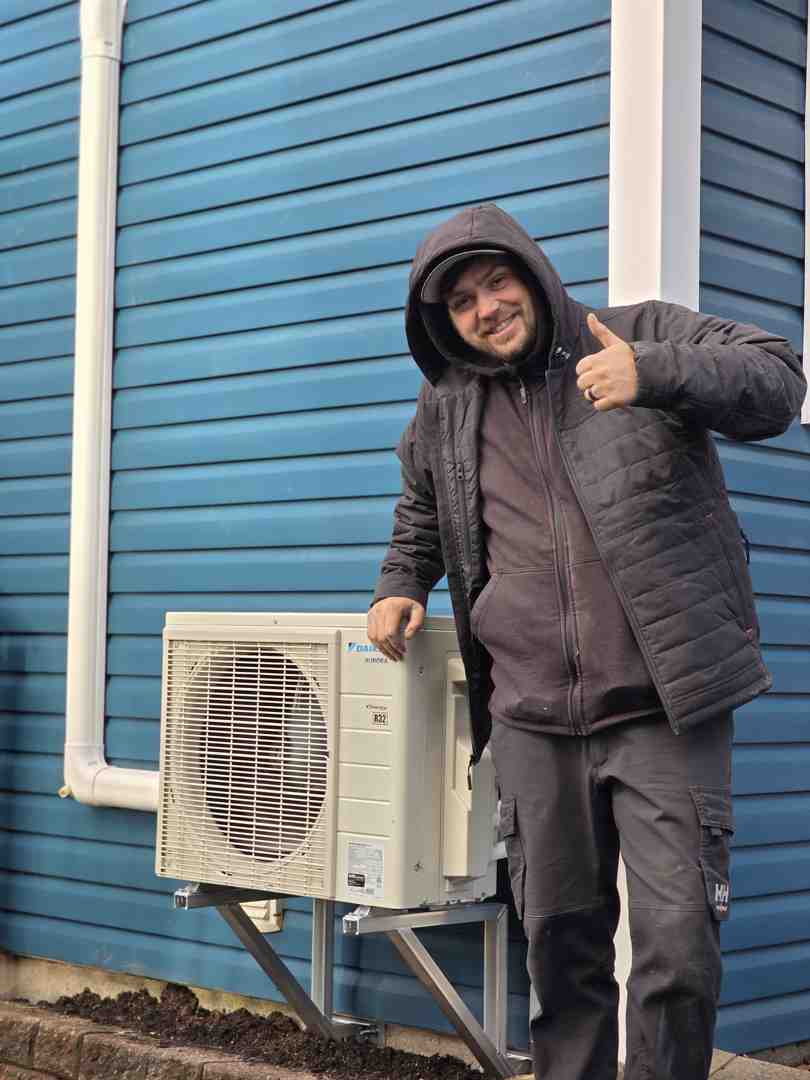
The best heating and cooling system replacement in Dartmouth, NS can mean the difference between a home that struggles through Nova Scotia's damp, unpredictable winters and one that stays consistently comfortable all year long. Dartmouth's coastal climate is demanding — cold snaps, high humidity, and wide temperature swings put serious stress on home comfort systems. When an aging system starts to fail, the impact shows up fast: higher energy use, uneven temperatures, and equipment working harder than it should.
Here's a quick look at what defines a top-tier replacement in Dartmouth:
• Cold-climate performance — Look for systems rated to deliver strong output even at -15°C
• Proper sizing — A Manual J load calculation ensures your new system matches your home's actual needs
• Professional installation — Proper installation protects performance and long-term reliability
• Proven equipment options — Choose a system designed for coastal Atlantic Canada conditions
• Efficiency ratings — Higher efficiency can reduce long-term energy use
A well-maintained system can also last 15 to 20 years, making the replacement decision one of the most impactful home upgrades you can make.
Whether your current system is approaching the end of its lifespan or already showing signs of trouble, understanding what makes a replacement the right one for Dartmouth's specific conditions is the first step.
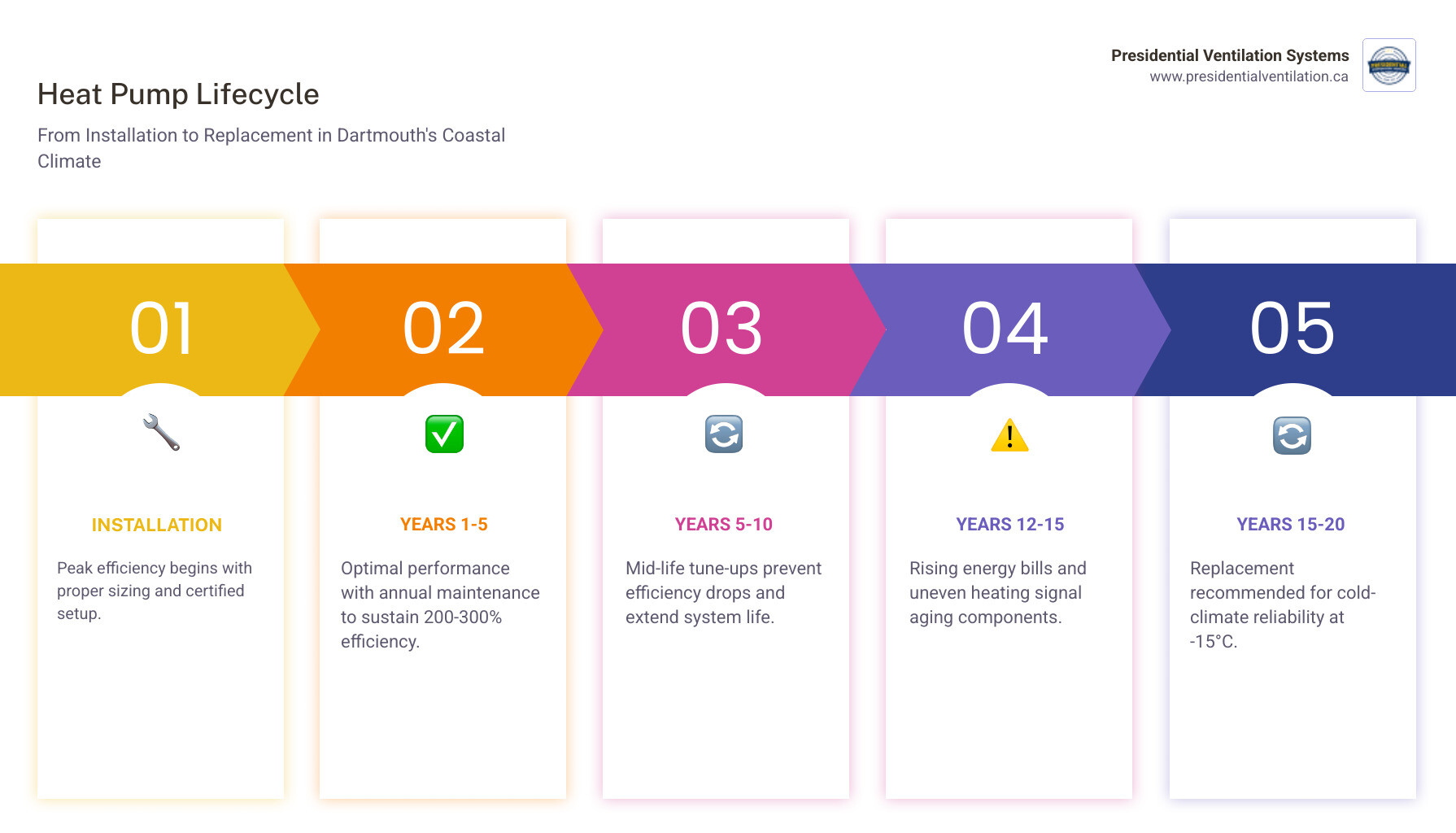
Knowing when to stop repairing and start replacing is the key to maintaining a stress-free home. While a well-maintained system can last between 15 and 20 years, the coastal air in Dartmouth can sometimes accelerate wear and tear. If your unit is around the 15-year mark, it might be time to start looking at the best heating and cooling system replacement in Dartmouth, NS.
One of the most obvious red flags is a sudden spike in your energy use. If your power bills are climbing but your home still feels chilly in January, your system is likely losing efficiency. You might also notice inconsistent temperatures — one room feels overly warm while another stays noticeably cooler. This often points to aging components that can no longer modulate effectively.
Frequent mechanical failures are another major sign. If you find yourself scheduling service visits more than once a season, those interruptions add up quickly and often signal that the system is nearing the end of its useful life.
Listen to your unit, too. Unusual operating noises like grinding, squealing, or loud rattling aren't just annoying; they can indicate failing motors, worn bearings, or loose internal components. Combined with poor airflow or a noticeable increase in dust, these symptoms suggest your equipment may no longer be able to deliver the comfort and air quality your home needs.
Selecting a replacement isn't a one-size-fits-all process. Dartmouth homes range from historic properties in the downtown core to newer builds in Burnside or Cole Harbour, each with unique heating and cooling requirements.
• Best For — Ducted System: Homes with existing ductwork — Ductless System: Homes without ductwork or with additions
• Aesthetic — Ducted System: Hidden vents in floors/ceilings — Ductless System: Wall or floor-mounted indoor units
• Comfort — Ducted System: Whole-home uniform temperature — Ductless System: Zoned control for specific rooms
• Installation — Ducted System: Uses existing vents/registers — Ductless System: Minimal structural changes required
For many homeowners, a ducted configuration is an ideal upgrade because it provides seamless, uniform comfort throughout every room. However, if you have a home with electric baseboards, radiant heat, or you've added a sunroom, a ductless configuration offers excellent flexibility and zoned control.
Modern inverter technology is a game-changer for our climate. Unlike older "on/off" systems, inverter-driven units ramp up and down smoothly, helping maintain a steady temperature and manage the high humidity levels we often see in the Maritimes. Our comprehensive HVAC services in Dartmouth ensure that whichever path you choose, the system is integrated into your home's layout for dependable, year-round comfort.
Technology has come a long way since your last system was installed. Today's "cold-climate" models are specifically engineered to handle the -15°C nights we experience in Nova Scotia. One of the most critical metrics to check is the heating output at low temperatures. Systems that maintain strong performance in colder weather help reduce reliance on backup heating during cold snaps.
When reviewing efficiency and performance details, pay attention to:
• HSPF (Heating Seasonal Performance Factor): Higher numbers mean more efficient heating during the winter.
• SEER (Seasonal Energy Efficiency Ratio): This measures how well the unit cools during our humid summers.
• Variable-Speed Compressors: These allow the system to ramp output up or down depending on the weather, leading to more consistent temperatures and quieter operation.
Modern systems can also include enhanced air filtration options that support cleaner indoor air by trapping fine particles. Pairing the right equipment with proper setup and regular maintenance helps protect comfort, efficiency, and long-term reliability.
A replacement system is only as good as its installation. The process begins with a Manual J load calculation. We don't just guess the size based on your square footage; we look at your insulation, window types, and even the direction your house faces to ensure the system is correctly sized.
The replacement process generally follows these steps:
1. Assessment: We evaluate your current setup, including ductwork (if applicable) and electrical capacity required for the new system.
2. System Selection: We help you choose a model that fits your home, comfort goals, and local climate needs.
3. Decommissioning: We safely remove your old equipment and prepare the space for a clean, secure installation.
4. Installation & Calibration: We install the indoor and outdoor equipment, connect refrigerant lines with quality materials, and calibrate controls for steady, efficient performance.
With a careful, detail-driven approach, homeowners get a system that runs the way it should—quietly, reliably, and consistently through Dartmouth's changing seasons.
Once you've invested in the best heating and cooling system replacement in Dartmouth, NS, you want it to last. The secret to a long lifespan is consistent, professional care. We recommend scheduling routine maintenance at least once a year.
During a tune-up, we check refrigerant levels, clean coils, confirm proper airflow, and ensure the condensate drain is clear. This helps keep performance steady and reduces avoidable wear on key components.
You can also do your part by keeping the outdoor unit clear of snow, ice, and fallen leaves. Ensuring there is at least two feet of clearance around the unit allows for the airflow necessary for efficient operation—especially during winter weather.
The "best" replacement is one that is designed for cold climates and properly sized for your home's footprint. It should maintain strong heating performance at low outdoor temperatures and be installed with attention to airflow, refrigerant charging, drainage, and control setup so it performs reliably in Dartmouth's coastal conditions.
Start with a professional home assessment. We look at your home's layout, insulation levels, window performance, and whether you have existing ductwork. The best choice balances comfort, efficiency, and long-term reliability, with a configuration that fits how your household actually uses each space.
You can expect an in-home evaluation first, followed by removal of the old equipment, installation of the new indoor and outdoor components, and careful calibration. Before we finish, we confirm proper airflow and operation, review thermostat settings, and explain basic homeowner care such as filter checks and outdoor clearance.
At Presidential Ventilation Systems, we've spent over 30 years helping our neighbors across Dartmouth, Cole Harbour, and the wider HRM stay comfortable. As a premier Daikin Comfort Pro Dealer, we take pride in offering the best heating and cooling system replacement in Dartmouth, NS. We don't just sell equipment; we provide long-term energy-saving solutions backed by industry-leading warranties and a team of licensed experts who treat your home like their own.
If your current heating system is struggling to keep up or your energy bills are giving you a headache, don't wait for a total breakdown in the middle of a blizzard. Let us help you navigate the replacement process from start to finish. From the initial Manual J calculation to the final system calibration, we ensure your new system is ready to tackle whatever the Atlantic coast throws its way.
Ready to upgrade your home comfort? Contact us today to schedule your assessment for the best heating and cooling system replacement in Dartmouth, NS and experience the difference that 30 years of local expertise can make.

The best heating and cooling system replacement in Dartmouth, NS can mean the difference between a home that struggles through Nova Scotia's damp, unpredictable winters and one that stays consistently comfortable all year long. Dartmouth's coastal climate is demanding — cold snaps, high humidity, and wide temperature swings put serious stress on home comfort systems. When an aging system starts to fail, the impact shows up fast: higher energy use, uneven temperatures, and equipment working harder than it should.
Here's a quick look at what defines a top-tier replacement in Dartmouth:
• Cold-climate performance — Look for systems rated to deliver strong output even at -15°C
• Proper sizing — A Manual J load calculation ensures your new system matches your home's actual needs
• Professional installation — Proper installation protects performance and long-term reliability
• Proven equipment options — Choose a system designed for coastal Atlantic Canada conditions
• Efficiency ratings — Higher efficiency can reduce long-term energy use
A well-maintained system can also last 15 to 20 years, making the replacement decision one of the most impactful home upgrades you can make.
Whether your current system is approaching the end of its lifespan or already showing signs of trouble, understanding what makes a replacement the right one for Dartmouth's specific conditions is the first step.
Knowing when to stop repairing and start replacing is the key to maintaining a stress-free home. While a well-maintained system can last between 15 and 20 years, the coastal air in Dartmouth can sometimes accelerate wear and tear. If your unit is around the 15-year mark, it might be time to start looking at the best heating and cooling system replacement in Dartmouth, NS.
One of the most obvious red flags is a sudden spike in your energy use. If your power bills are climbing but your home still feels chilly in January, your system is likely losing efficiency. You might also notice inconsistent temperatures — one room feels overly warm while another stays noticeably cooler. This often points to aging components that can no longer modulate effectively.
Frequent mechanical failures are another major sign. If you find yourself scheduling service visits more than once a season, those interruptions add up quickly and often signal that the system is nearing the end of its useful life.
Listen to your unit, too. Unusual operating noises like grinding, squealing, or loud rattling aren't just annoying; they can indicate failing motors, worn bearings, or loose internal components. Combined with poor airflow or a noticeable increase in dust, these symptoms suggest your equipment may no longer be able to deliver the comfort and air quality your home needs.
Selecting a replacement isn't a one-size-fits-all process. Dartmouth homes range from historic properties in the downtown core to newer builds in Burnside or Cole Harbour, each with unique heating and cooling requirements.
• Best For — Ducted System: Homes with existing ductwork — Ductless System: Homes without ductwork or with additions
• Aesthetic — Ducted System: Hidden vents in floors/ceilings — Ductless System: Wall or floor-mounted indoor units
• Comfort — Ducted System: Whole-home uniform temperature — Ductless System: Zoned control for specific rooms
• Installation — Ducted System: Uses existing vents/registers — Ductless System: Minimal structural changes required
For many homeowners, a ducted configuration is an ideal upgrade because it provides seamless, uniform comfort throughout every room. However, if you have a home with electric baseboards, radiant heat, or you've added a sunroom, a ductless configuration offers excellent flexibility and zoned control.
Modern inverter technology is a game-changer for our climate. Unlike older "on/off" systems, inverter-driven units ramp up and down smoothly, helping maintain a steady temperature and manage the high humidity levels we often see in the Maritimes. Our comprehensive HVAC services in Dartmouth ensure that whichever path you choose, the system is integrated into your home's layout for dependable, year-round comfort.
Technology has come a long way since your last system was installed. Today's "cold-climate" models are specifically engineered to handle the -15°C nights we experience in Nova Scotia. One of the most critical metrics to check is the heating output at low temperatures. Systems that maintain strong performance in colder weather help reduce reliance on backup heating during cold snaps.
When reviewing efficiency and performance details, pay attention to:
• HSPF (Heating Seasonal Performance Factor): Higher numbers mean more efficient heating during the winter.
• SEER (Seasonal Energy Efficiency Ratio): This measures how well the unit cools during our humid summers.
• Variable-Speed Compressors: These allow the system to ramp output up or down depending on the weather, leading to more consistent temperatures and quieter operation.
Modern systems can also include enhanced air filtration options that support cleaner indoor air by trapping fine particles. Pairing the right equipment with proper setup and regular maintenance helps protect comfort, efficiency, and long-term reliability.
A replacement system is only as good as its installation. The process begins with a Manual J load calculation. We don't just guess the size based on your square footage; we look at your insulation, window types, and even the direction your house faces to ensure the system is correctly sized.
The replacement process generally follows these steps:
1. Assessment: We evaluate your current setup, including ductwork (if applicable) and electrical capacity required for the new system.
2. System Selection: We help you choose a model that fits your home, comfort goals, and local climate needs.
3. Decommissioning: We safely remove your old equipment and prepare the space for a clean, secure installation.
4. Installation & Calibration: We install the indoor and outdoor equipment, connect refrigerant lines with quality materials, and calibrate controls for steady, efficient performance.
With a careful, detail-driven approach, homeowners get a system that runs the way it should—quietly, reliably, and consistently through Dartmouth's changing seasons.
Once you've invested in the best heating and cooling system replacement in Dartmouth, NS, you want it to last. The secret to a long lifespan is consistent, professional care. We recommend scheduling routine maintenance at least once a year.
During a tune-up, we check refrigerant levels, clean coils, confirm proper airflow, and ensure the condensate drain is clear. This helps keep performance steady and reduces avoidable wear on key components.
You can also do your part by keeping the outdoor unit clear of snow, ice, and fallen leaves. Ensuring there is at least two feet of clearance around the unit allows for the airflow necessary for efficient operation—especially during winter weather.
The "best" replacement is one that is designed for cold climates and properly sized for your home's footprint. It should maintain strong heating performance at low outdoor temperatures and be installed with attention to airflow, refrigerant charging, drainage, and control setup so it performs reliably in Dartmouth's coastal conditions.
Start with a professional home assessment. We look at your home's layout, insulation levels, window performance, and whether you have existing ductwork. The best choice balances comfort, efficiency, and long-term reliability, with a configuration that fits how your household actually uses each space.
You can expect an in-home evaluation first, followed by removal of the old equipment, installation of the new indoor and outdoor components, and careful calibration. Before we finish, we confirm proper airflow and operation, review thermostat settings, and explain basic homeowner care such as filter checks and outdoor clearance.
At Presidential Ventilation Systems, we've spent over 30 years helping our neighbors across Dartmouth, Cole Harbour, and the wider HRM stay comfortable. As a premier Daikin Comfort Pro Dealer, we take pride in offering the best heating and cooling system replacement in Dartmouth, NS. We don't just sell equipment; we provide long-term energy-saving solutions backed by industry-leading warranties and a team of licensed experts who treat your home like their own.
If your current heating system is struggling to keep up or your energy bills are giving you a headache, don't wait for a total breakdown in the middle of a blizzard. Let us help you navigate the replacement process from start to finish. From the initial Manual J calculation to the final system calibration, we ensure your new system is ready to tackle whatever the Atlantic coast throws its way.
Ready to upgrade your home comfort? Contact us today to schedule your assessment for the best heating and cooling system replacement in Dartmouth, NS and experience the difference that 30 years of local expertise can make.

At Presidential Ventilation Systems, a pattern we see often in our residential and commercial projects is the misconception that a 200-square-foot glass enclosure requires the exact same cooling capacity as a standard residential bedroom. Selecting a ductless system primarily for summer cooling in south-facing sunrooms demands an entirely different approach than conditioning an interior hallway or den. If you buy an off-the-shelf unit based solely on room dimensions, you will likely encounter a frustrating problem our Red Seal tradespeople are frequently called to fix: a system that short-cycles, leaving the space feeling cold but distinctly clammy. True comfort requires balancing the temperature drop with active dehumidification.
To establish the right baseline for your home's unique layout, explore our ductless heat pumps and review the capabilities of Lennox ductless systems.
The standard rule of thumb for HVAC sizing relies heavily on square footage, assuming standard insulation, standard ceiling heights, and a typical number of windows. However, in our experience handling new construction and home renovations throughout Nova Scotia, a south-facing sunroom shatters all of these assumptions. The intense summer solar gain pouring through expansive glass walls creates a thermal environment completely unlike the rest of your house.
Furthermore, Nova Scotia's humid maritime summers compound the short-cycling problem. If a unit is oversized for the square footage to combat the heat, it blasts cold air and shuts off too fast. Because it shuts down prematurely, it fails to run long enough to remove the heavy maritime humidity from the air. The result is a room that hits 20°C on the thermostat but feels damp and uncomfortable. Understanding the difference between sensible cooling and latent cooling is the key to solving this issue.
The Problem: Sunrooms are designed to capture light, but in doing so, they also capture immense amounts of thermal energy. During peak July and August afternoons, a south-facing room acts like a thermal battery. The heat enters, but the glass prevents it from easily escaping, creating a dual-load challenge for any climate control system.
The Cause: This phenomenon is known as solar heat gain. Radiant energy from the sun passes through the glass and strikes the floors, furniture, and walls. These objects absorb the energy and reradiate it as infrared heat. Because standard window glass is largely opaque to infrared radiation, the heat becomes trapped inside the room. This is the classic greenhouse effect. If you compare a highly insulated interior room to a sunroom with extensive glazing, the sunroom might require two to three times the cooling capacity simply to counteract the sun, regardless of the square footage.
The Solution: Counteracting the greenhouse effect requires a system designed specifically for high sensible heat loads. It means looking beyond the physical dimensions of the room and calculating the exact amount of solar energy entering the space during the hottest part of the day.
The type of glass in your sunroom plays a massive role in how much heat enters the space. The Solar Heat Gain Coefficient (SHGC) is a metric that measures the fraction of solar radiation admitted through a window. A lower SHGC means less heat is transmitted.
• Single-pane glass: Offers almost no resistance to solar heat gain, resulting in massive temperature spikes.
• Standard double-pane: Provides better insulation but still allows significant radiant heat through.
• Low-E coated glass: Reflects a portion of the infrared energy, reducing the cooling load, though rapid temperature spikes on sunny days still occur.
Even in a well-insulated sunroom with high-quality Low-E windows, the sheer volume of glass means the space will experience rapid temperature spikes on sunny days, demanding a highly responsive cooling solution.
To properly condition a high-glass space, you have to understand how air conditioners actually treat the air. An air conditioning system performs two distinct jobs simultaneously: lowering the temperature and removing moisture. These two functions are technically referred to as sensible cooling and latent cooling.
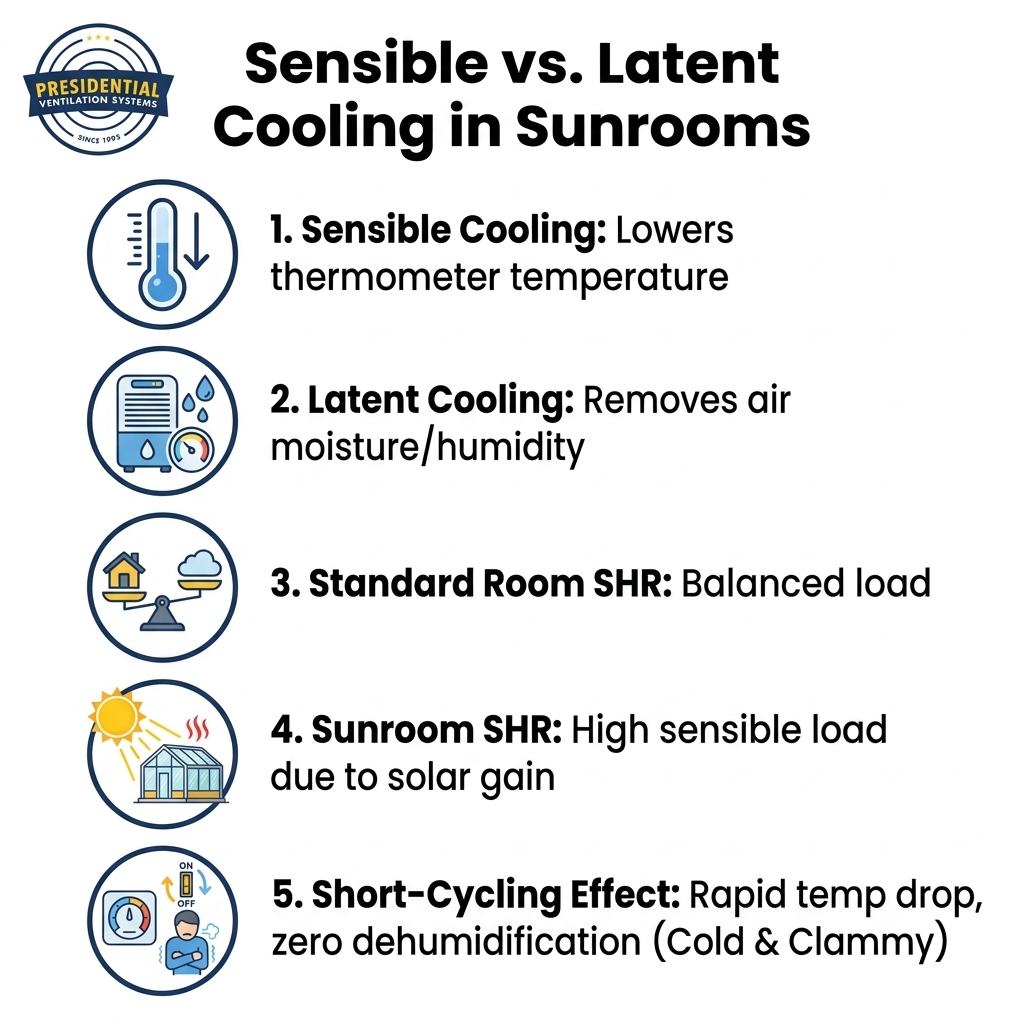
Sensible cooling is the system's ability to lower the actual air temperature—the metric you feel on your skin and read on a thermometer. Latent cooling is the system's ability to extract moisture and humidity from the air. The ratio between these two functions is called the Sensible Heat Ratio (SHR). A standard living room might require an SHR of 0.75 (meaning 75% of the system's effort goes to dropping the temperature and 25% goes to removing humidity). However, a sunroom baking in the afternoon sun requires a system optimized for a much higher sensible heat load.
• Sensible Cooling — What It Does: Lowers the measurable air temperature (thermometer reading). — Sunroom Impact: Must be exceptionally high to combat direct solar radiation entering through glass.
• Latent Cooling — What It Does: Removes water vapor and humidity from the air. — Sunroom Impact: Requires sustained system run-time to pull moisture out of humid maritime air.
• Sensible Heat Ratio (SHR) — What It Does: The balance between temperature drop and moisture removal. — Sunroom Impact: Sunrooms need a specific SHR to avoid dropping the temperature faster than the humidity.
If you are exploring different equipment options, our best ductless heat pumps guide outlines how different systems balance these critical ratios.
Short-cycling occurs when an oversized unit blasts a massive amount of cold air into a small space, satisfying the thermostat in a matter of minutes. Because the thermostat only measures sensible heat (temperature), it tells the system to shut off.
The problem is that the indoor evaporator coil needs sustained, continuous run time to effectively pull moisture from the air. When the system shuts down after five minutes, the latent cooling process stops entirely. The result is a rapid temperature drop with zero dehumidification, leading directly to the dreaded "cold and clammy" effect.
Finding the right equipment for a sunroom means looking beyond familiar brand names and focusing on the technical specifications that dictate performance. As a Daikin Comfort Pro contractor, our team recommends prioritizing one critical feature for a sunroom: a variable-speed (inverter) compressor. Unlike older single-stage units that only run at 100% capacity or 0%, an inverter compressor can modulate its output to perfectly match the fluctuating solar load.
As the sun shifts behind a cloud, the compressor slows down. As the afternoon sun hits the glass directly, the compressor ramps up. This continuous, modulated operation is the absolute best way to maintain long run times, ensuring both the sensible temperature is managed and the latent humidity is consistently extracted.
We see the importance of this careful selection frequently in our field work around the Mount Uniacke NS area. Last summer, a homeowner reached out to have heat pumps installed with careful attention to detail for their specific layout. By thoroughly assessing the space and taking the time to answer their questions about handling intense solar loads, our installation team delivered a finished product that left the customer completely satisfied.
When selecting the physical indoor unit, you also have to consider airflow. In a glass-heavy space, wall space is often at a premium. While traditional high-wall mounts are common, floor-mounted indoor units (often installed on dwarf walls beneath windows) can provide excellent upward airflow that washes the glass, preventing condensation and maintaining an even temperature profile. Because of these variables, relying on professional load calculations (Manual J) is necessary. Generic online BTU calculators cannot account for the specific orientation, glass type, and shading of your sunroom. For a system engineered to handle these precise demands, many homeowners turn to Lennox ductless systems.
The Problem: Adding a dedicated ductless system for a sunroom isn't just an HVAC project; it is an electrical project. A new heat pump requires a dedicated circuit, and simply adding breakers to an existing panel without verification can lead to overloaded circuits and tripped breakers.
The Cause: Many older Nova Scotia homes operate on 100-amp electrical services or have panels that are already physically full. When homeowners attempt to add a new 15-amp or 20-amp 240V circuit for a sunroom mini-split, they often discover their electrical infrastructure cannot safely support the additional load.
The Solution: Verifying panel capacity before finalizing the HVAC design is a non-negotiable step. In our 30+ years of multi-trade expertise across Nova Scotia, we have seen the pitfalls of the fragmented approach—where a homeowner hires a heat pump installer, only to be told halfway through the job that they need to go find an electrician. Because Presidential Ventilation Systems maintains in-house electrical and HVAC divisions, we handle both the precise load calculations and the licensed electrical panel upgrades under one roof. This ensures the installation process remains seamless, compliant, and safe.
The physical environment of a sunroom presents unique installation challenges that dictate the long-term performance and lifespan of the equipment. Proper planning by an experienced contractor is required to ensure the system operates efficiently without obstructing the view.
1. Assessing Available Wall Space: Sunrooms are primarily glass, leaving very little structural wall space for mounting indoor units. Technicians must carefully locate solid framing that can support the unit's weight while ensuring the airflow isn't blocked by furniture or architectural features.
2. Routing Line Sets and Drainage: The refrigerant lines and condensate drains must be routed to the exterior. In a room made of glass, hiding these lines requires careful planning to maintain the aesthetic appeal of the space. Gravity-fed condensate drains must have a proper slope, or a condensate pump must be integrated.
3. Evaluating Multi-Zone vs. Single-Zone: Homeowners often ask if they can just add a new head to an existing multi-zone heat pump system. While sometimes possible, sunrooms experience peak cooling demand at different times than the rest of the house. A completely independent single-zone system often provides better dedicated climate control for the extreme solar load.
4. Ensuring Proper Placement: Where the unit is placed affects both sensible and latent cooling efficiency. If installed too high in a vaulted sunroom, it may struggle to condition the living space below. Professional installation ensures the unit is positioned to optimize air distribution.
Last fall, a homeowner expressed concerns regarding an existing, inefficient heat pump system that another company had installed in their sunroom. After inspecting the system, our technicians provided helpful advice and efficiency tips, giving the customer clear guidance on improving their setup to better handle the space. To ensure your project is handled correctly from day one, trust a professional heat pump installation team.
Because sunroom systems operate under heavy loads during peak summer months, they require diligent upkeep to maintain their efficiency and protect the compressor.
• Clean the indoor filters frequently: High run-times mean more air is circulating through the filters. Check and wash the reusable filters every few weeks during peak summer to ensure unrestricted airflow.
• Keep the outdoor condenser clear: The outdoor unit needs to dissipate the massive amount of heat extracted from the sunroom. Keep vegetation, debris, and outdoor furniture at least two feet away from the condenser coil.
• Monitor for proper drainage: Because the system is doing heavy latent cooling (dehumidification), it will produce a significant amount of condensate water. Ensure the drain line remains clear and flows freely away from the home's foundation.
• Schedule professional deep cleaning: Over time, the indoor blower wheel and evaporator coil will accumulate micro-dust and organic growth. A professional deep clean restores the system's ability to transfer heat and extract moisture efficiently.
Preventive maintenance protects the compressor from the strain of heavy solar loads. To keep your system running at peak performance, consider enrolling in a comprehensive preventive maintenance plan.
Why is my sunroom mini split not dehumidifying?
If your system isn't removing moisture, it is likely short-cycling due to being oversized for the space. When a unit cools the room too quickly, it shuts off before the evaporator coil has time to extract humidity from the air. This results in a cold but clammy environment. A professional load calculation can determine if your system's sensible heat ratio is mismatched to the room.
What size mini split do I need for a 200 sq ft sunroom?
Sizing a system for a sunroom cannot be done accurately using only square footage. Because of the intense solar heat gain through the glass, a 200-square-foot sunroom often requires significantly more capacity than a standard room of the same size. A licensed HVAC technician must perform a Manual J load calculation to account for your specific glass type, insulation, and sun exposure.
Can you put a mini split in a 4 season room?
Yes, a ductless mini-split is often the ideal solution for a 4-season room. These systems provide both high-efficiency summer cooling and reliable winter heating without requiring ductwork. However, the installation requires careful planning regarding unit placement and electrical capacity to ensure it can handle the room's unique thermal loads year-round.
What is the best way to cool a sunroom?
The most effective way to cool a sunroom is by installing a dedicated ductless heat pump with a variable-speed inverter compressor. This technology modulates its cooling output to match the shifting solar load throughout the day. It provides consistent temperature control and superior dehumidification compared to window units or extending existing central ductwork.
How does sensible cooling differ from latent cooling in HVAC?
Sensible cooling refers to the system's ability to lower the actual air temperature, which is what you read on a thermometer. Latent cooling is the system's ability to remove moisture and humidity from the air. In high-glass spaces, balancing these two factors is critical to preventing the room from feeling damp and uncomfortable.
Do I need an electrical panel upgrade to add a heat pump to my sunroom?
Adding a new dedicated heat pump requires an available 240V circuit on your electrical panel. If your home has an older 100-amp service or a panel that is already full, an upgrade or a sub-panel may be required. As a multi-trade contractor, Presidential Ventilation Systems can assess your electrical capacity and handle both the HVAC and electrical requirements safely.
Cooling a sunroom effectively requires more than just guessing at square footage; it requires a precise understanding of sensible cooling ratios and proper electrical integration. With over 30 years of multi-trade expertise in Nova Scotia and a team of approximately 70 employees, Presidential Ventilation Systems ensures your system is sized perfectly and installed safely. If you are considering an installation, retrofit, or oil-to-heat-pump conversion, there may be rebates available. Because rebate programs and eligibility can change, we recommend confirming current programs directly with our team. Contact Presidential Ventilation Systems today to request a free estimate for your sunroom project.

Are you noticing weak airflow from your vents or rising energy bills, even though you change your air filter regularly? If you are researching why standard one-inch filters choke high-efficiency ducted heat pumps, you are likely dealing with a fundamental mismatch between modern HVAC technology and outdated filtration methods. Many homeowners upgrade to advanced, energy-efficient climate control systems but continue sliding the same basic disposable filters into the return grille, completely unaware that they are suffocating their equipment.
The core issue rarely stems from a mechanical defect in the heat pump itself. Instead, the typical pattern we see is a homeowner trying to improve their indoor air quality by purchasing a restrictive high-MERV 1-inch pleated filter from a big-box store. While these dense filters capture fine dust and allergens, they also act like a brick wall against the air trying to return to your system. This creates a severe bottleneck.
Proper filtration is a holistic airflow issue, not just a disposable product choice. You eventually reach a critical decision point: continue replacing 1-inch filters every single month while your system struggles to breathe, or upgrade the physical ductwork to accommodate a high-capacity filtration system that actually supports your equipment's performance.
Related resource: Learn more about how proper airflow supports our ducted heat pump systems.
To understand why your heat pump is struggling, you first need to understand a mechanical concept called static pressure. In simple terms, static pressure is the measurement of resistance to airflow within your ductwork. Every component in your HVAC system—from the sweeping curves of the sheet metal to the grilles in your floor—adds a certain amount of resistance. Your system's blower motor is engineered to overcome a very specific, calculated amount of this resistance.
Think of your heat pump's blower motor like your own lungs. If you go for a run while breathing normally, your lungs easily pull in the volume of air you need. Now, try running that same distance while breathing entirely through a narrow drinking straw. The intense strain you feel in your chest is exactly what your system's blower motor experiences when it faces high static pressure. It is forced to work exponentially harder just to pull the same volume of air, measured in cubic feet per minute (CFM), through the ductwork.
When you install a dense filter into a narrow slot, you drastically increase that resistance. If you need to order replacement heat pump filters, understanding how surface area dictates this pressure drop is critical to keeping your system healthy.
The fatal flaw of the high-MERV 1-inch pleated filter is its severe lack of surface area. MERV stands for Minimum Efficiency Reporting Value, which measures how effectively a filter traps microscopic particles. To achieve a high MERV rating, manufacturers pack the filter media tightly to catch more debris.
• Dense pleating: In a 1-inch space, the pleats are incredibly shallow and tightly packed together, leaving almost no open space for air to bypass the trapped dust.
• Rapid clogging: Because there is so little surface area, the face of the filter loads up with dust, pet dander, and hair almost immediately.
• Spiking pressure: Within just a few weeks of use, that 1-inch filter becomes severely clogged, causing the static pressure inside your ductwork to spike to unsafe levels.
Your heat pump requires a massive, continuous volume of air to transfer heat effectively. When that air is blocked by a small, dense filter, the entire thermodynamic process begins to break down.
The static pressure problem becomes even more destructive when we look at the specific technology inside modern high-efficiency heat pumps. Older furnaces used basic motors that simply moved less air when the filter got dirty. Modern systems use advanced ECM (Electronically Commutated Motors) that behave very differently when faced with a restriction.
Here is exactly how a high-MERV 1-inch pleated filter damages a modern ECM blower motor:
1. Sensing the restriction: ECM motors have built-in microprocessors programmed to maintain a precise, constant airflow (CFM). When the dense 1-inch filter restricts the air, the motor's sensors detect the drop in volume.
2. Ramping up RPMs: To compensate for the blockage and hit its programmed airflow target, the ECM automatically increases its speed and torque. It begins spinning faster and pulling more electricity to fight the resistance.
3. Constant maximum output: In Nova Scotia, heat pumps run almost continuously through freezing winters and humid summers. This near-constant operation means the blower motor is running at maximum RPMs year-round just to overcome the dense filter.
4. Overheating and failure: Electric motors are cooled by the air flowing over them. With restricted airflow and maximum electrical draw, the motor quickly overheats. Over time, this constant strain degrades the bearings and internal electronics, leading to premature motor failure.
Blower motor replacements are major, costly repairs. The most frustrating part for homeowners is that these failures are entirely preventable. By correcting the structural airflow design, you allow the ECM motor to operate at a low, quiet, and highly efficient speed exactly as the manufacturer intended.
The permanent solution to this airflow crisis is not found in the filter aisle of a hardware store. It requires a structural modification to your ductwork known as a 4-inch media cabinet. This is a dedicated, custom-fitted sheet-metal housing installed directly into the return air drop next to your indoor air handler.
Instead of a shallow 1-inch filter, this cabinet houses a massive, deeply pleated 4-inch filter. The difference in performance comes down to simple geometry. A 4-inch filter contains exponentially more physical filter media folded into those deep pleats. This massive increase in surface area means you can finally use a high-MERV filter to capture allergens without creating a restrictive wall. The air easily flows through the vast surface area, keeping static pressure low and protecting your ECM blower motor.
Because there is so much more material to hold dust and debris, a 4-inch media filter only needs to be replaced every 6 to 12 months, rather than every 30 days.
You cannot simply shove a 4-inch filter into a 1-inch slot, nor can you tape a larger box to the side of your system and expect it to work. Upgrading your filtration requires professional mechanical modification.
With our 30+ years Nova Scotia HVAC and sheet-metal expertise, we advocate for custom-fabricated media cabinets because aerodynamic flow is highly sensitive. The return air drop must be properly sized and transitioned. If the sheet metal is poorly designed, the air will create turbulence, bypassing the filter entirely or whistling through gaps. Custom sheet-metal fabrication ensures an airtight seal, preventing dirty basement or utility room air from being sucked into your pristine heating system. This commitment to proper mechanical design separates a long-lasting system from one plagued by constant breakdowns.

When a heat pump's airflow is choked, the consequences extend far beyond the mechanical room. Your central ductwork is the respiratory system of your entire home. If the air cannot move freely through the central air handler, the air in your living spaces quickly stagnates.
During the humid summer months, your heat pump removes moisture from the air by passing it over a cold indoor coil. If high static pressure slows that airflow to a crawl, the coil can actually freeze solid into a block of ice, shutting down your cooling completely. Even if it doesn't freeze, the weak airflow prevents the system from properly circulating and dehumidifying the distant rooms in your home, leaving bedrooms feeling sticky and uncomfortable.
In the winter, poor circulation prevents the warm air from reaching the furthest corners of your house, resulting in cold spots and uneven heating. Furthermore, your central heat pump often works in tandem with other indoor air quality equipment. For example, maintaining your HRV system is critical for fresh air exchange, but if your primary ductwork is choked by a restrictive filter, that fresh air cannot be properly distributed throughout the home. Maintaining clear, low-pressure airflow is the absolute foundation of a healthy, comfortable indoor environment.
When deciding how to handle your home's filtration, it helps to look at the hidden costs and daily frustrations of the standard 1-inch filter compared to the peace of mind that comes with a structural upgrade. Relying on 1-inch filters is an ongoing burden that actively puts your expensive heat pump at risk.
Most homeowners forget to change their 1-inch filter every 30 days. When life gets busy and that filter stays in place for 60 or 90 days, the static pressure reaches critical levels, causing severe wear and tear on the system's internal components. Positioning a 4-inch cabinet as a permanent upgrade is an investment in the heat pump's lifespan.
• Surface Area — High-MERV 1-Inch Pleated Filter: Extremely limited; pleats are shallow and tightly packed. — Custom 4-Inch Media Cabinet: Massive; deep pleats allow high volume of air to pass easily.
• Static Pressure — High-MERV 1-Inch Pleated Filter: High; severely restricts airflow and strains the ECM motor. — Custom 4-Inch Media Cabinet: Low; supports optimal CFM and allows the motor to run efficiently.
• Replacement Frequency — High-MERV 1-Inch Pleated Filter: Must be replaced every 30 days to prevent system damage. — Custom 4-Inch Media Cabinet: Only requires replacement every 6 to 12 months.
• System Protection — High-MERV 1-Inch Pleated Filter: Causes overheating, coil freezing, and premature breakdowns. — Custom 4-Inch Media Cabinet: Protects the blower motor and extends the lifespan of the heat pump.
• Installation — High-MERV 1-Inch Pleated Filter: Slides into standard, often leaky, factory filter slots. — Custom 4-Inch Media Cabinet: Requires professional sheet-metal fabrication for an airtight seal.
Addressing airflow is a critical part of comprehensive system care. We highly encourage homeowners to have their static pressure and ductwork evaluated during their next service visit. Incorporating this check into a preventative HVAC maintenance plan ensures your system is always breathing easily and operating at peak efficiency.
Weak airflow is most commonly caused by a clogged or highly restrictive air filter that creates high static pressure within the ductwork. When you use a dense filter, the system's blower motor cannot push air through the dense physical barrier, resulting in a very low volume of air making it to your room vents. Checking and replacing a dirty filter is the first step, but if the airflow remains weak, your ductwork may be undersized or you may need a deeper filter cabinet to reduce the resistance.
Yes, a restrictive filter forces the blower motor to overwork, which can lead to overheating, premature motor failure, and frozen indoor coils. Modern heat pumps rely on a specific, constant volume of air to transfer heat safely. When a high-MERV 1-inch pleated filter chokes that airflow, the internal components run hotter and harder than designed. This constant strain dramatically shortens the lifespan of the equipment, turning a simple maintenance oversight into a major mechanical failure.
Yes, 4-inch media cabinets provide exponentially more surface area, allowing for excellent indoor air quality filtration without choking the system. Because the filter media is folded deeply, air can pass through easily while still trapping microscopic dust and allergens. Beyond protecting your expensive heat pump from blower motor failure, they offer incredible convenience, as you only need to remember to change the filter once or twice a year instead of every single month.
You can use a high-MERV filter only if you have a media cabinet deep enough (like a 4-inch or 5-inch model) to handle the increased airflow resistance. We strongly warn against using high-MERV 1-inch filters, as they almost always cause unsafe static pressure levels that suffocate the system. If you want hospital-grade filtration or have severe allergies, you must upgrade the physical ductwork to accommodate a thicker filter so the system can still breathe.
For standard 1-inch filter slots, a MERV 8 filter is usually the maximum recommended rating to prevent severe airflow restriction and equipment issues. Anything higher in a 1-inch format becomes too dense. However, if you upgrade to a professionally installed 4-inch media cabinet, you can safely use MERV 11 or even MERV 13 filters without harming the equipment, giving you superior air cleaning and optimal system performance simultaneously.
In Nova Scotia, where heat pumps run year-round to combat freezing winters and humid summers, you should inspect a 4-inch filter every 6 months and replace it at least annually. Because your system rarely gets a break, it is filtering air constantly. Homes with multiple pets, recent renovations, or heavy dust accumulation may require more frequent changes, so pulling the filter out for a visual inspection at the change of seasons is a wise habit.
You do not have to settle for weak airflow, noisy vents, or the constant chore of replacing restrictive 1-inch filters every few weeks. Airflow issues can be permanently solved with the right mechanical modifications, ensuring your home stays perfectly comfortable without destroying your equipment in the process. Stop fighting with dense, undersized filters and take the steps necessary to protect your heat pump investment.
With our 30+ years Nova Scotia HVAC and sheet-metal expertise, our team can evaluate your system's static pressure and design a custom solution. Reach out to Presidential Ventilation Systems today to request a free estimate for a custom 4-inch media cabinet upgrade, and give your heat pump the clear, unrestricted airflow it needs to perform flawlessly for years to come.