


At Presidential Ventilation Systems Ltd., we often see that navigating the various heating system options comparisons for homeowners begins when an aging furnace starts to struggle against the Mount Uniacke cold. You are likely facing a critical mechanical decision: replace your failing equipment with another traditional combustion furnace, or transition to a modern heat transfer system. This choice goes far beyond simply picking a recognizable brand; it hinges on understanding the true mechanical efficiency and the objective operational limits of different heating technologies.
Deciding between a central heat pump and a traditional fossil-fuel setup requires evaluating how consistent winter heating is achieved in a maritime climate. Homeowners must look past generic marketing benefits to see exactly how these systems perform under continuous winter stress. Transitioning away from burning oil or gas changes the fundamental infrastructure of how a house stays warm. The decision point rests on whether the superior mechanical efficiency of heat transfer justifies the initial transition away from a familiar combustion system.
To make sense of these technologies, start by reviewing objective data on ductless heat pumps and how they operate differently from legacy systems. By comparing the underlying mechanics, you can accurately assess which technology aligns with your property's thermal envelope and your long-term comfort requirements.
The problem: Traditional heating systems are fundamentally limited by the laws of thermodynamics related to combustion. A furnace generates heat by burning a consumable fuel—such as oil, natural gas, or propane. Even in the most advanced combustion systems, the mechanical efficiency ceiling is capped because a portion of the thermal energy is always lost through the exhaust flue along with the combustion byproducts.
The cause: Because a furnace must create heat from scratch by consuming a resource, it can never produce more energy than the fuel contains. If a furnace operates at 95% efficiency, it means 95 percent of the fuel consumed becomes usable heat, while the remaining 5 percent escapes outdoors. There is no physical way for a combustion system to exceed 100% efficiency.
The solution: Heat pumps bypass this limitation entirely by utilizing a refrigeration cycle to transfer ambient thermal energy rather than burning fuel to create it. Even during a sub-zero maritime winter, there is still measurable heat energy in the outdoor air. A heat pump uses specialized refrigerant that absorbs this dispersed ambient heat, compresses it to raise its temperature, and transfers it inside the house. Because moving existing heat requires significantly less electrical input than generating new heat, the mechanical efficiency of Lennox ductless systems and similar equipment can easily exceed 100%, often operating at 200% to 300% efficiency under normal conditions.
To accurately compare heating systems, homeowners must understand the specific metrics used to grade different mechanical technologies. You cannot directly compare a heat pump to a furnace using the same number, as they operate on completely different principles. Understanding these ratings ensures that properties in Mount Uniacke and surrounding areas are equipped with systems capable of handling local weather demands.
AFUE (Annual Fuel Utilization Efficiency): This metric applies exclusively to combustion systems like furnaces and boilers. It measures the percentage of fuel that is successfully converted into usable heat over an entire year. A high-efficiency gas furnace might achieve an AFUE rating of 98%, meaning only 2% of the energy is lost as exhaust.
HSPF (Heating Seasonal Performance Factor): This rating applies to heat pumps operating in heating mode. It calculates the total space heating required during the season divided by the total electrical energy consumed by the system. A higher HSPF rating indicates a more efficient unit that requires less electricity to move the same amount of thermal energy.
For a deeper dive into specific equipment ratings and performance metrics, reviewing a comprehensive guide to the best ductless heat pumps provides valuable context on how these numbers translate to real-world operation.
• Standard Gas Furnace — Efficiency Metric: AFUE — Maximum Efficiency Ceiling: Up to 98% — Operational Mechanism: Combustion (Burns fuel to create heat)
• Oil Furnace — Efficiency Metric: AFUE — Maximum Efficiency Ceiling: 80% - 87% — Operational Mechanism: Combustion (Burns fuel to create heat)
• Standard Heat Pump — Efficiency Metric: HSPF — Maximum Efficiency Ceiling: Up to 250% — Operational Mechanism: Heat Transfer (Moves ambient heat)
• Cold-Climate Heat Pump — Efficiency Metric: HSPF — Maximum Efficiency Ceiling: Up to 300%+ — Operational Mechanism: Enhanced Heat Transfer (Inverter-driven)
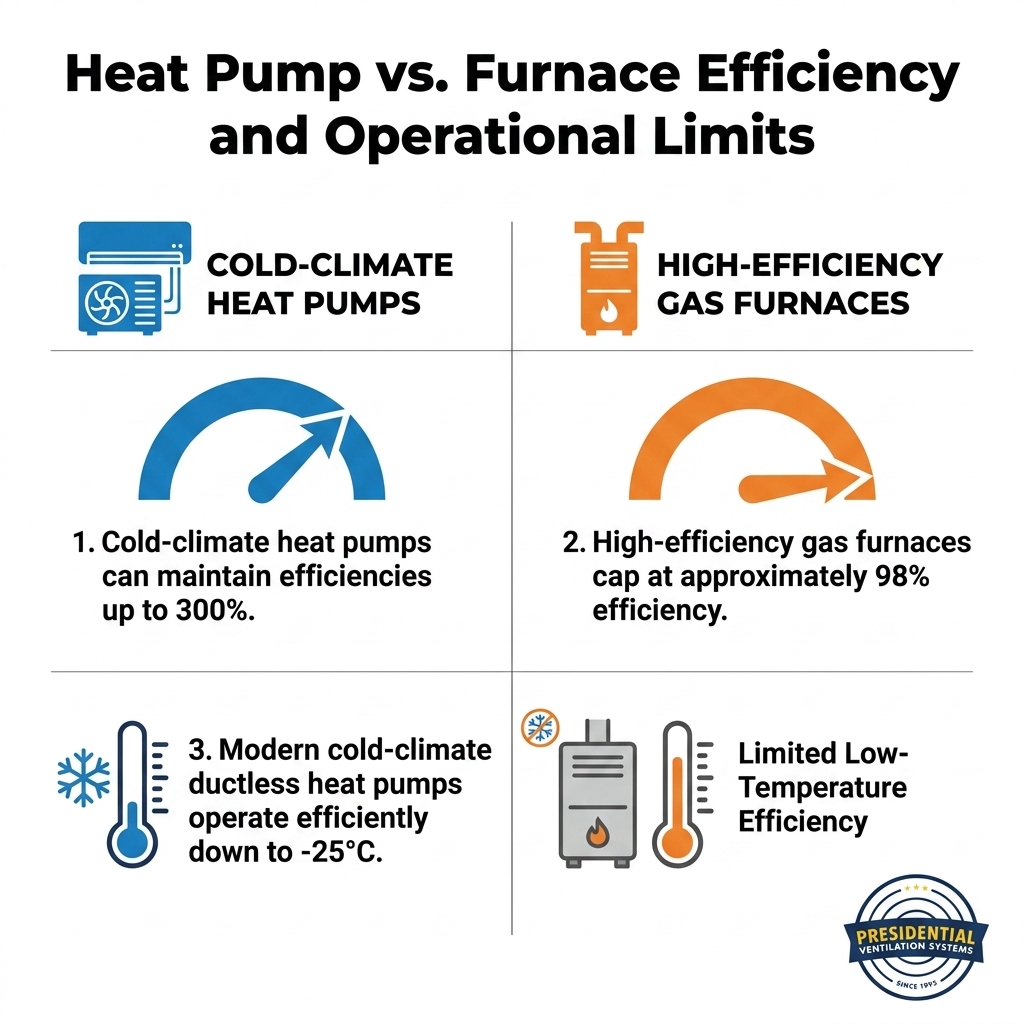
Temperature thresholds: The most critical factor in evaluating a heat pump is its objective operational limit during extreme weather. Standard heat pumps—often designed for milder southern climates—begin losing significant efficiency just below the freezing mark. As the temperature drops, there is less ambient thermal energy available, forcing the compressor to work harder to extract heat. Eventually, a standard unit reaches a balance point where it can no longer extract enough heat to keep the indoor space warm without relying on auxiliary electric resistance heating.
Cold-climate engineering: Modern cold-climate ductless heat pumps are engineered specifically to bypass these traditional limits. Utilizing advanced variable-speed inverter compressors and enhanced refrigerant management, these systems can operate efficiently in temperatures as low as -25 degrees Celsius. They physically accelerate the compressor speed to draw more thermal energy from the frigid air, maintaining indoor comfort through a sub-zero maritime winter.
Understanding these mechanical limits helps determine if a hybrid dual-fuel system or a complete transition to heat transfer is the right choice. For example, our technicians at Presidential Ventilation Systems Ltd. recently assessed a Mount Uniacke homeowner's existing, non-company installed heat pump system to evaluate its cold-weather performance. Our team explained the objective pros and cons of the current equipment's mechanical limits and offered helpful alternatives and advice for running the system efficiently despite its specific temperature thresholds.
Transitioning away from a traditional oil burner to a central or ductless heat pump system fundamentally alters a property's electrical load. A furnace primarily uses electricity just to run the blower motor, while a heat pump relies on electricity to power the heavy-duty outdoor compressor. We frequently find that older homes may require electrical panel upgrades—often moving from a 100-amp service to a 200-amp service—to safely support the continuous electrical draw of modern heating systems. Evaluating the existing electrical infrastructure is a mandatory step before committing to a heat transfer upgrade.
Cold temperatures are only one variable in the mechanical performance equation; ambient moisture plays a massive and often overlooked role. In our years of installing systems across Nova Scotia, we've found that the dampness of maritime winters requires specialized defrost capabilities, focusing on the specific challenges of high humidity combined with freezing temperatures. When a heat pump operates in heating mode, the outdoor coil becomes extremely cold—often colder than the ambient air—which causes moisture in the humid air to condense and freeze on the metal fins.
To maintain efficiency, the system must periodically clear this frost accumulation through an automatic defrost cycle. Here is the step-by-step mechanical process of how a system manages high humidity during a sub-zero maritime winter:
1. Frost Accumulation: High ambient humidity in the cold maritime air contacts the freezing outdoor condenser coils, rapidly forming a layer of frost that insulates the fins and restricts airflow.
2. Sensor Activation: Internal thermistors and solid-state control boards detect the drop in airflow and the changing temperature differential across the coil, signaling that the unit is losing efficiency.
3. Reversing the Valve: The system temporarily reverses the flow of refrigerant, shifting from heating mode to cooling mode. This redirects the hot, compressed refrigerant gas back outdoors instead of inside the house.
4. Ice Melt and Drainage: The hot refrigerant rapidly melts the accumulated ice on the outdoor coil. The resulting water must freely drain away from the base pan to prevent solid ice blocks from forming inside the chassis.
5. Resuming Heating: Once the sensors detect the coil is clear of ice, the reversing valve shifts back, and the system resumes extracting heat from the outdoor air to warm the home.
During this brief defrost period, the indoor unit temporarily stops blowing warm air. Systems engineered for damp, cold climates complete this cycle rapidly to minimize any disruption to indoor comfort.
Even the most advanced mechanical equipment will fail to reach its advertised efficiency ratings if the installation parameters are incorrect. Equipment ratings are only accurate if the system is precisely sized and installed correctly for the specific thermal envelope of the home. Certified installation practices, such as maintaining Daikin Comfort Pro status, directly impact a system's ability to maintain efficiency during extreme weather by ensuring strict adherence to manufacturer specifications.
• Precise Load Calculations: Technicians must perform detailed calculations to match the equipment capacity to the home's exact square footage, insulation levels, and window quality. Oversized units will short-cycle, while undersized units will run constantly without satisfying the thermostat.
• Strategic Outdoor Placement: Proper placement of outdoor units is critical in Mount Uniacke and surrounding areas to prevent snow burial. Units must be elevated on stands or wall brackets to allow for adequate defrost drainage and unobstructed airflow during heavy snowfall.
• Refrigerant Line Sizing: The copper lines connecting the indoor and outdoor units must be sized correctly and purged with nitrogen to prevent moisture and non-condensables from degrading the compressor oil.
• Documentation and Compliance: Navigating warranties and available rebates requires meticulous documentation during the installation phase. A recent project of ours demonstrated this full lifecycle: after providing a comprehensive quote, our installation team followed up, completed the installation, submitted the manufacturer warranty, and clearly explained the rebate process to the homeowner.
Executing these technical prerequisites accurately is why professional heat pump installations are vital for long-term mechanical reliability.
The ongoing mechanical care required for heat transfer systems differs significantly from combustion systems. Traditional furnaces require annual checks primarily focused on combustion safety. Our service technicians must inspect heat exchangers for microscopic cracks that could leak carbon monoxide, ensure the exhaust flues are drafting correctly, and clean the burner assemblies to maintain a safe flame.
Ductless systems and central heat pumps do not have combustion hazards, but they move massive volumes of air and are highly sensitive to airflow restrictions. They require frequent filter cleaning by the homeowner and professional deep cleaning of the indoor blower wheels and evaporator coils. If the micro-channel coils become clogged with household dust or pet dander, the system loses its ability to transfer heat efficiently, forcing the outdoor compressor to operate at higher pressures.
During a sub-zero maritime winter, a neglected heat pump will struggle to extract heat, leading to increased electrical consumption and premature component wear. We consistently see that preventative care directly correlates to the longevity of the compressor and the system's overall lifespan. Enrolling in a structured preventative maintenance plan ensures that both the indoor air handlers and the outdoor condenser are professionally calibrated and cleaned before the harsh weather arrives.
Choosing between a traditional combustion furnace and a modern heat transfer system comes down to understanding your home's existing infrastructure and the specific demands of the local climate. Reviewing objective options comparisons for homeowners allows you to look past the marketing language and focus on factual mechanical limits, electrical requirements, and efficiency ratings.
By evaluating how different systems handle defrost cycles, deep freezes, and ongoing maintenance, you can confidently plan your next HVAC upgrade. A clear, technically sound understanding of these operational differences ensures that the equipment you choose will provide consistent, efficient warmth. Consulting with our certified professionals at Presidential Ventilation Systems Ltd. guarantees that your chosen system is sized, placed, and installed to meet your year-round comfort expectations.
At what temperature do heat pumps lose efficiency?
Standard heat pumps typically begin to lose efficiency as temperatures drop below freezing (0°C). However, modern cold-climate heat pumps are engineered with advanced compressors that maintain high efficiency and heat output in temperatures as low as -25°C. The exact drop-off point depends heavily on the specific make and model of the equipment.
How does a maritime climate affect heat pump performance?
A damp maritime climate accelerates frost buildup on the outdoor condenser coils due to high ambient humidity. This requires the heat pump to initiate automatic defrost cycles more frequently to melt the accumulated ice. Systems installed in these regions must be specifically designed to handle rapid defrosting without severely interrupting indoor heating.
Can a heat pump replace a furnace completely?
Yes, a properly sized cold-climate heat pump can completely replace a traditional furnace in most homes. The property must have an adequate electrical panel to support the system, and the unit must be rated for the lowest expected winter temperatures in your specific region. In some cases, homeowners opt for a hybrid system that uses both technologies.
Is it better to have a heat pump or a furnace in Canada?
The better option depends on the specific region, the home's insulation, and the local cost of electricity versus fossil fuels. Cold-climate heat pumps offer superior mechanical efficiency and operate without producing carbon monoxide, making them highly effective for many Canadian homes. Furnaces may still be preferred in extreme northern climates where temperatures consistently remain below -30°C for extended periods.
Why does my heat pump's outdoor unit ice up in the winter?
It is completely normal for a thin layer of white frost to accumulate on the outdoor unit during winter operation, as the freezing coils condense moisture from the air. The system is designed to automatically melt this frost using a built-in defrost cycle. If the unit becomes encased in a solid block of thick ice that does not melt, it indicates a mechanical issue that requires professional service.
What are the electrical requirements for switching to a heat pump?
Switching from a fossil-fuel furnace to a heat pump often requires a dedicated 220-volt circuit for the outdoor compressor. Many older homes with 100-amp electrical panels need to be upgraded to 200-amp service to safely handle the increased electrical load. A certified electrician or HVAC technician must evaluate your current panel before installation.
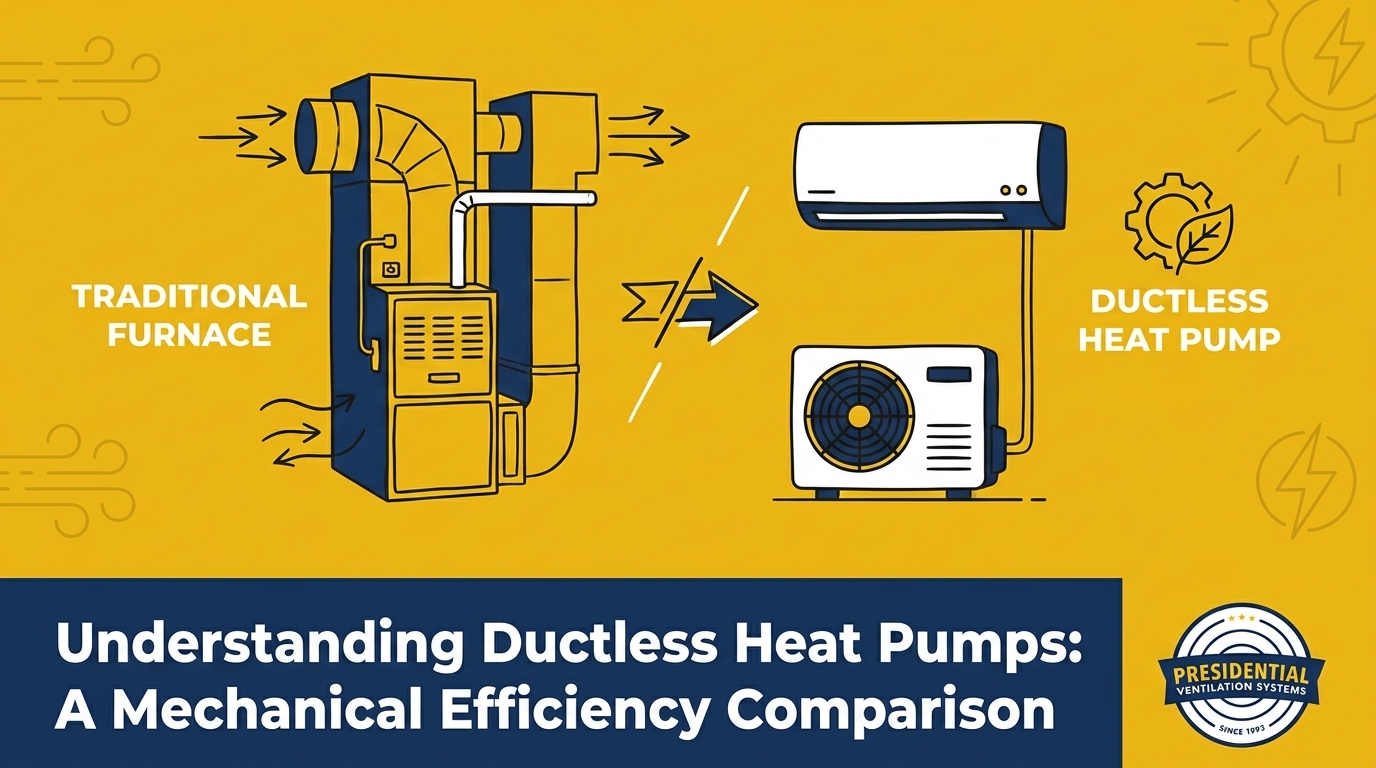

At Presidential Ventilation Systems Ltd., we often see that navigating the various heating system options comparisons for homeowners begins when an aging furnace starts to struggle against the Mount Uniacke cold. You are likely facing a critical mechanical decision: replace your failing equipment with another traditional combustion furnace, or transition to a modern heat transfer system. This choice goes far beyond simply picking a recognizable brand; it hinges on understanding the true mechanical efficiency and the objective operational limits of different heating technologies.
Deciding between a central heat pump and a traditional fossil-fuel setup requires evaluating how consistent winter heating is achieved in a maritime climate. Homeowners must look past generic marketing benefits to see exactly how these systems perform under continuous winter stress. Transitioning away from burning oil or gas changes the fundamental infrastructure of how a house stays warm. The decision point rests on whether the superior mechanical efficiency of heat transfer justifies the initial transition away from a familiar combustion system.
To make sense of these technologies, start by reviewing objective data on ductless heat pumps and how they operate differently from legacy systems. By comparing the underlying mechanics, you can accurately assess which technology aligns with your property's thermal envelope and your long-term comfort requirements.
The problem: Traditional heating systems are fundamentally limited by the laws of thermodynamics related to combustion. A furnace generates heat by burning a consumable fuel—such as oil, natural gas, or propane. Even in the most advanced combustion systems, the mechanical efficiency ceiling is capped because a portion of the thermal energy is always lost through the exhaust flue along with the combustion byproducts.
The cause: Because a furnace must create heat from scratch by consuming a resource, it can never produce more energy than the fuel contains. If a furnace operates at 95% efficiency, it means 95 percent of the fuel consumed becomes usable heat, while the remaining 5 percent escapes outdoors. There is no physical way for a combustion system to exceed 100% efficiency.
The solution: Heat pumps bypass this limitation entirely by utilizing a refrigeration cycle to transfer ambient thermal energy rather than burning fuel to create it. Even during a sub-zero maritime winter, there is still measurable heat energy in the outdoor air. A heat pump uses specialized refrigerant that absorbs this dispersed ambient heat, compresses it to raise its temperature, and transfers it inside the house. Because moving existing heat requires significantly less electrical input than generating new heat, the mechanical efficiency of Lennox ductless systems and similar equipment can easily exceed 100%, often operating at 200% to 300% efficiency under normal conditions.
To accurately compare heating systems, homeowners must understand the specific metrics used to grade different mechanical technologies. You cannot directly compare a heat pump to a furnace using the same number, as they operate on completely different principles. Understanding these ratings ensures that properties in Mount Uniacke and surrounding areas are equipped with systems capable of handling local weather demands.
AFUE (Annual Fuel Utilization Efficiency): This metric applies exclusively to combustion systems like furnaces and boilers. It measures the percentage of fuel that is successfully converted into usable heat over an entire year. A high-efficiency gas furnace might achieve an AFUE rating of 98%, meaning only 2% of the energy is lost as exhaust.
HSPF (Heating Seasonal Performance Factor): This rating applies to heat pumps operating in heating mode. It calculates the total space heating required during the season divided by the total electrical energy consumed by the system. A higher HSPF rating indicates a more efficient unit that requires less electricity to move the same amount of thermal energy.
For a deeper dive into specific equipment ratings and performance metrics, reviewing a comprehensive guide to the best ductless heat pumps provides valuable context on how these numbers translate to real-world operation.
• Standard Gas Furnace — Efficiency Metric: AFUE — Maximum Efficiency Ceiling: Up to 98% — Operational Mechanism: Combustion (Burns fuel to create heat)
• Oil Furnace — Efficiency Metric: AFUE — Maximum Efficiency Ceiling: 80% - 87% — Operational Mechanism: Combustion (Burns fuel to create heat)
• Standard Heat Pump — Efficiency Metric: HSPF — Maximum Efficiency Ceiling: Up to 250% — Operational Mechanism: Heat Transfer (Moves ambient heat)
• Cold-Climate Heat Pump — Efficiency Metric: HSPF — Maximum Efficiency Ceiling: Up to 300%+ — Operational Mechanism: Enhanced Heat Transfer (Inverter-driven)
Temperature thresholds: The most critical factor in evaluating a heat pump is its objective operational limit during extreme weather. Standard heat pumps—often designed for milder southern climates—begin losing significant efficiency just below the freezing mark. As the temperature drops, there is less ambient thermal energy available, forcing the compressor to work harder to extract heat. Eventually, a standard unit reaches a balance point where it can no longer extract enough heat to keep the indoor space warm without relying on auxiliary electric resistance heating.
Cold-climate engineering: Modern cold-climate ductless heat pumps are engineered specifically to bypass these traditional limits. Utilizing advanced variable-speed inverter compressors and enhanced refrigerant management, these systems can operate efficiently in temperatures as low as -25 degrees Celsius. They physically accelerate the compressor speed to draw more thermal energy from the frigid air, maintaining indoor comfort through a sub-zero maritime winter.
Understanding these mechanical limits helps determine if a hybrid dual-fuel system or a complete transition to heat transfer is the right choice. For example, our technicians at Presidential Ventilation Systems Ltd. recently assessed a Mount Uniacke homeowner's existing, non-company installed heat pump system to evaluate its cold-weather performance. Our team explained the objective pros and cons of the current equipment's mechanical limits and offered helpful alternatives and advice for running the system efficiently despite its specific temperature thresholds.
Transitioning away from a traditional oil burner to a central or ductless heat pump system fundamentally alters a property's electrical load. A furnace primarily uses electricity just to run the blower motor, while a heat pump relies on electricity to power the heavy-duty outdoor compressor. We frequently find that older homes may require electrical panel upgrades—often moving from a 100-amp service to a 200-amp service—to safely support the continuous electrical draw of modern heating systems. Evaluating the existing electrical infrastructure is a mandatory step before committing to a heat transfer upgrade.
Cold temperatures are only one variable in the mechanical performance equation; ambient moisture plays a massive and often overlooked role. In our years of installing systems across Nova Scotia, we've found that the dampness of maritime winters requires specialized defrost capabilities, focusing on the specific challenges of high humidity combined with freezing temperatures. When a heat pump operates in heating mode, the outdoor coil becomes extremely cold—often colder than the ambient air—which causes moisture in the humid air to condense and freeze on the metal fins.
To maintain efficiency, the system must periodically clear this frost accumulation through an automatic defrost cycle. Here is the step-by-step mechanical process of how a system manages high humidity during a sub-zero maritime winter:
1. Frost Accumulation: High ambient humidity in the cold maritime air contacts the freezing outdoor condenser coils, rapidly forming a layer of frost that insulates the fins and restricts airflow.
2. Sensor Activation: Internal thermistors and solid-state control boards detect the drop in airflow and the changing temperature differential across the coil, signaling that the unit is losing efficiency.
3. Reversing the Valve: The system temporarily reverses the flow of refrigerant, shifting from heating mode to cooling mode. This redirects the hot, compressed refrigerant gas back outdoors instead of inside the house.
4. Ice Melt and Drainage: The hot refrigerant rapidly melts the accumulated ice on the outdoor coil. The resulting water must freely drain away from the base pan to prevent solid ice blocks from forming inside the chassis.
5. Resuming Heating: Once the sensors detect the coil is clear of ice, the reversing valve shifts back, and the system resumes extracting heat from the outdoor air to warm the home.
During this brief defrost period, the indoor unit temporarily stops blowing warm air. Systems engineered for damp, cold climates complete this cycle rapidly to minimize any disruption to indoor comfort.
Even the most advanced mechanical equipment will fail to reach its advertised efficiency ratings if the installation parameters are incorrect. Equipment ratings are only accurate if the system is precisely sized and installed correctly for the specific thermal envelope of the home. Certified installation practices, such as maintaining Daikin Comfort Pro status, directly impact a system's ability to maintain efficiency during extreme weather by ensuring strict adherence to manufacturer specifications.
• Precise Load Calculations: Technicians must perform detailed calculations to match the equipment capacity to the home's exact square footage, insulation levels, and window quality. Oversized units will short-cycle, while undersized units will run constantly without satisfying the thermostat.
• Strategic Outdoor Placement: Proper placement of outdoor units is critical in Mount Uniacke and surrounding areas to prevent snow burial. Units must be elevated on stands or wall brackets to allow for adequate defrost drainage and unobstructed airflow during heavy snowfall.
• Refrigerant Line Sizing: The copper lines connecting the indoor and outdoor units must be sized correctly and purged with nitrogen to prevent moisture and non-condensables from degrading the compressor oil.
• Documentation and Compliance: Navigating warranties and available rebates requires meticulous documentation during the installation phase. A recent project of ours demonstrated this full lifecycle: after providing a comprehensive quote, our installation team followed up, completed the installation, submitted the manufacturer warranty, and clearly explained the rebate process to the homeowner.
Executing these technical prerequisites accurately is why professional heat pump installations are vital for long-term mechanical reliability.
The ongoing mechanical care required for heat transfer systems differs significantly from combustion systems. Traditional furnaces require annual checks primarily focused on combustion safety. Our service technicians must inspect heat exchangers for microscopic cracks that could leak carbon monoxide, ensure the exhaust flues are drafting correctly, and clean the burner assemblies to maintain a safe flame.
Ductless systems and central heat pumps do not have combustion hazards, but they move massive volumes of air and are highly sensitive to airflow restrictions. They require frequent filter cleaning by the homeowner and professional deep cleaning of the indoor blower wheels and evaporator coils. If the micro-channel coils become clogged with household dust or pet dander, the system loses its ability to transfer heat efficiently, forcing the outdoor compressor to operate at higher pressures.
During a sub-zero maritime winter, a neglected heat pump will struggle to extract heat, leading to increased electrical consumption and premature component wear. We consistently see that preventative care directly correlates to the longevity of the compressor and the system's overall lifespan. Enrolling in a structured preventative maintenance plan ensures that both the indoor air handlers and the outdoor condenser are professionally calibrated and cleaned before the harsh weather arrives.
Choosing between a traditional combustion furnace and a modern heat transfer system comes down to understanding your home's existing infrastructure and the specific demands of the local climate. Reviewing objective options comparisons for homeowners allows you to look past the marketing language and focus on factual mechanical limits, electrical requirements, and efficiency ratings.
By evaluating how different systems handle defrost cycles, deep freezes, and ongoing maintenance, you can confidently plan your next HVAC upgrade. A clear, technically sound understanding of these operational differences ensures that the equipment you choose will provide consistent, efficient warmth. Consulting with our certified professionals at Presidential Ventilation Systems Ltd. guarantees that your chosen system is sized, placed, and installed to meet your year-round comfort expectations.
At what temperature do heat pumps lose efficiency?
Standard heat pumps typically begin to lose efficiency as temperatures drop below freezing (0°C). However, modern cold-climate heat pumps are engineered with advanced compressors that maintain high efficiency and heat output in temperatures as low as -25°C. The exact drop-off point depends heavily on the specific make and model of the equipment.
How does a maritime climate affect heat pump performance?
A damp maritime climate accelerates frost buildup on the outdoor condenser coils due to high ambient humidity. This requires the heat pump to initiate automatic defrost cycles more frequently to melt the accumulated ice. Systems installed in these regions must be specifically designed to handle rapid defrosting without severely interrupting indoor heating.
Can a heat pump replace a furnace completely?
Yes, a properly sized cold-climate heat pump can completely replace a traditional furnace in most homes. The property must have an adequate electrical panel to support the system, and the unit must be rated for the lowest expected winter temperatures in your specific region. In some cases, homeowners opt for a hybrid system that uses both technologies.
Is it better to have a heat pump or a furnace in Canada?
The better option depends on the specific region, the home's insulation, and the local cost of electricity versus fossil fuels. Cold-climate heat pumps offer superior mechanical efficiency and operate without producing carbon monoxide, making them highly effective for many Canadian homes. Furnaces may still be preferred in extreme northern climates where temperatures consistently remain below -30°C for extended periods.
Why does my heat pump's outdoor unit ice up in the winter?
It is completely normal for a thin layer of white frost to accumulate on the outdoor unit during winter operation, as the freezing coils condense moisture from the air. The system is designed to automatically melt this frost using a built-in defrost cycle. If the unit becomes encased in a solid block of thick ice that does not melt, it indicates a mechanical issue that requires professional service.
What are the electrical requirements for switching to a heat pump?
Switching from a fossil-fuel furnace to a heat pump often requires a dedicated 220-volt circuit for the outdoor compressor. Many older homes with 100-amp electrical panels need to be upgraded to 200-amp service to safely handle the increased electrical load. A certified electrician or HVAC technician must evaluate your current panel before installation.

At Presidential Ventilation Systems, our team knows firsthand that before the first freeze hits and the damp Nova Scotia shoulder season takes hold, there is a narrow window to secure reliable heating for your home. If you are planning an HVAC upgrade, managing the removal of abandoned oil tanks during a heat pump conversion in Sackville, NS, is one of the most time-sensitive projects you can tackle. The transition from an aging fossil fuel system to a modern, efficient electric setup is a smart investment, but it requires precise logistical coordination to execute safely.
Ready to upgrade your home's comfort? Explore your heat pump installation options today.
Sackville's freezing winters are unforgiving. When temperatures plummet, your home cannot sit without an active heat source for days while you wait for different contractors to finish their part of a project. A delayed heating transition does not just mean a few days of wearing extra sweaters; it introduces the severe risk of frozen pipes, burst plumbing, and structural cold damage. Upgrading from an aging oil furnace to a modern electric heat pump involves two massive tasks that must happen in tandem: achieving environmental compliance by safely decommissioning your old oil tank, and maintaining a warm, safe home throughout the installation process.
The core logistical challenge lies in the overlap. You cannot simply leave an old oil tank sitting in your basement or yard once it is disconnected, and you cannot install a high-efficiency electric heating system without ensuring your home's electrical panel is ready for the load. Professional coordination is absolutely required to bridge the gap between safely removing the environmental hazard of an old tank and activating your new heating system without losing heat when you need it most.
When you decide to switch away from oil heating, dealing with the leftover tank is not an optional step—it is a strict regulatory requirement. In our 30+ years serving Nova Scotia, our technicians have seen countless homeowners completely unaware of the liability sitting in their basements or side yards. The Nova Scotia Environment and Climate Change (NSECC) guidelines clearly dictate how unused domestic oil tanks must be handled to protect the local environment.
Leaving an unused oil tank on your property presents significant environmental and financial risks. Over time, steel tanks corrode from the inside out due to condensation and sludge buildup. Even if a tank is empty, residual oil and sludge remain at the bottom.
• Soil Contamination: A corroded outdoor tank can leak residual sludge into the surrounding soil, leading to a costly environmental cleanup.
• Groundwater Risks: Contaminants can quickly reach local groundwater, creating hazards for your property and your neighbors.
• Indoor Air Quality: Indoor tanks that slowly degrade can release strong petroleum odors into your basement, compromising your home's air quality.
Home insurance providers take aging and abandoned oil tanks very seriously during property transitions. If you transition to a heat pump and leave a disconnected oil tank on the premises, your insurance company may view the property as an active environmental liability. Many providers will refuse to renew a policy—or will drop coverage entirely—if they discover an abandoned, undecommissioned tank on the property. Safe decommissioning involves pumping out residual oil, safely disconnecting and capping fill pipes, and removing the tank structure entirely in compliance with NSECC standards. It is a protective measure for your property value, your insurance standing, and the local ecosystem.
A major oversight many homeowners make during an HVAC retrofit is ignoring the home's electrical capacity. Moving from a fossil fuel system to an electric heat pump fundamentally changes your home's electrical load. An old oil furnace relies on a small amount of electricity to run the blower motor and the igniter. A modern heat pump, however, uses electricity to power the compressor, the condenser fan, the indoor air handler, and often a set of auxiliary electric heat strips for extreme weather.
Because of this increased demand, a 200-amp service upgrade is frequently necessary. At Presidential Ventilation Systems, our in-house electrical division frequently encounters outdated 100-amp panels in older homes that simply cannot safely support new HVAC equipment. If you attempt to install a robust heating system on an outdated panel, you risk overloaded circuits, frequent breaker trips, and potential fire hazards. Having qualified electricians assess your panel before the HVAC installation begins is a critical safety step.
For example, one homeowner reached out to us during the summer with concerns about the efficiency and capacity of their existing setup. One of our specialists visited the home to review the system, explain efficiency options, and confirm that their electrical infrastructure could safely handle the transition to ducted heat pump systems. This proactive assessment ensured the new equipment would run smoothly without overtaxing the home's electrical grid. Ignoring your electrical capacity during a major retrofit is a recipe for system failure and safety hazards down the road.
Upgrading your heating system while decommissioning an oil tank usually involves a frustrating scheduling puzzle. The traditional approach requires hiring separate environmental contractors to pump the tank, a demolition crew to remove it, an electrician to upgrade the panel, and an HVAC company to install the heat pump.
Trying to align schedules for tank removal, electrical upgrades, and the new system installation is a common frustration. The specific risk here is severe heating downtime. If the electrician is delayed by two days, the HVAC installer cannot turn on the new heat pump. If the tank removal crew is late, the physical space needed for the new air handler might not be clear. When communication breakdowns occur between disparate companies, you are the one left shivering in a cold house.
The Integrated Solution: An integrated approach eliminates these delays. When you are transitioning from oil forced air to a central ducted heat pump, relying on a single-source contractor like Presidential Ventilation Systems means the schedule is managed internally. Our electricians, tank removal specialists, and HVAC technicians work under one roof, ensuring that as soon as the old system is safely decommissioned, the electrical panel is ready, and the new heat pump is immediately brought online.
• Scheduling — Multi-Contractor Approach: Requires coordinating 3-4 separate companies. — Single-Source Approach: One phone call, one unified project timeline.
• Heating Downtime — Multi-Contractor Approach: High risk of multi-day delays if one trade falls behind. — Single-Source Approach: Seamless transition, often completed within a single day.
• Accountability — Multi-Contractor Approach: Contractors may blame each other for delays or issues. — Single-Source Approach: One company holds full responsibility for the outcome.
• Electrical Prep — Multi-Contractor Approach: Requires a separate visit and permit from an outside electrician. — Single-Source Approach: In-house electricians handle upgrades concurrently.
Managing this complex transition requires a strict, authoritative step-by-step methodology. Because Presidential Ventilation Systems features in-house HVAC, electrical, ventilation, and sheet-metal divisions manned by a team of approximately 70 professionals, we execute this sequence seamlessly, eliminating the dangerous downtime that puts your home at risk.
Recently, a homeowner needed a new heat pump installed in the dead of winter. Because our team handles the entire process internally, the installation was completed efficiently within a single day, ensuring the house did not sit without heat during freezing temperatures. Here is how our professional, single-source team manages the sequence:
1. Comprehensive Site Assessment: Before any tools are lifted, a thorough evaluation of the existing oil tank, the home's electrical panel, and the ductwork layout is conducted. This ensures there are no surprises on installation day.
2. Electrical Panel Upgrade: Our Red Seal electricians upgrade the electrical service (often to 200 amps) prior to installation, ensuring the home can handle the new load safely and legally.
3. Safe Tank Decommissioning: The old oil tank is pumped, safely disconnected, and removed from the property in strict compliance with NSECC standards, eliminating environmental and insurance liabilities.
4. Heat Pump Installation and Commissioning: The new electric heating system is installed, connected to the upgraded panel, and thoroughly tested to ensure peak performance and immediate comfort.
By keeping every step under one roof, you receive professional heating services that prioritize both your safety and your comfort.

Upgrading your home's heating infrastructure is a significant investment, but there is often financial support available to ease the transition. Provincial and federal rebate programs frequently exist to support oil-to-heat-pump conversions, designed specifically to offset the costs of upgrading to energy-efficient electric systems.
These incentives can make a substantial difference in your project's overall return on investment. However, navigating the paperwork requires attention to detail. Proper documentation of the tank decommissioning and the new equipment's efficiency ratings is usually mandatory to qualify.
Important Disclaimer: Rebate programs, funding availability, and eligibility requirements can change frequently. We strongly advise homeowners to confirm current programs and eligibility directly with the Presidential Ventilation Systems team during an initial free estimate. By working with an experienced contractor, you ensure that the equipment selected meets the specific criteria required by current incentive programs, and that all necessary documentation is handled correctly from day one.
Environmental compliance and proper electrical sizing are universal requirements across the province. Whether you live in a historic neighborhood with tight property lines or a newer development, the rules regarding oil tank safety and electrical codes remain the same. As a Daikin Comfort Pro with over three decades of experience across residential, commercial, and new construction projects, our professional teams are equipped to handle complex retrofits regardless of the specific neighborhood challenges.
Maritime weather waits for no one, which reinforces the need to secure reliable heating before the temperature drops. Proactive scheduling is your best defense against winter emergencies. By coordinating your project early, you ensure your home is secure, compliant, and comfortable well before extreme weather arrives. Check our HVAC service areas to see how we can assist your property.
The process begins with safely pumping out any residual oil and sludge from the tank. Next, technicians disconnect and cap all fill and vent pipes to prevent accidental deliveries. Finally, the tank is physically removed from the property and disposed of at a certified facility in accordance with Nova Scotia environmental regulations.
In most cases, yes, an electrical panel upgrade is required when switching from fossil fuels to a heat pump. Oil furnaces use minimal electricity, while heat pumps require a dedicated 200-amp service to safely power the compressor, air handler, and auxiliary electric heat strips without overloading the system. Our in-house electricians can assess and upgrade your panel as part of the conversion process.
Yes, leaving an unused oil tank on your property is highly discouraged and often violates local environmental and insurance mandates. Unused tanks must be properly decommissioned to prevent soil contamination, groundwater pollution, and potential liability issues with your home insurance provider.
Abandoned oil tanks must be removed by qualified professionals who understand provincial environmental regulations. Hiring a comprehensive contractor like Presidential Ventilation Systems, who handles both the tank decommissioning and the new HVAC installation, ensures the removal is done safely and legally without interrupting your home's heating schedule.
Leaving an unused oil tank on your property is a significant risk that can lead to dropped insurance coverage and environmental fines. Even empty tanks contain residual sludge that can corrode the steel and leak into the surrounding soil, creating a hazardous and costly cleanup situation.
A single contractor prevents downtime by coordinating the electrical, environmental, and HVAC teams internally. Because our electricians and installers work together under one roof, the panel is upgraded and the new heat pump is installed the exact same day the old oil system is decommissioned, ensuring your home stays warm.
Abandoning an oil tank and upgrading to a heat pump does not have to be a stressful, multi-contractor ordeal. When you rely on experienced professionals who handle both the environmental decommissioning and the complex electrical demands, the process becomes streamlined and secure. Managing the removal of abandoned oil tanks during a heat pump conversion in Sackville, NS, requires precision, adherence to provincial regulations, and a commitment to keeping your home warm throughout the transition. By choosing an integrated approach with our in-house Red Seal tradespeople, you gain the peace of mind that your property is safe and your new system will operate flawlessly. Contact Presidential Ventilation Systems today to request a free estimate and discuss your home's conversion needs.

At Presidential Ventilation Systems, a pattern we see often in our residential and commercial projects is the misconception that a 200-square-foot glass enclosure requires the exact same cooling capacity as a standard residential bedroom. Selecting a ductless system primarily for summer cooling in south-facing sunrooms demands an entirely different approach than conditioning an interior hallway or den. If you buy an off-the-shelf unit based solely on room dimensions, you will likely encounter a frustrating problem our Red Seal tradespeople are frequently called to fix: a system that short-cycles, leaving the space feeling cold but distinctly clammy. True comfort requires balancing the temperature drop with active dehumidification.
To establish the right baseline for your home's unique layout, explore our ductless heat pumps and review the capabilities of Lennox ductless systems.
The standard rule of thumb for HVAC sizing relies heavily on square footage, assuming standard insulation, standard ceiling heights, and a typical number of windows. However, in our experience handling new construction and home renovations throughout Nova Scotia, a south-facing sunroom shatters all of these assumptions. The intense summer solar gain pouring through expansive glass walls creates a thermal environment completely unlike the rest of your house.
Furthermore, Nova Scotia's humid maritime summers compound the short-cycling problem. If a unit is oversized for the square footage to combat the heat, it blasts cold air and shuts off too fast. Because it shuts down prematurely, it fails to run long enough to remove the heavy maritime humidity from the air. The result is a room that hits 20°C on the thermostat but feels damp and uncomfortable. Understanding the difference between sensible cooling and latent cooling is the key to solving this issue.
The Problem: Sunrooms are designed to capture light, but in doing so, they also capture immense amounts of thermal energy. During peak July and August afternoons, a south-facing room acts like a thermal battery. The heat enters, but the glass prevents it from easily escaping, creating a dual-load challenge for any climate control system.
The Cause: This phenomenon is known as solar heat gain. Radiant energy from the sun passes through the glass and strikes the floors, furniture, and walls. These objects absorb the energy and reradiate it as infrared heat. Because standard window glass is largely opaque to infrared radiation, the heat becomes trapped inside the room. This is the classic greenhouse effect. If you compare a highly insulated interior room to a sunroom with extensive glazing, the sunroom might require two to three times the cooling capacity simply to counteract the sun, regardless of the square footage.
The Solution: Counteracting the greenhouse effect requires a system designed specifically for high sensible heat loads. It means looking beyond the physical dimensions of the room and calculating the exact amount of solar energy entering the space during the hottest part of the day.
The type of glass in your sunroom plays a massive role in how much heat enters the space. The Solar Heat Gain Coefficient (SHGC) is a metric that measures the fraction of solar radiation admitted through a window. A lower SHGC means less heat is transmitted.
• Single-pane glass: Offers almost no resistance to solar heat gain, resulting in massive temperature spikes.
• Standard double-pane: Provides better insulation but still allows significant radiant heat through.
• Low-E coated glass: Reflects a portion of the infrared energy, reducing the cooling load, though rapid temperature spikes on sunny days still occur.
Even in a well-insulated sunroom with high-quality Low-E windows, the sheer volume of glass means the space will experience rapid temperature spikes on sunny days, demanding a highly responsive cooling solution.
To properly condition a high-glass space, you have to understand how air conditioners actually treat the air. An air conditioning system performs two distinct jobs simultaneously: lowering the temperature and removing moisture. These two functions are technically referred to as sensible cooling and latent cooling.
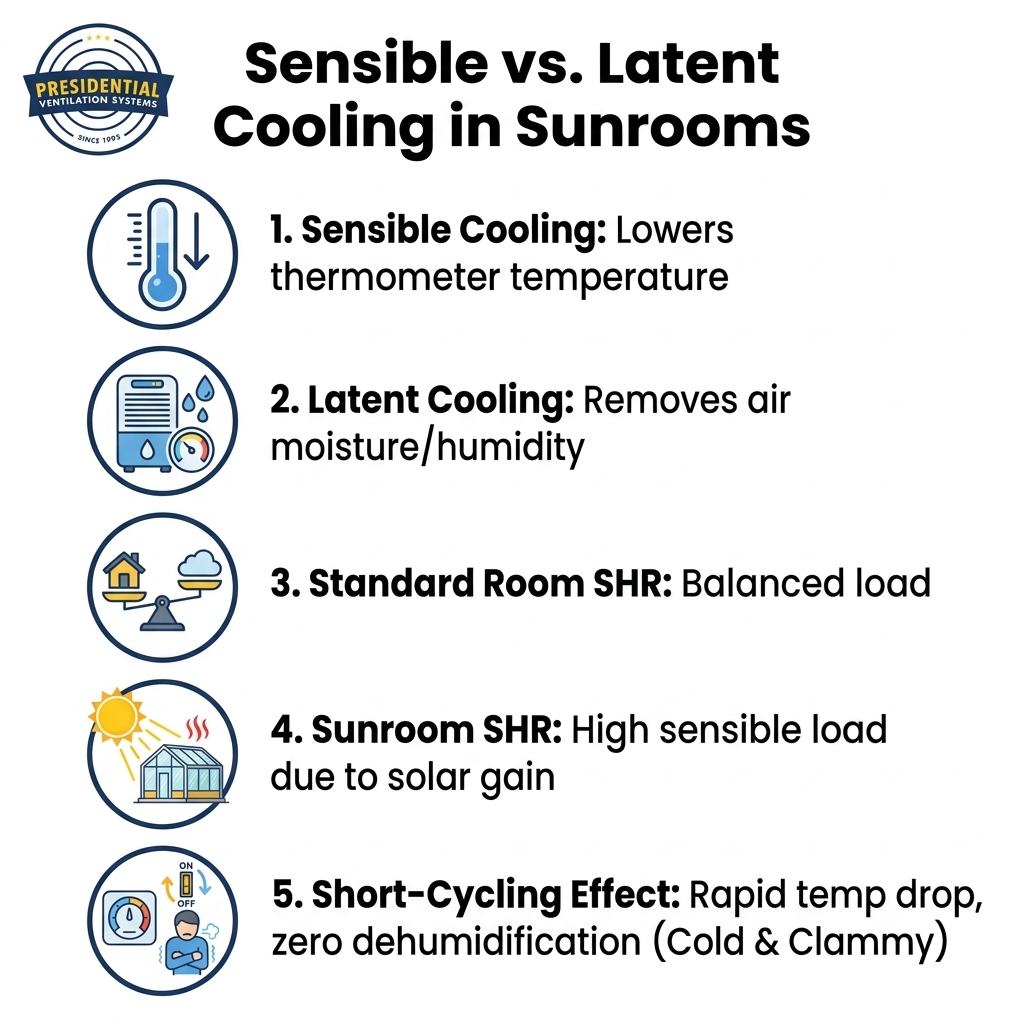
Sensible cooling is the system's ability to lower the actual air temperature—the metric you feel on your skin and read on a thermometer. Latent cooling is the system's ability to extract moisture and humidity from the air. The ratio between these two functions is called the Sensible Heat Ratio (SHR). A standard living room might require an SHR of 0.75 (meaning 75% of the system's effort goes to dropping the temperature and 25% goes to removing humidity). However, a sunroom baking in the afternoon sun requires a system optimized for a much higher sensible heat load.
• Sensible Cooling — What It Does: Lowers the measurable air temperature (thermometer reading). — Sunroom Impact: Must be exceptionally high to combat direct solar radiation entering through glass.
• Latent Cooling — What It Does: Removes water vapor and humidity from the air. — Sunroom Impact: Requires sustained system run-time to pull moisture out of humid maritime air.
• Sensible Heat Ratio (SHR) — What It Does: The balance between temperature drop and moisture removal. — Sunroom Impact: Sunrooms need a specific SHR to avoid dropping the temperature faster than the humidity.
If you are exploring different equipment options, our best ductless heat pumps guide outlines how different systems balance these critical ratios.
Short-cycling occurs when an oversized unit blasts a massive amount of cold air into a small space, satisfying the thermostat in a matter of minutes. Because the thermostat only measures sensible heat (temperature), it tells the system to shut off.
The problem is that the indoor evaporator coil needs sustained, continuous run time to effectively pull moisture from the air. When the system shuts down after five minutes, the latent cooling process stops entirely. The result is a rapid temperature drop with zero dehumidification, leading directly to the dreaded "cold and clammy" effect.
Finding the right equipment for a sunroom means looking beyond familiar brand names and focusing on the technical specifications that dictate performance. As a Daikin Comfort Pro contractor, our team recommends prioritizing one critical feature for a sunroom: a variable-speed (inverter) compressor. Unlike older single-stage units that only run at 100% capacity or 0%, an inverter compressor can modulate its output to perfectly match the fluctuating solar load.
As the sun shifts behind a cloud, the compressor slows down. As the afternoon sun hits the glass directly, the compressor ramps up. This continuous, modulated operation is the absolute best way to maintain long run times, ensuring both the sensible temperature is managed and the latent humidity is consistently extracted.
We see the importance of this careful selection frequently in our field work around the Mount Uniacke NS area. Last summer, a homeowner reached out to have heat pumps installed with careful attention to detail for their specific layout. By thoroughly assessing the space and taking the time to answer their questions about handling intense solar loads, our installation team delivered a finished product that left the customer completely satisfied.
When selecting the physical indoor unit, you also have to consider airflow. In a glass-heavy space, wall space is often at a premium. While traditional high-wall mounts are common, floor-mounted indoor units (often installed on dwarf walls beneath windows) can provide excellent upward airflow that washes the glass, preventing condensation and maintaining an even temperature profile. Because of these variables, relying on professional load calculations (Manual J) is necessary. Generic online BTU calculators cannot account for the specific orientation, glass type, and shading of your sunroom. For a system engineered to handle these precise demands, many homeowners turn to Lennox ductless systems.
The Problem: Adding a dedicated ductless system for a sunroom isn't just an HVAC project; it is an electrical project. A new heat pump requires a dedicated circuit, and simply adding breakers to an existing panel without verification can lead to overloaded circuits and tripped breakers.
The Cause: Many older Nova Scotia homes operate on 100-amp electrical services or have panels that are already physically full. When homeowners attempt to add a new 15-amp or 20-amp 240V circuit for a sunroom mini-split, they often discover their electrical infrastructure cannot safely support the additional load.
The Solution: Verifying panel capacity before finalizing the HVAC design is a non-negotiable step. In our 30+ years of multi-trade expertise across Nova Scotia, we have seen the pitfalls of the fragmented approach—where a homeowner hires a heat pump installer, only to be told halfway through the job that they need to go find an electrician. Because Presidential Ventilation Systems maintains in-house electrical and HVAC divisions, we handle both the precise load calculations and the licensed electrical panel upgrades under one roof. This ensures the installation process remains seamless, compliant, and safe.
The physical environment of a sunroom presents unique installation challenges that dictate the long-term performance and lifespan of the equipment. Proper planning by an experienced contractor is required to ensure the system operates efficiently without obstructing the view.
1. Assessing Available Wall Space: Sunrooms are primarily glass, leaving very little structural wall space for mounting indoor units. Technicians must carefully locate solid framing that can support the unit's weight while ensuring the airflow isn't blocked by furniture or architectural features.
2. Routing Line Sets and Drainage: The refrigerant lines and condensate drains must be routed to the exterior. In a room made of glass, hiding these lines requires careful planning to maintain the aesthetic appeal of the space. Gravity-fed condensate drains must have a proper slope, or a condensate pump must be integrated.
3. Evaluating Multi-Zone vs. Single-Zone: Homeowners often ask if they can just add a new head to an existing multi-zone heat pump system. While sometimes possible, sunrooms experience peak cooling demand at different times than the rest of the house. A completely independent single-zone system often provides better dedicated climate control for the extreme solar load.
4. Ensuring Proper Placement: Where the unit is placed affects both sensible and latent cooling efficiency. If installed too high in a vaulted sunroom, it may struggle to condition the living space below. Professional installation ensures the unit is positioned to optimize air distribution.
Last fall, a homeowner expressed concerns regarding an existing, inefficient heat pump system that another company had installed in their sunroom. After inspecting the system, our technicians provided helpful advice and efficiency tips, giving the customer clear guidance on improving their setup to better handle the space. To ensure your project is handled correctly from day one, trust a professional heat pump installation team.
Because sunroom systems operate under heavy loads during peak summer months, they require diligent upkeep to maintain their efficiency and protect the compressor.
• Clean the indoor filters frequently: High run-times mean more air is circulating through the filters. Check and wash the reusable filters every few weeks during peak summer to ensure unrestricted airflow.
• Keep the outdoor condenser clear: The outdoor unit needs to dissipate the massive amount of heat extracted from the sunroom. Keep vegetation, debris, and outdoor furniture at least two feet away from the condenser coil.
• Monitor for proper drainage: Because the system is doing heavy latent cooling (dehumidification), it will produce a significant amount of condensate water. Ensure the drain line remains clear and flows freely away from the home's foundation.
• Schedule professional deep cleaning: Over time, the indoor blower wheel and evaporator coil will accumulate micro-dust and organic growth. A professional deep clean restores the system's ability to transfer heat and extract moisture efficiently.
Preventive maintenance protects the compressor from the strain of heavy solar loads. To keep your system running at peak performance, consider enrolling in a comprehensive preventive maintenance plan.
Why is my sunroom mini split not dehumidifying?
If your system isn't removing moisture, it is likely short-cycling due to being oversized for the space. When a unit cools the room too quickly, it shuts off before the evaporator coil has time to extract humidity from the air. This results in a cold but clammy environment. A professional load calculation can determine if your system's sensible heat ratio is mismatched to the room.
What size mini split do I need for a 200 sq ft sunroom?
Sizing a system for a sunroom cannot be done accurately using only square footage. Because of the intense solar heat gain through the glass, a 200-square-foot sunroom often requires significantly more capacity than a standard room of the same size. A licensed HVAC technician must perform a Manual J load calculation to account for your specific glass type, insulation, and sun exposure.
Can you put a mini split in a 4 season room?
Yes, a ductless mini-split is often the ideal solution for a 4-season room. These systems provide both high-efficiency summer cooling and reliable winter heating without requiring ductwork. However, the installation requires careful planning regarding unit placement and electrical capacity to ensure it can handle the room's unique thermal loads year-round.
What is the best way to cool a sunroom?
The most effective way to cool a sunroom is by installing a dedicated ductless heat pump with a variable-speed inverter compressor. This technology modulates its cooling output to match the shifting solar load throughout the day. It provides consistent temperature control and superior dehumidification compared to window units or extending existing central ductwork.
How does sensible cooling differ from latent cooling in HVAC?
Sensible cooling refers to the system's ability to lower the actual air temperature, which is what you read on a thermometer. Latent cooling is the system's ability to remove moisture and humidity from the air. In high-glass spaces, balancing these two factors is critical to preventing the room from feeling damp and uncomfortable.
Do I need an electrical panel upgrade to add a heat pump to my sunroom?
Adding a new dedicated heat pump requires an available 240V circuit on your electrical panel. If your home has an older 100-amp service or a panel that is already full, an upgrade or a sub-panel may be required. As a multi-trade contractor, Presidential Ventilation Systems can assess your electrical capacity and handle both the HVAC and electrical requirements safely.
Cooling a sunroom effectively requires more than just guessing at square footage; it requires a precise understanding of sensible cooling ratios and proper electrical integration. With over 30 years of multi-trade expertise in Nova Scotia and a team of approximately 70 employees, Presidential Ventilation Systems ensures your system is sized perfectly and installed safely. If you are considering an installation, retrofit, or oil-to-heat-pump conversion, there may be rebates available. Because rebate programs and eligibility can change, we recommend confirming current programs directly with our team. Contact Presidential Ventilation Systems today to request a free estimate for your sunroom project.