


The early fall weather is finally arriving in Nova Scotia, but instead of cozy comfort, you might find yourself wondering why we check the heat pump contactor when your unit blows warm air in September. You turn on your system to take the chill out of the evening air, and nothing but unconditioned, tepid air comes through your vents. It is incredibly frustrating to experience a sudden temperature control failure right at the September seasonal changeover.
Most homeowners immediately suspect a broken thermostat or a refrigerant leak when the system fails to heat properly. However, a typical pattern we see is that the problem frequently traces back to a worn mechanical relay located inside the outdoor unit. This small but vital component takes the absolute brunt of heavy summer wear and tear.
Recognizing this specific mechanical failure requires a professional diagnosis, not just repeatedly adjusting your thermostat settings in hopes the system will catch up. For a deeper understanding of how these core components operate together, explore our comprehensive guide to heat pump systems.
To understand why your system is struggling, you have to look at the mechanical reality of how it operates. The contactor is a high-voltage electromagnetic relay switch that acts as the primary gatekeeper for your system's most power-hungry components. When you adjust your indoor temperature, your thermostat sends a low-voltage signal (usually 24 volts) out to this relay.
Once that low-voltage signal reaches the outdoor unit, it energizes a magnetic coil inside the contactor. This magnetic force physically pulls a set of heavy metal contacts together, closing the circuit. When those metal plates touch, they allow high-voltage electricity (typically 240 volts) to flow directly into the compressor and the outdoor fan motor.
This mechanical movement is absolute critical for your unit to switch modes and provide the requested air temperature. Without a solid, clean connection at the contactor, the heavy-duty components simply cannot start. If this mechanical bridge fails, you will need professional heating services to restore your home's comfort and keep your equipment running safely.
• Thermostat Connection — Voltage Level: Low Voltage (24V) — Primary Function: Sends the command to start or stop the heating/cooling cycle.
• Magnetic Coil — Voltage Level: Low Voltage (24V) — Primary Function: Creates the magnetic field that pulls the metal contacts together.
• Metal Contacts — Voltage Level: High Voltage (240V) — Primary Function: Closes the main circuit to deliver heavy power to the system.
• Compressor & Fan — Voltage Level: High Voltage (240V) — Primary Function: Circulates refrigerant and air to physically heat or cool your home.
You might wonder why this specific component tends to fail just as the seasons change. The answer lies in the cumulative effect of summer cooling cycles. Throughout a hot summer, your heat pump turns on and off thousands of times. Every single time that contactor engages to battle the summer heat, it handles a massive surge of electrical current.
Over months of heavy electrical loads, this continuous operation takes a severe physical toll on the metal contact points. The failure peak during the early fall is a direct result of the heavy electrical load from the preceding summer.
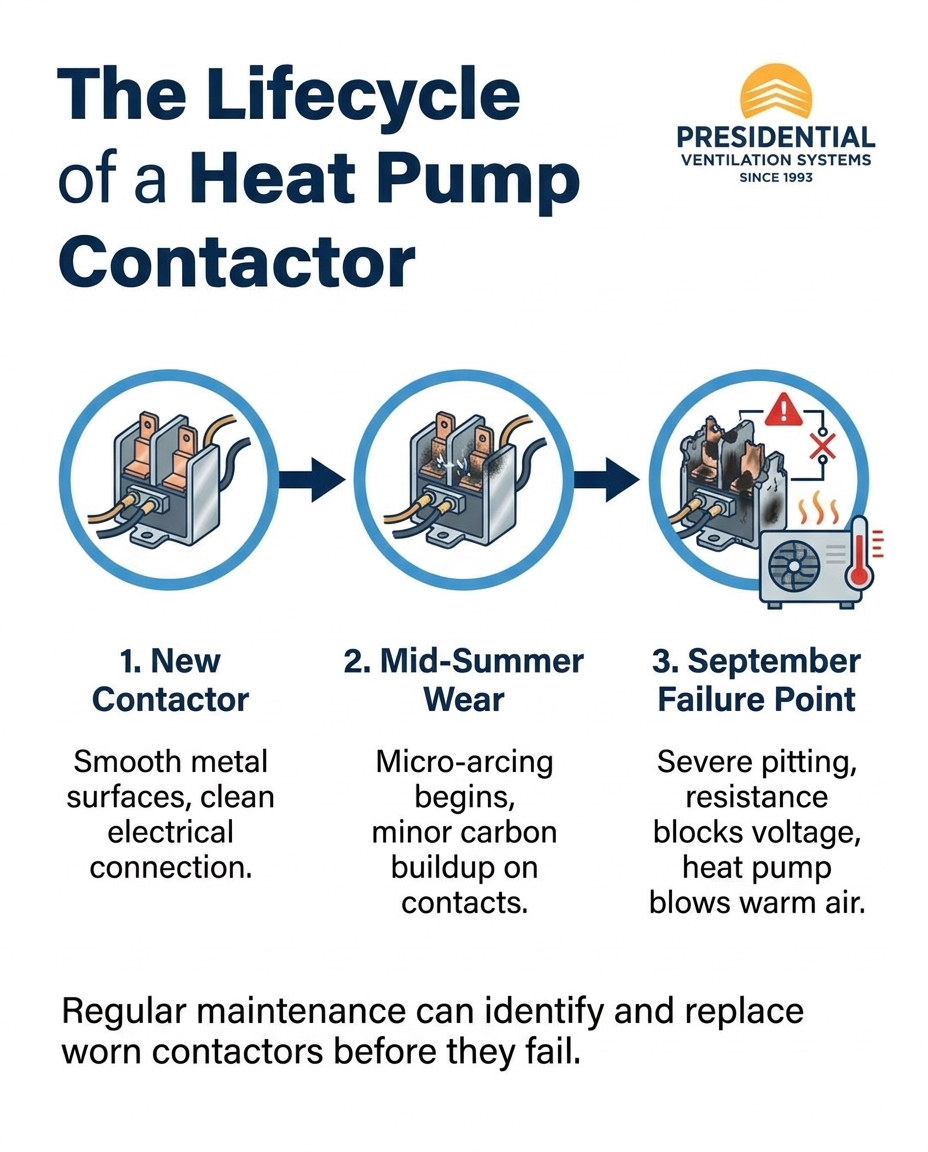
• New condition: The metal contacts are smooth, flat, and provide a perfectly clean connection for electricity to flow.
• Mid-summer wear: The constant opening and closing begins to leave minor carbon deposits on the metal surfaces.
• Early fall failure: The surfaces become deeply pitted and covered in carbon, creating physical resistance that disrupts the voltage.
This pitting creates severe electrical resistance. When the resistance becomes too high, the contactor will either stick closed (causing the outdoor unit to run constantly) or fail to engage completely (meaning the compressor never starts, resulting in warm air blowing from your vents).
The primary culprit behind this degradation is electrical arcing. Arcing is a miniature spark of electricity that jumps across the tiny gap between the metal contacts just milliseconds before they physically touch, and again just as they pull apart.
Because the contactor handles such high voltage, this arcing is completely unavoidable in mechanical switches. The resulting heat from that tiny spark slowly burns and degrades the metal surfaces over time. After thousands of cycles, what used to be a smooth, flat metal plate looks like a miniature, scorched crater, preventing the clean transfer of power.
The physical wear on electrical components is not just about usage; it is heavily influenced by your local environment. In areas like Mount Uniacke NS, the maritime weather plays a massive role in how quickly these parts degrade. High summer humidity significantly increases the severity of electrical arcing. Moisture in the air acts as a conductor, making those miniature sparks hotter and more destructive every time the relay engages.
Humid summers: The heavy moisture content in maritime air accelerates corrosion on exposed mechanical relays within the outdoor unit. Even with protective casing, the ambient humidity slowly oxidizes the metal components, compounding the damage caused by electrical arcing.
Unpredictable autumns: As the season shifts, unpredictable temperature swings force the heat pump to switch frequently between heating and cooling modes. This rapid cycling places immense stress on an already worn component right at the moment it is most vulnerable.
Experienced local HVAC technicians understand these specific maritime weather impacts and know exactly what to look for during seasonal transitions. Because local environmental factors make electrical wear so aggressive, annual inspections are absolutely crucial for catching a failing relay before it leaves you without heat on a chilly fall night.
Identifying a failing contactor can be tricky because the symptoms often mimic other common HVAC problems. Knowing what to look for can help you communicate effectively with your technician, but accurate diagnosis remains critical.
1. The system blows warm air: The indoor fan runs, but because the contactor fails to send power to the outdoor compressor, no actual heating takes place.
2. The outdoor unit hums but won't start: You might hear a buzzing or humming sound from the outside cabinet. This is often the magnetic coil trying to engage, but the pitted contacts are preventing the voltage from passing through.
3. The system refuses to shut off: If the arcing has caused the metal contacts to literally weld themselves together, the outdoor unit will run continuously, even when the thermostat is turned off.
4. Intermittent operation: The system works fine one day and fails the next, depending on whether the pitted contacts happen to catch a clean edge when they close.
A failing contactor can easily mimic a bad run capacitor, a low refrigerant charge, or a faulty thermostat. Misdiagnosis by inexperienced technicians can lead to unnecessary, expensive repairs. One local customer reached out last fall when their mini splits were not working properly. Another company had previously visited but failed to diagnose the root cause, charging them for a visit with no resolution. A skilled technician arrived, diagnosed the relay issue within ten minutes, and arranged for the proper warranty repair.
This illustrates the incredible value of a technician who can quickly and accurately pinpoint a relay issue within minutes. For more insights on this process, read our guide on troubleshooting a tripped heat pump contactor.
It is vital to understand that diagnosing and replacing a contactor is strictly professional work. This component handles high voltage—often 240 volts or more—to run the heavy compressor motor. Attempting to inspect or replace this part yourself is not a DIY project due to severe, potentially fatal electrical shock hazards.
A licensed HVAC professional has the rigorous training required to safely navigate these high-voltage systems. They know how to safely discharge the dual run capacitors (which store massive amounts of electricity even when the power is off), test the incoming voltage with a professional multimeter, and install the correct replacement part with the exact amperage rating your specific unit requires.
Electrical work always demands licensed expertise, especially when integrating new systems. Over the summer, a customer had concerns about an electrical panel upgrade related to a new central heat pump installation. A specialist named Jack stepped in and completely resolved the electrical panel issues, ensuring the heavy-duty components had safe, reliable power to operate efficiently.
Professional maintenance can catch these pitted contactors before they fail completely, keeping your system efficient and preventing secondary damage to your compressor. This level of professional oversight is a core part of a strong preventative maintenance plan.
It is often due to a stuck or pitted contactor relay failing to engage the compressor. After a long summer of cooling, the electrical contacts become worn and covered in carbon. This physical resistance prevents the system from switching over properly to provide heat when the early fall weather arrives.
A contactor is an electromagnetic switch that controls the flow of high-voltage electricity to the compressor and outdoor fan. It acts as the vital mechanical bridge between your low-voltage thermostat signals and the heavy-duty components of your heat pump. Without it, the outdoor unit simply cannot turn on.
Common signs include the outdoor unit humming without starting, the system blowing unconditioned air, or the unit running continuously and refusing to shut off. Because these symptoms mimic other failures, a professional multimeter test is required to confirm if the voltage is passing through the relay correctly.
Contactors stick due to carbon buildup, pitting from electrical arcing, or physical wear on the magnetic coil over thousands of cycles. In some cases, insects or outdoor debris can also occasionally get trapped between the contact points, physically blocking the electrical connection and causing the switch to jam.
Yes, a failing contactor that provides inconsistent voltage can severely damage the compressor motor over time. If the compressor receives partial or fluctuating power, it strains the motor windings and can lead to premature failure. This is why replacing a worn, pitted contactor during routine maintenance is a critical preventative measure.
An expert explanation and a professional diagnosis are the safest ways to resolve a heat pump blowing warm air during the seasonal transition. Dealing with high-voltage mechanical relays is never something you should leave to chance or attempt to fix on your own.
Do not wait until the deep winter cold arrives to fix a struggling system. If your equipment is showing signs of electrical wear or failing to switch modes properly, talk to an expert about your specific situation. Scheduling a thorough inspection now ensures you will have safe, reliable heating exactly when you need it most.


The early fall weather is finally arriving in Nova Scotia, but instead of cozy comfort, you might find yourself wondering why we check the heat pump contactor when your unit blows warm air in September. You turn on your system to take the chill out of the evening air, and nothing but unconditioned, tepid air comes through your vents. It is incredibly frustrating to experience a sudden temperature control failure right at the September seasonal changeover.
Most homeowners immediately suspect a broken thermostat or a refrigerant leak when the system fails to heat properly. However, a typical pattern we see is that the problem frequently traces back to a worn mechanical relay located inside the outdoor unit. This small but vital component takes the absolute brunt of heavy summer wear and tear.
Recognizing this specific mechanical failure requires a professional diagnosis, not just repeatedly adjusting your thermostat settings in hopes the system will catch up. For a deeper understanding of how these core components operate together, explore our comprehensive guide to heat pump systems.
To understand why your system is struggling, you have to look at the mechanical reality of how it operates. The contactor is a high-voltage electromagnetic relay switch that acts as the primary gatekeeper for your system's most power-hungry components. When you adjust your indoor temperature, your thermostat sends a low-voltage signal (usually 24 volts) out to this relay.
Once that low-voltage signal reaches the outdoor unit, it energizes a magnetic coil inside the contactor. This magnetic force physically pulls a set of heavy metal contacts together, closing the circuit. When those metal plates touch, they allow high-voltage electricity (typically 240 volts) to flow directly into the compressor and the outdoor fan motor.
This mechanical movement is absolute critical for your unit to switch modes and provide the requested air temperature. Without a solid, clean connection at the contactor, the heavy-duty components simply cannot start. If this mechanical bridge fails, you will need professional heating services to restore your home's comfort and keep your equipment running safely.
• Thermostat Connection — Voltage Level: Low Voltage (24V) — Primary Function: Sends the command to start or stop the heating/cooling cycle.
• Magnetic Coil — Voltage Level: Low Voltage (24V) — Primary Function: Creates the magnetic field that pulls the metal contacts together.
• Metal Contacts — Voltage Level: High Voltage (240V) — Primary Function: Closes the main circuit to deliver heavy power to the system.
• Compressor & Fan — Voltage Level: High Voltage (240V) — Primary Function: Circulates refrigerant and air to physically heat or cool your home.
You might wonder why this specific component tends to fail just as the seasons change. The answer lies in the cumulative effect of summer cooling cycles. Throughout a hot summer, your heat pump turns on and off thousands of times. Every single time that contactor engages to battle the summer heat, it handles a massive surge of electrical current.
Over months of heavy electrical loads, this continuous operation takes a severe physical toll on the metal contact points. The failure peak during the early fall is a direct result of the heavy electrical load from the preceding summer.
• New condition: The metal contacts are smooth, flat, and provide a perfectly clean connection for electricity to flow.
• Mid-summer wear: The constant opening and closing begins to leave minor carbon deposits on the metal surfaces.
• Early fall failure: The surfaces become deeply pitted and covered in carbon, creating physical resistance that disrupts the voltage.
This pitting creates severe electrical resistance. When the resistance becomes too high, the contactor will either stick closed (causing the outdoor unit to run constantly) or fail to engage completely (meaning the compressor never starts, resulting in warm air blowing from your vents).
The primary culprit behind this degradation is electrical arcing. Arcing is a miniature spark of electricity that jumps across the tiny gap between the metal contacts just milliseconds before they physically touch, and again just as they pull apart.
Because the contactor handles such high voltage, this arcing is completely unavoidable in mechanical switches. The resulting heat from that tiny spark slowly burns and degrades the metal surfaces over time. After thousands of cycles, what used to be a smooth, flat metal plate looks like a miniature, scorched crater, preventing the clean transfer of power.
The physical wear on electrical components is not just about usage; it is heavily influenced by your local environment. In areas like Mount Uniacke NS, the maritime weather plays a massive role in how quickly these parts degrade. High summer humidity significantly increases the severity of electrical arcing. Moisture in the air acts as a conductor, making those miniature sparks hotter and more destructive every time the relay engages.
Humid summers: The heavy moisture content in maritime air accelerates corrosion on exposed mechanical relays within the outdoor unit. Even with protective casing, the ambient humidity slowly oxidizes the metal components, compounding the damage caused by electrical arcing.
Unpredictable autumns: As the season shifts, unpredictable temperature swings force the heat pump to switch frequently between heating and cooling modes. This rapid cycling places immense stress on an already worn component right at the moment it is most vulnerable.
Experienced local HVAC technicians understand these specific maritime weather impacts and know exactly what to look for during seasonal transitions. Because local environmental factors make electrical wear so aggressive, annual inspections are absolutely crucial for catching a failing relay before it leaves you without heat on a chilly fall night.
Identifying a failing contactor can be tricky because the symptoms often mimic other common HVAC problems. Knowing what to look for can help you communicate effectively with your technician, but accurate diagnosis remains critical.
1. The system blows warm air: The indoor fan runs, but because the contactor fails to send power to the outdoor compressor, no actual heating takes place.
2. The outdoor unit hums but won't start: You might hear a buzzing or humming sound from the outside cabinet. This is often the magnetic coil trying to engage, but the pitted contacts are preventing the voltage from passing through.
3. The system refuses to shut off: If the arcing has caused the metal contacts to literally weld themselves together, the outdoor unit will run continuously, even when the thermostat is turned off.
4. Intermittent operation: The system works fine one day and fails the next, depending on whether the pitted contacts happen to catch a clean edge when they close.
A failing contactor can easily mimic a bad run capacitor, a low refrigerant charge, or a faulty thermostat. Misdiagnosis by inexperienced technicians can lead to unnecessary, expensive repairs. One local customer reached out last fall when their mini splits were not working properly. Another company had previously visited but failed to diagnose the root cause, charging them for a visit with no resolution. A skilled technician arrived, diagnosed the relay issue within ten minutes, and arranged for the proper warranty repair.
This illustrates the incredible value of a technician who can quickly and accurately pinpoint a relay issue within minutes. For more insights on this process, read our guide on troubleshooting a tripped heat pump contactor.
It is vital to understand that diagnosing and replacing a contactor is strictly professional work. This component handles high voltage—often 240 volts or more—to run the heavy compressor motor. Attempting to inspect or replace this part yourself is not a DIY project due to severe, potentially fatal electrical shock hazards.
A licensed HVAC professional has the rigorous training required to safely navigate these high-voltage systems. They know how to safely discharge the dual run capacitors (which store massive amounts of electricity even when the power is off), test the incoming voltage with a professional multimeter, and install the correct replacement part with the exact amperage rating your specific unit requires.
Electrical work always demands licensed expertise, especially when integrating new systems. Over the summer, a customer had concerns about an electrical panel upgrade related to a new central heat pump installation. A specialist named Jack stepped in and completely resolved the electrical panel issues, ensuring the heavy-duty components had safe, reliable power to operate efficiently.
Professional maintenance can catch these pitted contactors before they fail completely, keeping your system efficient and preventing secondary damage to your compressor. This level of professional oversight is a core part of a strong preventative maintenance plan.
It is often due to a stuck or pitted contactor relay failing to engage the compressor. After a long summer of cooling, the electrical contacts become worn and covered in carbon. This physical resistance prevents the system from switching over properly to provide heat when the early fall weather arrives.
A contactor is an electromagnetic switch that controls the flow of high-voltage electricity to the compressor and outdoor fan. It acts as the vital mechanical bridge between your low-voltage thermostat signals and the heavy-duty components of your heat pump. Without it, the outdoor unit simply cannot turn on.
Common signs include the outdoor unit humming without starting, the system blowing unconditioned air, or the unit running continuously and refusing to shut off. Because these symptoms mimic other failures, a professional multimeter test is required to confirm if the voltage is passing through the relay correctly.
Contactors stick due to carbon buildup, pitting from electrical arcing, or physical wear on the magnetic coil over thousands of cycles. In some cases, insects or outdoor debris can also occasionally get trapped between the contact points, physically blocking the electrical connection and causing the switch to jam.
Yes, a failing contactor that provides inconsistent voltage can severely damage the compressor motor over time. If the compressor receives partial or fluctuating power, it strains the motor windings and can lead to premature failure. This is why replacing a worn, pitted contactor during routine maintenance is a critical preventative measure.
An expert explanation and a professional diagnosis are the safest ways to resolve a heat pump blowing warm air during the seasonal transition. Dealing with high-voltage mechanical relays is never something you should leave to chance or attempt to fix on your own.
Do not wait until the deep winter cold arrives to fix a struggling system. If your equipment is showing signs of electrical wear or failing to switch modes properly, talk to an expert about your specific situation. Scheduling a thorough inspection now ensures you will have safe, reliable heating exactly when you need it most.

Verifying Red Seal certification when hiring HVAC technicians in Nova Scotia is the single most important step you can take to protect your home, your safety, and your financial investment. You are looking at a competitive quote for your new heating system, but there is a crucial detail that might be missing from the paperwork. Many homeowners assume that any general contractor offering installation services is fully qualified to handle the complex requirements of modern HVAC systems. Unfortunately, a pattern we see often in our service calls is that this assumption frequently leads to unsafe installations, voided warranties, and systems that fail long before their time.
When you are planning a major home upgrade and need professional heating services, the critical moment occurs when you are reviewing estimates. This is the exact point when verifying credentials becomes your strongest defense against sub-par workmanship. Whether you are looking into a ductless mini-split or a comprehensive central heat pump installation, ensuring the team has the legal authority and technical training to perform the work is non-negotiable.
A proper installation is not simply a matter of bolting a piece of equipment to a wall and plugging it in. Modern heat pumps are highly sophisticated machines that require specialized knowledge of refrigerant pressures, precise airflow dynamics, and high-voltage electrical systems. Drawing on our 30+ years of experience across residential retrofits, new construction, and commercial projects in Mount Uniacke and beyond, we frequently see the costly downstream consequences of uncertified installations. When an unqualified individual attempts to balance refrigerant lines or wire a high-draw compressor, the results range from poor energy efficiency to severe fire hazards.
Homeowners often trust a general contractor because that individual has done excellent carpentry, plumbing, or renovation work for them in the past. However, HVAC is a distinct, highly regulated field. Without the proper training, even the most well-intentioned handyman cannot properly commission a heat pump to manufacturer specifications. By understanding what to look for on an estimate, you can ensure your system is installed safely and optimized for long-term performance.
To make an informed decision, it is essential to understand the vast difference between a general contractor and a certified refrigeration mechanic. A general contractor manages broad construction projects, coordinating various trades to build or renovate a space. While they are highly skilled in project management and general carpentry, they rarely hold the specialized licensing required for handling regulated refrigerants.
The Refrigeration and Air Conditioning Mechanic designation is a highly regulated trade in Canada. Earning a Red Seal refrigeration mechanic certification requires thousands of hours of hands-on apprenticeship, rigorous classroom instruction, and passing a comprehensive interprovincial examination. Only professionals who have earned this specific credential possess the legal authority and technical expertise to handle refrigerants safely.
At Presidential Ventilation Systems, we maintain a roster of approximately 70 employees, which allows us to deploy dedicated, skilled Red Seal tradespeople for every phase of a project. Hiring a multi-trade team—encompassing HVAC, electrical, ventilation, and sheet-metal experts—ensures that the specific complexities of your heating system are managed by dedicated specialists rather than generalists. When you work with certified HVAC technicians, you are paying for an uncompromising standard of technical proficiency.
• Refrigerant Handling — General Contractor: Legally prohibited without specific certification. — Red Seal Refrigeration Mechanic: Fully licensed and trained to handle, recover, and charge refrigerants safely.
• System Commissioning — General Contractor: Relies on basic manufacturer manuals, often missing technical nuances. — Red Seal Refrigeration Mechanic: Uses specialized gauges to calculate superheat and subcooling for exact performance.
• Warranty Authorization — General Contractor: Installations often result in immediate warranty denial by major brands. — Red Seal Refrigeration Mechanic: Recognized by premium manufacturers to validate and register full warranties.
• Environmental Compliance — General Contractor: High risk of accidental venting due to lack of specialized recovery equipment. — Red Seal Refrigeration Mechanic: Strict adherence to provincial and federal environmental protection laws.
Handling refrigerants without proper certification is a direct violation of environmental regulations and poses severe safety risks to your property. Beyond the legal implications, the physical behavior of refrigerant inside your heat pump dictates how well the system will heat and cool your home. Inaccurate refrigerant charges lead to immediate efficiency losses, causing the system to overwork, consume excess electricity, and eventually fail prematurely.
Nova Scotia's freezing Maritime winters and humid summers demand absolute precision in refrigerant charging to prevent system failure during extreme temperature swings. When a heat pump is extracting ambient heat from sub-zero winter air, the refrigerant must be balanced perfectly. If the system is undercharged, the compressor will overheat trying to meet the thermostat's demand. If it is overcharged, liquid refrigerant can flood back into the compressor, destroying the internal valves.
Certified technicians use specialized digital gauges, temperature probes, and mathematical formulas to achieve the exact charge required by the manufacturer. A pattern we see often across the province is systems completely breaking down because the initial installer lacked the training to correctly balance the refrigerant lines. Last summer, one Nova Scotia homeowner reached out to our team during a heat wave after going without a working heat pump since the previous August. Previous uncertified technicians had failed to diagnose and fix the broken system. A skilled technician from our team properly diagnosed the issue—which was completely different from what was previously claimed—and accurately repaired the system.
Installing a modern heating system is not just a plumbing or refrigeration job; it requires integrating high-voltage electrical components safely into your home's existing infrastructure. A heat pump requires dedicated circuits, properly sized breakers, and specific wire gauges to handle the significant electrical draw of the compressor and auxiliary heating elements.
Because our team handles comprehensive electrical panel upgrades and installations daily, we know firsthand that improperly sized wiring or incorrect breaker installations by uncertified workers pose severe fire hazards. If an installer uses a wire gauge that is too small for the circuit's amperage, the wire will generate extreme heat inside your walls, potentially melting the insulation and sparking an electrical fire. Furthermore, failing to install the required outdoor disconnect switches violates local building codes and puts future service technicians at risk of electrocution.
A true HVAC contractor provides a seamless integration of both refrigeration and electrical expertise to ensure the system operates safely. Because the installation spans multiple disciplines, homeowners must ensure that the electrical portion of the hookup is performed by appropriately licensed professionals to meet provincial building codes. Understanding the Red Seal electrician requirements for heat pump hookups is just as critical as verifying the refrigeration credentials. When a multi-trade company handles the installation, both the mechanical and electrical permits are pulled and executed by specialized tradespeople, leaving no room for dangerous guesswork.
Premium equipment manufacturers, such as Daikin and Lennox, strictly mandate that their systems be installed by licensed professionals. These companies invest heavily in engineering highly efficient equipment, and they know that the lifespan of that equipment is entirely dependent on the quality of the installation. If a system fails and the manufacturer discovers it was installed by an uncertified general contractor, the warranty claim is instantly denied.
Working with recognized, certified dealers ensures that your investment is protected for the full duration of the warranty period. For example, maintaining our Daikin Comfort Pro status requires strict adherence to manufacturer installation guidelines, continuous factory training, and a proven track record of technical excellence. When an installation is completed by a contractor holding this status, the manufacturer registers the equipment with full confidence.
Last fall, a homeowner contacted us because their mini-split heat pumps were not working properly after a poor initial service by a different company. The previous company had failed to identify the root problem. One of our certified technicians quickly diagnosed the issue and confirmed warranty coverage for the necessary parts, completely solving the problem and restoring the system to proper operation. Proper diagnostics by a certified technician can often salvage a system and restore its warranty standing after a poor initial installation, but we always recommend preventing the issue entirely by hiring a certified professional from day one.
Government and provincial rebate programs are designed to make energy-efficient upgrades more accessible to homeowners. Programs like Efficiency Nova Scotia offer significant incentives for upgrading to modern heating systems, particularly for oil-to-heat-pump conversions. However, these programs almost universally require that the installation be completed by an approved, certified contractor.
Submitting an invoice from an uncertified handyman or general contractor will result in a rejected rebate application. The administrative bodies governing these funds require strict proof of compliance, including the contractor's credentials, the exact AHRI (Air-Conditioning, Heating, and Refrigeration Institute) matching numbers of the equipment, and detailed commissioning reports. An uncertified installer simply cannot provide the necessary documentation to satisfy the auditors.
Because rebate programs, funding caps, and eligibility criteria can change frequently, we strongly recommend confirming current programs with Presidential Ventilation Systems before starting work. A reputable HVAC company will not only hold the necessary Red Seal certifications to keep you eligible, but their administrative team will also be familiar with the latest program updates. They can guide you through the required pre-approval steps, ensure the equipment selected qualifies for the highest possible incentive, and provide the exact invoicing format the provincial programs demand.
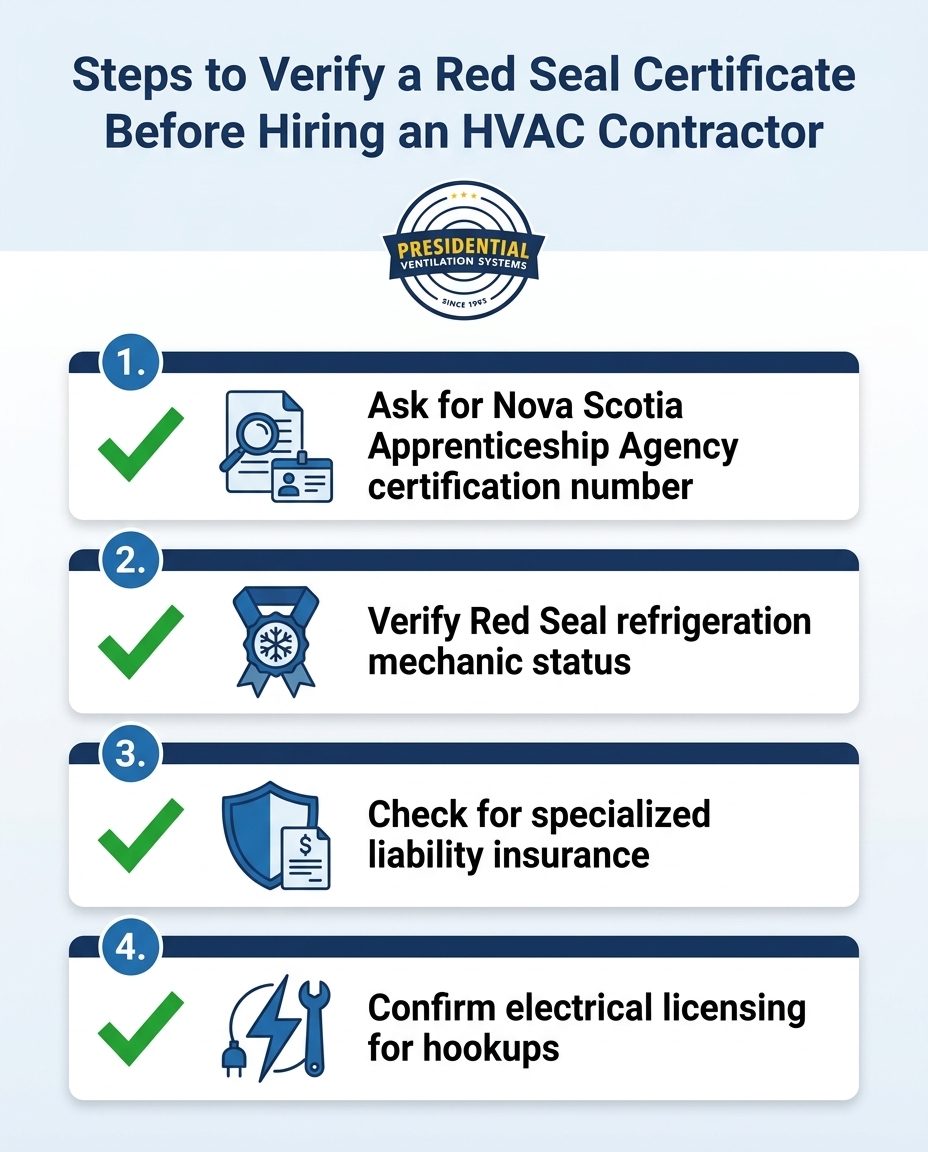
Protecting yourself during the estimate phase requires asking direct questions and requesting physical proof of credentials. Do not wait until the equipment is sitting in your driveway to confirm the installer's qualifications. Follow these actionable steps to verify a contractor's Red Seal certification before signing any agreements:
1. Ask for the Nova Scotia Apprenticeship Agency certification number: During the initial consultation, request the lead technician's certification number. Legitimate contractors are proud of their credentials and will provide this information without hesitation.
2. Request proof of dedicated Red Seal refrigeration mechanics: Ensure the company actually employs technicians with a Red Seal refrigeration mechanic certification on staff, rather than sub-contracting the work to unverified third parties.
3. Verify specialized liability insurance: Check that the contractor carries appropriate liability insurance and workers' compensation coverage specifically rated for HVAC and electrical work, not just general carpentry or landscaping.
4. Review the written estimate for trade specifics: Ensure the written quote clearly outlines who will be handling the electrical integration, who will be pulling the electrical permits, and who is responsible for the refrigerant charging.
5. Plan for ongoing professional care: Once verified and installed, ongoing care by these same certified professionals ensures the system maintains its efficiency. Securing preventative HVAC maintenance from a credentialed team extends the lifespan of your investment.
Yes, Refrigeration and Air Conditioning Mechanic is a designated Red Seal trade across Canada. It requires extensive apprenticeship hours and passing a rigorous interprovincial examination. This designation ensures the technician has mastered the complex thermodynamics, electrical troubleshooting, and environmental safety protocols required to work on modern heating and cooling systems.
Homeowners can ask the contractor directly for their certification card before the project begins. Credentials can also be cross-referenced with the Nova Scotia Apprenticeship Agency to ensure they are current and valid. A reputable HVAC company will always be transparent about the qualifications of the technicians they send to your home.
Yes, handling the refrigerants within a heat pump requires a certified refrigeration mechanic by law. Additionally, the electrical connections required to power the unit demand appropriate electrical licensing and permits. Attempting to bypass these licensing requirements can result in severe fines, voided warranties, and dangerous operating conditions.
It can lead to unsafe operation, voided manufacturer warranties, and rejected provincial rebate applications. Improper refrigerant handling can also cause premature system failure, meaning you may have to replace the entire unit years before its expected lifespan. Furthermore, uncertified electrical work poses a significant fire hazard to your property.
No, unless the general contractor personally holds a valid Red Seal refrigeration certification or directly employs someone who does. Environmental regulations strictly prohibit uncertified individuals from handling, recovering, or charging regulated refrigerants due to the severe environmental impact of accidental venting and the technical precision required for safe operation.
Protecting your home, your warranty, and your investment starts with asking the right questions during the estimate process. In our 30+ years of experience serving Mount Uniacke and greater Nova Scotia, we have found that transparency regarding credentials is the foundation of a trustworthy contractor relationship. You deserve the peace of mind that comes from knowing your equipment is being handled by professionals who respect the trade and adhere to all provincial safety standards.
Choosing a multi-trade team with verified tradespeople ensures your system is installed safely, efficiently, and in full compliance with warranty and rebate requirements. If you are planning an upgrade, explore your options with a team that prioritizes certification and ongoing education. Contact Presidential Ventilation Systems today to request a free estimate for your heat pump installation.
