


That strange cold draft across the living room floor isn't going away on its own. If you are struggling with unexplained cold drafts or smoke puffing back into your living room, balancing your HRV system after adding a wood stove in Mount Uniacke, NS, is often the exact solution you need. At Presidential Ventilation Systems, our team sees this scenario every winter: you fire up a brand-new wood stove expecting a cozy, warm evening, but instead, you are greeted by the sharp smell of woodsmoke trapped indoors and a room that somehow feels colder than before. This is a frustrating and incredibly common problem for homeowners across Mount Uniacke and rural Nova Scotia.
To resolve these airflow issues, we highly recommend exploring professional HVAC and ventilation services to keep your home safe and comfortable.
Most homeowners assume their chimney is blocked or their wood stove is defective. The truth is usually much more complex. Modern homes are built to be remarkably airtight. They do not have enough natural air leakage to feed a secondary heating source like a wood stove. When the fire starts burning, it desperately searches for oxygen, disrupting your home's mechanical ventilation in the process.
This creates a dangerous pressure imbalance between the inside of your house and the outdoors. Your Heat Recovery Ventilator (HRV) is suddenly thrown completely out of sync, fighting a losing battle against the powerful draw of the chimney. Resolving this hidden struggle requires a professional assessment of your home's total airflow, not guesswork or trial and error.
To understand why your wood stove smokes, you have to look at how air moves through a modern house. Fire requires oxygen to burn. A standard wood stove consumes anywhere from 10 to 50 cubic feet of air per minute (CFM) during active combustion. Without a dedicated external air intake, the stove pulls every single cubic foot of that air directly from your living space.
In older, drafty homes, this wasn't a noticeable issue. Air simply leaked in through poorly insulated walls, gaps around doors, and single-pane windows to replace the air going up the chimney. However, in our three decades of working on both new construction and home retrofits across Nova Scotia, we have seen how modern building practices change the game. Many newly built or renovated homes are sealed exceptionally tight, often testing below 2.0 ACH50 (Air Changes per Hour at 50 Pascals of pressure). This means air cannot easily enter the house to replace what the stove is consuming.
When the wood stove exhausts air up the chimney and no replacement air can get inside, your house experiences a vacuum effect known as negative pressure. During severe, cold Maritime winters, this problem peaks. Homeowners tightly seal their windows and doors to keep the freezing temperatures out, which inadvertently maximizes the negative pressure effect when the wood stove is running.
Negative pressure forces your house to seek air from any available opening, no matter how small. This air starvation completely undermines your heating efforts in several ways:
• Freezing drafts: The house pulls freezing outdoor air in through tiny cracks around windows, doors, and baseboards, creating uncomfortable cold streams across your floors.
• Wasted energy: The cold air entering the home counteracts the radiant heat being generated by the wood stove, forcing your primary heating system to work harder.
• Reversed exhaust flows: If the negative pressure is strong enough, it will pull air down through bathroom exhaust fans or range hoods, bringing cold air and frost directly into those rooms.
The resulting drafts make the home feel colder despite your secondary heat source running at full capacity. The fire is literally fighting your house for air.
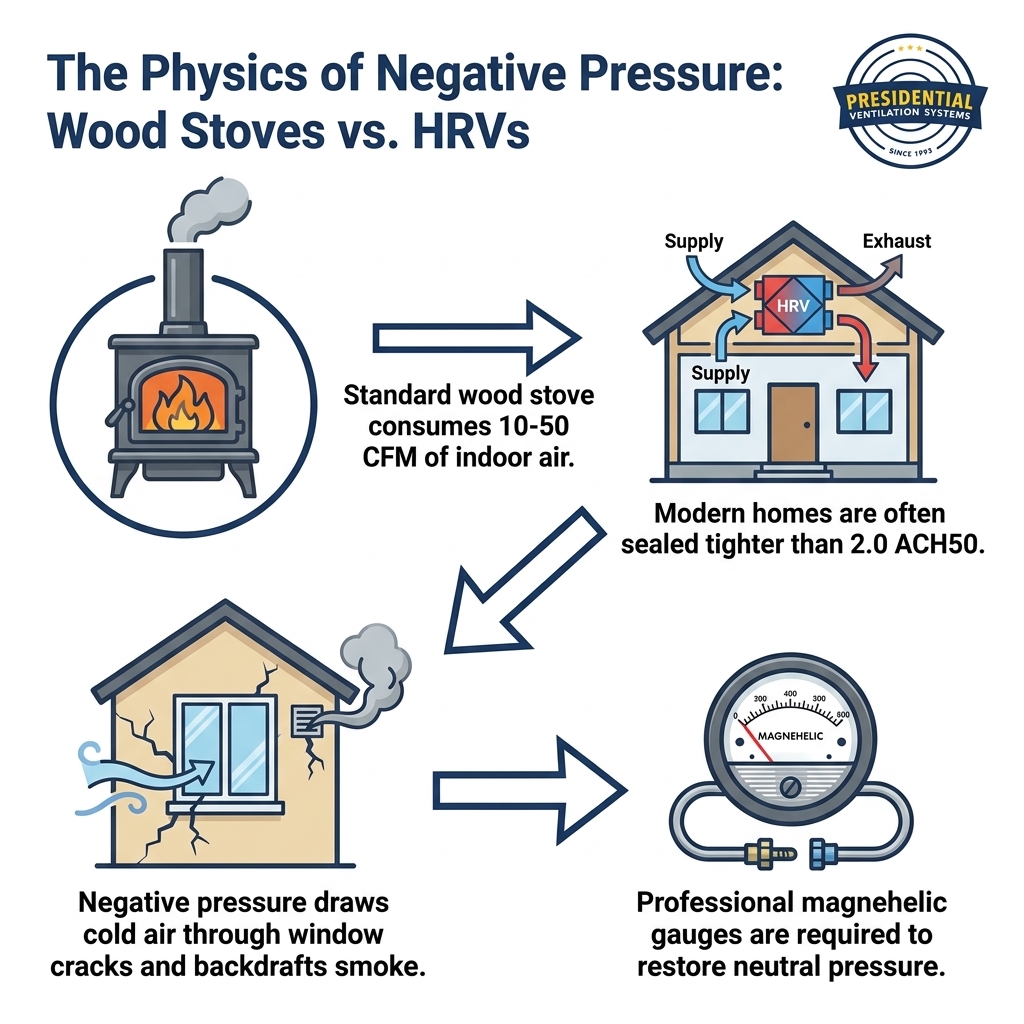
Your Heat Recovery Ventilator (HRV) is the lungs of your airtight home. It is meticulously calibrated to bring in exactly as much fresh air as it exhausts, maintaining a perfectly neutral pressure. This delicate balance ensures you get fresh, filtered air without creating drafts or vacuum effects.
When our Red Seal ventilation experts inspect these systems, we often find that adding a wood stove acts as a massive, unplanned exhaust fan. It pulls large amounts of air out of the equation, instantly destroying the baseline calibration of your HRV. The HRV system is suddenly fighting against the wood stove. Because the house is under negative pressure, the HRV's exhaust fan struggles to push stale air outside, while the intake fan is forced to pull in far more cold air than the system's core can effectively warm.
This imbalance causes the HRV to malfunction on a fundamental level. Instead of recovering heat, it becomes a conduit for freezing outdoor air. Furthermore, because the exhaust function is restricted by the negative pressure, the HRV fails to remove stale, moist air from your bathrooms and kitchen. This trapped excess winter moisture quickly leads to heavy window condensation, peeling paint, and a damp, uncomfortable indoor environment.
Restoring this delicate equilibrium requires precise HRV system installation and balancing to ensure your mechanical ventilation and your wood stove can operate simultaneously without conflict.
• Perfectly Balanced HRV — Airflow Dynamics: Intake and exhaust CFM are exactly equal. — Impact on the Home: Neutral pressure, dry windows, optimal heat recovery.
• Unbalanced (Stove Running) — Airflow Dynamics: Stove exhausts 30+ CFM; HRV exhaust is choked. — Impact on the Home: Negative pressure, cold drafts, heavy window condensation.
• Professionally Re-balanced — Airflow Dynamics: HRV adjusted to account for secondary combustion air. — Impact on the Home: Neutral or slightly positive pressure, safe wood burning.
The consequences of an unbalanced HRV and an air-starved wood stove go far beyond cold drafts and foggy windows. If the negative pressure in your home becomes strong enough, it will overcome the natural draft of your chimney. When this happens, the house literally sucks air down the flue.
This phenomenon, known as backdrafting, pulls exhaust gases, soot, and smoke directly back into your living room. You will usually notice this when you open the stove door to add a log, and a cloud of smoke immediately billows into your face instead of drafting upward. Backdrafting introduces harmful particulates, volatile organic compounds (VOCs), and dangerous carbon monoxide into your tightly sealed home.
Normally, an HRV helps clear out indoor pollutants. But an improperly balanced HRV, choked by negative pressure, can no longer dilute these contaminants. The stale, toxic air simply circulates inside the house, severely degrading your indoor air quality during the long winter heating season. Ignoring these warning signs puts your family at risk of poor air quality and creates long-term structural moisture issues.
Understanding what happens if you don't maintain your HRV is crucial, but knowing how other appliances impact that maintenance is just as important for your safety.
When faced with drafts or a smoking stove, many homeowners turn to internet forums for a quick fix. You will often find DIY tutorials suggesting you can balance an HRV using a garbage bag and a stopwatch, or by simply adjusting the dampers until the airflow "feels" right. These methods are highly inaccurate and can actually make your negative pressure problem much worse.
Proper balancing is a complex science that requires professional expertise. Here is why you should never attempt to balance your HRV yourself:
1. Inaccurate Measurements: A garbage bag cannot measure total static pressure. Proper balancing requires specialized tools, such as magnehelic gauges or digital manometers, to measure exact cubic feet per minute (CFM) across the HRV core.
2. Hidden Exhaust Factors: Balancing isn't just about the HRV. You must calculate the total exhaust rate of the home, including range hoods, central vacuums, bathroom fans, and the wood stove. Missing even one factor throws the whole calculation off.
3. Code Compliance: Nova Scotia building codes mandate that mechanical ventilation must be properly calibrated to manage moisture safely and provide adequate fresh air. A DIY job rarely meets these strict safety standards.
4. Increased Backdraft Risks: Attempting to balance an HRV without understanding the entire home's pressure dynamics often leads to over-pressurizing or under-pressurizing the house, directly worsening the backdrafting risks of your wood stove.
As an established Nova Scotia contractor with a team of approximately 70 employees, Presidential Ventilation Systems relies on our Red Seal certified sheet-metal and ventilation experts who use calibrated, professional-grade instruments to ensure safety and code compliance. If you live within the Mount Uniacke service area, relying on our 30+ years of local ventilation experience guarantees your system is calibrated correctly the first time.
Resolving negative pressure requires a comprehensive, whole-home approach. When our Red Seal tradespeople arrive at your home, they don't just look at the HRV box; they evaluate how every system in your house interacts.
A pattern we see often in our retrofit and renovation projects is that any major modification to your home's energy profile requires professional problem-solving. For example, when one local homeowner transitioned from an older oil system to a central heat pump last summer, the project required an unexpected electrical panel upgrade. Our skilled technician, Jack, stepped in to coordinate and resolve the electrical concerns, ensuring the entire system operated safely and flawlessly. (If you are planning a similar oil-to-heat-pump conversion or major heating upgrade, provincial and federal rebates may be available; we always recommend confirming current programs and eligibility with our team.) Adding a wood stove requires that same level of whole-home coordination, particularly regarding your ventilation.
The technician will first assess the home's total exhaust requirements. They will measure the draw of your new wood stove, your kitchen range hood, and all bathroom fans. Once the total air consumption is calculated, they can determine exactly how much makeup air your home needs to remain neutral.
In many airtight homes, simply adjusting the HRV isn't enough to feed a hungry wood stove. The technician may recommend installing a dedicated combustion air intake. This is an insulated duct that runs directly from the outdoors to the air intake of the wood stove.
A dedicated air intake isolates the wood stove from the home's ambient air. The stove pulls its oxygen directly from outside, rather than robbing the HRV of its required airflow. This is often the safest, most reliable fix for airtight homes, completely eliminating the vacuum effect and stopping cold drafts in their tracks.
Once the combustion air is addressed, the HRV dampers are professionally adjusted using precise magnehelic gauges. The technician sets the system to provide slightly positive or perfectly neutral pressure, even when the stove is burning hot. Finally, you receive honest, expert advice on how to manage the system efficiently going forward.
Once your HRV is professionally balanced to accommodate your wood stove, keeping it running optimally requires regular attention. The balance of your system relies on unobstructed airflow, and even minor blockages can shift the pressure dynamics back into the negative.
To ensure your home remains comfortable and safe throughout the winter heating season, our maintenance team recommends these essential steps:
• Clean the filters monthly: The filters inside your HRV catch dust, pet dander, and outdoor debris. When they clog, the intake fan has to work harder, reducing fresh air and altering the system's balance. Wash or vacuum them regularly.
• Inspect the exterior hoods: Check the outdoor intake and exhaust vents frequently. Snowdrifts, ice buildup, or even bird nests can block the airflow, immediately throwing the system out of balance.
• Monitor for condensation: Keep a close eye on your windows during cold snaps. Excessive, pooling condensation is often the first indicator that your filters are clogged and the HRV is failing to exhaust stale, moist air.
• Maintain the core: The heat recovery core should be removed and gently washed according to the manufacturer's instructions at least once a year to ensure optimal heat transfer.
Because ventilation dynamics are so precise, it is wise to schedule annual check-ups. A professional can verify that the system is still calibrated correctly, especially if you have completed other home renovations like installing new windows or upgrading insulation. Enrolling in a preventative maintenance plan takes the guesswork out of this process, ensuring your equipment is always operating at peak efficiency.
A wood stove and an HRV do not have to fight for air. When a home's pressure dynamics are properly understood and the ventilation system is accurately calibrated, you can enjoy the cozy warmth of a wood fire without sacrificing your indoor air quality or enduring freezing floor drafts.
Adding a secondary heat source fundamentally changes how your house breathes. Prioritizing safety means acknowledging that these complex changes require specialized tools and deep expertise to manage correctly. Don't let negative pressure compromise your comfort or your health. Reach out to the experienced team at Presidential Ventilation Systems to request a free estimate or book a service call, and let our Red Seal tradespeople restore perfect, healthy airflow to your home.
At Presidential Ventilation Systems, we often explain to customers that your wood stove smokes when you open the door because your home is under negative pressure, which reverses the natural draft of the chimney. Instead of smoke rising up and out, the vacuum effect inside your airtight home pulls the smoke down and into the living room. This is a clear sign that your wood stove is struggling to find enough combustion air. A professional assessment can determine if a dedicated air intake or an HRV re-balancing is required to fix the draft.
Yes, a wood stove can easily cause negative pressure in a tightly sealed modern house. A standard stove consumes up to 50 cubic feet of air per minute to keep the fire burning. If your home is airtight and doesn't have a dedicated way to replace that consumed air, it creates a vacuum effect. This negative pressure pulls cold outdoor air in through window cracks and disrupts your home's mechanical ventilation.
If you have a modern, airtight home, you absolutely need an HRV, regardless of whether you have a wood stove. Building codes require HRVs to ensure stale, moist indoor air is exhausted and fresh outdoor air is brought in. However, when you add a wood stove, the HRV must be professionally balanced to account for the air the stove consumes, ensuring both systems can operate safely at the same time.
An HRV works alongside a wood stove by maintaining the overall air quality and moisture levels in the home, provided the system is properly balanced. The HRV continuously swaps stale indoor air for fresh outdoor air, transferring heat in the process. If balanced correctly, the HRV maintains neutral pressure so the wood stove can draft properly up the chimney without pulling cold exhaust air backward through the ventilation system.
Fixing negative pressure requires introducing enough makeup air to replace the air being exhausted by appliances like wood stoves, range hoods, and bathroom fans. Our team typically achieves this by installing a dedicated combustion air intake directly to the wood stove and professionally re-balancing the HRV system using magnehelic gauges. It is not a DIY project; a ventilation expert must measure the total airflow to ensure the home returns to a safe, neutral pressure.
Yes, an unbalanced HRV is a primary cause of severe window condensation during the winter. If negative pressure prevents the HRV from exhausting stale air, the moisture generated by cooking, bathing, and breathing becomes trapped inside the house. When this warm, humid air hits freezing window glass, it instantly condenses into water droplets. Properly balancing the HRV restores the exhaust flow and eliminates the trapped humidity.

That strange cold draft across the living room floor isn't going away on its own. If you are struggling with unexplained cold drafts or smoke puffing back into your living room, balancing your HRV system after adding a wood stove in Mount Uniacke, NS, is often the exact solution you need. At Presidential Ventilation Systems, our team sees this scenario every winter: you fire up a brand-new wood stove expecting a cozy, warm evening, but instead, you are greeted by the sharp smell of woodsmoke trapped indoors and a room that somehow feels colder than before. This is a frustrating and incredibly common problem for homeowners across Mount Uniacke and rural Nova Scotia.
To resolve these airflow issues, we highly recommend exploring professional HVAC and ventilation services to keep your home safe and comfortable.
Most homeowners assume their chimney is blocked or their wood stove is defective. The truth is usually much more complex. Modern homes are built to be remarkably airtight. They do not have enough natural air leakage to feed a secondary heating source like a wood stove. When the fire starts burning, it desperately searches for oxygen, disrupting your home's mechanical ventilation in the process.
This creates a dangerous pressure imbalance between the inside of your house and the outdoors. Your Heat Recovery Ventilator (HRV) is suddenly thrown completely out of sync, fighting a losing battle against the powerful draw of the chimney. Resolving this hidden struggle requires a professional assessment of your home's total airflow, not guesswork or trial and error.
To understand why your wood stove smokes, you have to look at how air moves through a modern house. Fire requires oxygen to burn. A standard wood stove consumes anywhere from 10 to 50 cubic feet of air per minute (CFM) during active combustion. Without a dedicated external air intake, the stove pulls every single cubic foot of that air directly from your living space.
In older, drafty homes, this wasn't a noticeable issue. Air simply leaked in through poorly insulated walls, gaps around doors, and single-pane windows to replace the air going up the chimney. However, in our three decades of working on both new construction and home retrofits across Nova Scotia, we have seen how modern building practices change the game. Many newly built or renovated homes are sealed exceptionally tight, often testing below 2.0 ACH50 (Air Changes per Hour at 50 Pascals of pressure). This means air cannot easily enter the house to replace what the stove is consuming.
When the wood stove exhausts air up the chimney and no replacement air can get inside, your house experiences a vacuum effect known as negative pressure. During severe, cold Maritime winters, this problem peaks. Homeowners tightly seal their windows and doors to keep the freezing temperatures out, which inadvertently maximizes the negative pressure effect when the wood stove is running.
Negative pressure forces your house to seek air from any available opening, no matter how small. This air starvation completely undermines your heating efforts in several ways:
• Freezing drafts: The house pulls freezing outdoor air in through tiny cracks around windows, doors, and baseboards, creating uncomfortable cold streams across your floors.
• Wasted energy: The cold air entering the home counteracts the radiant heat being generated by the wood stove, forcing your primary heating system to work harder.
• Reversed exhaust flows: If the negative pressure is strong enough, it will pull air down through bathroom exhaust fans or range hoods, bringing cold air and frost directly into those rooms.
The resulting drafts make the home feel colder despite your secondary heat source running at full capacity. The fire is literally fighting your house for air.
Your Heat Recovery Ventilator (HRV) is the lungs of your airtight home. It is meticulously calibrated to bring in exactly as much fresh air as it exhausts, maintaining a perfectly neutral pressure. This delicate balance ensures you get fresh, filtered air without creating drafts or vacuum effects.
When our Red Seal ventilation experts inspect these systems, we often find that adding a wood stove acts as a massive, unplanned exhaust fan. It pulls large amounts of air out of the equation, instantly destroying the baseline calibration of your HRV. The HRV system is suddenly fighting against the wood stove. Because the house is under negative pressure, the HRV's exhaust fan struggles to push stale air outside, while the intake fan is forced to pull in far more cold air than the system's core can effectively warm.
This imbalance causes the HRV to malfunction on a fundamental level. Instead of recovering heat, it becomes a conduit for freezing outdoor air. Furthermore, because the exhaust function is restricted by the negative pressure, the HRV fails to remove stale, moist air from your bathrooms and kitchen. This trapped excess winter moisture quickly leads to heavy window condensation, peeling paint, and a damp, uncomfortable indoor environment.
Restoring this delicate equilibrium requires precise HRV system installation and balancing to ensure your mechanical ventilation and your wood stove can operate simultaneously without conflict.
• Perfectly Balanced HRV — Airflow Dynamics: Intake and exhaust CFM are exactly equal. — Impact on the Home: Neutral pressure, dry windows, optimal heat recovery.
• Unbalanced (Stove Running) — Airflow Dynamics: Stove exhausts 30+ CFM; HRV exhaust is choked. — Impact on the Home: Negative pressure, cold drafts, heavy window condensation.
• Professionally Re-balanced — Airflow Dynamics: HRV adjusted to account for secondary combustion air. — Impact on the Home: Neutral or slightly positive pressure, safe wood burning.
The consequences of an unbalanced HRV and an air-starved wood stove go far beyond cold drafts and foggy windows. If the negative pressure in your home becomes strong enough, it will overcome the natural draft of your chimney. When this happens, the house literally sucks air down the flue.
This phenomenon, known as backdrafting, pulls exhaust gases, soot, and smoke directly back into your living room. You will usually notice this when you open the stove door to add a log, and a cloud of smoke immediately billows into your face instead of drafting upward. Backdrafting introduces harmful particulates, volatile organic compounds (VOCs), and dangerous carbon monoxide into your tightly sealed home.
Normally, an HRV helps clear out indoor pollutants. But an improperly balanced HRV, choked by negative pressure, can no longer dilute these contaminants. The stale, toxic air simply circulates inside the house, severely degrading your indoor air quality during the long winter heating season. Ignoring these warning signs puts your family at risk of poor air quality and creates long-term structural moisture issues.
Understanding what happens if you don't maintain your HRV is crucial, but knowing how other appliances impact that maintenance is just as important for your safety.
When faced with drafts or a smoking stove, many homeowners turn to internet forums for a quick fix. You will often find DIY tutorials suggesting you can balance an HRV using a garbage bag and a stopwatch, or by simply adjusting the dampers until the airflow "feels" right. These methods are highly inaccurate and can actually make your negative pressure problem much worse.
Proper balancing is a complex science that requires professional expertise. Here is why you should never attempt to balance your HRV yourself:
1. Inaccurate Measurements: A garbage bag cannot measure total static pressure. Proper balancing requires specialized tools, such as magnehelic gauges or digital manometers, to measure exact cubic feet per minute (CFM) across the HRV core.
2. Hidden Exhaust Factors: Balancing isn't just about the HRV. You must calculate the total exhaust rate of the home, including range hoods, central vacuums, bathroom fans, and the wood stove. Missing even one factor throws the whole calculation off.
3. Code Compliance: Nova Scotia building codes mandate that mechanical ventilation must be properly calibrated to manage moisture safely and provide adequate fresh air. A DIY job rarely meets these strict safety standards.
4. Increased Backdraft Risks: Attempting to balance an HRV without understanding the entire home's pressure dynamics often leads to over-pressurizing or under-pressurizing the house, directly worsening the backdrafting risks of your wood stove.
As an established Nova Scotia contractor with a team of approximately 70 employees, Presidential Ventilation Systems relies on our Red Seal certified sheet-metal and ventilation experts who use calibrated, professional-grade instruments to ensure safety and code compliance. If you live within the Mount Uniacke service area, relying on our 30+ years of local ventilation experience guarantees your system is calibrated correctly the first time.
Resolving negative pressure requires a comprehensive, whole-home approach. When our Red Seal tradespeople arrive at your home, they don't just look at the HRV box; they evaluate how every system in your house interacts.
A pattern we see often in our retrofit and renovation projects is that any major modification to your home's energy profile requires professional problem-solving. For example, when one local homeowner transitioned from an older oil system to a central heat pump last summer, the project required an unexpected electrical panel upgrade. Our skilled technician, Jack, stepped in to coordinate and resolve the electrical concerns, ensuring the entire system operated safely and flawlessly. (If you are planning a similar oil-to-heat-pump conversion or major heating upgrade, provincial and federal rebates may be available; we always recommend confirming current programs and eligibility with our team.) Adding a wood stove requires that same level of whole-home coordination, particularly regarding your ventilation.
The technician will first assess the home's total exhaust requirements. They will measure the draw of your new wood stove, your kitchen range hood, and all bathroom fans. Once the total air consumption is calculated, they can determine exactly how much makeup air your home needs to remain neutral.
In many airtight homes, simply adjusting the HRV isn't enough to feed a hungry wood stove. The technician may recommend installing a dedicated combustion air intake. This is an insulated duct that runs directly from the outdoors to the air intake of the wood stove.
A dedicated air intake isolates the wood stove from the home's ambient air. The stove pulls its oxygen directly from outside, rather than robbing the HRV of its required airflow. This is often the safest, most reliable fix for airtight homes, completely eliminating the vacuum effect and stopping cold drafts in their tracks.
Once the combustion air is addressed, the HRV dampers are professionally adjusted using precise magnehelic gauges. The technician sets the system to provide slightly positive or perfectly neutral pressure, even when the stove is burning hot. Finally, you receive honest, expert advice on how to manage the system efficiently going forward.
Once your HRV is professionally balanced to accommodate your wood stove, keeping it running optimally requires regular attention. The balance of your system relies on unobstructed airflow, and even minor blockages can shift the pressure dynamics back into the negative.
To ensure your home remains comfortable and safe throughout the winter heating season, our maintenance team recommends these essential steps:
• Clean the filters monthly: The filters inside your HRV catch dust, pet dander, and outdoor debris. When they clog, the intake fan has to work harder, reducing fresh air and altering the system's balance. Wash or vacuum them regularly.
• Inspect the exterior hoods: Check the outdoor intake and exhaust vents frequently. Snowdrifts, ice buildup, or even bird nests can block the airflow, immediately throwing the system out of balance.
• Monitor for condensation: Keep a close eye on your windows during cold snaps. Excessive, pooling condensation is often the first indicator that your filters are clogged and the HRV is failing to exhaust stale, moist air.
• Maintain the core: The heat recovery core should be removed and gently washed according to the manufacturer's instructions at least once a year to ensure optimal heat transfer.
Because ventilation dynamics are so precise, it is wise to schedule annual check-ups. A professional can verify that the system is still calibrated correctly, especially if you have completed other home renovations like installing new windows or upgrading insulation. Enrolling in a preventative maintenance plan takes the guesswork out of this process, ensuring your equipment is always operating at peak efficiency.
A wood stove and an HRV do not have to fight for air. When a home's pressure dynamics are properly understood and the ventilation system is accurately calibrated, you can enjoy the cozy warmth of a wood fire without sacrificing your indoor air quality or enduring freezing floor drafts.
Adding a secondary heat source fundamentally changes how your house breathes. Prioritizing safety means acknowledging that these complex changes require specialized tools and deep expertise to manage correctly. Don't let negative pressure compromise your comfort or your health. Reach out to the experienced team at Presidential Ventilation Systems to request a free estimate or book a service call, and let our Red Seal tradespeople restore perfect, healthy airflow to your home.
At Presidential Ventilation Systems, we often explain to customers that your wood stove smokes when you open the door because your home is under negative pressure, which reverses the natural draft of the chimney. Instead of smoke rising up and out, the vacuum effect inside your airtight home pulls the smoke down and into the living room. This is a clear sign that your wood stove is struggling to find enough combustion air. A professional assessment can determine if a dedicated air intake or an HRV re-balancing is required to fix the draft.
Yes, a wood stove can easily cause negative pressure in a tightly sealed modern house. A standard stove consumes up to 50 cubic feet of air per minute to keep the fire burning. If your home is airtight and doesn't have a dedicated way to replace that consumed air, it creates a vacuum effect. This negative pressure pulls cold outdoor air in through window cracks and disrupts your home's mechanical ventilation.
If you have a modern, airtight home, you absolutely need an HRV, regardless of whether you have a wood stove. Building codes require HRVs to ensure stale, moist indoor air is exhausted and fresh outdoor air is brought in. However, when you add a wood stove, the HRV must be professionally balanced to account for the air the stove consumes, ensuring both systems can operate safely at the same time.
An HRV works alongside a wood stove by maintaining the overall air quality and moisture levels in the home, provided the system is properly balanced. The HRV continuously swaps stale indoor air for fresh outdoor air, transferring heat in the process. If balanced correctly, the HRV maintains neutral pressure so the wood stove can draft properly up the chimney without pulling cold exhaust air backward through the ventilation system.
Fixing negative pressure requires introducing enough makeup air to replace the air being exhausted by appliances like wood stoves, range hoods, and bathroom fans. Our team typically achieves this by installing a dedicated combustion air intake directly to the wood stove and professionally re-balancing the HRV system using magnehelic gauges. It is not a DIY project; a ventilation expert must measure the total airflow to ensure the home returns to a safe, neutral pressure.
Yes, an unbalanced HRV is a primary cause of severe window condensation during the winter. If negative pressure prevents the HRV from exhausting stale air, the moisture generated by cooking, bathing, and breathing becomes trapped inside the house. When this warm, humid air hits freezing window glass, it instantly condenses into water droplets. Properly balancing the HRV restores the exhaust flow and eliminates the trapped humidity.

Winter in Nova Scotia arrives fast, bringing freezing temperatures that immediately test your commercial building's infrastructure. It is a familiar frustration for many facility managers: the temperature drops, the heating kicks on, and suddenly, a main breaker trips, taking a section of your building offline. The culprit is rarely a broken system, but rather a hidden synchronization issue on your roof. If you want to keep your facility online, managing defrost cycles on multiple commercial rooftop heat pumps to prevent power spikes is a critical step that requires proactive attention.
During sudden Nova Scotia winter cold snaps, outdoor temperatures plummet below the balance point of your rooftop units. Ice begins to form on the outdoor coils, prompting the systems to initiate their built-in defrost cycles. The concrete problem arises when several units enter this mode at the exact same time. This simultaneous action demands a massive surge of electricity that easily overwhelms the building's electrical capacity.
For facility managers and building owners, simply resetting the breaker is not a long-term strategy. You face an important decision point: you must proactively manage peak electrical loads across the roof by properly staggering these cycles. This is not a standard maintenance task; it requires a coordinated approach between HVAC mechanics and electrical systems to ensure your commercial heat pumps operate efficiently without threatening your facility's power supply.
To understand why a tripped breaker happens, we have to look at exactly what occurs mechanically during a defrost cycle. When frost accumulates on the outdoor coil, the heat pump must clear it to maintain airflow and efficiency. To melt this outdoor ice, the system temporarily reverses its operation, essentially shifting back into air conditioning mode. It pulls heat from inside the building and sends it outside to thaw the frozen coil.
Because blowing cold air into a commercial workspace during winter is unacceptable, the system simultaneously engages its auxiliary electric heat strips. These strips warm the air before it reaches the vents, keeping the indoor climate comfortable. This is a standard feature on most ducted heat pump systems in commercial applications. However, this perfectly normal operation creates a simultaneous auxiliary power draw that places a tremendous temporary demand on your electrical panel.
The core issue lies in the difference between how a heat pump normally operates and how auxiliary heat functions. A compressor moves existing heat from one place to another, which is a highly efficient process that draws relatively low amperage. Electric heat strips, on the other hand, rely on resistive heating—they create heat by forcing electricity through high-resistance wires. This sudden shift completely changes the electrical profile of the rooftop unit.
The technical difference at a glance:
• Heat Pump Compressor — Heating Method: Thermodynamic heat transfer — Electrical Demand: Low to moderate amperage — Primary Function: Primary, highly efficient daily heating
• Auxiliary Heat Strips — Heating Method: Electrical resistance — Electrical Demand: Massive amperage spike — Primary Function: Temporary comfort during defrost mode
This massive amperage draw means that during a defrost cycle, a single rooftop unit can temporarily consume significantly more electricity than it does during hours of standard heating operation. The system is not broken; it is simply doing exactly what it was engineered to do under freezing conditions.
The physics of frost buildup go beyond just cold air. Frost accumulation is driven heavily by the moisture content present in the atmosphere. In our region, the unique mix of freezing winter temperatures and high coastal humidity creates the perfect storm for rapid, heavy frost on commercial coils.
In drier inland regions, a heat pump might run for hours in freezing temperatures before accumulating enough frost to trigger a defrost cycle. However, coastal humidity means the air holds significantly more water vapor. When that moisture-laden air is pulled across a freezing metal coil on an exposed commercial roof, the water vapor rapidly condenses and freezes.
Environmental factors that accelerate coastal frosting:
• High relative humidity: More suspended moisture in the air means more water available to freeze upon contact with the coil.
• Rapid temperature fluctuations: Sudden drops in ambient temperature cause dew points to shift quickly, increasing condensation.
• Rooftop wind exposure: High winds on commercial roofs constantly feed fresh, humid air over the coils, speeding up the icing process.
This specific climate reality necessitates far more frequent and prolonged defrost cycles than you would see elsewhere. Your commercial systems have to work overtime to keep their coils clear of thick coastal ice, which directly increases the frequency of those high-amperage auxiliary heat cycles.
Most commercial facilities are not cooled and heated by a single unit. A typical commercial setup involves multiple rooftop units, each serving different zones of the building—such as the warehouse, office spaces, retail floors, and server rooms. Because these units are exposed to the exact same outdoor weather conditions, they often react to the environment in unison.
When a uniform drop in outdoor temperature hits the roof, multiple independent units reach their frost thresholds at roughly the same time. If their internal timers are not actively managed, they will trigger their defrost cycles simultaneously. This creates a dangerous cascade effect across your electrical infrastructure.
The sequence of a facility power spike:
1. The outdoor temperature drops sharply, and coastal humidity coats all rooftop coils in frost.
2. Multiple units detect the restricted airflow or reach their set time intervals concurrently.
3. Several units reverse their reversing valves and engage their auxiliary resistive heat strips at the exact same moment.
4. The massive amperage draw of one unit's auxiliary heat is multiplied by three, four, or five units across the roof.
5. The combined peak electrical load exceeds the facility's main breaker capacity, resulting in a total power trip.
This cascade effect leads to sudden facility downtime, disrupted operations, and the immediate need to assess whether you require heavy electrical work, such as breaker panel upgrades, or if the issue can be resolved through intelligent system configuration.

The most effective way to prevent these massive power spikes is through professional load sequencing. By staggering the defrost timers across your commercial roof, you ensure that only one or two units can enter defrost mode at any given time. This flattens the peak electrical load, keeping the facility's total power draw safely below the main breaker's trip threshold.
It is vital to note that configuring commercial electrical loads and adjusting these specific timers requires a licensed professional. Commercial rooftop units operate on high-voltage electricity, and interacting with their internal control boards carries severe safety risks. Never attempt to adjust these settings yourself.
For standard rooftop units, technicians interact directly with the time-temperature defrost boards located inside each unit's control cabinet. These boards monitor the temperature of the coil and dictate how often the unit is allowed to check for frost. A licensed technician will adjust the pin settings or digital parameters on individual boards to offset their cycles.
For example, instead of all units checking for frost every 60 minutes, a professional might configure Unit A for 30-minute intervals, Unit B for 60-minute intervals, and Unit C for 90-minute intervals. This deliberate staggering prevents the units from syncing up and pulling auxiliary power concurrently, even during severe cold snaps.
Modern commercial facilities often utilize advanced Building Automation Systems (BAS) to monitor and control their HVAC equipment centrally. A properly programmed BAS can monitor the total electrical load of the building in real-time. If the system detects that the building is nearing its peak load capacity, it can dynamically prevent additional rooftop units from engaging their auxiliary heat until the first unit finishes its defrost cycle. This level of dynamic sequencing provides the ultimate protection against unexpected breaker trips.
In our 30+ years working on commercial projects, we have seen firsthand the danger of siloed approaches to facility maintenance. If you hire an HVAC-only contractor to investigate a tripped breaker, they might simply verify that the heat pump is producing heat, check the refrigerant charge, and declare the system healthy. Conversely, if you bring in a standard electrician, they will see the massive amperage draw, assume the building is underpowered, and suggest a highly extensive electrical panel upgrade.
Neither approach solves the root cause efficiently. Treating the HVAC system and the electrical panel as a single coordinated ecosystem is the only way to resolve this issue. The heating demand and the building's electrical load capacity are permanently linked.
This is why having approximately 70 employees and skilled Red Seal tradespeople across multiple disciplines matters. A contractor who handles both the HVAC mechanics and the electrical systems natively can diagnose the configuration error, stagger the timers, and verify the electrical load without pointing fingers at another trade. What we've learned diagnosing these complex commercial issues is that true reliability comes from understanding the whole picture—preventing power spikes before they ever have the chance to halt your operations.
Commercial heat pumps trip breakers in the winter primarily because they enter defrost mode to melt ice off their outdoor coils. During this cycle, they activate auxiliary electric heat strips to keep indoor air warm. If multiple units on a roof enter this high-amperage mode simultaneously, the combined electrical draw can easily exceed the main breaker's capacity.
A heat pump uses significantly more power in defrost mode because it relies on resistive heating. While normal heating uses a highly efficient compressor to move heat, the auxiliary heat strips used during defrost create heat through electrical resistance. This process can draw two to three times the amperage of standard compressor operation.
Yes, multiple commercial heat pumps can run safely on a single electrical panel, provided the panel is sized correctly and the equipment is professionally configured. The key to safety is load management. By staggering the defrost timers, professionals ensure the units do not draw their peak auxiliary loads at the exact same time.
Peak electrical loads are managed through a process called load sequencing. A licensed professional will adjust the time-temperature boards on each unit to offset their defrost intervals, or they will program a Building Automation System (BAS) to dynamically control when auxiliary heat is allowed to engage.
The most obvious sign of synced defrost timers is a main breaker tripping specifically during sudden drops in outdoor temperature or heavy winter precipitation. You might also notice a sudden, temporary dimming of facility lights right before a breaker trips, indicating a massive, simultaneous call for auxiliary power across the roof.
Winter cold snaps will inevitably test your facility's electrical capacity. The high coastal humidity and freezing temperatures will force your rooftop units into frequent defrost cycles. However, unexpected downtime and tripped breakers do not have to be a normal part of your winter operations. Proactive timer staggering and professional load management can flatten your peak electrical demand and protect your infrastructure.
Do not wait until a sudden freeze takes your building offline. Taking action now ensures your systems are properly sequenced for the months ahead. Schedule a professional assessment and secure a comprehensive commercial HVAC maintenance plan before the harshest weather arrives, ensuring your facility remains warm, efficient, and fully powered all winter long.

Are you constantly wiping condensation off your windows on chilly January mornings, or waking up with a scratchy throat because your indoor air feels bone dry? When evaluating sensible vs enthalpy heat recovery cores for Nova Scotia's specific humidity profile, many homeowners find themselves frustrated by generic ventilation advice that simply doesn't apply to the East Coast. Tightly sealed modern homes tend to trap moisture, while older, draftier homes often leak it away too quickly. Balancing this delicate indoor climate during a freezing Maritime winter requires more than just picking a box off a shelf.
The critical decision point for builders and homeowners comes down to choosing between a sensible heat recovery core (typically found in an HRV) and an enthalpy core (found in an ERV). While standard guidelines often recommend one over the other based purely on cold temperatures, our coastal climate demands a much more nuanced approach to managing indoor moisture. If you want to dive deeper into the basics of these units, you can explore how HRV systems function, but here we will break down exactly which core type is right for your specific home environment.
To make the right choice for your home, you first need to understand how these systems handle the air you breathe. A sensible heat recovery core—the standard technology behind most traditional Heat Recovery Ventilators—deals strictly with "sensible heat." In physics, sensible heat is the energy you can actually measure with a thermometer. These cores transfer temperature energy from your stale exhaust air to your incoming fresh air, but they do not mix the moisture.
As warm, damp indoor air passes through the exhaust side of the core, it warms up the cold, fresh air coming in from outside. The two air streams cross paths inside a series of narrow, separated channels (often made of aluminum or specialized plastics), never physically mixing. The heat is transferred, but the indoor humidity is expelled directly outside. If you are tired of dealing with excessive indoor moisture, you can book an HRV consultation online to see if this core type is the right fit.
This separation makes sensible cores incredibly effective for homes struggling with high indoor humidity. Natural Resources Canada (NRCan) guidelines frequently highlight these systems for basic ventilation needs in cold climates because they provide excellent condensation clearance.
Sensible cores are essentially moisture-removal engines during the winter. When you expel humid indoor air and replace it with cold outdoor air, you are fundamentally changing your home's moisture balance. Cold air simply cannot hold as much water vapor as warm air. When that cold, dry outdoor air is brought inside and heated up by your primary heating system, its relative humidity plummets.
Why this matters for your home:
• Tightly sealed construction: Modern homes generate a massive amount of internal moisture from cooking, showering, and simply breathing. Without a way to escape, this moisture builds up.
• Continuous clearance: By constantly swapping moist indoor air for dry outdoor air, a sensible core naturally lowers your indoor relative humidity.
• Window protection: Lowering the indoor humidity prevents warm, moist air from condensing and freezing on cold window panes, protecting your sills from water damage and mold.
While sensible cores focus only on temperature, enthalpy cores (the heart of an Energy Recovery Ventilator, or ERV) handle both temperature and moisture. Enthalpy refers to "latent heat," which is the energy contained within water vapor itself. These cores are designed to transfer both sensible heat (temperature) and latent heat (humidity) between the two air streams.
Inside an enthalpy core, the dividing walls between the incoming and outgoing air streams are made from a specialized, permeable membrane. This material allows water vapor molecules to pass from the more humid air stream into the drier one, while still blocking larger contaminants, odors, and exhaust gases. In the winter, this means a significant portion of the moisture in your outgoing stale air is captured and transferred back into the incoming fresh air.
The primary benefit here is maintaining indoor comfort. By retaining moisture, enthalpy cores help prevent your home from suffering through overly dry indoor air during the coldest parts of the year. It is important to address a common misconception: enthalpy cores do not "create" or generate moisture. They cannot add humidity that isn't already there; they merely retain a percentage of the moisture your household naturally produces.
Managing indoor air quality is a delicate balancing act. Health Canada and building science experts generally recommend maintaining indoor relative humidity between 30% and 50% during the winter months. If it drops below 30%, you experience static shocks, dry skin, and shrinking hardwood floors. If it climbs above 50% during a deep freeze, you invite trouble.
Retaining too much moisture during a severe cold snap can quickly lead to window condensation if the system isn't properly monitored. An enthalpy core is fantastic for keeping a home comfortable, but if your home already produces more moisture than it can handle, retaining that humidity might push you over the edge into condensation problems.
If you read a generic ventilation manual, the advice is usually straightforward: use an HRV in cold climates and an ERV in hot, humid climates. But living on the East Coast means we don't fit neatly into those boxes. Nova Scotia features a highly unique coastal humidity profile that throws standard manufacturer guidelines out the window.
The Problem: Generic advice assumes that cold winter air is always bone-dry. In inland provinces, a -15°C day usually means zero humidity. But in the Maritimes, we experience damp shoulder seasons, rapid freeze-thaw cycles, and winter air that is often heavy with moisture even when the temperature drops. This damp cold fundamentally alters the physics of moisture transfer in your home.
The Cause: Sudden coastal temperature swings—where it can be -10°C on Tuesday and +5°C with driving rain on Wednesday—wreak havoc on standard ventilation strategies. High outdoor relative humidity at low temperatures impacts how these cores operate, particularly when it comes to freezing. When moist exhaust air meets freezing incoming air inside the core, condensation forms. If it's cold enough, that condensation turns to ice, blocking airflow. If you are already seeing the effects of this, troubleshooting winter condensation with HRVs is a good next step.
The Solution: Because our outdoor air isn't always dry, an enthalpy core might be preferred in certain Nova Scotia homes to manage the rapid shifts in humidity, while a sensible core might be heavily favored in others to combat the dampness of the shoulder seasons. Both core types have defrost cycles—usually by shutting off the fresh air intake and recirculating warm indoor air to melt the ice—but how often they need to defrost depends heavily on our local weather patterns.
To truly understand which core fits your home, we need to look at a direct, side-by-side comparison tailored specifically to Maritime winter performance.
• Moisture Clearance — Sensible Core (Traditional HRV): Excellent. Aggressively expels indoor moisture during damp shoulder seasons. — Enthalpy Core (Traditional ERV): Moderate. Retains a portion of indoor moisture, keeping the home from drying out.
• Frost Resistance — Sensible Core (Traditional HRV): Prone to freezing in deep cold due to high condensation inside the core. Requires frequent defrosting. — Enthalpy Core (Traditional ERV): More resistant to freezing because moisture is transferred as vapor, not liquid condensation.
• Indoor Comfort — Sensible Core (Traditional HRV): Can lead to dry skin, static electricity, and dry nasal passages in drafty homes. — Enthalpy Core (Traditional ERV): Maintains a more consistent, comfortable indoor humidity level during cold snaps.
• Best Home Fit — Sensible Core (Traditional HRV): Airtight new builds, large families, homes with existing condensation issues. — Enthalpy Core (Traditional ERV): Older homes with air leaks, homes with wood heat, homes suffering from extreme winter dryness.
A sensible core is the obvious choice if your home is fighting a constant battle against moisture. Homes with high occupancy, excessive indoor moisture generation (frequent cooking, multiple showers without strong exhaust fans), or a history of weeping windows benefit immensely from the aggressive drying power of a sensible core. Tightly sealed new construction homes, which trap every ounce of vapor, almost always require this level of moisture expulsion.
Conversely, an enthalpy core makes sense for homes that suffer from extreme dryness in winter. Older homes with significant air leakage often lose their indoor moisture rapidly to the outdoors. If you heat your home with a wood stove, which notoriously dries out indoor air, an enthalpy core helps capture and recycle the little moisture you have left, keeping your living space comfortable without needing standalone humidifiers.

Manufacturers provide detailed selection charts based on broad, generalized climate zones. But those charts don't account for the micro-climates we navigate every day. The weather in a coastal community facing the Atlantic is drastically different from a sheltered valley just twenty minutes inland. As a local Maritime HVAC expert with 30+ years serving Nova Scotia, Presidential Ventilation Systems understands the exact humidity profiles of our region and recommends cores based on real-world regional performance rather than generic guidelines.
A true professional assessment looks far beyond the square footage of your house. We evaluate the home's building envelope, test for air tightness, inspect existing ductwork, and discuss your family's daily habits. Recommending a specific model or equipment solely based on square footage without this localized, professional assessment often leads to poor air quality and lingering condensation issues. Regional expertise is absolutely required to balance energy recovery with condensation prevention safely and effectively.
A ventilation core does not operate in isolation; it is just one component of your home's respiratory system. It must work seamlessly with your primary heat source, whether that's a central heat pump, a furnace, or baseboard heating. Integrating an HRV or ERV with your existing heating services ensures proper air distribution throughout every room and avoids creating dangerous pressure imbalances.
If a ventilation system pulls more air out than it brings in, it creates negative pressure, which can draw cold drafts through your walls or even pull harmful exhaust gases back down your chimney. Proper installation requires careful balancing, and retrofitting these systems into older homes often involves electrical considerations, such as wiring interlock controls to your air handler. This is why working with a contractor who has comprehensive in-house trades—including licensed electricians and HVAC technicians—ensures the system operates exactly as intended.
One of the most overlooked aspects of ventilation is how the air actually gets to and from the core.
• The problem with flexible ducting: Generic, flexible ducting is prone to sagging, creating dips where condensation can pool. Its ribbed interior also creates friction, slowing down airflow and hindering the performance of high-efficiency cores.
• The rigid solution: Smooth, rigid ductwork ensures that the specific humidity and temperature transfers happen efficiently without restriction.
• Professional integration: Relying on custom sheet metal fabrication and ductwork guarantees that your ventilation system is perfectly sized and routed for your specific home layout.
The short answer is that an HRV (Heat Recovery Ventilator) transfers only temperature between exhaust and fresh air streams, while an ERV (Energy Recovery Ventilator) transfers both temperature and moisture. HRVs are highly effective at clearing out excess indoor humidity, making them great for tightly sealed homes. ERVs help retain indoor moisture, which is beneficial for homes that suffer from extreme dryness during the winter months.
There is no single "best" core; it depends entirely on your home's tightness and your family's moisture generation. A sensible core (HRV) is typically best for newer, airtight homes in Nova Scotia that trap moisture and risk window condensation. An enthalpy core (ERV) is often recommended for older, draftier homes that lose moisture quickly and become uncomfortably dry during cold snaps.
An enthalpy core utilizes a specialized permeable membrane that allows water vapor molecules to pass through it. As warm, moist indoor air is exhausted outside, the core captures a percentage of that moisture and transfers it into the incoming cold, dry fresh air. This continuous recycling process prevents your home's relative humidity from dropping to uncomfortable levels.
Yes, winter moisture recovery is the primary function of an enthalpy core. During cold weather, outdoor air holds very little moisture. By recovering the humidity generated indoors (from cooking, bathing, and breathing) before it is exhausted outside, the core helps maintain a balanced, comfortable indoor climate without the need for excessive standalone humidification.
If your window condensation is caused by high indoor humidity and a lack of fresh air exchange, a sensible core is highly effective at resolving the issue. By continuously exhausting damp indoor air and replacing it with drier outdoor air, it naturally lowers your home's relative humidity. However, severe condensation may also require addressing poor window insulation or excessive moisture sources in the home.
Rapid temperature drops can cause the condensation inside an HRV core to freeze, blocking airflow. When this happens, the unit enters a defrost cycle, usually by shutting off the cold fresh air intake and circulating warm indoor air through the core to melt the ice. In Nova Scotia's damp, freezing coastal climate, systems may enter defrost mode more frequently, making proper core selection and professional balancing vital for uninterrupted performance.
Choosing between sensible and enthalpy cores ultimately comes down to understanding the physics of moisture transfer and managing your home's specific humidity levels against our unpredictable coastal climate. While the science can seem complex, you don't have to make this technical decision alone. Relying on generic charts or guesswork can lead to lingering condensation, uncomfortable dry air, or inefficient system performance.
With 30+ years serving Nova Scotia, our team has the hands-on experience and in-house trades required to evaluate your home's envelope, ductwork, and specific air quality challenges. If you are building a new home, planning a retrofit, or simply tired of wiping down sweaty windows every winter morning, reach out to Presidential Ventilation Systems. We invite you to request a free estimate and get a professional assessment of your home's unique ventilation needs.