


Heat pump performance in extreme cold explained simply: modern cold-climate heat pumps continue to deliver efficient heating well below freezing, with real-world data showing a Coefficient of Performance (COP) averaging around 2.7 between 5°C and -10°C, and purpose-built cold-climate models maintaining useful output down to -25°C or lower.
Here is a quick summary of what to expect at different temperatures:
• 5°C to -10°C — Typical COP Range: 2.4 - 3.3 — Notes: Strong, efficient performance
• -10°C to -20°C — Typical COP Range: 2.0 - 2.5 — Notes: Cold-climate models perform well
• -20°C to -30°C — Typical COP Range: 1.5 - 2.0 — Notes: Reduced but still useful efficiency
• Below -30°C — Typical COP Range: 1.3 - 1.5 — Notes: Near operational limits; backup may help
A COP above 1.0 means the system is still delivering more heat energy than the electricity it consumes — making it more efficient than electric resistance heating at nearly every outdoor temperature.
Despite this, many homeowners across Nova Scotia and beyond wonder if their heating system is failing when they notice it running constantly during a cold snap, blowing slightly cooler air, or kicking into defrost mode. These are actually normal behaviours, not signs of a breakdown.
The reality is that public skepticism about heat pumps in cold weather is largely rooted in outdated assumptions. Countries with some of the coldest winters on earth — Norway, Sweden, Finland — have among the highest rates of heat pump adoption anywhere. Norway alone has more than 60 heat pumps per 100 households. Meanwhile, field testing in Alaska recorded a COP of 2.0 at -25°C and 1.8 at -35°C, confirming that even in extreme conditions, these systems keep working.
Understanding the physics behind how a heat pump extracts warmth from frigid air — and knowing where the real performance limits lie — helps homeowners make confident decisions about winter heating in Atlantic Canada.
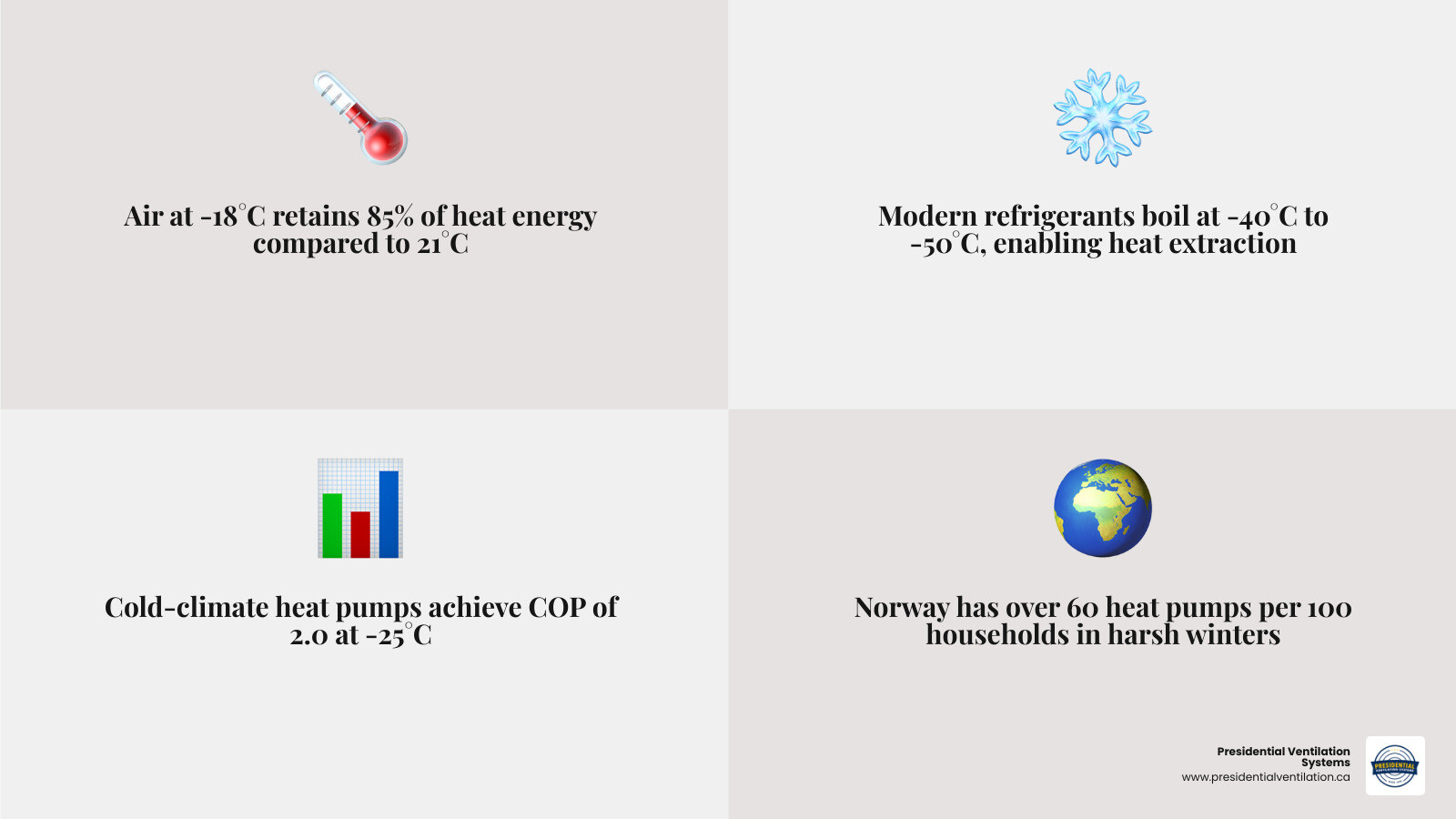
It might seem like a magic trick: how can a machine pull "heat" out of air that feels bone-chillingly cold to us? To understand this, we have to look at the world through the eyes of a scientist. Even when it is -15°C in Dartmouth or Bedford, there is still a significant amount of thermal energy in the air. In fact, air at -18°C still contains about 85% of the heat energy it has at 21°C.
The secret lies in the refrigerant—a specialized fluid that circulates through your system. This fluid has an incredibly low boiling point. While water boils at 100°C, some refrigerants used in modern systems boil at temperatures as low as -40°C or -50°C.
When the cold outdoor air is blown over the outdoor evaporator coil, the refrigerant inside is even colder than the air. Because heat naturally moves from "warmer" objects to "colder" ones, the refrigerant absorbs the thermal energy from the outdoor air and begins to boil, turning into a gas.
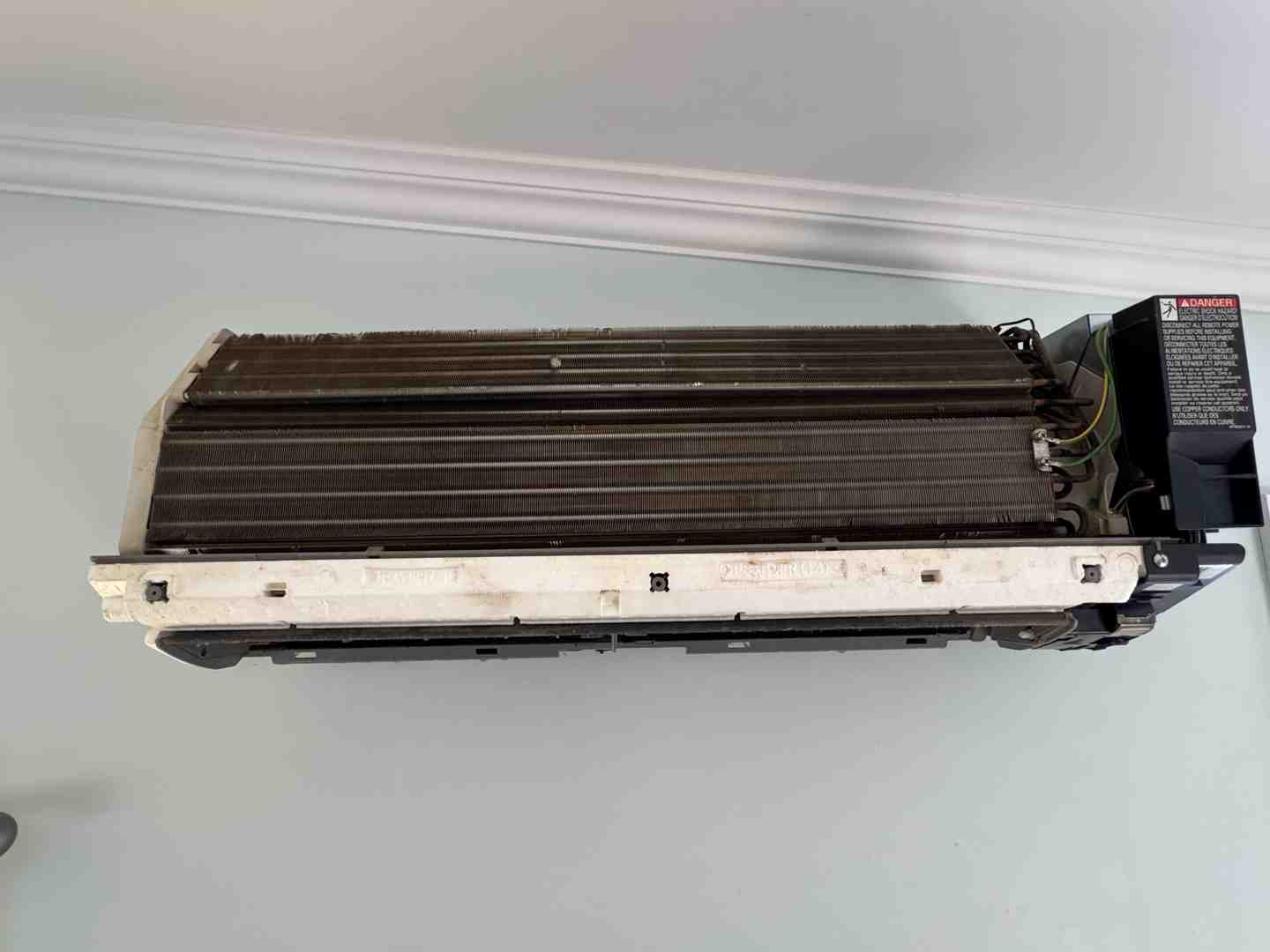
Once that gas is full of heat, we use a compressor to squeeze it. If you’ve ever used a bicycle pump, you know that when you compress air, it gets hot. The same thing happens here. By the time that gas reaches your indoor unit, it is hot enough to warm your home to a cozy temperature, even during a February deep freeze. This process of moving heat rather than creating it is why Heat Pump Efficiency Extreme Temperatures are so much better than traditional electric baseboards.
When we talk about heat pump performance in extreme cold explained, we are usually talking about the "balance point." This is the temperature where the heat pump's output perfectly matches the amount of heat your home is losing through its walls and windows.
In the past (think back to the early 2000s), standard heat pumps were famous for "giving up" once the thermometer hit 0°C. They would lose efficiency rapidly, and their heating capacity would drop just when you needed it most. However, it is now April 2026, and the technology has leaped forward. Modern systems are designed to handle the specific Climate On Heat Pump Performance challenges we face in Atlantic Canada.
The primary metric we use is the Coefficient of Performance (COP). If a system has a COP of 3.0, it is producing 3 units of heat for every 1 unit of electricity it uses. Even in extreme cold, such as -25°C, many cold-climate units maintain a COP between 1.5 and 2.0. To put that in perspective, a traditional electric heater has a COP of exactly 1.0. Even at their least efficient, modern heat pumps are still significantly better than the alternatives.
What makes a 2026-era heat pump so much better than the models from a decade ago? It comes down to three major technological advancements:
1. Variable-Speed Inverter Compressors: Older units were either "on" or "off." Think of it like a car that only goes 0 or 100 km/h. Modern inverter compressors can adjust their speed with incredible precision. They can "cruise" at a low speed to maintain temperature or "rev up" to extract more heat when the temperature plunges.
2. Vapor Injection Technology: This is a game-changer for sub-zero performance. By injecting a small amount of refrigerant back into the compressor, the system can maintain higher heating capacities at much lower temperatures without overheating the compressor.
3. Enhanced Heat Exchangers: Modern units use larger coils and specialized coatings to maximize the surface area available for heat exchange, ensuring every bit of available warmth is captured from the Nova Scotia air.
To get the best out of your system during a Halifax winter, you need to understand how it manages ice. Because the outdoor coil becomes very cold while absorbing heat, moisture in the air can freeze on the coils. This is where the "defrost cycle" comes in.
Your system will periodically reverse itself for a few minutes to melt that ice. You might see steam rising from the unit or hear a "whooshing" sound—don't panic! This is a sign that the sensors are calibrated correctly and the system is maintaining its own efficiency.
Proper maintenance is key here. If the sensors are dirty or the airflow is blocked by snow or debris, the system might stay in defrost too long or not long enough, which impacts Seasonal Changes Affect Heat Pump Performance. Keeping the outdoor unit clear of snow drifts is the single most important "homework" task for a homeowner in regions like Fall River or Waverley.
Not all heat pumps are created equal. If you install a system designed for the mild winters of South Carolina in a home in Timberlea, you are going to have a very cold February.
• Operational Limit — Standard Heat Pump: Typically struggles below -5°C — Cold-Climate Heat Pump (ccASHP): Operates effectively down to -25°C or -30°C
• Capacity at 5°F (-15°C) — Standard Heat Pump: May lose 40-50% of heating capacity — Cold-Climate Heat Pump (ccASHP): Maintains 80-100% of heating capacity
• Compressor Type — Standard Heat Pump: Often single or two-stage — Cold-Climate Heat Pump (ccASHP): Variable-speed inverter-driven
• Special Tech — Standard Heat Pump: Standard refrigeration cycle — Cold-Climate Heat Pump (ccASHP): Vapor injection & flash injection
• Efficiency (COP) — Standard Heat Pump: Drops near 1.0 at -10°C — Cold-Climate Heat Pump (ccASHP): Stays well above 1.5 at -20°C
Standard models are great for cooling in the summer and providing heat during the "shoulder seasons" (spring and fall). However, for a primary heating source in Nova Scotia, a cold-climate model is essential. These units feature oversized heat exchangers and "hot-start" technology, which prevents the system from blowing cold air into the house while the compressor is warming up.
Selecting the right model is about more than just the brand; it's about matching the system to the thermal reality of your home. This is why Can A Heat Pump Heat Your Home In Nova Scotia Winters is a question best answered by looking at the specific low-ambient performance ratings of the unit.
We often hear folks in Cole Harbour or Eastern Passage express concern that heat pumps are only for "warm" places. The data says otherwise. In fact, heat pumps are most popular in the coldest regions of the world.
In Finland, field testing of leading cold-climate brands showed they maintained a COP above 2.0 at -20°C. Even when the temperature dropped to -30°C, they stayed between 1.5 and 2.0. In Minnesota—a climate much harsher than our own—field assessments showed that cold-climate air-source heat pumps consistently outperformed electric resistance heating even when temperatures stayed below -12°C for weeks.
One of the most telling statistics comes from a UK study of over 2,500 users. Three-quarters of heat pump owners reported being just as happy, or even happier, than they were with their previous gas or oil systems. This satisfaction held true even for those living in older, draftier homes, provided the system was sized correctly.
In Nova Scotia, we also have to deal with high humidity and wind. These factors can increase the frequency of defrost cycles. Understanding How Nova Scotia Storms Affect Your Heat Pump is vital for setting realistic expectations during our messy Atlantic winters.
A high-performance machine is only as good as its installation. We’ve seen many cases where a top-tier unit struggled simply because it was placed in a wind tunnel or buried under a snow roof.
To ensure your system thrives in locations like Sackville, Tantallon, or Indigo Shores, we follow several best practices:
1. Elevation is Everything: In Nova Scotia, we get snow—and then we get rain, and then it freezes. We always mount outdoor units on a stand, typically 12 to 18 inches above the ground. This keeps the unit clear of snow accumulation and ensures that the water melting off during a defrost cycle can drain away and not freeze into a block of ice under the unit.
2. Strategic Placement: We look for the gabled side of the house where snow is less likely to fall off the roof directly onto the unit. We also try to avoid areas prone to heavy wind drifts.
3. The "Manual J" Calculation: We never guess the size of the system you need. We perform a detailed load calculation that considers your home’s insulation, window types, and local design temperatures. An undersized unit will run non-stop and struggle to keep up, while an oversized unit will "short-cycle," reducing its lifespan.
4. Weatherization First: A heat pump moves heat into your home; insulation keeps it there. We often recommend addressing air leaks and attic insulation as part of the process. This lowers the "balance point" of your home, allowing the heat pump to handle even colder days without needing help.
Finding the Best Heating Setup For Nova Scotia Weather means looking at the whole home as a system, not just the box sitting outside.
If you are used to a furnace that kicks on with a roar for 10 minutes and then shuts off, a heat pump can be a bit of a shock. Heat pumps are designed to run for long periods at lower speeds. This is actually more efficient and provides much more consistent comfort. When it is -10°C in Dartmouth, your heat pump is likely running "non-stop" because it is perfectly modulating its speed to replace the heat your home is losing in real-time. It’s like a marathon runner finding a steady pace rather than a sprinter constantly stopping to catch their breath.
For most Nova Scotia homes, we recommend a "hybrid" or "dual-fuel" setup or at least an electric resistance backup (often called "heat strips"). While a cold-climate heat pump can handle 100% of your needs down to -20°C, there may be those rare nights where the temperature plunges further or a storm creates extreme heat loss. Having a backup ensures you stay cozy no matter what, and modern thermostats are smart enough to only engage the backup when absolutely necessary.
Yes! Modern cold-climate models are specifically engineered for these temperatures. While their efficiency (COP) will be lower than it is on a mild day, they are still extracting heat from the air. In fact, many of the units we install in places like Beaver Bank and Hubbards are rated to provide significant heat even at -25°C.
At Presidential Ventilation Systems Ltd., we have spent over 30 years helping Nova Scotians stay comfortable through every kind of weather the Atlantic can throw at us. From the salt air of Peggys Cove to the deep snows of Mount Uniacke, we understand that heat pump performance in extreme cold explained isn't just about laboratory numbers—it's about real-world reliability.
As a Daikin Comfort Pro Dealer, we take pride in offering energy-saving solutions that are built for our climate. Whether you are in Halifax, Dartmouth, or anywhere in between, our team is here to ensure your system is sized correctly, installed professionally, and maintained for a long, efficient life.
If you’re ready to stop worrying about the next cold snap and start enjoying the comfort and savings of a modern system, we are here to help. Learn more about our high-performance heating solutions and let's make sure your home is ready for whatever winter brings.

Heat pump performance in extreme cold explained simply: modern cold-climate heat pumps continue to deliver efficient heating well below freezing, with real-world data showing a Coefficient of Performance (COP) averaging around 2.7 between 5°C and -10°C, and purpose-built cold-climate models maintaining useful output down to -25°C or lower.
Here is a quick summary of what to expect at different temperatures:
• 5°C to -10°C — Typical COP Range: 2.4 - 3.3 — Notes: Strong, efficient performance
• -10°C to -20°C — Typical COP Range: 2.0 - 2.5 — Notes: Cold-climate models perform well
• -20°C to -30°C — Typical COP Range: 1.5 - 2.0 — Notes: Reduced but still useful efficiency
• Below -30°C — Typical COP Range: 1.3 - 1.5 — Notes: Near operational limits; backup may help
A COP above 1.0 means the system is still delivering more heat energy than the electricity it consumes — making it more efficient than electric resistance heating at nearly every outdoor temperature.
Despite this, many homeowners across Nova Scotia and beyond wonder if their heating system is failing when they notice it running constantly during a cold snap, blowing slightly cooler air, or kicking into defrost mode. These are actually normal behaviours, not signs of a breakdown.
The reality is that public skepticism about heat pumps in cold weather is largely rooted in outdated assumptions. Countries with some of the coldest winters on earth — Norway, Sweden, Finland — have among the highest rates of heat pump adoption anywhere. Norway alone has more than 60 heat pumps per 100 households. Meanwhile, field testing in Alaska recorded a COP of 2.0 at -25°C and 1.8 at -35°C, confirming that even in extreme conditions, these systems keep working.
Understanding the physics behind how a heat pump extracts warmth from frigid air — and knowing where the real performance limits lie — helps homeowners make confident decisions about winter heating in Atlantic Canada.
It might seem like a magic trick: how can a machine pull "heat" out of air that feels bone-chillingly cold to us? To understand this, we have to look at the world through the eyes of a scientist. Even when it is -15°C in Dartmouth or Bedford, there is still a significant amount of thermal energy in the air. In fact, air at -18°C still contains about 85% of the heat energy it has at 21°C.
The secret lies in the refrigerant—a specialized fluid that circulates through your system. This fluid has an incredibly low boiling point. While water boils at 100°C, some refrigerants used in modern systems boil at temperatures as low as -40°C or -50°C.
When the cold outdoor air is blown over the outdoor evaporator coil, the refrigerant inside is even colder than the air. Because heat naturally moves from "warmer" objects to "colder" ones, the refrigerant absorbs the thermal energy from the outdoor air and begins to boil, turning into a gas.
Once that gas is full of heat, we use a compressor to squeeze it. If you’ve ever used a bicycle pump, you know that when you compress air, it gets hot. The same thing happens here. By the time that gas reaches your indoor unit, it is hot enough to warm your home to a cozy temperature, even during a February deep freeze. This process of moving heat rather than creating it is why Heat Pump Efficiency Extreme Temperatures are so much better than traditional electric baseboards.
When we talk about heat pump performance in extreme cold explained, we are usually talking about the "balance point." This is the temperature where the heat pump's output perfectly matches the amount of heat your home is losing through its walls and windows.
In the past (think back to the early 2000s), standard heat pumps were famous for "giving up" once the thermometer hit 0°C. They would lose efficiency rapidly, and their heating capacity would drop just when you needed it most. However, it is now April 2026, and the technology has leaped forward. Modern systems are designed to handle the specific Climate On Heat Pump Performance challenges we face in Atlantic Canada.
The primary metric we use is the Coefficient of Performance (COP). If a system has a COP of 3.0, it is producing 3 units of heat for every 1 unit of electricity it uses. Even in extreme cold, such as -25°C, many cold-climate units maintain a COP between 1.5 and 2.0. To put that in perspective, a traditional electric heater has a COP of exactly 1.0. Even at their least efficient, modern heat pumps are still significantly better than the alternatives.
What makes a 2026-era heat pump so much better than the models from a decade ago? It comes down to three major technological advancements:
1. Variable-Speed Inverter Compressors: Older units were either "on" or "off." Think of it like a car that only goes 0 or 100 km/h. Modern inverter compressors can adjust their speed with incredible precision. They can "cruise" at a low speed to maintain temperature or "rev up" to extract more heat when the temperature plunges.
2. Vapor Injection Technology: This is a game-changer for sub-zero performance. By injecting a small amount of refrigerant back into the compressor, the system can maintain higher heating capacities at much lower temperatures without overheating the compressor.
3. Enhanced Heat Exchangers: Modern units use larger coils and specialized coatings to maximize the surface area available for heat exchange, ensuring every bit of available warmth is captured from the Nova Scotia air.
To get the best out of your system during a Halifax winter, you need to understand how it manages ice. Because the outdoor coil becomes very cold while absorbing heat, moisture in the air can freeze on the coils. This is where the "defrost cycle" comes in.
Your system will periodically reverse itself for a few minutes to melt that ice. You might see steam rising from the unit or hear a "whooshing" sound—don't panic! This is a sign that the sensors are calibrated correctly and the system is maintaining its own efficiency.
Proper maintenance is key here. If the sensors are dirty or the airflow is blocked by snow or debris, the system might stay in defrost too long or not long enough, which impacts Seasonal Changes Affect Heat Pump Performance. Keeping the outdoor unit clear of snow drifts is the single most important "homework" task for a homeowner in regions like Fall River or Waverley.
Not all heat pumps are created equal. If you install a system designed for the mild winters of South Carolina in a home in Timberlea, you are going to have a very cold February.
• Operational Limit — Standard Heat Pump: Typically struggles below -5°C — Cold-Climate Heat Pump (ccASHP): Operates effectively down to -25°C or -30°C
• Capacity at 5°F (-15°C) — Standard Heat Pump: May lose 40-50% of heating capacity — Cold-Climate Heat Pump (ccASHP): Maintains 80-100% of heating capacity
• Compressor Type — Standard Heat Pump: Often single or two-stage — Cold-Climate Heat Pump (ccASHP): Variable-speed inverter-driven
• Special Tech — Standard Heat Pump: Standard refrigeration cycle — Cold-Climate Heat Pump (ccASHP): Vapor injection & flash injection
• Efficiency (COP) — Standard Heat Pump: Drops near 1.0 at -10°C — Cold-Climate Heat Pump (ccASHP): Stays well above 1.5 at -20°C
Standard models are great for cooling in the summer and providing heat during the "shoulder seasons" (spring and fall). However, for a primary heating source in Nova Scotia, a cold-climate model is essential. These units feature oversized heat exchangers and "hot-start" technology, which prevents the system from blowing cold air into the house while the compressor is warming up.
Selecting the right model is about more than just the brand; it's about matching the system to the thermal reality of your home. This is why Can A Heat Pump Heat Your Home In Nova Scotia Winters is a question best answered by looking at the specific low-ambient performance ratings of the unit.
We often hear folks in Cole Harbour or Eastern Passage express concern that heat pumps are only for "warm" places. The data says otherwise. In fact, heat pumps are most popular in the coldest regions of the world.
In Finland, field testing of leading cold-climate brands showed they maintained a COP above 2.0 at -20°C. Even when the temperature dropped to -30°C, they stayed between 1.5 and 2.0. In Minnesota—a climate much harsher than our own—field assessments showed that cold-climate air-source heat pumps consistently outperformed electric resistance heating even when temperatures stayed below -12°C for weeks.
One of the most telling statistics comes from a UK study of over 2,500 users. Three-quarters of heat pump owners reported being just as happy, or even happier, than they were with their previous gas or oil systems. This satisfaction held true even for those living in older, draftier homes, provided the system was sized correctly.
In Nova Scotia, we also have to deal with high humidity and wind. These factors can increase the frequency of defrost cycles. Understanding How Nova Scotia Storms Affect Your Heat Pump is vital for setting realistic expectations during our messy Atlantic winters.
A high-performance machine is only as good as its installation. We’ve seen many cases where a top-tier unit struggled simply because it was placed in a wind tunnel or buried under a snow roof.
To ensure your system thrives in locations like Sackville, Tantallon, or Indigo Shores, we follow several best practices:
1. Elevation is Everything: In Nova Scotia, we get snow—and then we get rain, and then it freezes. We always mount outdoor units on a stand, typically 12 to 18 inches above the ground. This keeps the unit clear of snow accumulation and ensures that the water melting off during a defrost cycle can drain away and not freeze into a block of ice under the unit.
2. Strategic Placement: We look for the gabled side of the house where snow is less likely to fall off the roof directly onto the unit. We also try to avoid areas prone to heavy wind drifts.
3. The "Manual J" Calculation: We never guess the size of the system you need. We perform a detailed load calculation that considers your home’s insulation, window types, and local design temperatures. An undersized unit will run non-stop and struggle to keep up, while an oversized unit will "short-cycle," reducing its lifespan.
4. Weatherization First: A heat pump moves heat into your home; insulation keeps it there. We often recommend addressing air leaks and attic insulation as part of the process. This lowers the "balance point" of your home, allowing the heat pump to handle even colder days without needing help.
Finding the Best Heating Setup For Nova Scotia Weather means looking at the whole home as a system, not just the box sitting outside.
If you are used to a furnace that kicks on with a roar for 10 minutes and then shuts off, a heat pump can be a bit of a shock. Heat pumps are designed to run for long periods at lower speeds. This is actually more efficient and provides much more consistent comfort. When it is -10°C in Dartmouth, your heat pump is likely running "non-stop" because it is perfectly modulating its speed to replace the heat your home is losing in real-time. It’s like a marathon runner finding a steady pace rather than a sprinter constantly stopping to catch their breath.
For most Nova Scotia homes, we recommend a "hybrid" or "dual-fuel" setup or at least an electric resistance backup (often called "heat strips"). While a cold-climate heat pump can handle 100% of your needs down to -20°C, there may be those rare nights where the temperature plunges further or a storm creates extreme heat loss. Having a backup ensures you stay cozy no matter what, and modern thermostats are smart enough to only engage the backup when absolutely necessary.
Yes! Modern cold-climate models are specifically engineered for these temperatures. While their efficiency (COP) will be lower than it is on a mild day, they are still extracting heat from the air. In fact, many of the units we install in places like Beaver Bank and Hubbards are rated to provide significant heat even at -25°C.
At Presidential Ventilation Systems Ltd., we have spent over 30 years helping Nova Scotians stay comfortable through every kind of weather the Atlantic can throw at us. From the salt air of Peggys Cove to the deep snows of Mount Uniacke, we understand that heat pump performance in extreme cold explained isn't just about laboratory numbers—it's about real-world reliability.
As a Daikin Comfort Pro Dealer, we take pride in offering energy-saving solutions that are built for our climate. Whether you are in Halifax, Dartmouth, or anywhere in between, our team is here to ensure your system is sized correctly, installed professionally, and maintained for a long, efficient life.
If you’re ready to stop worrying about the next cold snap and start enjoying the comfort and savings of a modern system, we are here to help. Learn more about our high-performance heating solutions and let's make sure your home is ready for whatever winter brings.

The fall shoulder season in maritime Nova Scotia is fast approaching, and your retail store's climate control is about to face its toughest test of the year. Preparing your Dartmouth retail store's HVAC for the fall shoulder season means navigating freezing mornings that demand heat, followed by busy, sunlit afternoons that require active cooling. This extreme daily temperature swing creates a unique concrete problem for commercial spaces: the building requires robust heating at dawn, but rapid cooling just a few hours later when the store fills with customers.
If your commercial thermostat controls are not configured correctly, this dramatic shift causes your heating and cooling systems to fight each other. The core decision point for facility managers is how to properly configure commercial thermostat deadband settings to handle these rapid daily temperature shifts without causing excessive mechanical strain. Ensure you have reliable commercial heating services on standby before the unpredictable coastal weather takes a toll on your equipment.
Managing a commercial retail space is vastly different from controlling a residential home. In a residential setting, you might simply switch the thermostat from "Cool" to "Heat" once October arrives. In a Dartmouth retail environment, doing so will almost certainly result in an uncomfortably hot store by 2:00 PM. The challenge lies in balancing the natural climate fluctuations of maritime fall weather with the heavy internal heat loads generated by retail operations. When commercial systems are left on standard factory settings during this transition, the resulting inefficiency leads to massive energy waste and significant wear on expensive commercial electrical components.
Retail stores struggle with temperature regulation during the fall significantly more than standard office buildings or warehouses. This difficulty stems from the concept of latent and sensible heat loads. Even when the outside air is crisp and cool, the inside of a retail store generates a massive amount of its own heat.
Consider the typical heat sources present in a busy retail environment:
• High-intensity lighting: Large arrays of display lights, track lighting, and illuminated signage generate continuous radiant heat throughout business hours.
• Electronic displays: Point-of-sale systems, digital advertising screens, and massive refrigeration units (which exhaust heat into the aisles) constantly raise the ambient temperature.
• Foot traffic: Every customer walking through the door introduces body heat and moisture into the space, rapidly changing the indoor climate during peak shopping hours.
Dartmouth's coastal proximity exacerbates rapid temperature and humidity shifts during the fall transition period, stressing improperly configured commercial HVAC systems. The frequent opening and closing of main entry doors allows cold, damp maritime air to rush in, confusing the thermostat sensors located deeper inside the store. The system detects a sudden drop in temperature and triggers the furnace or heating mode.
However, within minutes, the massive internal heat loads from lights and bodies warm that air back up, pushing the indoor temperature past the comfort zone. This dynamic triggers the need for active cooling even when outdoor temperatures begin to drop into the single digits. Standard residential thermostat practices simply do not apply to commercial retail environments because residential homes do not experience this rapid, intense fluctuation of internal heat generation. Commercial spaces require specialized control strategies to manage this chaotic thermal environment.
To resolve the issue of systems fighting each other, commercial HVAC relies on a specific control setting known as a thermostat deadband. A thermostat deadband is defined as the specific temperature range where neither heating nor cooling is activated. It is a neutral zone, or a buffer, programmed into the commercial control system to give the mechanical equipment a rest.
Without a proper deadband, a commercial HVAC system can experience "overlap." This happens when the heating setpoint and the cooling setpoint are too close together. For example, if the heat is set to turn on at 20°C and the AC is set to turn on at 21°C, the system will constantly bounce back and forth. The furnace runs, overshoots the target slightly to 21.5°C, which immediately triggers the air conditioning to turn on. The AC then cools the space down to 19.5°C, which immediately triggers the heat again. The systems are literally fighting each other, wasting massive amounts of energy.
According to ASHRAE (American Society of Heating, Refrigerating and Air-Conditioning Engineers) commercial building temperature guidelines, establishing a proper deadband is critical for energy efficiency and occupant comfort. A typical thermostat deadband variance of 3-5 degrees is recommended to prevent this overlap.
• Zero Deadband (Incorrect) — Heating Setpoint: 21°C — Cooling Setpoint: 21°C — System Behavior: Constant switching between heat and AC; rapid component failure.
• Narrow Deadband (Risky) — Heating Setpoint: 20°C — Cooling Setpoint: 21°C — System Behavior: Frequent cycling during fall shoulder season temperature swings.
• Optimized Deadband (Correct) — Heating Setpoint: 19°C — Cooling Setpoint: 23°C — System Behavior: System rests in the 4-degree neutral zone; saves energy and wear.
Configuring these advanced deadband controls requires a professional understanding of commercial electrical and mechanical systems. Facility managers should never attempt to rewire internal commercial thermostats, adjust electrical contactors, or bypass safety limits, as commercial voltage can be highly dangerous and improper settings can instantly damage heavy rooftop units (RTUs).
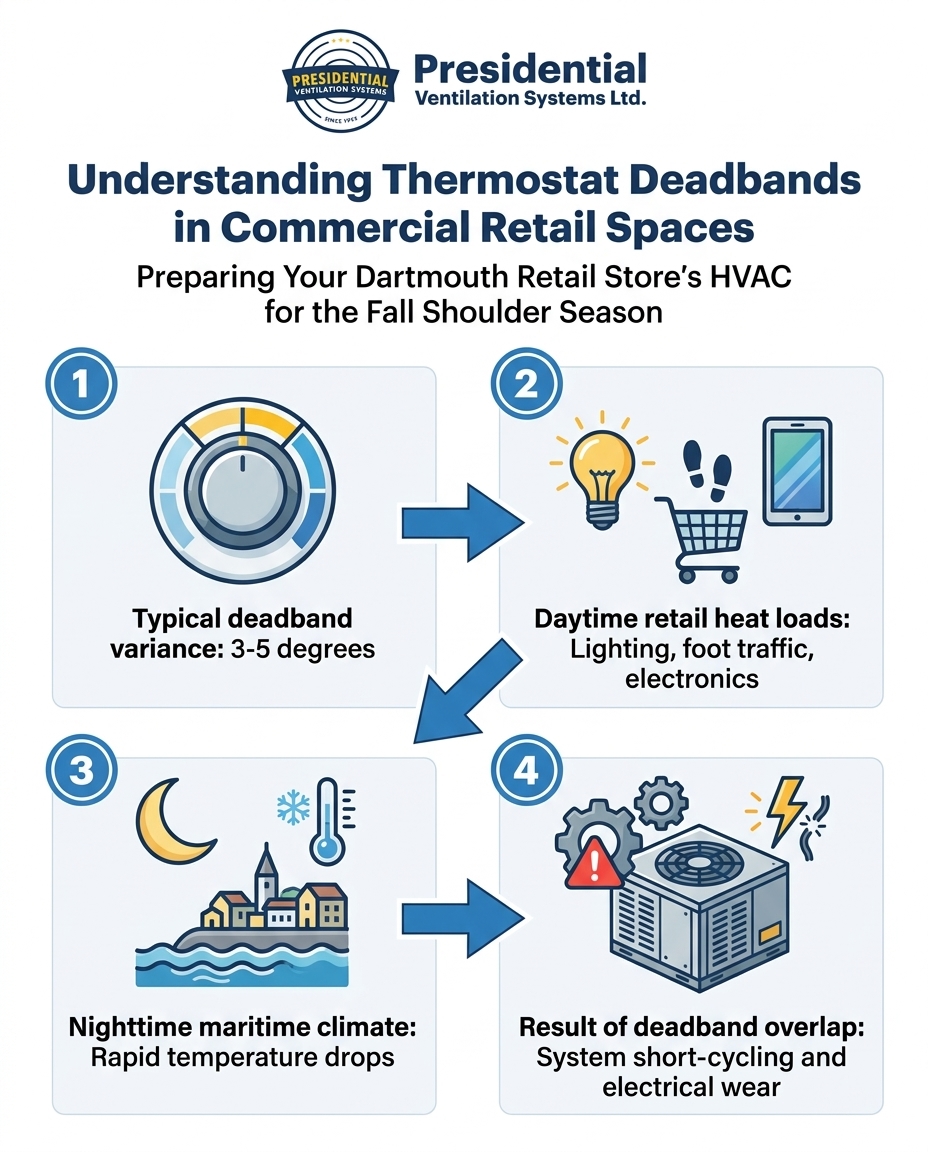
When a deadband is improperly configured during the fall shoulder season, the most immediate consequence is short-cycling. In a commercial context, short-cycling occurs when a massive piece of HVAC equipment turns on, runs for only a few minutes, and then abruptly shuts off, only to restart moments later. Fall weather frequently causes this because the ambient temperature hovers right on the edge of the thermostat's setpoints.
Rapid daily temperature shifts lead to excessive mechanical wear and tear on commercial compressors. A compressor is designed to run in long, steady cycles to efficiently move refrigerant and allow lubricating oils to circulate properly. When the system short-cycles, the oil never fully returns to the compressor, leading to increased friction, overheating, and eventual catastrophic mechanical failure. The constant starting and stopping grinds down bearings and stresses the blower motor belts.
Beyond the mechanical parts, short-cycling places immense strain on commercial electrical components. Every time a heavy commercial rooftop unit starts up, it draws a massive surge of power known as inrush current. This current is often several times higher than the running current. When heavy machinery cycles on and off too frequently, this repeated surge overheats electrical contactors, degrades capacitors, and can even cause phase imbalances in the building's electrical panel.
Establishing a proper thermostat deadband variance (typically 3-5 degrees) allows the system to rest. By widening the gap between the heating and cooling triggers, the indoor temperature is allowed to drift naturally within a comfortable range. This simple optimization drastically reduces the number of startup cycles, extending the equipment lifespan and protecting the building's electrical infrastructure.
Facility managers and store owners need to know how to identify if their current deadband settings are incorrect before the equipment suffers permanent damage. Because the fall shoulder season in maritime Nova Scotia forces systems to work in both modes daily, symptoms of deadband overlap become highly visible.
Watch for these common warning signs that your retail HVAC system is fighting itself:
• Noticeable temperature swings: Customers or staff complain that the store feels freezing near the entrance but boiling hot near the back displays, changing rapidly by the hour.
• Constant blower fan operation: The air never stops rushing through the vents, yet the temperature never seems to stabilize.
• Unusually high energy bills: A sudden, unexplained spike in commercial electrical costs during September or October often indicates the heat and AC are running simultaneously.
• Rapid clicking noises: Hearing the thermostat or the rooftop unit constantly clicking on and off every ten minutes.
One of the most frustrating scenarios for a retail manager is when the air conditioner not working during warm afternoons becomes a daily disruption, despite the system functioning perfectly to heat the store that very same morning. This usually means the safety sensors have locked the cooling system out due to short-cycling or frozen coils caused by improper fall settings.
Always observe the operational cycles by listening to the vents and monitoring the thermostat readouts, but never attempt internal electrical diagnostics. Instead, document these specific issues—noting the time of day the temperature swings occur and how often the system cycles—to share with a commercial HVAC technician upon arrival.
Optimizing your commercial controls is not just about preventing breakdowns; it is directly tied to your retail store's bottom line. The relationship between reduced short-cycling and overall energy consumption in retail spaces is profound. Every unnecessary startup surge avoided is electricity saved.
When you optimize commercial HVAC controls, you reduce unnecessary mechanical wear, which lowers your long-term maintenance costs. However, the immediate financial benefit comes from reduced monthly utility bills. By allowing the store's temperature to drift naturally within that 3-5 degree deadband, the system relies on the building's thermal mass rather than active mechanical heating or cooling.
Furthermore, upgrading to advanced commercial thermostats or building automation controls can help businesses qualify for provincial energy efficiency rebates. Programs designed to reduce grid strain often reward commercial properties that upgrade from outdated, manual thermostats to smart, deadband-capable control systems. Reviewing Efficiency Nova Scotia commercial rebate literature is a smart first step, as many of these incentives require professional installation and verification. Seeking a professional system assessment not only ensures your deadbands are set perfectly for the maritime fall, but it also provides the documentation needed to pursue construction, electrical, and energy efficiency rebates.
Transitioning from a technical understanding of deadbands to actual implementation requires professional support. A professional fall inspection for a commercial system entails much more than changing a filter. Technicians must test the advanced controls, verify the deadband variance, inspect the electrical contactors for pitting caused by summer short-cycling, and perform a deep cleaning of the coils to ensure proper airflow.
Preventative maintenance avoids costly downtime during peak retail shopping seasons. If a rooftop unit fails on Black Friday because the compressor finally gave out after weeks of fall short-cycling, the loss of foot traffic and inventory damage far outweighs the cost of a routine inspection. This highlights the absolute necessity of having a structured maintenance plan for complex commercial equipment.
One local commercial customer reached out during the spring when their heat pump system failed entirely, and previous technicians from other companies could not resolve the issue. A skilled technician properly diagnosed the complex control problem, explained the underlying cause to the facility manager, and successfully fixed the heat pump after previous failed attempts. This level of insight is crucial when dealing with commercial ducted heat pump systems that require precise calibration.
Presidential Ventilation's expertise in commercial HVAC systems ensures retail businesses avoid costly downtime and maintain perfect customer comfort through advanced thermostat deadband optimization. Working with technicians who deeply understand local maritime climate challenges across various local HVAC service areas means your system will be tailored to handle the exact humidity and temperature swings unique to the coast.
The fall shoulder season in maritime Nova Scotia is the optimal time to configure your controls, well before the deep winter freeze sets in. Stabilizing your indoor temperatures now protects sensitive retail inventory, keeps your staff productive, and ensures every customer experiences a comfortable shopping environment the moment they walk through the doors.
Don't wait until the system locks itself out from excessive short-cycling. Schedule a professional assessment of your store's HVAC controls today and secure an HVAC maintenance plan to keep your commercial electrical and mechanical systems running safely and efficiently all year long.
What is a thermostat deadband?
A thermostat deadband is a specific temperature range programmed into an HVAC control system where neither heating nor cooling is activated. This neutral zone, typically 3-5 degrees, gives the mechanical equipment time to rest and prevents the heating and cooling systems from fighting each other.
How do I stop my commercial HVAC from short-cycling during the fall?
The most effective way to stop short-cycling during the fall shoulder season is to have a professional widen the thermostat deadband variance. This prevents the system from rapidly turning on and off in response to minor temperature fluctuations, reducing strain on the electrical components and compressor.
What temperature should a retail store be kept at?
While exact temperatures depend on the inventory, ASHRAE guidelines generally suggest a heating setpoint around 19°C to 20°C and a cooling setpoint around 23°C to 24°C. Maintaining this gap ensures energy efficiency and keeps the environment comfortable for shoppers moving through the store.
Why is my commercial AC running in the fall?
Your commercial AC runs in the fall because retail spaces generate massive latent heat loads from high-intensity lighting, electronic displays, and heavy foot traffic. Even when it is cold outside, this internal heat can quickly push the indoor temperature past the cooling setpoint, requiring the AC to engage.
Can improper deadband settings damage commercial electrical components?
Yes, improper deadband settings cause the system to short-cycle, which forces heavy commercial equipment to restart constantly. Each startup draws a massive surge of inrush current that can overheat electrical contactors, degrade capacitors, and eventually lead to catastrophic mechanical failure.
How do commercial HVAC rebates work in Nova Scotia?
Commercial HVAC rebates, such as those offered by Efficiency Nova Scotia, provide financial incentives for businesses that upgrade to high-efficiency equipment and advanced control systems. Qualifying for these rebates typically requires a professional assessment and installation to verify that the new systems significantly reduce electrical grid strain.

You finally have the keys to your brand-new build, but despite the pristine floors and fresh paint, a fine layer of white dust keeps settling on your countertops. At Presidential Ventilation Systems Ltd., our team often encounters a frustrating reality for many property owners: What happens when you skip HRV duct cleaning in a newly constructed home means your state-of-the-art ventilation network is already compromised before you even move your furniture inside. For example, in homes completed during the recent 2022-2024 residential and commercial construction boom, we routinely find significant amounts of drywall dust, heavy sawdust, and fiberglass particles accumulated heavily during the final stages of home construction, settling deep inside the ductwork.
To ensure your new property operates as efficiently as it was designed to, exploring professional ventilation and HVAC services is the best first step you can take.
The most common decision point for new homeowners is whether to schedule a post-build cleaning or simply assume the system is spotless because the house has never been lived in. Modern construction practices generate massive amounts of ultrafine particulate matter. Even with diligent contractors sweeping up daily, microscopic debris becomes airborne and inevitably finds its way into the ventilation returns. As we remind our Mount Uniacke NS clients, a "new" home does not automatically equal a "clean" ventilation system.
The unseen accumulation process:
• Drywall sanding: Produces a flour-like dust that stays suspended in the air for hours, easily drifting into open vent boots.
• Hardwood cutting: Heavy sawdust falls into floor registers before grilles are officially installed.
• Insulation installation: Airborne fiberglass particles get pulled into the return ducting if the system is tested prematurely.
If left unaddressed, this debris travels straight to the HRV heat recovery core, turning a brand-new mechanical system into a strained, inefficient unit from day one.
The timeline of a new build is complex, with multiple trades overlapping to meet deadlines. During the busy spring and summer building seasons, heavy particulate matter is introduced into the environment daily. One local homeowner recently noted how crucial a tidy, efficient installation is during a summer project; when contractors prioritize a clean work environment, it helps, but even the best crews cannot stop airborne dust from entering an active air exchange network.
When you run the heating or cooling during the construction or major renovation phase—often done to dry drywall mud faster or keep workers comfortable—the system pulls this debris directly into the return vents. This creates an immediate burden on your HRV systems right out of the gate.
Sanding drywall and cutting wood generate suspended particles—often measuring as small as 2.5 microns (PM2.5)—that behave very differently than normal household dust. Standard household dust is primarily made of fabric fibers, pet dander, and skin cells. Construction dust is heavy, abrasive, and highly concentrated.
• Standard Household Dust — Particle Characteristics: Light, easily trapped by basic filters, organic material. — Impact on Ventilation Systems: Gradual buildup over months; easily managed with standard maintenance.
• Construction Debris — Particle Characteristics: Ultrafine, abrasive, inorganic (silica, gypsum, wood). — Impact on Ventilation Systems: Rapid clogging; coats internal components and bypasses basic filters.
Because systems are often tested or run temporarily before the final cleanup is complete, the ductwork acts as a vacuum for the entire job site.
You might assume the disposable filter installed by the builder will catch the mess. Unfortunately, standard construction-grade fiberglass filters are designed to stop large debris like hair and large dust bunnies, not ultrafine drywall powder. These microscopic particles bypass basic filters entirely. The dust settles deep within the ductwork, waiting to be circulated, ultimately leading to restricted airflow and reduced heat exchange efficiency the moment you take occupancy.
To understand why this specific type of dust is so damaging, you have to look at the mechanical heart of your ventilation setup: the HRV heat recovery core. This component is an intricate, honeycomb-like structure made of thin aluminum or specialized plastic plates. Its job is to cross outgoing stale indoor air with incoming fresh outdoor air, transferring the heat without mixing the air streams.
When our technicians open these units in Mount Uniacke NS, we see firsthand how skipping a post-construction cleaning sends a continuous stream of ultrafine dust straight into this delicate honeycomb structure. If you are wondering what happens if you don't maintain your HRV, the core is the first place to look for failure, often causing standard 75% to 80% Sensible Recovery Efficiency (SRE) ratings to plummet.
Ultrafine dust easily navigates through the ducts to the central unit. Once it reaches the core, a damaging chemical reaction occurs. Drywall dust is highly absorbent. When it combines with normal indoor humidity—or the moisture from fresh paint and curing concrete—it acts exactly like a paste. This paste coats the core's delicate transfer surfaces.
The mechanical breakdown:
• Insulating barrier: The drywall paste hardens into an insulating layer over the heat exchange plates.
• Blocked transfer: Heat can no longer pass efficiently from the warm exhaust air to the cold incoming air.
• Physical blockage: The narrow channels of the honeycomb structure physically plug up, stopping air from moving through the unit.
This buildup happens rapidly in new builds. Without intervention, a high-end, brand-new piece of equipment is quickly reduced to the efficiency of a heavily aged, neglected unit.
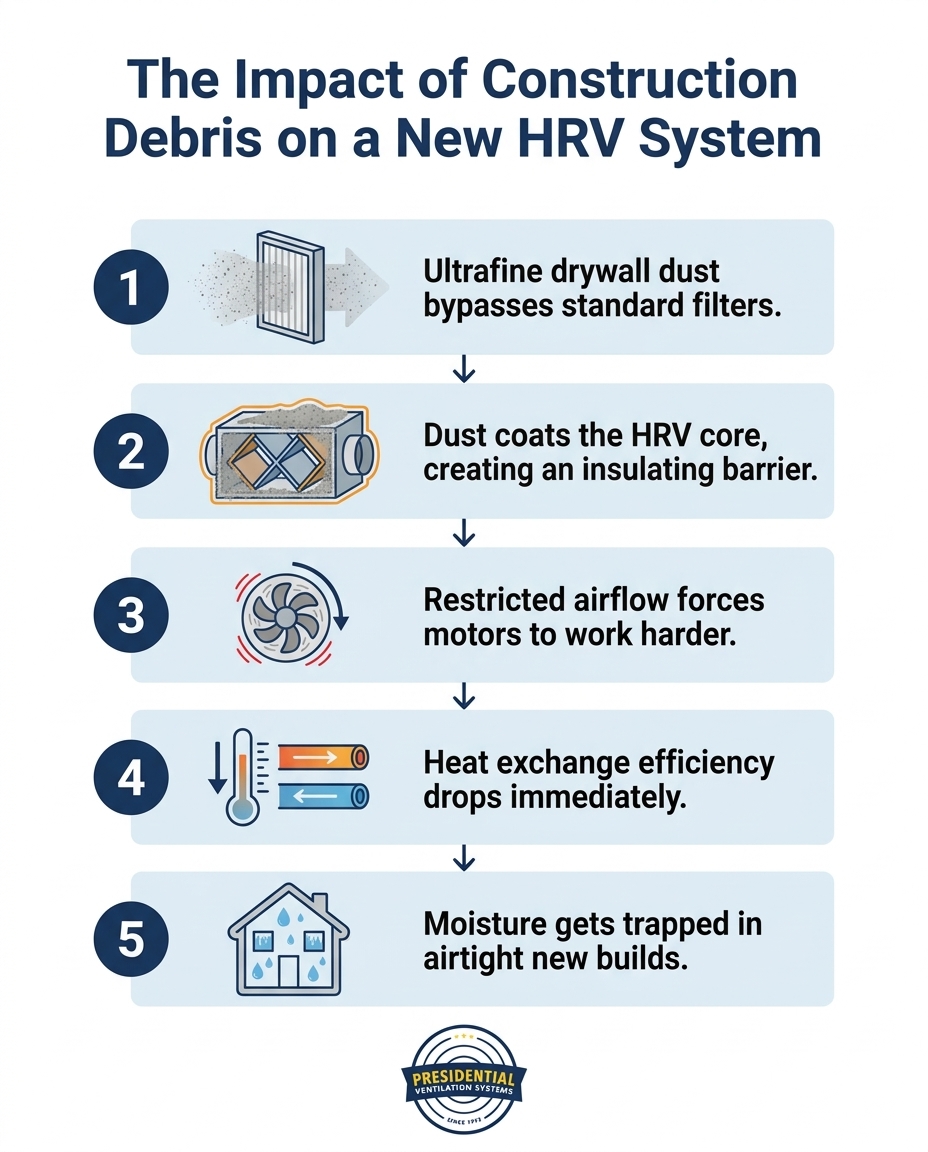
The secondary mechanical failures caused by a clogged core are often what homeowners notice first. The primary symptom is a sudden spike in energy usage or a home that feels stuffy despite the system running constantly. This is the direct result of restricted airflow and reduced heat exchange efficiency.
In a brand-new, airtight home, airflow must be perfectly balanced. When the channels of the HRV core become clogged with drywall dust, the volume of fresh air entering the home is drastically reduced. This creates a bottleneck. The static pressure inside the ductwork increases, forcing the system out of its optimal operating range. The blower motors, which are designed to push air with minimal resistance, suddenly have to push past 2,000 RPMs just to force air through the physical blockage.
Energy is wasted trying to overcome this resistance. The motors draw more electricity to maintain the required RPMs, negating the financial benefits of installing high-efficiency equipment in your new build. Furthermore, because the heat transfer surfaces are insulated by a layer of dust, the heat recovery rates plummet. Instead of capturing the heat from your outgoing air to warm the incoming winter air, that energy is lost to the outside, forcing your primary heating system to run longer and harder to make up the difference. This constant electrical strain leads directly to premature wear on blower motors and electrical components.
Modern new construction homes are built to rigorous energy codes, meaning they are highly airtight to prevent drafts and heat loss. While this is fantastic for your heating bill, it creates a unique challenge: airtight homes rely entirely on mechanical ventilation to expel indoor moisture. In Nova Scotia's damp maritime climate, managing high indoor humidity—especially keeping it below the critical 50% threshold during winter—is critical. The regional moisture levels make an efficiently running HRV heat recovery core essential to protect a brand-new airtight home from severe moisture damage.
Airtight construction traps moisture inside. Everyday activities like cooking, bathing, and even breathing generate significant humidity. More importantly, new building materials—such as fresh lumber, poured concrete, and interior paint—release gallons of moisture into the air during the first year of occupancy as they dry and cure.
The risks of trapped moisture:
• Window condensation: Water pools on sills, damaging brand-new trim and drywall.
• Poor indoor air quality: High humidity breeds mold and mildew in dark corners and closets.
• Material warping: Hardwood floors and cabinetry can swell or warp when indoor humidity remains unchecked.
In our years of servicing Mount Uniacke NS, we have seen how a dust-clogged HRV fails to expel this moisture effectively. When the airflow is restricted by construction debris, the damp, stale air stays trapped inside, putting your brand-new investment at immediate risk.
The transition from the installation phase to the occupancy phase is a critical window for your HVAC system's health. The final steps of an air exchanger installation involve balancing the airflow and testing the controls, but the job isn't truly finished until the post-build environment is completely clean. Because commercial and residential construction timelines often overlap, dust continues to enter newly installed systems right up until move-in day.
Our team at Presidential Ventilation Systems Ltd. brings deep local expertise in new construction HVAC, understanding exactly how Maritime building practices and timelines impact brand-new ventilation systems. Professional HVAC installers view the transition from a messy construction site to an occupied home as the most vulnerable time for mechanical equipment. If you have complementary systems, such as ducted heat pump systems, coordinating a professional cleaning immediately after construction protects the entire HVAC ecosystem. It ensures that restricted airflow and reduced heat exchange efficiency don't compromise the lifespan of your interconnected climate control units, while also maintaining system efficiency to ensure you qualify for regional energy rebates.
Assuming your system is clean simply because it is new is a costly mistake. One local homeowner scheduled a routine fall inspection and deep cleaning within the first 6 months of occupancy, only to realize the immense value of thorough testing and product care information after seeing the heavy particulate buildup removed from their seemingly "clean" new system. The evidence is clear: the HRV heat recovery core cannot process construction debris.
The immediate consequences of skipping a post-build cleaning include:
• Immediate reduction in heat exchange efficiency: Dust insulates the core, preventing heat transfer.
• Increased strain on blower motors: Motors overwork to push air through clogged channels, leading to higher electrical energy consumption.
• Poor indoor air quality: Ultrafine drywall dust recirculates continuously into your living spaces.
• Inability to manage indoor humidity: Airtight homes suffer from condensation and potential mold growth when ventilation fails.
• Premature component failure: Overworked motors and sensors burn out faster than their expected lifespan.
Highlighting the value of a thorough, professional inspection and deep clean to verify system health before move-in is essential. For property owners across our local service areas, scheduling this service is the ultimate peace-of-mind check.
A clear, technical understanding of how construction debris interacts with modern ventilation validates the absolute necessity of a post-build cleaning. Protecting the core from the abrasive, paste-like buildup of drywall dust ensures the system operates at peak efficiency from the moment you move in. By clearing out the hidden threats, our team ensures you eliminate the risks of restricted airflow and reduced heat exchange efficiency, allowing your equipment to properly manage the unique moisture loads of a new, airtight build.
Don't let the "new build myth" compromise your comfort. Consult with our local experts at Presidential Ventilation Systems Ltd. to clear out construction dust thoroughly, ensuring you start your new home journey with truly clean, healthy air.
Your new home is likely dusty because ultrafine construction debris, such as drywall dust and sawdust, has settled inside your ductwork. When the HVAC system kicks on, it continuously blows these hidden particles back into your living spaces. A professional duct cleaning removes this trapped debris at the source.
Yes, new builds almost always require duct cleaning before or immediately after move-in. During commercial and residential construction, the open ductwork acts as a collection point for sawdust, fiberglass, and drywall powder. Cleaning the system ensures this abrasive debris doesn't damage your brand-new HVAC equipment.
If an HRV core is clogged, the system cannot efficiently transfer heat between the incoming and outgoing air streams. This blockage restricts fresh airflow, forces the blower motors to overwork, and traps stale, humid air inside your home. In new airtight builds, this often leads to rapid window condensation.
Drywall dust affects an air exchanger installation by bypassing standard filters and coating the internal heat recovery core. Because drywall dust absorbs moisture, it forms a thick paste that blocks the narrow air channels. This immediately reduces the newly installed unit's efficiency and lifespan.
Yes, construction dust can permanently damage a new HRV system if left unaddressed. The constant electrical strain of pushing air through a clogged core can burn out the blower motors prematurely. Additionally, the abrasive nature of the dust can wear down delicate internal sensors and moving parts.