


When you are looking up home maintenance tips and troubleshooting strategies, you might notice one recurring issue that seems impossible to fix: condensation dripping down your windows while the indoor air feels heavy and stale. Balancing heat retention with adequate moisture control and indoor air quality during the freezing winter months is a massive challenge in modern construction. You want to keep the bitter cold outside where it belongs, but in doing so, you inadvertently trap everyday humidity inside your living space.
The core decision you face as a homeowner is understanding when your property requires a mechanical ventilation intervention to prevent winter moisture buildup without overloading your primary heating equipment. Upgrading your building envelope with heavy insulation and double-pane windows is fantastic for lowering your monthly energy consumption, but it fundamentally changes how your house breathes.
If you are exploring ways to improve your indoor comfort and energy efficiency, upgrading to ductless heat pumps is an excellent starting point. However, heating your home is only half of the equation. To truly resolve window condensation and stale air, you have to look at the entire structural ecosystem. The conflict between retaining expensive heat and exhausting unwanted moisture requires a strategic approach, blending advanced thermal conditioning with dedicated airflow management.
To understand why your windows are crying in January, you have to look at the basic physics of your home. Condensation occurs when warm, moisture-laden indoor air comes into contact with a cold surface, like window glass or an exterior wall. The air rapidly cools, loses its ability to hold water vapor, and deposits that water as liquid droplets.
Everyday activities constantly pump water vapor into your living space. Cooking dinner, taking hot showers, running the dishwasher, and even basic human breathing add gallons of unseen water to your indoor air every single week. In a tightly sealed home, that moisture has absolutely nowhere to go. It builds up until it reaches a saturation point, manifesting as foggy windows, damp walls, and eventually, structural mold.
Older homes rarely had severe winter condensation problems, but not because they were designed better. They were simply drafty. Heat escaped through cracks around doors, poorly sealed windows, and uninsulated attics, taking the indoor humidity out with it. Modern upgrades eliminate those drafts, which saves energy but removes the natural escape route for humid air.
• Older, Drafty Homes — Heat Retention: Poor (High heat loss) — Natural Ventilation: High (Constant drafts) — Winter Condensation Risk: Low (Moisture escapes easily)
• Modern, Airtight Homes — Heat Retention: Excellent (Low heat loss) — Natural Ventilation: Very Low (Sealed envelope) — Winter Condensation Risk: High (Moisture is trapped inside)
This creates a paradox: the more energy-efficient you make your home, the worse your indoor air quality can become if you ignore ventilation. You are essentially living inside a sealed plastic bag. The goal is not to go back to drafty, uncomfortable rooms, but rather to find a way to manage the air exchange deliberately rather than accidentally.
You cannot manage what you do not measure. The most effective way to monitor your indoor relative humidity levels is by using a digital hygrometer. These inexpensive devices give you a real-time readout of the moisture in your air. During the peak cold season, you generally want to aim for an indoor relative humidity between 30% and 40%. If your hygrometer consistently reads above 50% during freezing weather, your home is at a high risk for condensation, mold growth, and structural rot. Tracking these numbers takes the guesswork out of your indoor climate control.
One of the most common misconceptions in modern HVAC is the belief that heat pumps ventilate the home. Because the outdoor unit sits outside and connects to the indoor head, many homeowners assume the system is pulling fresh, crisp air from the yard and blowing it into the living room. This is a myth. Ductless systems do not bring in fresh air.
A heat pump strictly recirculates and conditions the existing indoor air. The connection between the outdoor compressor and the indoor unit consists only of copper refrigerant lines and electrical wires. There is no air duct passing through your wall. The system absorbs heat energy from the outside air, transfers that heat into the refrigerant, pumps the hot refrigerant inside, and blows your existing indoor air over the warm coils to heat your room.
This means if your indoor air is stale, humid, or full of cooking odors, a heat pump will simply heat that stale air and blow it right back at you. If you are researching the best ductless heat pumps guide to solve a stuffy house, you will quickly learn that thermal conditioning (heating and cooling) is completely separate from mechanical ventilation. Relying solely on a heat pump to fix poor air quality is like expecting a space heater to clean your floors—it is simply the wrong tool for the job.
If your home is sealed tight and your heat pump only recirculates existing air, how do you get fresh air inside without opening a window and freezing? The answer is a Heat Recovery Ventilator (HRV). An HRV is a dedicated mechanical ventilation system that actively exchanges stale indoor air for fresh outdoor air, making it a structural necessity for modern airtight homes rather than just a luxury add-on.
Here is how the process works: The HRV pulls warm, humid, stale air from inside your home (typically from bathrooms and kitchens) and pushes it outside. Simultaneously, it pulls cold, fresh air from the outside and brings it indoors. Before the two airstreams exit and enter, they pass through a heat exchange core. The warm outgoing air transfers its heat energy to the cold incoming air without the two airstreams ever physically mixing.
• Energy Retention: You get fresh outdoor air that has been pre-warmed by the heat you were about to throw away.
• Moisture Control: The system actively exhausts the heavy, humid air that causes window condensation.
• Continuous Exchange: It provides a constant, measured flow of fresh air regardless of how tightly sealed your home is.
By constantly managing the air exchange during the freezing winter months, an HRV prevents mold growth and structural rot. It dilutes indoor pollutants, volatile organic compounds (VOCs) from furniture, and lingering odors that build up in sealed environments. For homeowners utilizing ducted heat pump systems, HRV units can often be integrated directly into the existing ductwork, providing seamless, whole-home ventilation that works in perfect harmony with your primary heating source.

When a tightly sealed home feels overly humid or the heating seems unbalanced, the instinct is often to assume the primary heating equipment has failed. However, persistent issues frequently stem from a misdiagnosis of the equipment's role rather than a total system breakdown.
A typical pattern we see is homeowners struggling with poor airflow and assuming their heat pump is broken. One homeowner reached out last fall when their mini splits were not working properly. A previous company had misdiagnosed the equipment and failed to resolve the issue, leaving the home uncomfortable. A specialized technician was able to diagnose the actual airflow and refrigerant problem within minutes, arranged a warranty repair, and permanently resolved the system failure, proving that accurate diagnosis is everything.
If you are experiencing high indoor relative humidity levels or poor heating performance, there are a few baseline checks you can perform:
• Check your HRV controls: Ensure the system is actually turned on and set correctly for winter operation. Many HRVs require higher continuous ventilation rates during extreme cold to handle the stark temperature differentials.
• Verify heat pump fan speeds: Ensure your indoor heads are set to appropriate fan speeds. If the fan is set too low, the unit cannot properly mix the conditioned air throughout the room, leading to cold spots and stagnant air.
• Clear obstructions: Make sure furniture, curtains, or rugs are not blocking the airflow path of your indoor units.
While checking settings is safe and encouraged, complex airflow imbalances, electrical faults, or refrigerant issues require a licensed professional. Attempting DIY fixes on high-voltage equipment or sealed refrigerant lines is dangerous and will void your manufacturer warranties. When basic setting adjustments do not solve the problem, calling a qualified technician ensures the root cause is addressed safely.
To protect your investment and ensure both your heating and ventilation systems operate efficiently, ongoing maintenance is non-negotiable. Neglecting routine upkeep forces your equipment to work harder, driving up your energy bills and shortening the lifespan of the system.
The most critical maintenance task you can perform is cleaning the indoor air filters on your heat pump. These washable mesh screens trap dust, pet hair, and airborne debris before they can coat the sensitive evaporator coils.
1. Turn off the power: Always turn off the unit using the remote control before opening the front panel.
2. Remove the filters: Gently lift the front cover and slide the mesh filters out of their tracks.
3. Wash and dry: Rinse the filters under lukewarm water. If they are heavily soiled, use a mild dish soap. Crucially, let them air dry completely before reinstalling them. Putting wet filters back into the unit invites mold growth.
4. Repeat frequently: During the freezing winter months when the system runs constantly, you should clean these filters every two to four weeks.
Clogged filters drastically reduce heating capacity. The system simply cannot push warm air through a wall of dust, causing the equipment to overwork and eventually shut down on a high-pressure fault.
The outdoor compressor requires just as much attention as the indoor head. Maintaining proper clearance around the unit is vital. After heavy snowfalls, carefully brush snow away from the top and sides of the unit. Never use a hard shovel, as you can easily bend the delicate aluminum fins that facilitate heat transfer. Ensure there is at least 18 to 24 inches of clear space around the entire unit so it can pull in the massive volumes of air it needs to operate.
Nova Scotia's coastal salt air and high ambient humidity present unique challenges for outdoor equipment. The maritime environment can accelerate corrosion and cause rapid frost accumulation on the coils. Working with local experts who understand how to properly place and protect systems against maritime weather ensures your equipment withstands these harsh conditions. Regular visual inspections are necessary to check for salt buildup or excessive ice.
It is also important to understand the normal defrost cycle. When it is cold and humid outside, frost naturally forms on the outdoor coils. The heat pump will temporarily reverse its cycle, stopping the indoor fan and sending hot refrigerant outside to melt the ice. You may see steam rising from the outdoor unit—this is completely normal. However, if the unit becomes encased in a solid block of ice that does not melt, turn it off immediately and schedule routine heat pump maintenance to prevent severe compressor damage.
Condensation forms when warm, moist indoor air hits cold window glass and cools rapidly, turning water vapor into liquid droplets. In modern, tightly sealed homes, everyday activities like cooking and showering generate moisture that cannot escape through natural drafts. If your indoor relative humidity levels are too high during freezing weather, this trapped moisture will consistently pool on your windows, signaling a need for better mechanical ventilation.
No, ductless heat pumps do not bring in fresh outside air. They strictly recirculate and heat or cool the existing air inside your room. The connection between the outdoor and indoor units consists only of refrigerant lines and wiring, not air ducts. To introduce fresh air into a tightly sealed home, you need a separate mechanical ventilation system, such as a Heat Recovery Ventilator (HRV).
A heat pump alone cannot actively reduce winter humidity, as it does not exhaust air to the outside. To control humidity, you must pair your heating system with proper mechanical ventilation. Operating an HRV allows you to exhaust the heavy, damp indoor air and replace it with drier outside air, effectively lowering your indoor relative humidity levels while your heat pump maintains the room's temperature.
Winter air feels stale because modern homes are built with tight envelopes that prevent natural air leakage. When windows and doors stay closed for months at a time, odors, carbon dioxide, and volatile organic compounds (VOCs) become trapped inside. Without a dedicated ventilation strategy to physically remove this stale air and pull in fresh outdoor air, the indoor environment quickly degrades, regardless of how warm the house is.
Yes, an HRV system is designed to run simultaneously with your heat pump. In fact, they are perfect partners. The HRV handles the critical task of exchanging stale, moist air for fresh outdoor air, while the heat pump focuses entirely on maintaining your desired temperature. Running them together ensures your home remains both comfortably warm and filled with healthy, breathable air throughout the winter.
A comfortable, healthy home requires a deliberate balance between efficient thermal heating and dedicated moisture control. While airtight construction is fantastic for keeping your utility bills low, it demands a proactive approach to indoor air quality. Condensation, stale air, and trapped odors are not permanent flaws in your home; they are simply solvable structural challenges that require the right mechanical integration.
By understanding that heating and ventilation are separate but deeply complementary functions, you can stop fighting your home's natural physics. A clear, technically accurate explanation of how mechanical ventilation solves moisture and air quality issues without compromising the home's heating efficiency is the key to long-term comfort. If you are ready to integrate your systems seamlessly and eliminate winter condensation for good, exploring professional solutions like Lennox ductless systems paired with proper ventilation will transform how your home feels all season long.


When you are looking up home maintenance tips and troubleshooting strategies, you might notice one recurring issue that seems impossible to fix: condensation dripping down your windows while the indoor air feels heavy and stale. Balancing heat retention with adequate moisture control and indoor air quality during the freezing winter months is a massive challenge in modern construction. You want to keep the bitter cold outside where it belongs, but in doing so, you inadvertently trap everyday humidity inside your living space.
The core decision you face as a homeowner is understanding when your property requires a mechanical ventilation intervention to prevent winter moisture buildup without overloading your primary heating equipment. Upgrading your building envelope with heavy insulation and double-pane windows is fantastic for lowering your monthly energy consumption, but it fundamentally changes how your house breathes.
If you are exploring ways to improve your indoor comfort and energy efficiency, upgrading to ductless heat pumps is an excellent starting point. However, heating your home is only half of the equation. To truly resolve window condensation and stale air, you have to look at the entire structural ecosystem. The conflict between retaining expensive heat and exhausting unwanted moisture requires a strategic approach, blending advanced thermal conditioning with dedicated airflow management.
To understand why your windows are crying in January, you have to look at the basic physics of your home. Condensation occurs when warm, moisture-laden indoor air comes into contact with a cold surface, like window glass or an exterior wall. The air rapidly cools, loses its ability to hold water vapor, and deposits that water as liquid droplets.
Everyday activities constantly pump water vapor into your living space. Cooking dinner, taking hot showers, running the dishwasher, and even basic human breathing add gallons of unseen water to your indoor air every single week. In a tightly sealed home, that moisture has absolutely nowhere to go. It builds up until it reaches a saturation point, manifesting as foggy windows, damp walls, and eventually, structural mold.
Older homes rarely had severe winter condensation problems, but not because they were designed better. They were simply drafty. Heat escaped through cracks around doors, poorly sealed windows, and uninsulated attics, taking the indoor humidity out with it. Modern upgrades eliminate those drafts, which saves energy but removes the natural escape route for humid air.
• Older, Drafty Homes — Heat Retention: Poor (High heat loss) — Natural Ventilation: High (Constant drafts) — Winter Condensation Risk: Low (Moisture escapes easily)
• Modern, Airtight Homes — Heat Retention: Excellent (Low heat loss) — Natural Ventilation: Very Low (Sealed envelope) — Winter Condensation Risk: High (Moisture is trapped inside)
This creates a paradox: the more energy-efficient you make your home, the worse your indoor air quality can become if you ignore ventilation. You are essentially living inside a sealed plastic bag. The goal is not to go back to drafty, uncomfortable rooms, but rather to find a way to manage the air exchange deliberately rather than accidentally.
You cannot manage what you do not measure. The most effective way to monitor your indoor relative humidity levels is by using a digital hygrometer. These inexpensive devices give you a real-time readout of the moisture in your air. During the peak cold season, you generally want to aim for an indoor relative humidity between 30% and 40%. If your hygrometer consistently reads above 50% during freezing weather, your home is at a high risk for condensation, mold growth, and structural rot. Tracking these numbers takes the guesswork out of your indoor climate control.
One of the most common misconceptions in modern HVAC is the belief that heat pumps ventilate the home. Because the outdoor unit sits outside and connects to the indoor head, many homeowners assume the system is pulling fresh, crisp air from the yard and blowing it into the living room. This is a myth. Ductless systems do not bring in fresh air.
A heat pump strictly recirculates and conditions the existing indoor air. The connection between the outdoor compressor and the indoor unit consists only of copper refrigerant lines and electrical wires. There is no air duct passing through your wall. The system absorbs heat energy from the outside air, transfers that heat into the refrigerant, pumps the hot refrigerant inside, and blows your existing indoor air over the warm coils to heat your room.
This means if your indoor air is stale, humid, or full of cooking odors, a heat pump will simply heat that stale air and blow it right back at you. If you are researching the best ductless heat pumps guide to solve a stuffy house, you will quickly learn that thermal conditioning (heating and cooling) is completely separate from mechanical ventilation. Relying solely on a heat pump to fix poor air quality is like expecting a space heater to clean your floors—it is simply the wrong tool for the job.
If your home is sealed tight and your heat pump only recirculates existing air, how do you get fresh air inside without opening a window and freezing? The answer is a Heat Recovery Ventilator (HRV). An HRV is a dedicated mechanical ventilation system that actively exchanges stale indoor air for fresh outdoor air, making it a structural necessity for modern airtight homes rather than just a luxury add-on.
Here is how the process works: The HRV pulls warm, humid, stale air from inside your home (typically from bathrooms and kitchens) and pushes it outside. Simultaneously, it pulls cold, fresh air from the outside and brings it indoors. Before the two airstreams exit and enter, they pass through a heat exchange core. The warm outgoing air transfers its heat energy to the cold incoming air without the two airstreams ever physically mixing.
• Energy Retention: You get fresh outdoor air that has been pre-warmed by the heat you were about to throw away.
• Moisture Control: The system actively exhausts the heavy, humid air that causes window condensation.
• Continuous Exchange: It provides a constant, measured flow of fresh air regardless of how tightly sealed your home is.
By constantly managing the air exchange during the freezing winter months, an HRV prevents mold growth and structural rot. It dilutes indoor pollutants, volatile organic compounds (VOCs) from furniture, and lingering odors that build up in sealed environments. For homeowners utilizing ducted heat pump systems, HRV units can often be integrated directly into the existing ductwork, providing seamless, whole-home ventilation that works in perfect harmony with your primary heating source.
When a tightly sealed home feels overly humid or the heating seems unbalanced, the instinct is often to assume the primary heating equipment has failed. However, persistent issues frequently stem from a misdiagnosis of the equipment's role rather than a total system breakdown.
A typical pattern we see is homeowners struggling with poor airflow and assuming their heat pump is broken. One homeowner reached out last fall when their mini splits were not working properly. A previous company had misdiagnosed the equipment and failed to resolve the issue, leaving the home uncomfortable. A specialized technician was able to diagnose the actual airflow and refrigerant problem within minutes, arranged a warranty repair, and permanently resolved the system failure, proving that accurate diagnosis is everything.
If you are experiencing high indoor relative humidity levels or poor heating performance, there are a few baseline checks you can perform:
• Check your HRV controls: Ensure the system is actually turned on and set correctly for winter operation. Many HRVs require higher continuous ventilation rates during extreme cold to handle the stark temperature differentials.
• Verify heat pump fan speeds: Ensure your indoor heads are set to appropriate fan speeds. If the fan is set too low, the unit cannot properly mix the conditioned air throughout the room, leading to cold spots and stagnant air.
• Clear obstructions: Make sure furniture, curtains, or rugs are not blocking the airflow path of your indoor units.
While checking settings is safe and encouraged, complex airflow imbalances, electrical faults, or refrigerant issues require a licensed professional. Attempting DIY fixes on high-voltage equipment or sealed refrigerant lines is dangerous and will void your manufacturer warranties. When basic setting adjustments do not solve the problem, calling a qualified technician ensures the root cause is addressed safely.
To protect your investment and ensure both your heating and ventilation systems operate efficiently, ongoing maintenance is non-negotiable. Neglecting routine upkeep forces your equipment to work harder, driving up your energy bills and shortening the lifespan of the system.
The most critical maintenance task you can perform is cleaning the indoor air filters on your heat pump. These washable mesh screens trap dust, pet hair, and airborne debris before they can coat the sensitive evaporator coils.
1. Turn off the power: Always turn off the unit using the remote control before opening the front panel.
2. Remove the filters: Gently lift the front cover and slide the mesh filters out of their tracks.
3. Wash and dry: Rinse the filters under lukewarm water. If they are heavily soiled, use a mild dish soap. Crucially, let them air dry completely before reinstalling them. Putting wet filters back into the unit invites mold growth.
4. Repeat frequently: During the freezing winter months when the system runs constantly, you should clean these filters every two to four weeks.
Clogged filters drastically reduce heating capacity. The system simply cannot push warm air through a wall of dust, causing the equipment to overwork and eventually shut down on a high-pressure fault.
The outdoor compressor requires just as much attention as the indoor head. Maintaining proper clearance around the unit is vital. After heavy snowfalls, carefully brush snow away from the top and sides of the unit. Never use a hard shovel, as you can easily bend the delicate aluminum fins that facilitate heat transfer. Ensure there is at least 18 to 24 inches of clear space around the entire unit so it can pull in the massive volumes of air it needs to operate.
Nova Scotia's coastal salt air and high ambient humidity present unique challenges for outdoor equipment. The maritime environment can accelerate corrosion and cause rapid frost accumulation on the coils. Working with local experts who understand how to properly place and protect systems against maritime weather ensures your equipment withstands these harsh conditions. Regular visual inspections are necessary to check for salt buildup or excessive ice.
It is also important to understand the normal defrost cycle. When it is cold and humid outside, frost naturally forms on the outdoor coils. The heat pump will temporarily reverse its cycle, stopping the indoor fan and sending hot refrigerant outside to melt the ice. You may see steam rising from the outdoor unit—this is completely normal. However, if the unit becomes encased in a solid block of ice that does not melt, turn it off immediately and schedule routine heat pump maintenance to prevent severe compressor damage.
Condensation forms when warm, moist indoor air hits cold window glass and cools rapidly, turning water vapor into liquid droplets. In modern, tightly sealed homes, everyday activities like cooking and showering generate moisture that cannot escape through natural drafts. If your indoor relative humidity levels are too high during freezing weather, this trapped moisture will consistently pool on your windows, signaling a need for better mechanical ventilation.
No, ductless heat pumps do not bring in fresh outside air. They strictly recirculate and heat or cool the existing air inside your room. The connection between the outdoor and indoor units consists only of refrigerant lines and wiring, not air ducts. To introduce fresh air into a tightly sealed home, you need a separate mechanical ventilation system, such as a Heat Recovery Ventilator (HRV).
A heat pump alone cannot actively reduce winter humidity, as it does not exhaust air to the outside. To control humidity, you must pair your heating system with proper mechanical ventilation. Operating an HRV allows you to exhaust the heavy, damp indoor air and replace it with drier outside air, effectively lowering your indoor relative humidity levels while your heat pump maintains the room's temperature.
Winter air feels stale because modern homes are built with tight envelopes that prevent natural air leakage. When windows and doors stay closed for months at a time, odors, carbon dioxide, and volatile organic compounds (VOCs) become trapped inside. Without a dedicated ventilation strategy to physically remove this stale air and pull in fresh outdoor air, the indoor environment quickly degrades, regardless of how warm the house is.
Yes, an HRV system is designed to run simultaneously with your heat pump. In fact, they are perfect partners. The HRV handles the critical task of exchanging stale, moist air for fresh outdoor air, while the heat pump focuses entirely on maintaining your desired temperature. Running them together ensures your home remains both comfortably warm and filled with healthy, breathable air throughout the winter.
A comfortable, healthy home requires a deliberate balance between efficient thermal heating and dedicated moisture control. While airtight construction is fantastic for keeping your utility bills low, it demands a proactive approach to indoor air quality. Condensation, stale air, and trapped odors are not permanent flaws in your home; they are simply solvable structural challenges that require the right mechanical integration.
By understanding that heating and ventilation are separate but deeply complementary functions, you can stop fighting your home's natural physics. A clear, technically accurate explanation of how mechanical ventilation solves moisture and air quality issues without compromising the home's heating efficiency is the key to long-term comfort. If you are ready to integrate your systems seamlessly and eliminate winter condensation for good, exploring professional solutions like Lennox ductless systems paired with proper ventilation will transform how your home feels all season long.
You finally have the keys to your brand-new build, but despite the pristine floors and fresh paint, a fine layer of white dust keeps settling on your countertops. At Presidential Ventilation Systems Ltd., our team often encounters a frustrating reality for many property owners: What happens when you skip HRV duct cleaning in a newly constructed home means your state-of-the-art ventilation network is already compromised before you even move your furniture inside. For example, in homes completed during the recent 2022-2024 residential and commercial construction boom, we routinely find significant amounts of drywall dust, heavy sawdust, and fiberglass particles accumulated heavily during the final stages of home construction, settling deep inside the ductwork.
To ensure your new property operates as efficiently as it was designed to, exploring professional ventilation and HVAC services is the best first step you can take.
The most common decision point for new homeowners is whether to schedule a post-build cleaning or simply assume the system is spotless because the house has never been lived in. Modern construction practices generate massive amounts of ultrafine particulate matter. Even with diligent contractors sweeping up daily, microscopic debris becomes airborne and inevitably finds its way into the ventilation returns. As we remind our Mount Uniacke NS clients, a "new" home does not automatically equal a "clean" ventilation system.
The unseen accumulation process:
• Drywall sanding: Produces a flour-like dust that stays suspended in the air for hours, easily drifting into open vent boots.
• Hardwood cutting: Heavy sawdust falls into floor registers before grilles are officially installed.
• Insulation installation: Airborne fiberglass particles get pulled into the return ducting if the system is tested prematurely.
If left unaddressed, this debris travels straight to the HRV heat recovery core, turning a brand-new mechanical system into a strained, inefficient unit from day one.
The timeline of a new build is complex, with multiple trades overlapping to meet deadlines. During the busy spring and summer building seasons, heavy particulate matter is introduced into the environment daily. One local homeowner recently noted how crucial a tidy, efficient installation is during a summer project; when contractors prioritize a clean work environment, it helps, but even the best crews cannot stop airborne dust from entering an active air exchange network.
When you run the heating or cooling during the construction or major renovation phase—often done to dry drywall mud faster or keep workers comfortable—the system pulls this debris directly into the return vents. This creates an immediate burden on your HRV systems right out of the gate.
Sanding drywall and cutting wood generate suspended particles—often measuring as small as 2.5 microns (PM2.5)—that behave very differently than normal household dust. Standard household dust is primarily made of fabric fibers, pet dander, and skin cells. Construction dust is heavy, abrasive, and highly concentrated.
• Standard Household Dust — Particle Characteristics: Light, easily trapped by basic filters, organic material. — Impact on Ventilation Systems: Gradual buildup over months; easily managed with standard maintenance.
• Construction Debris — Particle Characteristics: Ultrafine, abrasive, inorganic (silica, gypsum, wood). — Impact on Ventilation Systems: Rapid clogging; coats internal components and bypasses basic filters.
Because systems are often tested or run temporarily before the final cleanup is complete, the ductwork acts as a vacuum for the entire job site.
You might assume the disposable filter installed by the builder will catch the mess. Unfortunately, standard construction-grade fiberglass filters are designed to stop large debris like hair and large dust bunnies, not ultrafine drywall powder. These microscopic particles bypass basic filters entirely. The dust settles deep within the ductwork, waiting to be circulated, ultimately leading to restricted airflow and reduced heat exchange efficiency the moment you take occupancy.
To understand why this specific type of dust is so damaging, you have to look at the mechanical heart of your ventilation setup: the HRV heat recovery core. This component is an intricate, honeycomb-like structure made of thin aluminum or specialized plastic plates. Its job is to cross outgoing stale indoor air with incoming fresh outdoor air, transferring the heat without mixing the air streams.
When our technicians open these units in Mount Uniacke NS, we see firsthand how skipping a post-construction cleaning sends a continuous stream of ultrafine dust straight into this delicate honeycomb structure. If you are wondering what happens if you don't maintain your HRV, the core is the first place to look for failure, often causing standard 75% to 80% Sensible Recovery Efficiency (SRE) ratings to plummet.
Ultrafine dust easily navigates through the ducts to the central unit. Once it reaches the core, a damaging chemical reaction occurs. Drywall dust is highly absorbent. When it combines with normal indoor humidity—or the moisture from fresh paint and curing concrete—it acts exactly like a paste. This paste coats the core's delicate transfer surfaces.
The mechanical breakdown:
• Insulating barrier: The drywall paste hardens into an insulating layer over the heat exchange plates.
• Blocked transfer: Heat can no longer pass efficiently from the warm exhaust air to the cold incoming air.
• Physical blockage: The narrow channels of the honeycomb structure physically plug up, stopping air from moving through the unit.
This buildup happens rapidly in new builds. Without intervention, a high-end, brand-new piece of equipment is quickly reduced to the efficiency of a heavily aged, neglected unit.
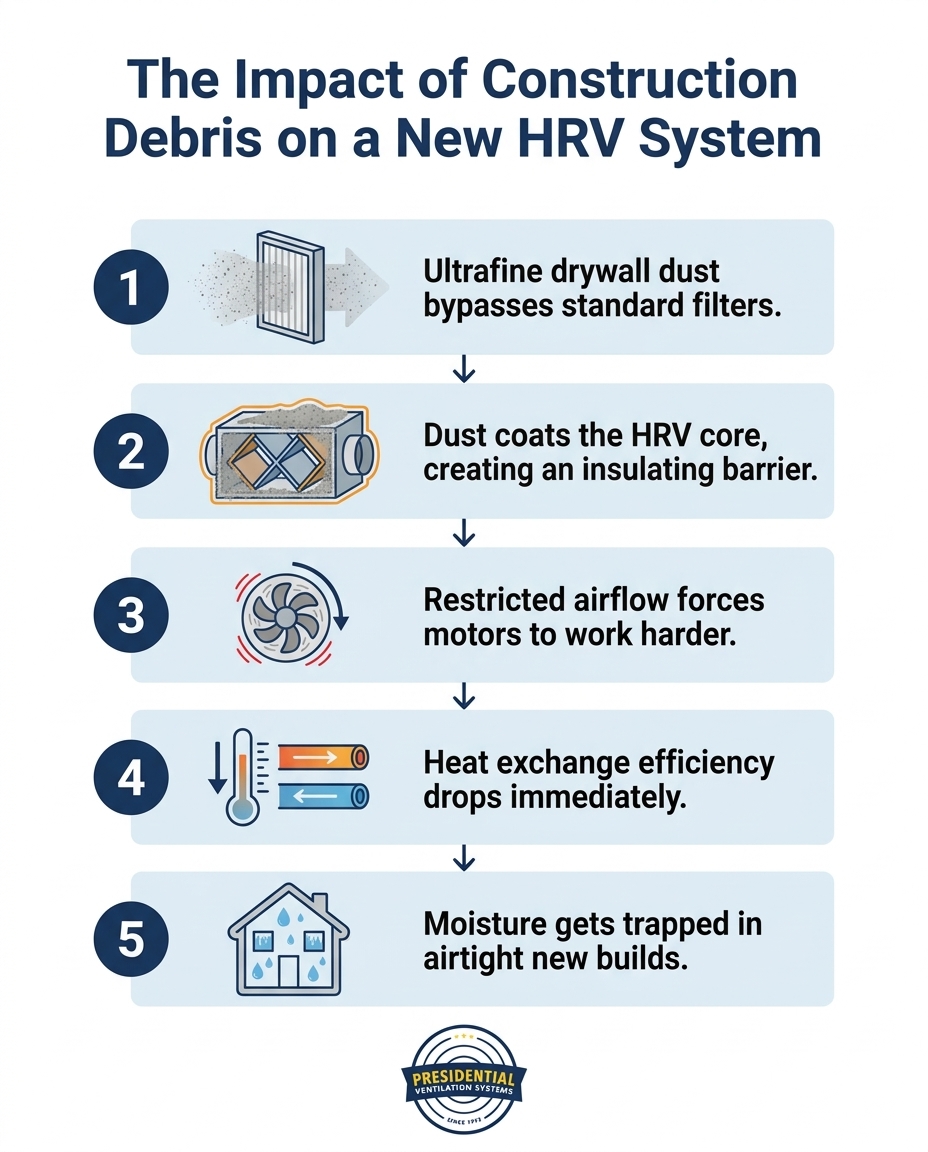
The secondary mechanical failures caused by a clogged core are often what homeowners notice first. The primary symptom is a sudden spike in energy usage or a home that feels stuffy despite the system running constantly. This is the direct result of restricted airflow and reduced heat exchange efficiency.
In a brand-new, airtight home, airflow must be perfectly balanced. When the channels of the HRV core become clogged with drywall dust, the volume of fresh air entering the home is drastically reduced. This creates a bottleneck. The static pressure inside the ductwork increases, forcing the system out of its optimal operating range. The blower motors, which are designed to push air with minimal resistance, suddenly have to push past 2,000 RPMs just to force air through the physical blockage.
Energy is wasted trying to overcome this resistance. The motors draw more electricity to maintain the required RPMs, negating the financial benefits of installing high-efficiency equipment in your new build. Furthermore, because the heat transfer surfaces are insulated by a layer of dust, the heat recovery rates plummet. Instead of capturing the heat from your outgoing air to warm the incoming winter air, that energy is lost to the outside, forcing your primary heating system to run longer and harder to make up the difference. This constant electrical strain leads directly to premature wear on blower motors and electrical components.
Modern new construction homes are built to rigorous energy codes, meaning they are highly airtight to prevent drafts and heat loss. While this is fantastic for your heating bill, it creates a unique challenge: airtight homes rely entirely on mechanical ventilation to expel indoor moisture. In Nova Scotia's damp maritime climate, managing high indoor humidity—especially keeping it below the critical 50% threshold during winter—is critical. The regional moisture levels make an efficiently running HRV heat recovery core essential to protect a brand-new airtight home from severe moisture damage.
Airtight construction traps moisture inside. Everyday activities like cooking, bathing, and even breathing generate significant humidity. More importantly, new building materials—such as fresh lumber, poured concrete, and interior paint—release gallons of moisture into the air during the first year of occupancy as they dry and cure.
The risks of trapped moisture:
• Window condensation: Water pools on sills, damaging brand-new trim and drywall.
• Poor indoor air quality: High humidity breeds mold and mildew in dark corners and closets.
• Material warping: Hardwood floors and cabinetry can swell or warp when indoor humidity remains unchecked.
In our years of servicing Mount Uniacke NS, we have seen how a dust-clogged HRV fails to expel this moisture effectively. When the airflow is restricted by construction debris, the damp, stale air stays trapped inside, putting your brand-new investment at immediate risk.
The transition from the installation phase to the occupancy phase is a critical window for your HVAC system's health. The final steps of an air exchanger installation involve balancing the airflow and testing the controls, but the job isn't truly finished until the post-build environment is completely clean. Because commercial and residential construction timelines often overlap, dust continues to enter newly installed systems right up until move-in day.
Our team at Presidential Ventilation Systems Ltd. brings deep local expertise in new construction HVAC, understanding exactly how Maritime building practices and timelines impact brand-new ventilation systems. Professional HVAC installers view the transition from a messy construction site to an occupied home as the most vulnerable time for mechanical equipment. If you have complementary systems, such as ducted heat pump systems, coordinating a professional cleaning immediately after construction protects the entire HVAC ecosystem. It ensures that restricted airflow and reduced heat exchange efficiency don't compromise the lifespan of your interconnected climate control units, while also maintaining system efficiency to ensure you qualify for regional energy rebates.
Assuming your system is clean simply because it is new is a costly mistake. One local homeowner scheduled a routine fall inspection and deep cleaning within the first 6 months of occupancy, only to realize the immense value of thorough testing and product care information after seeing the heavy particulate buildup removed from their seemingly "clean" new system. The evidence is clear: the HRV heat recovery core cannot process construction debris.
The immediate consequences of skipping a post-build cleaning include:
• Immediate reduction in heat exchange efficiency: Dust insulates the core, preventing heat transfer.
• Increased strain on blower motors: Motors overwork to push air through clogged channels, leading to higher electrical energy consumption.
• Poor indoor air quality: Ultrafine drywall dust recirculates continuously into your living spaces.
• Inability to manage indoor humidity: Airtight homes suffer from condensation and potential mold growth when ventilation fails.
• Premature component failure: Overworked motors and sensors burn out faster than their expected lifespan.
Highlighting the value of a thorough, professional inspection and deep clean to verify system health before move-in is essential. For property owners across our local service areas, scheduling this service is the ultimate peace-of-mind check.
A clear, technical understanding of how construction debris interacts with modern ventilation validates the absolute necessity of a post-build cleaning. Protecting the core from the abrasive, paste-like buildup of drywall dust ensures the system operates at peak efficiency from the moment you move in. By clearing out the hidden threats, our team ensures you eliminate the risks of restricted airflow and reduced heat exchange efficiency, allowing your equipment to properly manage the unique moisture loads of a new, airtight build.
Don't let the "new build myth" compromise your comfort. Consult with our local experts at Presidential Ventilation Systems Ltd. to clear out construction dust thoroughly, ensuring you start your new home journey with truly clean, healthy air.
Your new home is likely dusty because ultrafine construction debris, such as drywall dust and sawdust, has settled inside your ductwork. When the HVAC system kicks on, it continuously blows these hidden particles back into your living spaces. A professional duct cleaning removes this trapped debris at the source.
Yes, new builds almost always require duct cleaning before or immediately after move-in. During commercial and residential construction, the open ductwork acts as a collection point for sawdust, fiberglass, and drywall powder. Cleaning the system ensures this abrasive debris doesn't damage your brand-new HVAC equipment.
If an HRV core is clogged, the system cannot efficiently transfer heat between the incoming and outgoing air streams. This blockage restricts fresh airflow, forces the blower motors to overwork, and traps stale, humid air inside your home. In new airtight builds, this often leads to rapid window condensation.
Drywall dust affects an air exchanger installation by bypassing standard filters and coating the internal heat recovery core. Because drywall dust absorbs moisture, it forms a thick paste that blocks the narrow air channels. This immediately reduces the newly installed unit's efficiency and lifespan.
Yes, construction dust can permanently damage a new HRV system if left unaddressed. The constant electrical strain of pushing air through a clogged core can burn out the blower motors prematurely. Additionally, the abrasive nature of the dust can wear down delicate internal sensors and moving parts.
When it comes to new construction, a common myth is that a standard electrical service is automatically robust enough to handle anything a modern homeowner throws at it, making the process of Deciding Between a 200-Amp and 400-Amp Panel for a Multi-Zone Heat Pump Setup feel like an afterthought. The reality is far more complex. A standard 200-amp service has been the baseline for decades, but total home electrification has drastically shifted the goalposts. Today's custom homes are no longer relying on fossil fuels for heating, cooking, or transportation. Instead, they are powered entirely by electricity, which requires a fundamental shift in how we plan residential infrastructure.
The specific challenge lies in balancing total home electrification without overloading the system. You might assume that because your appliances are high-efficiency, they draw less power overall. While they use energy more effectively, the sheer number of high-draw systems operating simultaneously—like induction ranges, electric water heaters, and comprehensive Heat Pump Systems—creates a massive cumulative demand. If this demand exceeds the capacity of the main breaker, you face nuisance tripping, system lockouts, or the need for a highly disruptive electrical overhaul shortly after moving in.
At Presidential Ventilation Systems Ltd., we've found this creates a critical decision point for anyone planning Mount Uniacke custom home builds. Evaluating your current and future power needs during the blueprint phase is the only way to avoid expensive retrofits once the drywall is up and the landscaping is finished. Electrical load planning is a strict professional requirement dictated by national safety codes, not a casual DIY estimate. Getting it right from day one ensures that your home functions smoothly, safely, and efficiently, regardless of how many systems are running at once.
To understand why upgrading your electrical service might be necessary, you have to break down the actual electrical demands of modern, high-efficiency home systems. This process is governed by strict regulations, specifically the Canadian Electrical Code (CEC) Rule 8-200, which dictates how residential load calculations must be performed. Our electrical and HVAC teams know that a licensed electrician doesn't just guess your power needs; they use a precise mathematical formula to ensure safety and compliance.
1. Assess the square footage baseline: The CEC assigns a base wattage requirement based on the livable square footage of the home to cover general lighting and standard receptacles.
2. Factor in major appliances: Dedicated circuits for induction stoves, electric dryers, and electric water heaters are added to the calculation, often carrying a demand factor that accounts for the reality that not everything runs at 100% capacity simultaneously.
3. Calculate HVAC loads: This is where the math gets serious. The amperage requirements for large-scale heating and cooling systems are significant. Multi-zone configurations draw substantial power, especially when multiple compressor units are required to service a large footprint.
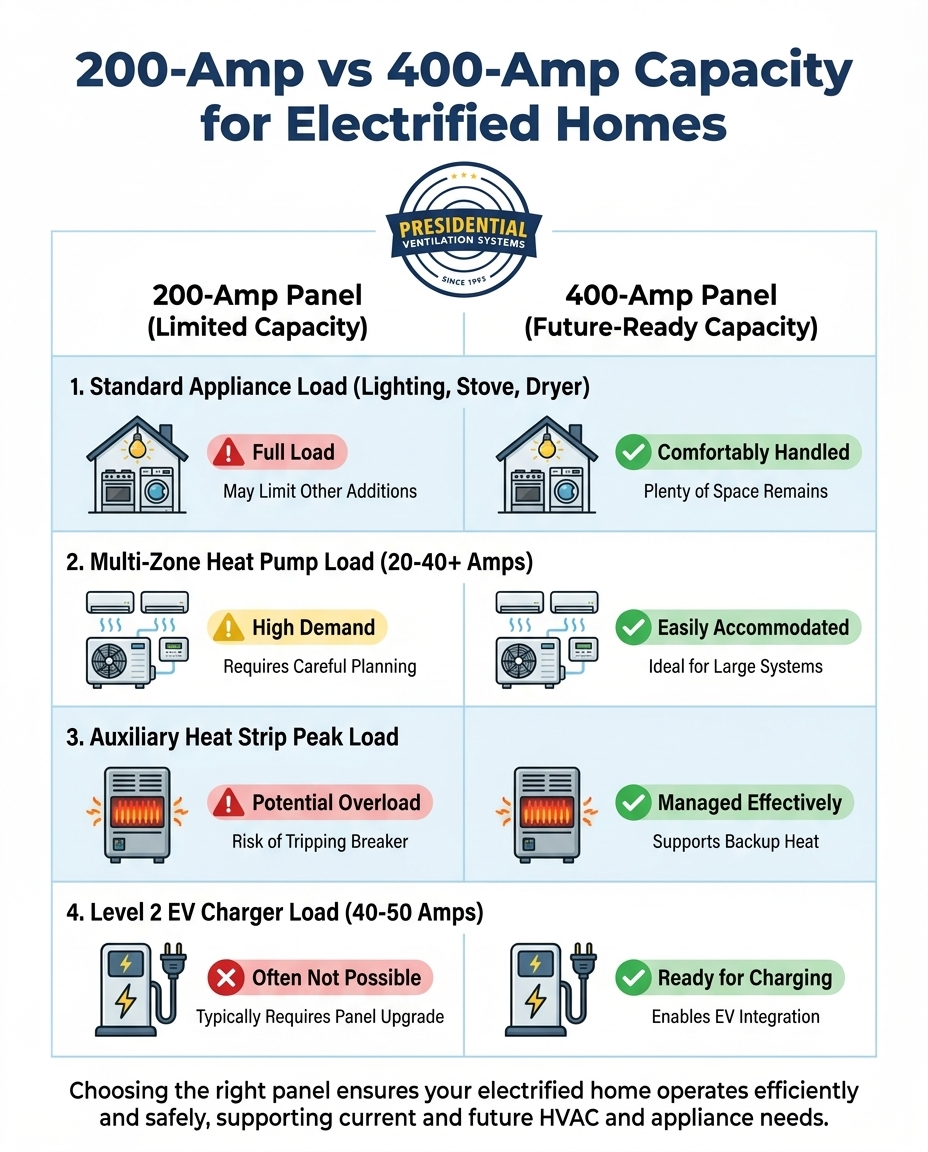
4. Add electric vehicle infrastructure: Integrating a Level 2 electric vehicle charger adds a massive continuous load. These chargers typically require dedicated 40-50 amp circuits, and unlike an oven that cycles on and off, an EV charger pulls maximum current for hours at a time.
The cumulative effect of running these systems simultaneously alongside standard household appliances is what pushes a standard panel to its absolute limit. When you combine Multi-zone heat pump + Level 2 EV charger loads, you are consuming a vast portion of a 200-amp panel's available capacity before you even turn on a light switch. This is a pattern we see often, which is why thorough planning is essential for anyone installing Multi-Zone Ductless Heat Pumps in a fully electrified home.
Summing up the baseline requirements for a modern home reveals just how quickly amperage is consumed. An induction stove might require a 40-amp breaker, an electric dryer needs 30 amps, and an electric water heater requires another 30 amps. While the CEC applies a demand factor to these non-continuous loads (assuming you won't bake a turkey, dry three loads of laundry, and take a long shower all at the exact same moment), the baseline draw remains exceptionally high.
The critical distinction in residential planning is understanding continuous versus non-continuous loads. A continuous load operates for three hours or more at a time. EV chargers and heating systems fall into this category. The electrical code requires that continuous loads only utilize 80% of a breaker's rated capacity to prevent overheating. This means a 50-amp circuit for an EV charger can only safely provide 40 amps of continuous power, further complicating the load calculation and eating into the panel's overall budget.
The Problem: In mild climates, a heat pump operates with incredible efficiency, drawing a relatively moderate and steady amount of power to move heat from the outside air into your home. However, local climate conditions drastically impact peak electrical loads. When temperatures plummet, the electrical math changes completely.
The Cause: In our years of installing systems across Nova Scotia, we always focus heavily on the impact of our cold winters here. Robust multi-zone heat pump systems draw significant continuous power to maintain indoor temperatures during deep winter freezes. As the outside air gets colder, the compressor has to work harder and longer to extract heat. More importantly, when the temperature drops below the heat pump's optimal operating range, the system relies on auxiliary electrical resistance heat strips. These heat strips function like a giant toaster inside your ductwork or air handler. They are incredibly effective at warming the air, but they require a massive amperage spike to operate. This auxiliary heat draw is often overlooked in mild-climate load calculations, but it is a harsh reality for Mount Uniacke custom home builds.
The Solution: You must factor worst-case winter scenarios into the initial electrical plan. Sufficient electrical capacity is critical for uninterrupted heating. If your load calculation only accounts for the heat pump's base compressor draw and ignores the 60-to-100-amp spike that occurs when the auxiliary heat strips activate on a -20°C night, your main breaker will trip. Planning for extreme cold ensures that your family stays warm without plunging the house into darkness.
A 200-amp service is the current standard for most new construction, and for many homes, it is perfectly adequate. However, providing a realistic assessment of when a 200-amp service is sufficient and when it falls short requires looking at the specific appliance profile of the home.
• Gas Heat, Gas Appliances, No EV — 200-Amp Panel Suitability: Highly Suitable — Potential Bottlenecks: None. Plenty of capacity for future minor additions.
• Electric Heat (Standard), Electric Appliances, No EV — 200-Amp Panel Suitability: Suitable — Potential Bottlenecks: Approaching limits during peak winter usage.
• Multi-Zone Heat Pump, Electric Appliances, One EV — 200-Amp Panel Suitability: Borderline / Requires Load Shedding — Potential Bottlenecks: Combining Multi-zone heat pump + Level 2 EV charger loads often exceeds safe continuous limits.
• Multi-Zone Heat Pump, Electric Appliances, Multiple EVs, Hot Tub — 200-Amp Panel Suitability: Inadequate — Potential Bottlenecks: Guaranteed to fail CEC load calculations without a service upgrade.
From what our technicians typically see in the field, a 200-amp panel can safely support a moderately sized home (under 2,500 square feet) with standard electric appliances and a basic HVAC system. However, adding a single heavy continuous load—like a Level 2 EV charger—to a home that already relies on electric heat can push a 200-amp panel to its absolute limit.
The load-shedding workaround: If you are locked into a 200-amp service, load-shedding devices or smart electrical panels offer a potential workaround. These devices monitor the total power draw and automatically pause specific heavy loads (like the EV charger) when the HVAC system requires maximum power. While effective, they have limitations for large properties and can be frustrating if you need your car fully charged on a cold winter morning. Ultimately, any panel evaluation and load calculation must be conducted by a licensed professional to ensure safety and code compliance.
When our team's math clearly shows that 200 amps won't cut it, we recommend upgrading to a 400-amp service during the construction phase as the most logical step for Mount Uniacke custom home builds. But what exactly does this upgrade entail? In residential applications, a "400-amp service" usually consists of a 320-amp continuous meter base installed on the exterior of the home, which then feeds into two separate 200-amp breaker panels inside.
Unlocking total flexibility: This expanded capacity easily accommodates multiple heat pumps, multiple electric vehicles, and luxury amenities that draw heavy power, such as hot tubs, electrically heated outbuildings, or large commercial-style workshop equipment. With two 200-amp panels, you have an abundance of breaker spaces, ensuring that every high-draw appliance can have its own dedicated circuit without compromising the safety of the main feed.
The long-term value: The true benefit of this upgrade is future-proofing. The automotive industry is moving rapidly toward total electrification, and home heating is following suit. Installing this infrastructure during the initial build is vastly more efficient than attempting a retrofit later. While the initial investment for a larger meter base, heavier gauge wiring, and dual panels is higher upfront, it prevents costly teardowns, drywall patching, and service interruptions down the road. If you are curious about the mechanics of upgrading, understanding the factors involved in breaker panel upgrade cost and scope can help you budget accurately during the blueprint stage.
One of the most common pitfalls in custom construction is treating the HVAC system and the electrical system as entirely separate entities. Illustrating the necessity of having mechanical and electrical teams aligned is crucial to prevent installation bottlenecks. Common scenarios arise where a perfectly planned HVAC installation is suddenly halted because the existing or planned electrical panel simply lacks the capacity to power the equipment.
Holistic planning prevents these last-minute scrambles and ensures seamless system integration. When the mechanical load requirements are calculated in tandem with the electrical infrastructure, there are no surprises on installation day. For example, our team had a Mount Uniacke homeowner reach out during a summer heat wave when an issue arose with their electrical panel upgrade during a central heat pump installation. Because our teams communicated effectively, our specialist Jack helped resolve the panel concerns on-site, ensuring the electrical infrastructure could safely support the new equipment, and the system now works flawlessly.
This highlights the immense value of working with professionals who understand the complete picture. As a comprehensive HVAC installer, Presidential Ventilation Systems Ltd. understands both the mechanical load requirements and the electrical infrastructure needed to support high-efficiency systems in large custom homes. When you are balancing Multi-zone heat pump + Level 2 EV charger loads, having a unified strategy ensures your project stays on schedule and your home operates safely.
Building a custom home with robust electrical and HVAC systems is a significant investment, but there are financial incentives available that can help offset the initial outlay. Provincial and federal rebates are increasingly tied directly to home electrification and energy efficiency, rewarding homeowners who choose to move away from fossil fuels.
Unlocking incentive tiers: Upgrading electrical panels in conjunction with qualifying heat pumps often unlocks specific incentive tiers. Many government and utility programs recognize that older electrical infrastructure is a barrier to heat pump adoption. As a result, they offer valuable rebates specifically designed to help cover the cost of electrical service upgrades when they are required to support high-efficiency heating and cooling systems.
Budgeting for efficiency: Our team strongly encourages homeowners planning Mount Uniacke custom home builds to factor these rebates into their initial construction budgets. Exploring HVAC and Electrical Financing alongside available rebates can make the decision to upgrade to a 400-amp service much easier. However, it is important to note that professional installation is almost always a strict requirement to ensure all equipment meets rebate eligibility standards. DIY installations or unpermitted electrical work will immediately disqualify you from receiving these valuable financial incentives.
Is 200 amps enough for a heat pump and EV charger?
In our experience, it depends entirely on the size of the home and the other appliances in use. While a 200-amp panel can sometimes support a heat pump and a single EV charger in a smaller home with gas appliances, combining Multi-zone heat pump + Level 2 EV charger loads in a fully electrified home usually exceeds safe continuous load limits, requiring load-shedding devices or a panel upgrade.
When should I upgrade to 400 amp service for a custom build?
We advise planning for a 400-amp service during the blueprint phase if your home will feature total electrification. This includes multi-zone heating, multiple electric vehicles, an induction range, electric water heating, and luxury additions like a hot tub or heated outbuilding. Doing this during the initial build avoids highly disruptive retrofits later.
How much power does a multi-zone heat pump use?
The power draw varies significantly based on the tonnage of the system and the outdoor temperature. A standard multi-zone compressor might draw 20 to 40 amps during normal operation, but this number can spike drastically if extreme cold forces the system to activate auxiliary electrical resistance heat strips.
Do auxiliary heat strips require their own dedicated breaker?
Yes, auxiliary heat strips require their own heavy-duty dedicated circuits. Because they use electrical resistance to generate heat, they draw a massive amount of amperage—often requiring 60 to 100 amps depending on the size of the air handler—which must be carefully factored into the home's total load calculation.
Can a load calculation be done after the house is framed?
While a load calculation can technically be performed at any time, doing it after framing is incredibly risky. If the calculation reveals that a 400-amp service is required, you may have to tear out framing or alter the utility connection point, causing major delays and budget overruns. Load calculations should always be finalized during the architectural design phase.
The choice between a 200-amp and 400-amp service ultimately dictates the future flexibility, safety, and comfort of your home. Assuming that standard infrastructure will support total electrification is a risk that modern custom builds simply cannot afford. A professional load calculation that factors in your specific HVAC goals, EV charging needs, and extreme weather variables is the only way to ensure your electrical panel is up to the task.
Before you finalize your blueprints for your Mount Uniacke custom home builds, ensure your mechanical and electrical plans are perfectly aligned. We encourage you to Schedule a Consultation with our team to review your load requirements, discuss high-efficiency heat pump options, and secure a power strategy that supports your home for decades to come.