


Ductless heat pumps service in brookfield ns keeps your home comfortable year-round while saving energy. When choosing a provider, here's what to look for:
• Red Seal certified technicians
• Authorized dealer status (especially Daikin)
• Positive customer reviews
• Strong warranty offerings
• Free home assessments
• Experience with Nova Scotia's climate
Living in Brookfield means dealing with cold winters and humid summers. Your ductless heat pump needs proper care to handle these conditions. One homeowner shared their experience: "wow, great people that go to work with pride and with outstanding service."
The good news is that qualified providers in Brookfield offer installation, maintenance, and repair services. Most provide free assessments to help you understand your needs before committing.
Regular maintenance matters most. Annual service keeps your system running efficiently, prevents breakdowns, and ensures your warranty stays valid. Many local providers offer maintenance plans to make this easier.
If you've lived in Brookfield, you know our weather keeps us on our toes with cold, damp winters and warm, humid summers. Your home needs a system that can handle both extremes without draining your wallet, which is what makes ductless heat pumps a smart investment.
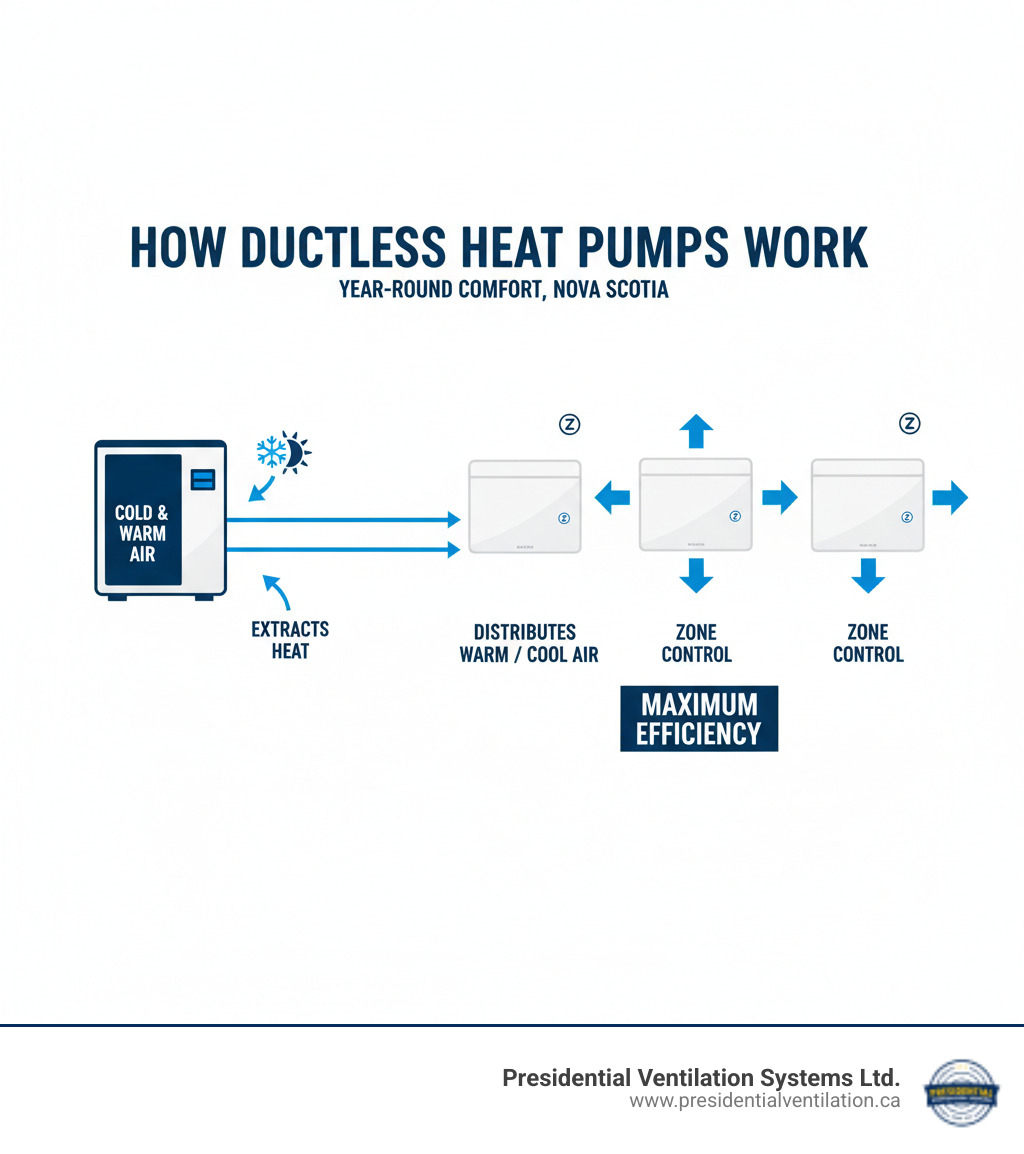
Let's start with energy savings. Traditional heating systems create heat, which uses a lot of energy. Ductless heat pumps simply move existing heat. This efficient approach can make a real difference in your monthly bills. Wondering exactly how much a heat pump will save you? The answer might surprise you.
Another benefit is zoned heating and cooling. With a ductless system, you control each room independently, so you can stop wasting energy on empty spaces. It's comfort on your terms, and it saves money.
Your home's air quality also improves. Many ductless heat pumps have advanced filtration systems that capture dust, pollen, and other particles, which is helpful for those with allergies. Learn more about how heat pumps enhance air quality in your home.
You'll also appreciate the quiet operation and flexible installation. Because they don't require ductwork, they can be installed in almost any home with less disruption. For a complete picture, check out our complete guide to ductless heat pump benefits.
When you're ready to explore professional ductless heat pumps service in Brookfield NS, you'll find experienced providers who understand our local climate.
Not all heat pumps are created equal, especially for Nova Scotia weather. When choosing a system for your Brookfield home, certain features make all the difference.
Cold-climate performance should be at the top of your list. Modern ductless heat pumps are engineered to extract heat from outside air even when temperatures drop well below freezing. However, not all models perform equally well in extreme cold, so paying attention to specifications is crucial.
Pay attention to two key ratings: HSPF (Heating Seasonal Performance Factor) and SEER (Seasonal Energy Efficiency Ratio). HSPF measures heating efficiency, while SEER measures cooling efficiency. Higher numbers mean better performance and lower energy bills. If these ratings seem confusing, our guide on understanding heat pump ratings breaks it down.
Inverter technology is another feature worth understanding. Unlike traditional systems that cycle on and off, wasting energy and creating temperature swings, inverter-driven compressors adjust their speed to match your home's needs. This results in more precise temperature control, quieter operation, and significantly better efficiency. This technology helps heat pumps maintain excellent efficiency even in extreme temperatures.
Daikin systems, which Presidential Ventilation Systems Ltd. specializes in as a Daikin Comfort Pro Dealer, are specifically designed to handle the demanding conditions of Canadian climates, delivering reliable, year-round comfort.
Your ductless heat pump works hard to keep your Brookfield home comfortable. Like any appliance, it'll let you know when something's not right – you just need to know the signs.

Increased energy bills are often the first clue. If your power bill suddenly jumps without a change in your usage habits, your heat pump might be struggling and consuming more electricity than it should.
Weak airflow from your indoor units is another sign. If the air feels weak or isn't reaching the set temperature, it could be due to something simple like dirty filters or a more serious issue like a clogged coil or fan problem that requires professional ductless heat pumps service in Brookfield NS.
Frequent cycling – when your system constantly turns on and off in short bursts – is another telltale sign. This often points to thermostat problems, an improperly sized unit, or low refrigerant levels.
Your ears can also alert you to problems. Unusual noises like grinding, hissing, or rattling suggest loose parts, motor troubles, or refrigerant leaks. Similarly, unpleasant odors deserve immediate attention. A musty smell can mean mold, while a burning scent could indicate electrical issues.
During colder months, watch for ice buildup on your outdoor unit. While some frost is normal, excessive ice coating the coil blocks airflow and prevents your heat pump from working effectively.
Catching these warning signs early makes a difference. Small issues are easier and less expensive to fix than major breakdowns. If you notice any of these symptoms, it's time to call the professionals. For more guidance, check out our articles on signs your heat pump needs immediate attention and common heat pump issues.
Finding reliable ductless heat pumps service in Brookfield NS is essential for keeping your home comfortable through our challenging Nova Scotia seasons. Professional service isn't just about fixing things when they break; it's about ensuring your system operates at peak performance year after year, saving you money and preventing emergencies.

At Presidential Ventilation Systems Ltd., we understand the demands of Brookfield's climate. Our team brings over 30 years of experience to every service call, combining technical expertise with a commitment to your comfort. For a comprehensive look at what we offer, visit our heat pump services page.
When it comes to ductless heat pumps service in Brookfield NS, we cover all aspects of heat pump care.
Professional installation is where your heat pump journey begins, and getting it right is crucial. Our certified technicians carefully assess your home's unique needs, considering factors like square footage and insulation. We strategically place indoor units for optimal airflow and efficiency, ensuring every installation meets manufacturer specifications and local codes. Our complete guide to ductless heat pump installation offers more insight.
Even the best systems occasionally need expert repair. When your heat pump isn't performing correctly, our skilled technicians will diagnose and fix the problem efficiently. We use advanced diagnostic tools and genuine parts to address issues like refrigerant leaks or electrical faults. Our heat pump repair services in Halifax NS page shows our comprehensive capabilities.
Routine maintenance is a crucial investment. Our thorough annual tune-ups include cleaning coils, checking refrigerant levels, and inspecting electrical connections. This preventative approach catches small issues before they become expensive problems, extends your system's lifespan, and keeps your energy bills low. Learn more about the value of an annual heat pump tune-up.
Choosing the right company for your ductless heat pumps service in Brookfield NS requires knowing what to look for.
• Local experience: A company that understands Nova Scotia's weather brings valuable insight.
• Certifications: Look for Red Seal certified technicians, which signifies rigorous training and expertise.
• Positive customer reviews: Real feedback from homeowners provides insight into a company's reliability. We invite you to read our customer reviews.
• Strong warranties: As a Daikin Comfort Pro Dealer, we offer exceptional warranty benefits, including a 12-year parts warranty on many Daikin products.
• Authorized dealer status: This designation means a company has met stringent manufacturer standards for training and customer service.
Regular maintenance is the most valuable ductless heat pumps service in Brookfield NS you can invest in. It's the secret to long-term comfort and savings.
Think of maintenance as preventative care. We identify minor issues before they become expensive repairs. The impact on energy efficiency is remarkable. A clean system runs at peak efficiency and keeps your utility bills lower. You can even calculate your home energy savings with a well-maintained system.
Regular maintenance also extends your system's lifespan and is often required to keep warranties valid. It also leads to improved indoor air quality by reducing allergens and pollutants. Between professional visits, you can learn how to clean your ductless heat pump filters yourself.
The bottom line: regular maintenance is an investment in your comfort, health, and long-term savings. Explore why heat pump maintenance is essential.
Investing in a new ductless heat pump is a big decision, and the cost can feel overwhelming. The good news is there are many ways to make ductless heat pumps service in brookfield ns affordable for your family.
We believe every Brookfield homeowner deserves a comfortable, energy-efficient home, and we can help you access available government incentives and flexible payment options to make it affordable.
Provincial and federal governments offer substantial rebates for switching to energy-efficient heat pumps. These programs can significantly reduce your upfront investment and are designed to help lower energy consumption.
For Brookfield residents, you have two excellent rebate opportunities. You can apply for a provincial rebate through Efficiency NS and also access the federal Canada Greener Homes Grant. These programs can work together to maximize your savings. Our team can guide you through the application process.
Beyond rebates, we offer flexible financing solutions to fit your budget. We've partnered with trusted institutions like Comfort Owl and FinanceIt to provide accessible payment plans with straightforward terms. This allows you to enjoy the comfort and savings of a new heat pump now while spreading the investment over time.
Want to explore your options? Visit our financing page to learn more, or apply directly for pre-approval with Comfort Owl or financing with FinanceIt. The application process is simple and fast.
With government rebates and flexible financing, upgrading to a ductless heat pump is more achievable than you might think. Let's work together to find the solution that fits your home and your budget.
We love hearing from homeowners in Brookfield! Here are the most common questions we get, along with straightforward answers.
Annual service is your best bet to maintain efficiency, ensure reliability, and keep your manufacturer's warranty valid. During a professional tune-up for your ductless heat pumps service in brookfield ns, our technicians perform a thorough check: we clean coils, inspect electrical components, and verify refrigerant levels. This preventative approach catches small issues before they become expensive problems. Want to dive deeper? Check out our guide on annual heat pump maintenance.
Yes, absolutely! A multi-zone ductless system can provide comprehensive heating and cooling for your entire home. We connect multiple indoor units to a single outdoor unit, giving you individual temperature control in different rooms or zones. It's comfort and energy efficiency rolled into one. Curious about how this all comes together? You can learn more about multi-zone systems and see if they're the right fit for your home.
An authorized dealer is an HVAC provider that has met rigorous standards set by a manufacturer for training, installation practices, and customer service. As an authorized Daikin dealer, we have direct access to manufacturer resources, genuine parts, and the latest product information. This status translates into real benefits for you, including better warranties and the peace of mind that your system is in capable hands.
Ductless heat pumps are far more energy-efficient than traditional systems like oil furnaces or electric baseboards. Instead of generating heat, they move it, using significantly less electricity. This leads to substantial savings on operating costs, which is crucial during Nova Scotia's heating season.
While the initial installation cost can be higher, the long-term savings on energy bills, combined with government rebates and financing, often make ductless systems more cost-effective over their lifespan. They also provide efficient cooling in the summer, offering a complete, year-round climate solution.
Your home deserves comfort, efficiency, and reliability. This guide has covered what you need to know about ductless heat pumps service in brookfield ns, from why they are a smart investment for our climate to finding the right provider.
We've seen how ductless heat pumps deliver remarkable energy savings, personalized comfort through zoned control, and healthier indoor air. These benefits make a tangible difference in your daily life and monthly utility bills.
Even the best system needs professional care. Regular maintenance is the key to protecting your investment, keeping energy bills low, and ensuring year-round comfort. Annual tune-ups prevent small issues from becoming expensive emergencies and extend your system's life.
When looking for a service provider, remember to look for local experience, Red Seal certifications, positive reviews, strong warranties, and authorized dealer status. These are your assurance of quality workmanship.
Making the switch is more affordable than ever, thanks to government rebates and flexible financing options that can significantly offset your costs.
At Presidential Ventilation Systems Ltd., we've spent over 30 years helping Nova Scotia homeowners with their heat pump systems. As a Daikin Comfort Pro Dealer, we bring factory-trained expertise, exceptional warranties, and a commitment to your satisfaction. We understand Brookfield's climate because we live and work here too.
Whether you're considering a new installation, need a repair, or want to schedule your annual maintenance, we're here to help. Your comfort is our priority.

For expert advice and service on Ductless Heat Pumps in the Truro and Brookfield area, contact our team today.

Ductless heat pumps service in brookfield ns keeps your home comfortable year-round while saving energy. When choosing a provider, here's what to look for:
• Red Seal certified technicians
• Authorized dealer status (especially Daikin)
• Positive customer reviews
• Strong warranty offerings
• Free home assessments
• Experience with Nova Scotia's climate
Living in Brookfield means dealing with cold winters and humid summers. Your ductless heat pump needs proper care to handle these conditions. One homeowner shared their experience: "wow, great people that go to work with pride and with outstanding service."
The good news is that qualified providers in Brookfield offer installation, maintenance, and repair services. Most provide free assessments to help you understand your needs before committing.
Regular maintenance matters most. Annual service keeps your system running efficiently, prevents breakdowns, and ensures your warranty stays valid. Many local providers offer maintenance plans to make this easier.
If you've lived in Brookfield, you know our weather keeps us on our toes with cold, damp winters and warm, humid summers. Your home needs a system that can handle both extremes without draining your wallet, which is what makes ductless heat pumps a smart investment.
Let's start with energy savings. Traditional heating systems create heat, which uses a lot of energy. Ductless heat pumps simply move existing heat. This efficient approach can make a real difference in your monthly bills. Wondering exactly how much a heat pump will save you? The answer might surprise you.
Another benefit is zoned heating and cooling. With a ductless system, you control each room independently, so you can stop wasting energy on empty spaces. It's comfort on your terms, and it saves money.
Your home's air quality also improves. Many ductless heat pumps have advanced filtration systems that capture dust, pollen, and other particles, which is helpful for those with allergies. Learn more about how heat pumps enhance air quality in your home.
You'll also appreciate the quiet operation and flexible installation. Because they don't require ductwork, they can be installed in almost any home with less disruption. For a complete picture, check out our complete guide to ductless heat pump benefits.
When you're ready to explore professional ductless heat pumps service in Brookfield NS, you'll find experienced providers who understand our local climate.
Not all heat pumps are created equal, especially for Nova Scotia weather. When choosing a system for your Brookfield home, certain features make all the difference.
Cold-climate performance should be at the top of your list. Modern ductless heat pumps are engineered to extract heat from outside air even when temperatures drop well below freezing. However, not all models perform equally well in extreme cold, so paying attention to specifications is crucial.
Pay attention to two key ratings: HSPF (Heating Seasonal Performance Factor) and SEER (Seasonal Energy Efficiency Ratio). HSPF measures heating efficiency, while SEER measures cooling efficiency. Higher numbers mean better performance and lower energy bills. If these ratings seem confusing, our guide on understanding heat pump ratings breaks it down.
Inverter technology is another feature worth understanding. Unlike traditional systems that cycle on and off, wasting energy and creating temperature swings, inverter-driven compressors adjust their speed to match your home's needs. This results in more precise temperature control, quieter operation, and significantly better efficiency. This technology helps heat pumps maintain excellent efficiency even in extreme temperatures.
Daikin systems, which Presidential Ventilation Systems Ltd. specializes in as a Daikin Comfort Pro Dealer, are specifically designed to handle the demanding conditions of Canadian climates, delivering reliable, year-round comfort.
Your ductless heat pump works hard to keep your Brookfield home comfortable. Like any appliance, it'll let you know when something's not right – you just need to know the signs.
Increased energy bills are often the first clue. If your power bill suddenly jumps without a change in your usage habits, your heat pump might be struggling and consuming more electricity than it should.
Weak airflow from your indoor units is another sign. If the air feels weak or isn't reaching the set temperature, it could be due to something simple like dirty filters or a more serious issue like a clogged coil or fan problem that requires professional ductless heat pumps service in Brookfield NS.
Frequent cycling – when your system constantly turns on and off in short bursts – is another telltale sign. This often points to thermostat problems, an improperly sized unit, or low refrigerant levels.
Your ears can also alert you to problems. Unusual noises like grinding, hissing, or rattling suggest loose parts, motor troubles, or refrigerant leaks. Similarly, unpleasant odors deserve immediate attention. A musty smell can mean mold, while a burning scent could indicate electrical issues.
During colder months, watch for ice buildup on your outdoor unit. While some frost is normal, excessive ice coating the coil blocks airflow and prevents your heat pump from working effectively.
Catching these warning signs early makes a difference. Small issues are easier and less expensive to fix than major breakdowns. If you notice any of these symptoms, it's time to call the professionals. For more guidance, check out our articles on signs your heat pump needs immediate attention and common heat pump issues.
Finding reliable ductless heat pumps service in Brookfield NS is essential for keeping your home comfortable through our challenging Nova Scotia seasons. Professional service isn't just about fixing things when they break; it's about ensuring your system operates at peak performance year after year, saving you money and preventing emergencies.
At Presidential Ventilation Systems Ltd., we understand the demands of Brookfield's climate. Our team brings over 30 years of experience to every service call, combining technical expertise with a commitment to your comfort. For a comprehensive look at what we offer, visit our heat pump services page.
When it comes to ductless heat pumps service in Brookfield NS, we cover all aspects of heat pump care.
Professional installation is where your heat pump journey begins, and getting it right is crucial. Our certified technicians carefully assess your home's unique needs, considering factors like square footage and insulation. We strategically place indoor units for optimal airflow and efficiency, ensuring every installation meets manufacturer specifications and local codes. Our complete guide to ductless heat pump installation offers more insight.
Even the best systems occasionally need expert repair. When your heat pump isn't performing correctly, our skilled technicians will diagnose and fix the problem efficiently. We use advanced diagnostic tools and genuine parts to address issues like refrigerant leaks or electrical faults. Our heat pump repair services in Halifax NS page shows our comprehensive capabilities.
Routine maintenance is a crucial investment. Our thorough annual tune-ups include cleaning coils, checking refrigerant levels, and inspecting electrical connections. This preventative approach catches small issues before they become expensive problems, extends your system's lifespan, and keeps your energy bills low. Learn more about the value of an annual heat pump tune-up.
Choosing the right company for your ductless heat pumps service in Brookfield NS requires knowing what to look for.
• Local experience: A company that understands Nova Scotia's weather brings valuable insight.
• Certifications: Look for Red Seal certified technicians, which signifies rigorous training and expertise.
• Positive customer reviews: Real feedback from homeowners provides insight into a company's reliability. We invite you to read our customer reviews.
• Strong warranties: As a Daikin Comfort Pro Dealer, we offer exceptional warranty benefits, including a 12-year parts warranty on many Daikin products.
• Authorized dealer status: This designation means a company has met stringent manufacturer standards for training and customer service.
Regular maintenance is the most valuable ductless heat pumps service in Brookfield NS you can invest in. It's the secret to long-term comfort and savings.
Think of maintenance as preventative care. We identify minor issues before they become expensive repairs. The impact on energy efficiency is remarkable. A clean system runs at peak efficiency and keeps your utility bills lower. You can even calculate your home energy savings with a well-maintained system.
Regular maintenance also extends your system's lifespan and is often required to keep warranties valid. It also leads to improved indoor air quality by reducing allergens and pollutants. Between professional visits, you can learn how to clean your ductless heat pump filters yourself.
The bottom line: regular maintenance is an investment in your comfort, health, and long-term savings. Explore why heat pump maintenance is essential.
Investing in a new ductless heat pump is a big decision, and the cost can feel overwhelming. The good news is there are many ways to make ductless heat pumps service in brookfield ns affordable for your family.
We believe every Brookfield homeowner deserves a comfortable, energy-efficient home, and we can help you access available government incentives and flexible payment options to make it affordable.
Provincial and federal governments offer substantial rebates for switching to energy-efficient heat pumps. These programs can significantly reduce your upfront investment and are designed to help lower energy consumption.
For Brookfield residents, you have two excellent rebate opportunities. You can apply for a provincial rebate through Efficiency NS and also access the federal Canada Greener Homes Grant. These programs can work together to maximize your savings. Our team can guide you through the application process.
Beyond rebates, we offer flexible financing solutions to fit your budget. We've partnered with trusted institutions like Comfort Owl and FinanceIt to provide accessible payment plans with straightforward terms. This allows you to enjoy the comfort and savings of a new heat pump now while spreading the investment over time.
Want to explore your options? Visit our financing page to learn more, or apply directly for pre-approval with Comfort Owl or financing with FinanceIt. The application process is simple and fast.
With government rebates and flexible financing, upgrading to a ductless heat pump is more achievable than you might think. Let's work together to find the solution that fits your home and your budget.
We love hearing from homeowners in Brookfield! Here are the most common questions we get, along with straightforward answers.
Annual service is your best bet to maintain efficiency, ensure reliability, and keep your manufacturer's warranty valid. During a professional tune-up for your ductless heat pumps service in brookfield ns, our technicians perform a thorough check: we clean coils, inspect electrical components, and verify refrigerant levels. This preventative approach catches small issues before they become expensive problems. Want to dive deeper? Check out our guide on annual heat pump maintenance.
Yes, absolutely! A multi-zone ductless system can provide comprehensive heating and cooling for your entire home. We connect multiple indoor units to a single outdoor unit, giving you individual temperature control in different rooms or zones. It's comfort and energy efficiency rolled into one. Curious about how this all comes together? You can learn more about multi-zone systems and see if they're the right fit for your home.
An authorized dealer is an HVAC provider that has met rigorous standards set by a manufacturer for training, installation practices, and customer service. As an authorized Daikin dealer, we have direct access to manufacturer resources, genuine parts, and the latest product information. This status translates into real benefits for you, including better warranties and the peace of mind that your system is in capable hands.
Ductless heat pumps are far more energy-efficient than traditional systems like oil furnaces or electric baseboards. Instead of generating heat, they move it, using significantly less electricity. This leads to substantial savings on operating costs, which is crucial during Nova Scotia's heating season.
While the initial installation cost can be higher, the long-term savings on energy bills, combined with government rebates and financing, often make ductless systems more cost-effective over their lifespan. They also provide efficient cooling in the summer, offering a complete, year-round climate solution.
Your home deserves comfort, efficiency, and reliability. This guide has covered what you need to know about ductless heat pumps service in brookfield ns, from why they are a smart investment for our climate to finding the right provider.
We've seen how ductless heat pumps deliver remarkable energy savings, personalized comfort through zoned control, and healthier indoor air. These benefits make a tangible difference in your daily life and monthly utility bills.
Even the best system needs professional care. Regular maintenance is the key to protecting your investment, keeping energy bills low, and ensuring year-round comfort. Annual tune-ups prevent small issues from becoming expensive emergencies and extend your system's life.
When looking for a service provider, remember to look for local experience, Red Seal certifications, positive reviews, strong warranties, and authorized dealer status. These are your assurance of quality workmanship.
Making the switch is more affordable than ever, thanks to government rebates and flexible financing options that can significantly offset your costs.
At Presidential Ventilation Systems Ltd., we've spent over 30 years helping Nova Scotia homeowners with their heat pump systems. As a Daikin Comfort Pro Dealer, we bring factory-trained expertise, exceptional warranties, and a commitment to your satisfaction. We understand Brookfield's climate because we live and work here too.
Whether you're considering a new installation, need a repair, or want to schedule your annual maintenance, we're here to help. Your comfort is our priority.
For expert advice and service on Ductless Heat Pumps in the Truro and Brookfield area, contact our team today.

The fall shoulder season in maritime Nova Scotia is fast approaching, and your retail store's climate control is about to face its toughest test of the year. Preparing your Dartmouth retail store's HVAC for the fall shoulder season means navigating freezing mornings that demand heat, followed by busy, sunlit afternoons that require active cooling. This extreme daily temperature swing creates a unique concrete problem for commercial spaces: the building requires robust heating at dawn, but rapid cooling just a few hours later when the store fills with customers.
If your commercial thermostat controls are not configured correctly, this dramatic shift causes your heating and cooling systems to fight each other. The core decision point for facility managers is how to properly configure commercial thermostat deadband settings to handle these rapid daily temperature shifts without causing excessive mechanical strain. Ensure you have reliable commercial heating services on standby before the unpredictable coastal weather takes a toll on your equipment.
Managing a commercial retail space is vastly different from controlling a residential home. In a residential setting, you might simply switch the thermostat from "Cool" to "Heat" once October arrives. In a Dartmouth retail environment, doing so will almost certainly result in an uncomfortably hot store by 2:00 PM. The challenge lies in balancing the natural climate fluctuations of maritime fall weather with the heavy internal heat loads generated by retail operations. When commercial systems are left on standard factory settings during this transition, the resulting inefficiency leads to massive energy waste and significant wear on expensive commercial electrical components.
Retail stores struggle with temperature regulation during the fall significantly more than standard office buildings or warehouses. This difficulty stems from the concept of latent and sensible heat loads. Even when the outside air is crisp and cool, the inside of a retail store generates a massive amount of its own heat.
Consider the typical heat sources present in a busy retail environment:
• High-intensity lighting: Large arrays of display lights, track lighting, and illuminated signage generate continuous radiant heat throughout business hours.
• Electronic displays: Point-of-sale systems, digital advertising screens, and massive refrigeration units (which exhaust heat into the aisles) constantly raise the ambient temperature.
• Foot traffic: Every customer walking through the door introduces body heat and moisture into the space, rapidly changing the indoor climate during peak shopping hours.
Dartmouth's coastal proximity exacerbates rapid temperature and humidity shifts during the fall transition period, stressing improperly configured commercial HVAC systems. The frequent opening and closing of main entry doors allows cold, damp maritime air to rush in, confusing the thermostat sensors located deeper inside the store. The system detects a sudden drop in temperature and triggers the furnace or heating mode.
However, within minutes, the massive internal heat loads from lights and bodies warm that air back up, pushing the indoor temperature past the comfort zone. This dynamic triggers the need for active cooling even when outdoor temperatures begin to drop into the single digits. Standard residential thermostat practices simply do not apply to commercial retail environments because residential homes do not experience this rapid, intense fluctuation of internal heat generation. Commercial spaces require specialized control strategies to manage this chaotic thermal environment.
To resolve the issue of systems fighting each other, commercial HVAC relies on a specific control setting known as a thermostat deadband. A thermostat deadband is defined as the specific temperature range where neither heating nor cooling is activated. It is a neutral zone, or a buffer, programmed into the commercial control system to give the mechanical equipment a rest.
Without a proper deadband, a commercial HVAC system can experience "overlap." This happens when the heating setpoint and the cooling setpoint are too close together. For example, if the heat is set to turn on at 20°C and the AC is set to turn on at 21°C, the system will constantly bounce back and forth. The furnace runs, overshoots the target slightly to 21.5°C, which immediately triggers the air conditioning to turn on. The AC then cools the space down to 19.5°C, which immediately triggers the heat again. The systems are literally fighting each other, wasting massive amounts of energy.
According to ASHRAE (American Society of Heating, Refrigerating and Air-Conditioning Engineers) commercial building temperature guidelines, establishing a proper deadband is critical for energy efficiency and occupant comfort. A typical thermostat deadband variance of 3-5 degrees is recommended to prevent this overlap.
• Zero Deadband (Incorrect) — Heating Setpoint: 21°C — Cooling Setpoint: 21°C — System Behavior: Constant switching between heat and AC; rapid component failure.
• Narrow Deadband (Risky) — Heating Setpoint: 20°C — Cooling Setpoint: 21°C — System Behavior: Frequent cycling during fall shoulder season temperature swings.
• Optimized Deadband (Correct) — Heating Setpoint: 19°C — Cooling Setpoint: 23°C — System Behavior: System rests in the 4-degree neutral zone; saves energy and wear.
Configuring these advanced deadband controls requires a professional understanding of commercial electrical and mechanical systems. Facility managers should never attempt to rewire internal commercial thermostats, adjust electrical contactors, or bypass safety limits, as commercial voltage can be highly dangerous and improper settings can instantly damage heavy rooftop units (RTUs).
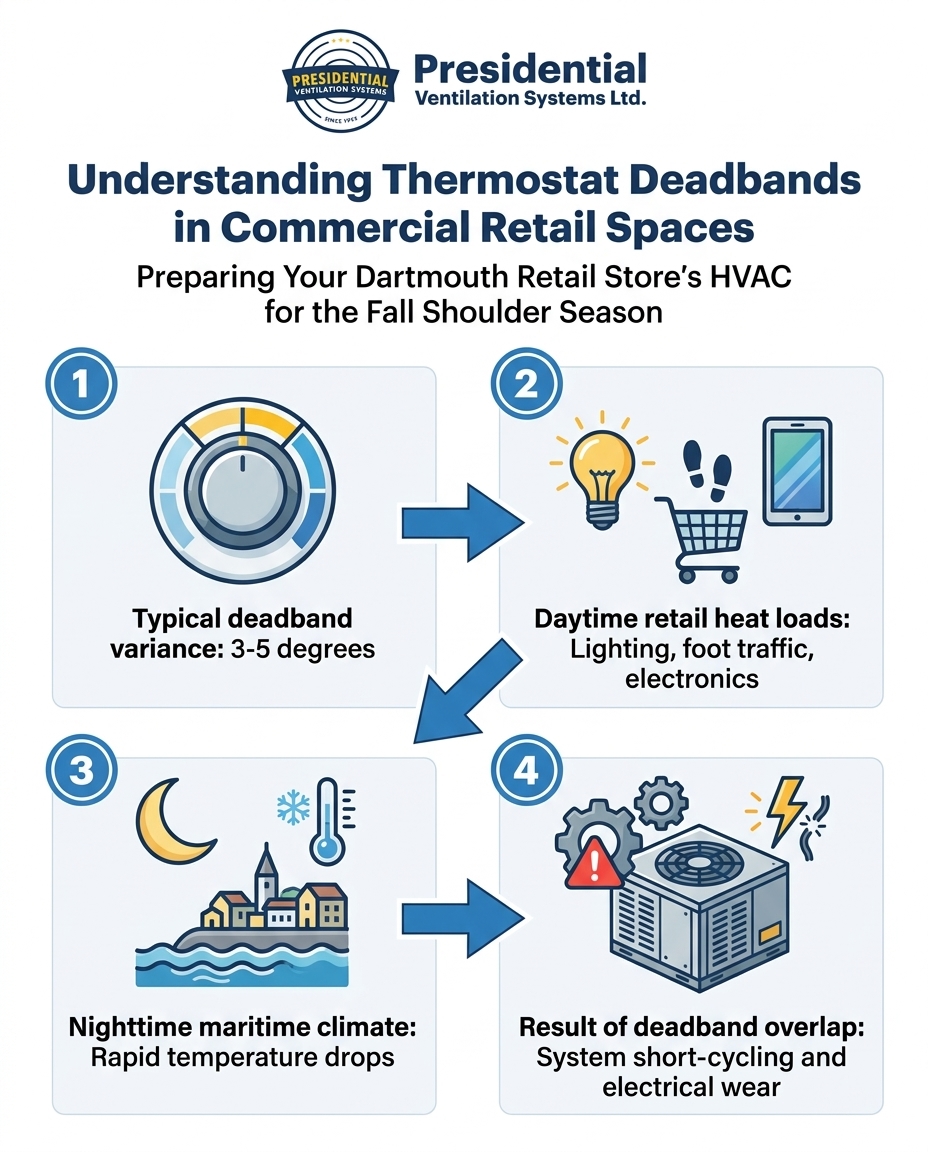
When a deadband is improperly configured during the fall shoulder season, the most immediate consequence is short-cycling. In a commercial context, short-cycling occurs when a massive piece of HVAC equipment turns on, runs for only a few minutes, and then abruptly shuts off, only to restart moments later. Fall weather frequently causes this because the ambient temperature hovers right on the edge of the thermostat's setpoints.
Rapid daily temperature shifts lead to excessive mechanical wear and tear on commercial compressors. A compressor is designed to run in long, steady cycles to efficiently move refrigerant and allow lubricating oils to circulate properly. When the system short-cycles, the oil never fully returns to the compressor, leading to increased friction, overheating, and eventual catastrophic mechanical failure. The constant starting and stopping grinds down bearings and stresses the blower motor belts.
Beyond the mechanical parts, short-cycling places immense strain on commercial electrical components. Every time a heavy commercial rooftop unit starts up, it draws a massive surge of power known as inrush current. This current is often several times higher than the running current. When heavy machinery cycles on and off too frequently, this repeated surge overheats electrical contactors, degrades capacitors, and can even cause phase imbalances in the building's electrical panel.
Establishing a proper thermostat deadband variance (typically 3-5 degrees) allows the system to rest. By widening the gap between the heating and cooling triggers, the indoor temperature is allowed to drift naturally within a comfortable range. This simple optimization drastically reduces the number of startup cycles, extending the equipment lifespan and protecting the building's electrical infrastructure.
Facility managers and store owners need to know how to identify if their current deadband settings are incorrect before the equipment suffers permanent damage. Because the fall shoulder season in maritime Nova Scotia forces systems to work in both modes daily, symptoms of deadband overlap become highly visible.
Watch for these common warning signs that your retail HVAC system is fighting itself:
• Noticeable temperature swings: Customers or staff complain that the store feels freezing near the entrance but boiling hot near the back displays, changing rapidly by the hour.
• Constant blower fan operation: The air never stops rushing through the vents, yet the temperature never seems to stabilize.
• Unusually high energy bills: A sudden, unexplained spike in commercial electrical costs during September or October often indicates the heat and AC are running simultaneously.
• Rapid clicking noises: Hearing the thermostat or the rooftop unit constantly clicking on and off every ten minutes.
One of the most frustrating scenarios for a retail manager is when the air conditioner not working during warm afternoons becomes a daily disruption, despite the system functioning perfectly to heat the store that very same morning. This usually means the safety sensors have locked the cooling system out due to short-cycling or frozen coils caused by improper fall settings.
Always observe the operational cycles by listening to the vents and monitoring the thermostat readouts, but never attempt internal electrical diagnostics. Instead, document these specific issues—noting the time of day the temperature swings occur and how often the system cycles—to share with a commercial HVAC technician upon arrival.
Optimizing your commercial controls is not just about preventing breakdowns; it is directly tied to your retail store's bottom line. The relationship between reduced short-cycling and overall energy consumption in retail spaces is profound. Every unnecessary startup surge avoided is electricity saved.
When you optimize commercial HVAC controls, you reduce unnecessary mechanical wear, which lowers your long-term maintenance costs. However, the immediate financial benefit comes from reduced monthly utility bills. By allowing the store's temperature to drift naturally within that 3-5 degree deadband, the system relies on the building's thermal mass rather than active mechanical heating or cooling.
Furthermore, upgrading to advanced commercial thermostats or building automation controls can help businesses qualify for provincial energy efficiency rebates. Programs designed to reduce grid strain often reward commercial properties that upgrade from outdated, manual thermostats to smart, deadband-capable control systems. Reviewing Efficiency Nova Scotia commercial rebate literature is a smart first step, as many of these incentives require professional installation and verification. Seeking a professional system assessment not only ensures your deadbands are set perfectly for the maritime fall, but it also provides the documentation needed to pursue construction, electrical, and energy efficiency rebates.
Transitioning from a technical understanding of deadbands to actual implementation requires professional support. A professional fall inspection for a commercial system entails much more than changing a filter. Technicians must test the advanced controls, verify the deadband variance, inspect the electrical contactors for pitting caused by summer short-cycling, and perform a deep cleaning of the coils to ensure proper airflow.
Preventative maintenance avoids costly downtime during peak retail shopping seasons. If a rooftop unit fails on Black Friday because the compressor finally gave out after weeks of fall short-cycling, the loss of foot traffic and inventory damage far outweighs the cost of a routine inspection. This highlights the absolute necessity of having a structured maintenance plan for complex commercial equipment.
One local commercial customer reached out during the spring when their heat pump system failed entirely, and previous technicians from other companies could not resolve the issue. A skilled technician properly diagnosed the complex control problem, explained the underlying cause to the facility manager, and successfully fixed the heat pump after previous failed attempts. This level of insight is crucial when dealing with commercial ducted heat pump systems that require precise calibration.
Presidential Ventilation's expertise in commercial HVAC systems ensures retail businesses avoid costly downtime and maintain perfect customer comfort through advanced thermostat deadband optimization. Working with technicians who deeply understand local maritime climate challenges across various local HVAC service areas means your system will be tailored to handle the exact humidity and temperature swings unique to the coast.
The fall shoulder season in maritime Nova Scotia is the optimal time to configure your controls, well before the deep winter freeze sets in. Stabilizing your indoor temperatures now protects sensitive retail inventory, keeps your staff productive, and ensures every customer experiences a comfortable shopping environment the moment they walk through the doors.
Don't wait until the system locks itself out from excessive short-cycling. Schedule a professional assessment of your store's HVAC controls today and secure an HVAC maintenance plan to keep your commercial electrical and mechanical systems running safely and efficiently all year long.
What is a thermostat deadband?
A thermostat deadband is a specific temperature range programmed into an HVAC control system where neither heating nor cooling is activated. This neutral zone, typically 3-5 degrees, gives the mechanical equipment time to rest and prevents the heating and cooling systems from fighting each other.
How do I stop my commercial HVAC from short-cycling during the fall?
The most effective way to stop short-cycling during the fall shoulder season is to have a professional widen the thermostat deadband variance. This prevents the system from rapidly turning on and off in response to minor temperature fluctuations, reducing strain on the electrical components and compressor.
What temperature should a retail store be kept at?
While exact temperatures depend on the inventory, ASHRAE guidelines generally suggest a heating setpoint around 19°C to 20°C and a cooling setpoint around 23°C to 24°C. Maintaining this gap ensures energy efficiency and keeps the environment comfortable for shoppers moving through the store.
Why is my commercial AC running in the fall?
Your commercial AC runs in the fall because retail spaces generate massive latent heat loads from high-intensity lighting, electronic displays, and heavy foot traffic. Even when it is cold outside, this internal heat can quickly push the indoor temperature past the cooling setpoint, requiring the AC to engage.
Can improper deadband settings damage commercial electrical components?
Yes, improper deadband settings cause the system to short-cycle, which forces heavy commercial equipment to restart constantly. Each startup draws a massive surge of inrush current that can overheat electrical contactors, degrade capacitors, and eventually lead to catastrophic mechanical failure.
How do commercial HVAC rebates work in Nova Scotia?
Commercial HVAC rebates, such as those offered by Efficiency Nova Scotia, provide financial incentives for businesses that upgrade to high-efficiency equipment and advanced control systems. Qualifying for these rebates typically requires a professional assessment and installation to verify that the new systems significantly reduce electrical grid strain.
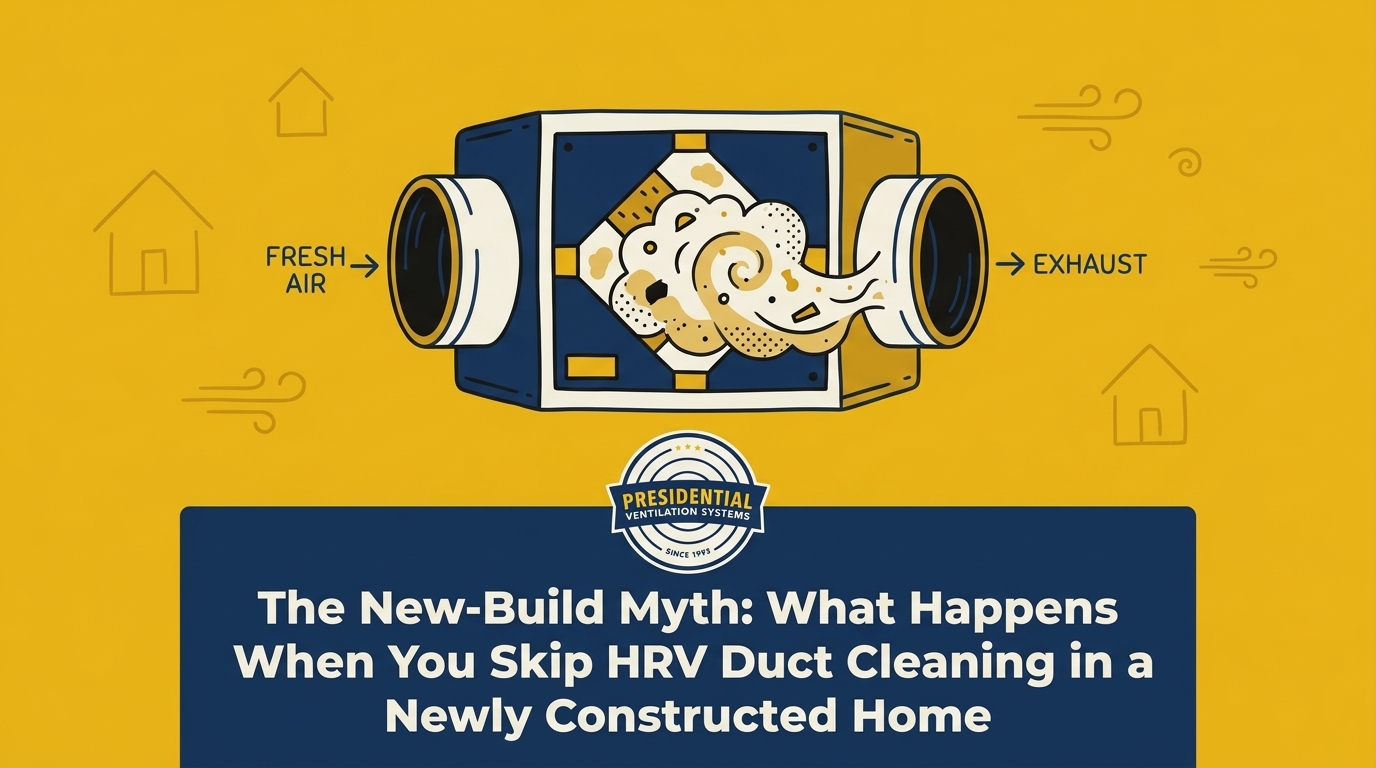
You finally have the keys to your brand-new build, but despite the pristine floors and fresh paint, a fine layer of white dust keeps settling on your countertops. At Presidential Ventilation Systems Ltd., our team often encounters a frustrating reality for many property owners: What happens when you skip HRV duct cleaning in a newly constructed home means your state-of-the-art ventilation network is already compromised before you even move your furniture inside. For example, in homes completed during the recent 2022-2024 residential and commercial construction boom, we routinely find significant amounts of drywall dust, heavy sawdust, and fiberglass particles accumulated heavily during the final stages of home construction, settling deep inside the ductwork.
To ensure your new property operates as efficiently as it was designed to, exploring professional ventilation and HVAC services is the best first step you can take.
The most common decision point for new homeowners is whether to schedule a post-build cleaning or simply assume the system is spotless because the house has never been lived in. Modern construction practices generate massive amounts of ultrafine particulate matter. Even with diligent contractors sweeping up daily, microscopic debris becomes airborne and inevitably finds its way into the ventilation returns. As we remind our Mount Uniacke NS clients, a "new" home does not automatically equal a "clean" ventilation system.
The unseen accumulation process:
• Drywall sanding: Produces a flour-like dust that stays suspended in the air for hours, easily drifting into open vent boots.
• Hardwood cutting: Heavy sawdust falls into floor registers before grilles are officially installed.
• Insulation installation: Airborne fiberglass particles get pulled into the return ducting if the system is tested prematurely.
If left unaddressed, this debris travels straight to the HRV heat recovery core, turning a brand-new mechanical system into a strained, inefficient unit from day one.
The timeline of a new build is complex, with multiple trades overlapping to meet deadlines. During the busy spring and summer building seasons, heavy particulate matter is introduced into the environment daily. One local homeowner recently noted how crucial a tidy, efficient installation is during a summer project; when contractors prioritize a clean work environment, it helps, but even the best crews cannot stop airborne dust from entering an active air exchange network.
When you run the heating or cooling during the construction or major renovation phase—often done to dry drywall mud faster or keep workers comfortable—the system pulls this debris directly into the return vents. This creates an immediate burden on your HRV systems right out of the gate.
Sanding drywall and cutting wood generate suspended particles—often measuring as small as 2.5 microns (PM2.5)—that behave very differently than normal household dust. Standard household dust is primarily made of fabric fibers, pet dander, and skin cells. Construction dust is heavy, abrasive, and highly concentrated.
• Standard Household Dust — Particle Characteristics: Light, easily trapped by basic filters, organic material. — Impact on Ventilation Systems: Gradual buildup over months; easily managed with standard maintenance.
• Construction Debris — Particle Characteristics: Ultrafine, abrasive, inorganic (silica, gypsum, wood). — Impact on Ventilation Systems: Rapid clogging; coats internal components and bypasses basic filters.
Because systems are often tested or run temporarily before the final cleanup is complete, the ductwork acts as a vacuum for the entire job site.
You might assume the disposable filter installed by the builder will catch the mess. Unfortunately, standard construction-grade fiberglass filters are designed to stop large debris like hair and large dust bunnies, not ultrafine drywall powder. These microscopic particles bypass basic filters entirely. The dust settles deep within the ductwork, waiting to be circulated, ultimately leading to restricted airflow and reduced heat exchange efficiency the moment you take occupancy.
To understand why this specific type of dust is so damaging, you have to look at the mechanical heart of your ventilation setup: the HRV heat recovery core. This component is an intricate, honeycomb-like structure made of thin aluminum or specialized plastic plates. Its job is to cross outgoing stale indoor air with incoming fresh outdoor air, transferring the heat without mixing the air streams.
When our technicians open these units in Mount Uniacke NS, we see firsthand how skipping a post-construction cleaning sends a continuous stream of ultrafine dust straight into this delicate honeycomb structure. If you are wondering what happens if you don't maintain your HRV, the core is the first place to look for failure, often causing standard 75% to 80% Sensible Recovery Efficiency (SRE) ratings to plummet.
Ultrafine dust easily navigates through the ducts to the central unit. Once it reaches the core, a damaging chemical reaction occurs. Drywall dust is highly absorbent. When it combines with normal indoor humidity—or the moisture from fresh paint and curing concrete—it acts exactly like a paste. This paste coats the core's delicate transfer surfaces.
The mechanical breakdown:
• Insulating barrier: The drywall paste hardens into an insulating layer over the heat exchange plates.
• Blocked transfer: Heat can no longer pass efficiently from the warm exhaust air to the cold incoming air.
• Physical blockage: The narrow channels of the honeycomb structure physically plug up, stopping air from moving through the unit.
This buildup happens rapidly in new builds. Without intervention, a high-end, brand-new piece of equipment is quickly reduced to the efficiency of a heavily aged, neglected unit.
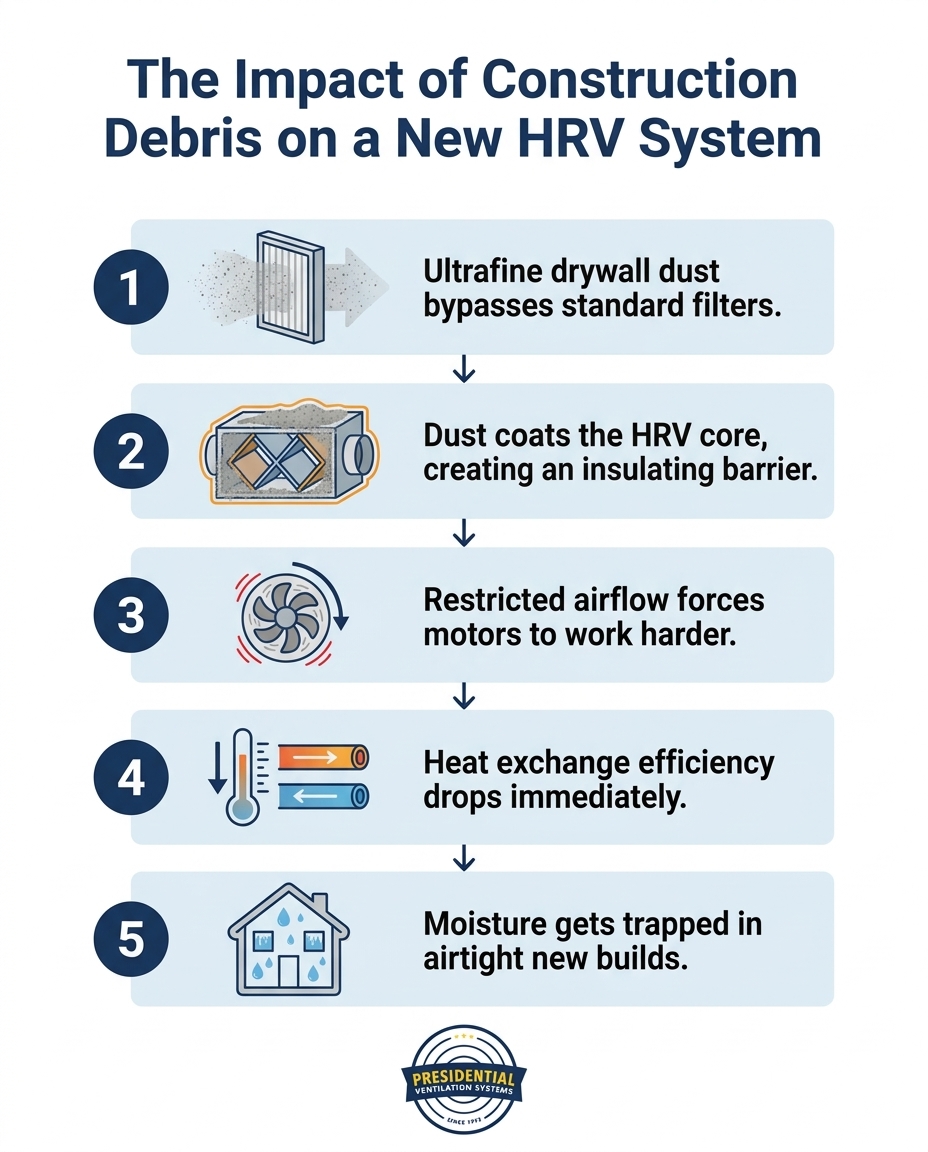
The secondary mechanical failures caused by a clogged core are often what homeowners notice first. The primary symptom is a sudden spike in energy usage or a home that feels stuffy despite the system running constantly. This is the direct result of restricted airflow and reduced heat exchange efficiency.
In a brand-new, airtight home, airflow must be perfectly balanced. When the channels of the HRV core become clogged with drywall dust, the volume of fresh air entering the home is drastically reduced. This creates a bottleneck. The static pressure inside the ductwork increases, forcing the system out of its optimal operating range. The blower motors, which are designed to push air with minimal resistance, suddenly have to push past 2,000 RPMs just to force air through the physical blockage.
Energy is wasted trying to overcome this resistance. The motors draw more electricity to maintain the required RPMs, negating the financial benefits of installing high-efficiency equipment in your new build. Furthermore, because the heat transfer surfaces are insulated by a layer of dust, the heat recovery rates plummet. Instead of capturing the heat from your outgoing air to warm the incoming winter air, that energy is lost to the outside, forcing your primary heating system to run longer and harder to make up the difference. This constant electrical strain leads directly to premature wear on blower motors and electrical components.
Modern new construction homes are built to rigorous energy codes, meaning they are highly airtight to prevent drafts and heat loss. While this is fantastic for your heating bill, it creates a unique challenge: airtight homes rely entirely on mechanical ventilation to expel indoor moisture. In Nova Scotia's damp maritime climate, managing high indoor humidity—especially keeping it below the critical 50% threshold during winter—is critical. The regional moisture levels make an efficiently running HRV heat recovery core essential to protect a brand-new airtight home from severe moisture damage.
Airtight construction traps moisture inside. Everyday activities like cooking, bathing, and even breathing generate significant humidity. More importantly, new building materials—such as fresh lumber, poured concrete, and interior paint—release gallons of moisture into the air during the first year of occupancy as they dry and cure.
The risks of trapped moisture:
• Window condensation: Water pools on sills, damaging brand-new trim and drywall.
• Poor indoor air quality: High humidity breeds mold and mildew in dark corners and closets.
• Material warping: Hardwood floors and cabinetry can swell or warp when indoor humidity remains unchecked.
In our years of servicing Mount Uniacke NS, we have seen how a dust-clogged HRV fails to expel this moisture effectively. When the airflow is restricted by construction debris, the damp, stale air stays trapped inside, putting your brand-new investment at immediate risk.
The transition from the installation phase to the occupancy phase is a critical window for your HVAC system's health. The final steps of an air exchanger installation involve balancing the airflow and testing the controls, but the job isn't truly finished until the post-build environment is completely clean. Because commercial and residential construction timelines often overlap, dust continues to enter newly installed systems right up until move-in day.
Our team at Presidential Ventilation Systems Ltd. brings deep local expertise in new construction HVAC, understanding exactly how Maritime building practices and timelines impact brand-new ventilation systems. Professional HVAC installers view the transition from a messy construction site to an occupied home as the most vulnerable time for mechanical equipment. If you have complementary systems, such as ducted heat pump systems, coordinating a professional cleaning immediately after construction protects the entire HVAC ecosystem. It ensures that restricted airflow and reduced heat exchange efficiency don't compromise the lifespan of your interconnected climate control units, while also maintaining system efficiency to ensure you qualify for regional energy rebates.
Assuming your system is clean simply because it is new is a costly mistake. One local homeowner scheduled a routine fall inspection and deep cleaning within the first 6 months of occupancy, only to realize the immense value of thorough testing and product care information after seeing the heavy particulate buildup removed from their seemingly "clean" new system. The evidence is clear: the HRV heat recovery core cannot process construction debris.
The immediate consequences of skipping a post-build cleaning include:
• Immediate reduction in heat exchange efficiency: Dust insulates the core, preventing heat transfer.
• Increased strain on blower motors: Motors overwork to push air through clogged channels, leading to higher electrical energy consumption.
• Poor indoor air quality: Ultrafine drywall dust recirculates continuously into your living spaces.
• Inability to manage indoor humidity: Airtight homes suffer from condensation and potential mold growth when ventilation fails.
• Premature component failure: Overworked motors and sensors burn out faster than their expected lifespan.
Highlighting the value of a thorough, professional inspection and deep clean to verify system health before move-in is essential. For property owners across our local service areas, scheduling this service is the ultimate peace-of-mind check.
A clear, technical understanding of how construction debris interacts with modern ventilation validates the absolute necessity of a post-build cleaning. Protecting the core from the abrasive, paste-like buildup of drywall dust ensures the system operates at peak efficiency from the moment you move in. By clearing out the hidden threats, our team ensures you eliminate the risks of restricted airflow and reduced heat exchange efficiency, allowing your equipment to properly manage the unique moisture loads of a new, airtight build.
Don't let the "new build myth" compromise your comfort. Consult with our local experts at Presidential Ventilation Systems Ltd. to clear out construction dust thoroughly, ensuring you start your new home journey with truly clean, healthy air.
Your new home is likely dusty because ultrafine construction debris, such as drywall dust and sawdust, has settled inside your ductwork. When the HVAC system kicks on, it continuously blows these hidden particles back into your living spaces. A professional duct cleaning removes this trapped debris at the source.
Yes, new builds almost always require duct cleaning before or immediately after move-in. During commercial and residential construction, the open ductwork acts as a collection point for sawdust, fiberglass, and drywall powder. Cleaning the system ensures this abrasive debris doesn't damage your brand-new HVAC equipment.
If an HRV core is clogged, the system cannot efficiently transfer heat between the incoming and outgoing air streams. This blockage restricts fresh airflow, forces the blower motors to overwork, and traps stale, humid air inside your home. In new airtight builds, this often leads to rapid window condensation.
Drywall dust affects an air exchanger installation by bypassing standard filters and coating the internal heat recovery core. Because drywall dust absorbs moisture, it forms a thick paste that blocks the narrow air channels. This immediately reduces the newly installed unit's efficiency and lifespan.
Yes, construction dust can permanently damage a new HRV system if left unaddressed. The constant electrical strain of pushing air through a clogged core can burn out the blower motors prematurely. Additionally, the abrasive nature of the dust can wear down delicate internal sensors and moving parts.