


You are planning an oil-to-heat-pump conversion, but you might be wondering why we require dedicated circuits for ductless mini splits in older homes instead of simply plugging the new unit into an existing wall outlet. It is a question our team at Presidential Ventilation Systems hears frequently during the estimate phase. Homeowners naturally want to save time and minimize disruptions to their drywall. Tying a new indoor air handler into a nearby bedroom or living room circuit seems like a fast, logical shortcut. However, the existing electrical infrastructure in aging properties was never designed to handle the continuous, heavy load of modern heating equipment.
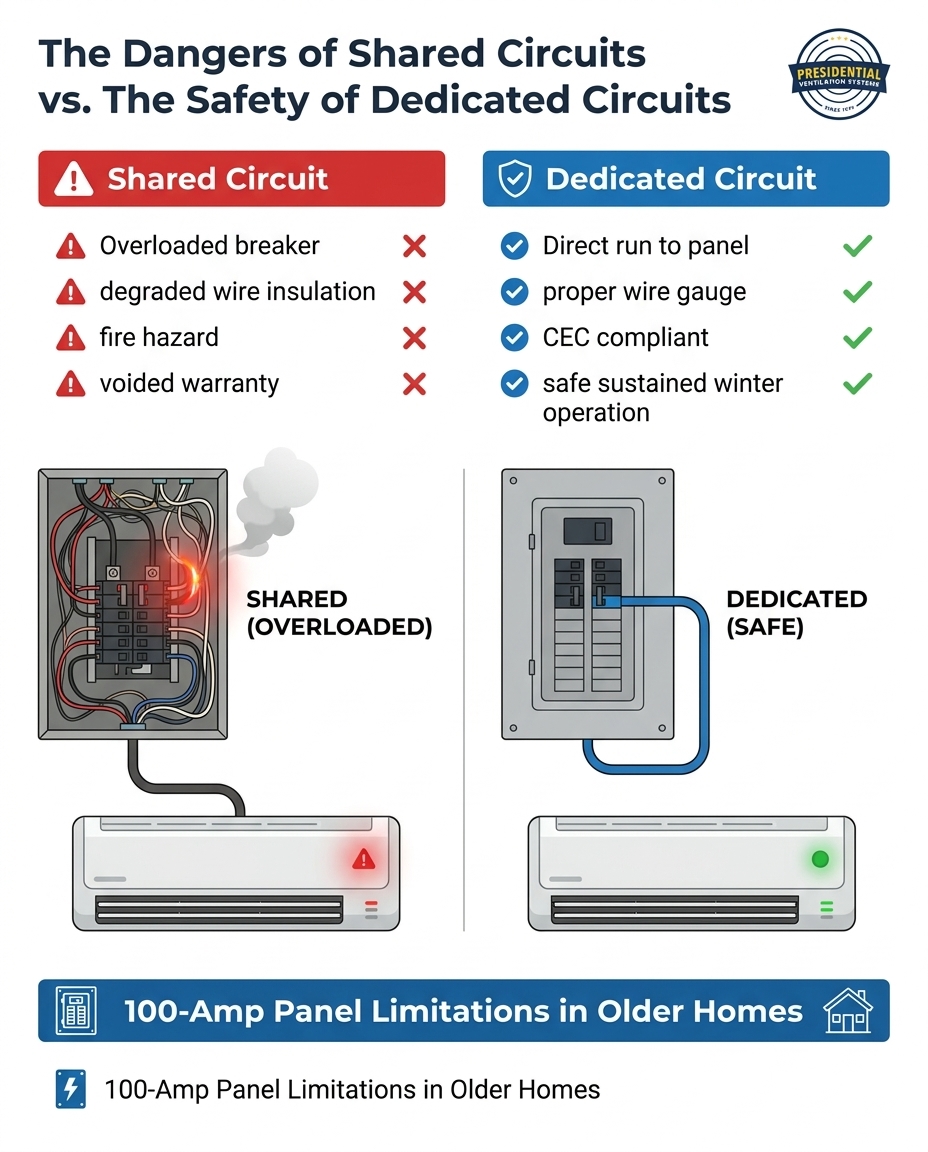
If you are exploring heat pump systems, understanding the electrical side of a ductless heat pump installation is just as critical as selecting the right hardware. The decision to run a dedicated electrical line straight back to your main electrical panel is not an arbitrary upsell. It is a strict safety standard. Without a dedicated circuit, you risk overloaded breakers, compromised wire insulation, and hidden fire hazards. In our 30+ years serving Mount Uniacke and the surrounding Nova Scotia communities, we have seen firsthand why taking shortcuts with existing wiring is a gamble no homeowner should take.
Common misconceptions about heat pump wiring:
• "It runs on electricity, so any outlet works." Standard wall outlets are wired for intermittent, low-draw devices, not continuous heating equipment.
• "My breaker hasn't tripped before, so it has room." A breaker that holds a television and a lamp will trip immediately when a compressor surges to life.
• "Smaller units do not need dedicated power." Even 110V mini splits require their own dedicated breaker to operate safely and meet code.
When our Red Seal electricians assess older Nova Scotia homes, it is very common to find properties still operating on 60-amp or 100-amp service panels. When these homes were built, the electrical demands of daily life were entirely different. A typical household ran a few incandescent lights, a refrigerator, and perhaps a small television. Today, we plug in computers, air fryers, electric vehicles, and high-efficiency heating systems. When you attempt to share a circuit, you are asking decades-old wiring to perform a job it was never engineered to do.
A shared circuit works by distributing available amperage across multiple outlets and fixtures on a single line. If you add a heat pump to a line that already powers your living room lights, a space heater, or a home entertainment center, you push the circuit far beyond its safe operational capacity. The immediate result is a frequently tripped breaker. While a tripped breaker is annoying, it is actually the safety mechanism doing its job. The real danger occurs when people ignore the tripping breaker, attempt to replace it with a larger one, or rely on degraded wiring that fails to trip the breaker in time.
• Microwave Oven — Typical Electrical Draw: High (Intermittent) — Duration of Load: 1 to 5 minutes — Circuit Requirement: Shared or Dedicated (Kitchen)
• Vacuum Cleaner — Typical Electrical Draw: Moderate — Duration of Load: 10 to 20 minutes — Circuit Requirement: Shared (General Lighting)
• Television / Electronics — Typical Electrical Draw: Low — Duration of Load: Hours — Circuit Requirement: Shared (General Lighting)
• Ductless Mini Split — Typical Electrical Draw: High (Continuous) — Duration of Load: Hours to Days — Circuit Requirement: Strictly Dedicated
Electrical safety comes down to matching the wire gauge and the breaker size to the specific draw of the appliance. If a heat pump draws 20 amps, it requires wiring thick enough to carry 20 amps without overheating, protected by a breaker designed to trip if the load exceeds that limit.
When you force a high-draw appliance onto an undersized, shared wire, the copper inside your walls gets hot. Over time, this sustained overheating degrades the plastic or rubber insulation surrounding the wire. Brittle, melted, or crumbling insulation exposes bare copper, creating a severe fire hazard hidden entirely behind your drywall. Taking shortcuts on electrical infrastructure compromises the safety of the entire household.
To truly understand why a dedicated circuit is necessary, we have to look at how a heat pump operates during freezing Maritime winters. Modern ductless mini splits are incredibly efficient, utilizing advanced inverter technology to modulate their output. However, efficiency does not mean they run on a trickle of electricity. When the temperature drops rapidly, these systems draw sustained amperage to keep your home comfortable.
During a deep freeze, your heat pump's compressor has to work at maximum capacity to extract ambient heat from the bitter outside air. This process requires a significant, continuous flow of electricity. Unlike a toaster or a hair dryer that runs for a few minutes and then shuts off, your heating system may run continuously for days during a severe winter storm. This sustained winter draw puts immense pressure on your electrical infrastructure.
How cold weather impacts electrical draw:
• Defrost cycles: The system periodically uses extra energy to melt ice buildup on the outdoor coil.
• Maximum compressor load: Extracting heat from -15°C air requires the compressor to run at its highest speed, drawing maximum running amps.
• Sustained operation: The system rarely cycles off during extreme cold, meaning the electrical wires have no time to cool down.
If your heat pump shares a circuit with other household items, the combined load during these extreme weather events will easily overwhelm older Nova Scotia homes. A dedicated circuit is the only way to ensure the system has the uninterrupted power it needs to keep your family warm when you need it most.
Beyond basic physics and safety, there is a legal and regulatory framework governing how heating equipment must be installed. The Canadian Electrical Code (CEC), also known as CSA C22.1, mandates specific standards for stationary heating appliances. Under these national regulations, hardwired heating equipment requires a dedicated circuit. Our in-house Red Seal tradespeople follow these codes strictly because they were written to prevent the exact circuit overloads and fire hazards we discussed earlier.
The electrical code also dictates how the system connects to the exterior of your home. A dedicated circuit is not just a wire running to the indoor unit; it involves an outdoor disconnect box mounted near the exterior compressor. This disconnect box provides a safe, immediate way for technicians to cut power to the unit during maintenance, repairs, or emergencies without having to run inside to the main breaker panel.
Ignoring these electrical codes during a major home upgrade carries significant consequences. If an unpermitted, non-compliant electrical installation causes a fire or property damage, your home insurance provider may deny your claim. Insurance companies expect major electrical modifications to be completed by licensed professionals following current CEC standards. Doing the job right the first time protects your property, your family, and your financial liability.
Improper electrical installation does not just pose a safety risk; it also threatens your long-term investment in the equipment itself. As a Daikin Comfort Pro, we know firsthand that major manufacturers like Daikin and Lennox explicitly require dedicated circuits in their official installation manuals. These engineering specifications are not suggestions—they are mandatory requirements for maintaining the validity of your manufacturer warranty.
The compressor is the heart of your heat pump and the most expensive component to replace. It is also highly vulnerable to electrical starvation. If a compressor operates on a shared circuit that experiences voltage drops or power fluctuations, it has to work much harder to maintain its internal magnetic fields. This causes the compressor motor to run hot, significantly reducing its lifespan.
Electrical issues that can void your warranty:
1. Voltage drops: Caused by undersized wiring or shared loads pulling power away from the heat pump.
2. Improper breaker sizing: Using a breaker that is too large for the wire, allowing the equipment to draw dangerous levels of current before tripping.
3. Lack of a disconnect box: Failing to install the required outdoor safety switch.
4. Non-compliant wiring methods: Splicing into existing room circuits instead of running a continuous line to the panel.
If your system fails prematurely and the manufacturer determines that voltage drops, power surges, or improper wiring caused the breakdown, they can—and often will—void the warranty. In our decades of experience, we have seen homeowners stuck with massive repair bills because a previous installer took an electrical shortcut. Doing the electrical work correctly the first time is the ultimate protection for your investment.
One of the most common homeowner headaches during a retrofit is dealing with multiple contractors. Often, an HVAC company will mount the indoor head, set the outdoor unit, run the refrigeration lines, and then tell the homeowner, "You will need to go hire a separate electrician to finish the wiring." This leaves you responsible for coordinating schedules, pulling separate permits, and managing communication between two different companies.
Because Presidential Ventilation Systems employs both HVAC and electrical professionals under one roof—with a team of approximately 70 skilled employees—we eliminate this frustration. Having both disciplines in-house ensures that your system is sized correctly from both a thermal and an electrical perspective. Our Red Seal tradespeople do not just view a heat pump as a refrigeration job; they view it as a comprehensive home infrastructure upgrade.
When you utilize our HVAC and electrical services, you experience a seamless process. One unified team handles the refrigeration lines, drills the necessary penetrations, runs the dedicated circuit back to the panel, and installs the outdoor disconnect box. This integrated approach provides peace of mind. There is a single point of accountability. If you ever have a question about how your system is running or how it is wired, you make one phone call to the team that built it, with no finger-pointing between separate contractors.
Understanding that you need a dedicated circuit is the first step, but what happens if your current electrical panel cannot support one? In older Nova Scotia homes, it is very common for our electricians to find a 100-amp panel that is completely full, lacking the physical space or the overall capacity for a new 220V breaker.
Before installing high-draw heating appliances, a professional must conduct a proper electrical load calculation. This calculation looks at the total square footage of your home, the existing major appliances (electric range, dryer, water heater), and the proposed new heating load. The goal is to determine if your current service can safely handle the additional demand without exceeding the main breaker's rating.
Solutions for a maxed-out electrical panel:
• Service Upgrades: Upgrading the entire home from a 100-amp service to a 200-amp service. This involves a new panel, a new meter base, and new service wires from the utility pole.
• Adding a Sub-Panel: If the main service has enough overall capacity but lacks physical breaker space, a smaller sub-panel can be installed next to the main panel to house the new circuits.
• Smart Load Management: In some cases, load-mizer devices can be installed to automatically manage power between high-draw appliances (like pausing the electric water heater while the heat pump runs at maximum capacity).
During this assessment, our team also looks for other aging infrastructure challenges. For example, if we encounter outdated wiring types during the upgrade, we can address the need for specialized aluminum wiring remediation to ensure the entire connection path is safe and code-compliant.
Yes, a mini split absolutely needs its own dedicated breaker. The Canadian Electrical Code (CEC) and all major equipment manufacturers require a dedicated circuit to prevent overloads. Sharing a breaker with other household items will lead to frequent tripping, potential fire hazards, and a voided equipment warranty.
No, you cannot plug a mini split into a regular household outlet. These systems require hardwiring directly to a dedicated circuit in your electrical panel. While most systems require a 220V connection, even smaller 110V units must be hardwired to their own dedicated line to operate safely.
It depends entirely on your current panel's capacity and your home's existing electrical load. A professional load calculation is required to determine if your current 100-amp or 200-amp service can handle the new equipment. If your panel is full or maxed out, a service upgrade or a sub-panel will be necessary.
If a heat pump is not on a dedicated circuit, you risk voiding your manufacturer warranty, constantly tripping breakers, and damaging the system's compressor due to voltage drops. More importantly, pulling continuous high amperage through shared, older wiring creates a severe fire hazard hidden behind your walls.
A licensed electrical professional must complete the high-voltage wiring, install the disconnect box, and make the final panel connections. Because Presidential Ventilation Systems employs in-house electrical and HVAC experts, our team handles the entire process from start to finish, ensuring total code compliance.
A dedicated circuit is a non-negotiable requirement for safety, code compliance, and the long-term longevity of your heating system. Proper electrical integration is just as important as choosing the right heat pump hardware. Taking shortcuts on the wiring in older properties puts your home at risk, voids warranties, and leads to premature equipment failure.
When you are planning a major home upgrade, it pays to seek a comprehensive assessment from a team that understands both the refrigeration and the electrical requirements. With 30+ years of local experience serving Mount Uniacke and beyond, we ensure that every aspect of your installation meets the highest safety standards. Rebates and incentive programs for these upgrades are frequently available, though programs and eligibility can change. We recommend confirming current programs with Presidential Ventilation Systems. Contact us today to request a free estimate and ensure your next heating upgrade is safe, reliable, and built to last.


You are planning an oil-to-heat-pump conversion, but you might be wondering why we require dedicated circuits for ductless mini splits in older homes instead of simply plugging the new unit into an existing wall outlet. It is a question our team at Presidential Ventilation Systems hears frequently during the estimate phase. Homeowners naturally want to save time and minimize disruptions to their drywall. Tying a new indoor air handler into a nearby bedroom or living room circuit seems like a fast, logical shortcut. However, the existing electrical infrastructure in aging properties was never designed to handle the continuous, heavy load of modern heating equipment.
If you are exploring heat pump systems, understanding the electrical side of a ductless heat pump installation is just as critical as selecting the right hardware. The decision to run a dedicated electrical line straight back to your main electrical panel is not an arbitrary upsell. It is a strict safety standard. Without a dedicated circuit, you risk overloaded breakers, compromised wire insulation, and hidden fire hazards. In our 30+ years serving Mount Uniacke and the surrounding Nova Scotia communities, we have seen firsthand why taking shortcuts with existing wiring is a gamble no homeowner should take.
Common misconceptions about heat pump wiring:
• "It runs on electricity, so any outlet works." Standard wall outlets are wired for intermittent, low-draw devices, not continuous heating equipment.
• "My breaker hasn't tripped before, so it has room." A breaker that holds a television and a lamp will trip immediately when a compressor surges to life.
• "Smaller units do not need dedicated power." Even 110V mini splits require their own dedicated breaker to operate safely and meet code.
When our Red Seal electricians assess older Nova Scotia homes, it is very common to find properties still operating on 60-amp or 100-amp service panels. When these homes were built, the electrical demands of daily life were entirely different. A typical household ran a few incandescent lights, a refrigerator, and perhaps a small television. Today, we plug in computers, air fryers, electric vehicles, and high-efficiency heating systems. When you attempt to share a circuit, you are asking decades-old wiring to perform a job it was never engineered to do.
A shared circuit works by distributing available amperage across multiple outlets and fixtures on a single line. If you add a heat pump to a line that already powers your living room lights, a space heater, or a home entertainment center, you push the circuit far beyond its safe operational capacity. The immediate result is a frequently tripped breaker. While a tripped breaker is annoying, it is actually the safety mechanism doing its job. The real danger occurs when people ignore the tripping breaker, attempt to replace it with a larger one, or rely on degraded wiring that fails to trip the breaker in time.
• Microwave Oven — Typical Electrical Draw: High (Intermittent) — Duration of Load: 1 to 5 minutes — Circuit Requirement: Shared or Dedicated (Kitchen)
• Vacuum Cleaner — Typical Electrical Draw: Moderate — Duration of Load: 10 to 20 minutes — Circuit Requirement: Shared (General Lighting)
• Television / Electronics — Typical Electrical Draw: Low — Duration of Load: Hours — Circuit Requirement: Shared (General Lighting)
• Ductless Mini Split — Typical Electrical Draw: High (Continuous) — Duration of Load: Hours to Days — Circuit Requirement: Strictly Dedicated
Electrical safety comes down to matching the wire gauge and the breaker size to the specific draw of the appliance. If a heat pump draws 20 amps, it requires wiring thick enough to carry 20 amps without overheating, protected by a breaker designed to trip if the load exceeds that limit.
When you force a high-draw appliance onto an undersized, shared wire, the copper inside your walls gets hot. Over time, this sustained overheating degrades the plastic or rubber insulation surrounding the wire. Brittle, melted, or crumbling insulation exposes bare copper, creating a severe fire hazard hidden entirely behind your drywall. Taking shortcuts on electrical infrastructure compromises the safety of the entire household.
To truly understand why a dedicated circuit is necessary, we have to look at how a heat pump operates during freezing Maritime winters. Modern ductless mini splits are incredibly efficient, utilizing advanced inverter technology to modulate their output. However, efficiency does not mean they run on a trickle of electricity. When the temperature drops rapidly, these systems draw sustained amperage to keep your home comfortable.
During a deep freeze, your heat pump's compressor has to work at maximum capacity to extract ambient heat from the bitter outside air. This process requires a significant, continuous flow of electricity. Unlike a toaster or a hair dryer that runs for a few minutes and then shuts off, your heating system may run continuously for days during a severe winter storm. This sustained winter draw puts immense pressure on your electrical infrastructure.
How cold weather impacts electrical draw:
• Defrost cycles: The system periodically uses extra energy to melt ice buildup on the outdoor coil.
• Maximum compressor load: Extracting heat from -15°C air requires the compressor to run at its highest speed, drawing maximum running amps.
• Sustained operation: The system rarely cycles off during extreme cold, meaning the electrical wires have no time to cool down.
If your heat pump shares a circuit with other household items, the combined load during these extreme weather events will easily overwhelm older Nova Scotia homes. A dedicated circuit is the only way to ensure the system has the uninterrupted power it needs to keep your family warm when you need it most.
Beyond basic physics and safety, there is a legal and regulatory framework governing how heating equipment must be installed. The Canadian Electrical Code (CEC), also known as CSA C22.1, mandates specific standards for stationary heating appliances. Under these national regulations, hardwired heating equipment requires a dedicated circuit. Our in-house Red Seal tradespeople follow these codes strictly because they were written to prevent the exact circuit overloads and fire hazards we discussed earlier.
The electrical code also dictates how the system connects to the exterior of your home. A dedicated circuit is not just a wire running to the indoor unit; it involves an outdoor disconnect box mounted near the exterior compressor. This disconnect box provides a safe, immediate way for technicians to cut power to the unit during maintenance, repairs, or emergencies without having to run inside to the main breaker panel.
Ignoring these electrical codes during a major home upgrade carries significant consequences. If an unpermitted, non-compliant electrical installation causes a fire or property damage, your home insurance provider may deny your claim. Insurance companies expect major electrical modifications to be completed by licensed professionals following current CEC standards. Doing the job right the first time protects your property, your family, and your financial liability.
Improper electrical installation does not just pose a safety risk; it also threatens your long-term investment in the equipment itself. As a Daikin Comfort Pro, we know firsthand that major manufacturers like Daikin and Lennox explicitly require dedicated circuits in their official installation manuals. These engineering specifications are not suggestions—they are mandatory requirements for maintaining the validity of your manufacturer warranty.
The compressor is the heart of your heat pump and the most expensive component to replace. It is also highly vulnerable to electrical starvation. If a compressor operates on a shared circuit that experiences voltage drops or power fluctuations, it has to work much harder to maintain its internal magnetic fields. This causes the compressor motor to run hot, significantly reducing its lifespan.
Electrical issues that can void your warranty:
1. Voltage drops: Caused by undersized wiring or shared loads pulling power away from the heat pump.
2. Improper breaker sizing: Using a breaker that is too large for the wire, allowing the equipment to draw dangerous levels of current before tripping.
3. Lack of a disconnect box: Failing to install the required outdoor safety switch.
4. Non-compliant wiring methods: Splicing into existing room circuits instead of running a continuous line to the panel.
If your system fails prematurely and the manufacturer determines that voltage drops, power surges, or improper wiring caused the breakdown, they can—and often will—void the warranty. In our decades of experience, we have seen homeowners stuck with massive repair bills because a previous installer took an electrical shortcut. Doing the electrical work correctly the first time is the ultimate protection for your investment.
One of the most common homeowner headaches during a retrofit is dealing with multiple contractors. Often, an HVAC company will mount the indoor head, set the outdoor unit, run the refrigeration lines, and then tell the homeowner, "You will need to go hire a separate electrician to finish the wiring." This leaves you responsible for coordinating schedules, pulling separate permits, and managing communication between two different companies.
Because Presidential Ventilation Systems employs both HVAC and electrical professionals under one roof—with a team of approximately 70 skilled employees—we eliminate this frustration. Having both disciplines in-house ensures that your system is sized correctly from both a thermal and an electrical perspective. Our Red Seal tradespeople do not just view a heat pump as a refrigeration job; they view it as a comprehensive home infrastructure upgrade.
When you utilize our HVAC and electrical services, you experience a seamless process. One unified team handles the refrigeration lines, drills the necessary penetrations, runs the dedicated circuit back to the panel, and installs the outdoor disconnect box. This integrated approach provides peace of mind. There is a single point of accountability. If you ever have a question about how your system is running or how it is wired, you make one phone call to the team that built it, with no finger-pointing between separate contractors.
Understanding that you need a dedicated circuit is the first step, but what happens if your current electrical panel cannot support one? In older Nova Scotia homes, it is very common for our electricians to find a 100-amp panel that is completely full, lacking the physical space or the overall capacity for a new 220V breaker.
Before installing high-draw heating appliances, a professional must conduct a proper electrical load calculation. This calculation looks at the total square footage of your home, the existing major appliances (electric range, dryer, water heater), and the proposed new heating load. The goal is to determine if your current service can safely handle the additional demand without exceeding the main breaker's rating.
Solutions for a maxed-out electrical panel:
• Service Upgrades: Upgrading the entire home from a 100-amp service to a 200-amp service. This involves a new panel, a new meter base, and new service wires from the utility pole.
• Adding a Sub-Panel: If the main service has enough overall capacity but lacks physical breaker space, a smaller sub-panel can be installed next to the main panel to house the new circuits.
• Smart Load Management: In some cases, load-mizer devices can be installed to automatically manage power between high-draw appliances (like pausing the electric water heater while the heat pump runs at maximum capacity).
During this assessment, our team also looks for other aging infrastructure challenges. For example, if we encounter outdated wiring types during the upgrade, we can address the need for specialized aluminum wiring remediation to ensure the entire connection path is safe and code-compliant.
Yes, a mini split absolutely needs its own dedicated breaker. The Canadian Electrical Code (CEC) and all major equipment manufacturers require a dedicated circuit to prevent overloads. Sharing a breaker with other household items will lead to frequent tripping, potential fire hazards, and a voided equipment warranty.
No, you cannot plug a mini split into a regular household outlet. These systems require hardwiring directly to a dedicated circuit in your electrical panel. While most systems require a 220V connection, even smaller 110V units must be hardwired to their own dedicated line to operate safely.
It depends entirely on your current panel's capacity and your home's existing electrical load. A professional load calculation is required to determine if your current 100-amp or 200-amp service can handle the new equipment. If your panel is full or maxed out, a service upgrade or a sub-panel will be necessary.
If a heat pump is not on a dedicated circuit, you risk voiding your manufacturer warranty, constantly tripping breakers, and damaging the system's compressor due to voltage drops. More importantly, pulling continuous high amperage through shared, older wiring creates a severe fire hazard hidden behind your walls.
A licensed electrical professional must complete the high-voltage wiring, install the disconnect box, and make the final panel connections. Because Presidential Ventilation Systems employs in-house electrical and HVAC experts, our team handles the entire process from start to finish, ensuring total code compliance.
A dedicated circuit is a non-negotiable requirement for safety, code compliance, and the long-term longevity of your heating system. Proper electrical integration is just as important as choosing the right heat pump hardware. Taking shortcuts on the wiring in older properties puts your home at risk, voids warranties, and leads to premature equipment failure.
When you are planning a major home upgrade, it pays to seek a comprehensive assessment from a team that understands both the refrigeration and the electrical requirements. With 30+ years of local experience serving Mount Uniacke and beyond, we ensure that every aspect of your installation meets the highest safety standards. Rebates and incentive programs for these upgrades are frequently available, though programs and eligibility can change. We recommend confirming current programs with Presidential Ventilation Systems. Contact us today to request a free estimate and ensure your next heating upgrade is safe, reliable, and built to last.

Winter in Nova Scotia arrives fast, bringing freezing temperatures that immediately test your commercial building's infrastructure. It is a familiar frustration for many facility managers: the temperature drops, the heating kicks on, and suddenly, a main breaker trips, taking a section of your building offline. The culprit is rarely a broken system, but rather a hidden synchronization issue on your roof. If you want to keep your facility online, managing defrost cycles on multiple commercial rooftop heat pumps to prevent power spikes is a critical step that requires proactive attention.
During sudden Nova Scotia winter cold snaps, outdoor temperatures plummet below the balance point of your rooftop units. Ice begins to form on the outdoor coils, prompting the systems to initiate their built-in defrost cycles. The concrete problem arises when several units enter this mode at the exact same time. This simultaneous action demands a massive surge of electricity that easily overwhelms the building's electrical capacity.
For facility managers and building owners, simply resetting the breaker is not a long-term strategy. You face an important decision point: you must proactively manage peak electrical loads across the roof by properly staggering these cycles. This is not a standard maintenance task; it requires a coordinated approach between HVAC mechanics and electrical systems to ensure your commercial heat pumps operate efficiently without threatening your facility's power supply.
To understand why a tripped breaker happens, we have to look at exactly what occurs mechanically during a defrost cycle. When frost accumulates on the outdoor coil, the heat pump must clear it to maintain airflow and efficiency. To melt this outdoor ice, the system temporarily reverses its operation, essentially shifting back into air conditioning mode. It pulls heat from inside the building and sends it outside to thaw the frozen coil.
Because blowing cold air into a commercial workspace during winter is unacceptable, the system simultaneously engages its auxiliary electric heat strips. These strips warm the air before it reaches the vents, keeping the indoor climate comfortable. This is a standard feature on most ducted heat pump systems in commercial applications. However, this perfectly normal operation creates a simultaneous auxiliary power draw that places a tremendous temporary demand on your electrical panel.
The core issue lies in the difference between how a heat pump normally operates and how auxiliary heat functions. A compressor moves existing heat from one place to another, which is a highly efficient process that draws relatively low amperage. Electric heat strips, on the other hand, rely on resistive heating—they create heat by forcing electricity through high-resistance wires. This sudden shift completely changes the electrical profile of the rooftop unit.
The technical difference at a glance:
• Heat Pump Compressor — Heating Method: Thermodynamic heat transfer — Electrical Demand: Low to moderate amperage — Primary Function: Primary, highly efficient daily heating
• Auxiliary Heat Strips — Heating Method: Electrical resistance — Electrical Demand: Massive amperage spike — Primary Function: Temporary comfort during defrost mode
This massive amperage draw means that during a defrost cycle, a single rooftop unit can temporarily consume significantly more electricity than it does during hours of standard heating operation. The system is not broken; it is simply doing exactly what it was engineered to do under freezing conditions.
The physics of frost buildup go beyond just cold air. Frost accumulation is driven heavily by the moisture content present in the atmosphere. In our region, the unique mix of freezing winter temperatures and high coastal humidity creates the perfect storm for rapid, heavy frost on commercial coils.
In drier inland regions, a heat pump might run for hours in freezing temperatures before accumulating enough frost to trigger a defrost cycle. However, coastal humidity means the air holds significantly more water vapor. When that moisture-laden air is pulled across a freezing metal coil on an exposed commercial roof, the water vapor rapidly condenses and freezes.
Environmental factors that accelerate coastal frosting:
• High relative humidity: More suspended moisture in the air means more water available to freeze upon contact with the coil.
• Rapid temperature fluctuations: Sudden drops in ambient temperature cause dew points to shift quickly, increasing condensation.
• Rooftop wind exposure: High winds on commercial roofs constantly feed fresh, humid air over the coils, speeding up the icing process.
This specific climate reality necessitates far more frequent and prolonged defrost cycles than you would see elsewhere. Your commercial systems have to work overtime to keep their coils clear of thick coastal ice, which directly increases the frequency of those high-amperage auxiliary heat cycles.
Most commercial facilities are not cooled and heated by a single unit. A typical commercial setup involves multiple rooftop units, each serving different zones of the building—such as the warehouse, office spaces, retail floors, and server rooms. Because these units are exposed to the exact same outdoor weather conditions, they often react to the environment in unison.
When a uniform drop in outdoor temperature hits the roof, multiple independent units reach their frost thresholds at roughly the same time. If their internal timers are not actively managed, they will trigger their defrost cycles simultaneously. This creates a dangerous cascade effect across your electrical infrastructure.
The sequence of a facility power spike:
1. The outdoor temperature drops sharply, and coastal humidity coats all rooftop coils in frost.
2. Multiple units detect the restricted airflow or reach their set time intervals concurrently.
3. Several units reverse their reversing valves and engage their auxiliary resistive heat strips at the exact same moment.
4. The massive amperage draw of one unit's auxiliary heat is multiplied by three, four, or five units across the roof.
5. The combined peak electrical load exceeds the facility's main breaker capacity, resulting in a total power trip.
This cascade effect leads to sudden facility downtime, disrupted operations, and the immediate need to assess whether you require heavy electrical work, such as breaker panel upgrades, or if the issue can be resolved through intelligent system configuration.

The most effective way to prevent these massive power spikes is through professional load sequencing. By staggering the defrost timers across your commercial roof, you ensure that only one or two units can enter defrost mode at any given time. This flattens the peak electrical load, keeping the facility's total power draw safely below the main breaker's trip threshold.
It is vital to note that configuring commercial electrical loads and adjusting these specific timers requires a licensed professional. Commercial rooftop units operate on high-voltage electricity, and interacting with their internal control boards carries severe safety risks. Never attempt to adjust these settings yourself.
For standard rooftop units, technicians interact directly with the time-temperature defrost boards located inside each unit's control cabinet. These boards monitor the temperature of the coil and dictate how often the unit is allowed to check for frost. A licensed technician will adjust the pin settings or digital parameters on individual boards to offset their cycles.
For example, instead of all units checking for frost every 60 minutes, a professional might configure Unit A for 30-minute intervals, Unit B for 60-minute intervals, and Unit C for 90-minute intervals. This deliberate staggering prevents the units from syncing up and pulling auxiliary power concurrently, even during severe cold snaps.
Modern commercial facilities often utilize advanced Building Automation Systems (BAS) to monitor and control their HVAC equipment centrally. A properly programmed BAS can monitor the total electrical load of the building in real-time. If the system detects that the building is nearing its peak load capacity, it can dynamically prevent additional rooftop units from engaging their auxiliary heat until the first unit finishes its defrost cycle. This level of dynamic sequencing provides the ultimate protection against unexpected breaker trips.
In our 30+ years working on commercial projects, we have seen firsthand the danger of siloed approaches to facility maintenance. If you hire an HVAC-only contractor to investigate a tripped breaker, they might simply verify that the heat pump is producing heat, check the refrigerant charge, and declare the system healthy. Conversely, if you bring in a standard electrician, they will see the massive amperage draw, assume the building is underpowered, and suggest a highly extensive electrical panel upgrade.
Neither approach solves the root cause efficiently. Treating the HVAC system and the electrical panel as a single coordinated ecosystem is the only way to resolve this issue. The heating demand and the building's electrical load capacity are permanently linked.
This is why having approximately 70 employees and skilled Red Seal tradespeople across multiple disciplines matters. A contractor who handles both the HVAC mechanics and the electrical systems natively can diagnose the configuration error, stagger the timers, and verify the electrical load without pointing fingers at another trade. What we've learned diagnosing these complex commercial issues is that true reliability comes from understanding the whole picture—preventing power spikes before they ever have the chance to halt your operations.
Commercial heat pumps trip breakers in the winter primarily because they enter defrost mode to melt ice off their outdoor coils. During this cycle, they activate auxiliary electric heat strips to keep indoor air warm. If multiple units on a roof enter this high-amperage mode simultaneously, the combined electrical draw can easily exceed the main breaker's capacity.
A heat pump uses significantly more power in defrost mode because it relies on resistive heating. While normal heating uses a highly efficient compressor to move heat, the auxiliary heat strips used during defrost create heat through electrical resistance. This process can draw two to three times the amperage of standard compressor operation.
Yes, multiple commercial heat pumps can run safely on a single electrical panel, provided the panel is sized correctly and the equipment is professionally configured. The key to safety is load management. By staggering the defrost timers, professionals ensure the units do not draw their peak auxiliary loads at the exact same time.
Peak electrical loads are managed through a process called load sequencing. A licensed professional will adjust the time-temperature boards on each unit to offset their defrost intervals, or they will program a Building Automation System (BAS) to dynamically control when auxiliary heat is allowed to engage.
The most obvious sign of synced defrost timers is a main breaker tripping specifically during sudden drops in outdoor temperature or heavy winter precipitation. You might also notice a sudden, temporary dimming of facility lights right before a breaker trips, indicating a massive, simultaneous call for auxiliary power across the roof.
Winter cold snaps will inevitably test your facility's electrical capacity. The high coastal humidity and freezing temperatures will force your rooftop units into frequent defrost cycles. However, unexpected downtime and tripped breakers do not have to be a normal part of your winter operations. Proactive timer staggering and professional load management can flatten your peak electrical demand and protect your infrastructure.
Do not wait until a sudden freeze takes your building offline. Taking action now ensures your systems are properly sequenced for the months ahead. Schedule a professional assessment and secure a comprehensive commercial HVAC maintenance plan before the harshest weather arrives, ensuring your facility remains warm, efficient, and fully powered all winter long.

Are you constantly wiping condensation off your windows on chilly January mornings, or waking up with a scratchy throat because your indoor air feels bone dry? When evaluating sensible vs enthalpy heat recovery cores for Nova Scotia's specific humidity profile, many homeowners find themselves frustrated by generic ventilation advice that simply doesn't apply to the East Coast. Tightly sealed modern homes tend to trap moisture, while older, draftier homes often leak it away too quickly. Balancing this delicate indoor climate during a freezing Maritime winter requires more than just picking a box off a shelf.
The critical decision point for builders and homeowners comes down to choosing between a sensible heat recovery core (typically found in an HRV) and an enthalpy core (found in an ERV). While standard guidelines often recommend one over the other based purely on cold temperatures, our coastal climate demands a much more nuanced approach to managing indoor moisture. If you want to dive deeper into the basics of these units, you can explore how HRV systems function, but here we will break down exactly which core type is right for your specific home environment.
To make the right choice for your home, you first need to understand how these systems handle the air you breathe. A sensible heat recovery core—the standard technology behind most traditional Heat Recovery Ventilators—deals strictly with "sensible heat." In physics, sensible heat is the energy you can actually measure with a thermometer. These cores transfer temperature energy from your stale exhaust air to your incoming fresh air, but they do not mix the moisture.
As warm, damp indoor air passes through the exhaust side of the core, it warms up the cold, fresh air coming in from outside. The two air streams cross paths inside a series of narrow, separated channels (often made of aluminum or specialized plastics), never physically mixing. The heat is transferred, but the indoor humidity is expelled directly outside. If you are tired of dealing with excessive indoor moisture, you can book an HRV consultation online to see if this core type is the right fit.
This separation makes sensible cores incredibly effective for homes struggling with high indoor humidity. Natural Resources Canada (NRCan) guidelines frequently highlight these systems for basic ventilation needs in cold climates because they provide excellent condensation clearance.
Sensible cores are essentially moisture-removal engines during the winter. When you expel humid indoor air and replace it with cold outdoor air, you are fundamentally changing your home's moisture balance. Cold air simply cannot hold as much water vapor as warm air. When that cold, dry outdoor air is brought inside and heated up by your primary heating system, its relative humidity plummets.
Why this matters for your home:
• Tightly sealed construction: Modern homes generate a massive amount of internal moisture from cooking, showering, and simply breathing. Without a way to escape, this moisture builds up.
• Continuous clearance: By constantly swapping moist indoor air for dry outdoor air, a sensible core naturally lowers your indoor relative humidity.
• Window protection: Lowering the indoor humidity prevents warm, moist air from condensing and freezing on cold window panes, protecting your sills from water damage and mold.
While sensible cores focus only on temperature, enthalpy cores (the heart of an Energy Recovery Ventilator, or ERV) handle both temperature and moisture. Enthalpy refers to "latent heat," which is the energy contained within water vapor itself. These cores are designed to transfer both sensible heat (temperature) and latent heat (humidity) between the two air streams.
Inside an enthalpy core, the dividing walls between the incoming and outgoing air streams are made from a specialized, permeable membrane. This material allows water vapor molecules to pass from the more humid air stream into the drier one, while still blocking larger contaminants, odors, and exhaust gases. In the winter, this means a significant portion of the moisture in your outgoing stale air is captured and transferred back into the incoming fresh air.
The primary benefit here is maintaining indoor comfort. By retaining moisture, enthalpy cores help prevent your home from suffering through overly dry indoor air during the coldest parts of the year. It is important to address a common misconception: enthalpy cores do not "create" or generate moisture. They cannot add humidity that isn't already there; they merely retain a percentage of the moisture your household naturally produces.
Managing indoor air quality is a delicate balancing act. Health Canada and building science experts generally recommend maintaining indoor relative humidity between 30% and 50% during the winter months. If it drops below 30%, you experience static shocks, dry skin, and shrinking hardwood floors. If it climbs above 50% during a deep freeze, you invite trouble.
Retaining too much moisture during a severe cold snap can quickly lead to window condensation if the system isn't properly monitored. An enthalpy core is fantastic for keeping a home comfortable, but if your home already produces more moisture than it can handle, retaining that humidity might push you over the edge into condensation problems.
If you read a generic ventilation manual, the advice is usually straightforward: use an HRV in cold climates and an ERV in hot, humid climates. But living on the East Coast means we don't fit neatly into those boxes. Nova Scotia features a highly unique coastal humidity profile that throws standard manufacturer guidelines out the window.
The Problem: Generic advice assumes that cold winter air is always bone-dry. In inland provinces, a -15°C day usually means zero humidity. But in the Maritimes, we experience damp shoulder seasons, rapid freeze-thaw cycles, and winter air that is often heavy with moisture even when the temperature drops. This damp cold fundamentally alters the physics of moisture transfer in your home.
The Cause: Sudden coastal temperature swings—where it can be -10°C on Tuesday and +5°C with driving rain on Wednesday—wreak havoc on standard ventilation strategies. High outdoor relative humidity at low temperatures impacts how these cores operate, particularly when it comes to freezing. When moist exhaust air meets freezing incoming air inside the core, condensation forms. If it's cold enough, that condensation turns to ice, blocking airflow. If you are already seeing the effects of this, troubleshooting winter condensation with HRVs is a good next step.
The Solution: Because our outdoor air isn't always dry, an enthalpy core might be preferred in certain Nova Scotia homes to manage the rapid shifts in humidity, while a sensible core might be heavily favored in others to combat the dampness of the shoulder seasons. Both core types have defrost cycles—usually by shutting off the fresh air intake and recirculating warm indoor air to melt the ice—but how often they need to defrost depends heavily on our local weather patterns.
To truly understand which core fits your home, we need to look at a direct, side-by-side comparison tailored specifically to Maritime winter performance.
• Moisture Clearance — Sensible Core (Traditional HRV): Excellent. Aggressively expels indoor moisture during damp shoulder seasons. — Enthalpy Core (Traditional ERV): Moderate. Retains a portion of indoor moisture, keeping the home from drying out.
• Frost Resistance — Sensible Core (Traditional HRV): Prone to freezing in deep cold due to high condensation inside the core. Requires frequent defrosting. — Enthalpy Core (Traditional ERV): More resistant to freezing because moisture is transferred as vapor, not liquid condensation.
• Indoor Comfort — Sensible Core (Traditional HRV): Can lead to dry skin, static electricity, and dry nasal passages in drafty homes. — Enthalpy Core (Traditional ERV): Maintains a more consistent, comfortable indoor humidity level during cold snaps.
• Best Home Fit — Sensible Core (Traditional HRV): Airtight new builds, large families, homes with existing condensation issues. — Enthalpy Core (Traditional ERV): Older homes with air leaks, homes with wood heat, homes suffering from extreme winter dryness.
A sensible core is the obvious choice if your home is fighting a constant battle against moisture. Homes with high occupancy, excessive indoor moisture generation (frequent cooking, multiple showers without strong exhaust fans), or a history of weeping windows benefit immensely from the aggressive drying power of a sensible core. Tightly sealed new construction homes, which trap every ounce of vapor, almost always require this level of moisture expulsion.
Conversely, an enthalpy core makes sense for homes that suffer from extreme dryness in winter. Older homes with significant air leakage often lose their indoor moisture rapidly to the outdoors. If you heat your home with a wood stove, which notoriously dries out indoor air, an enthalpy core helps capture and recycle the little moisture you have left, keeping your living space comfortable without needing standalone humidifiers.

Manufacturers provide detailed selection charts based on broad, generalized climate zones. But those charts don't account for the micro-climates we navigate every day. The weather in a coastal community facing the Atlantic is drastically different from a sheltered valley just twenty minutes inland. As a local Maritime HVAC expert with 30+ years serving Nova Scotia, Presidential Ventilation Systems understands the exact humidity profiles of our region and recommends cores based on real-world regional performance rather than generic guidelines.
A true professional assessment looks far beyond the square footage of your house. We evaluate the home's building envelope, test for air tightness, inspect existing ductwork, and discuss your family's daily habits. Recommending a specific model or equipment solely based on square footage without this localized, professional assessment often leads to poor air quality and lingering condensation issues. Regional expertise is absolutely required to balance energy recovery with condensation prevention safely and effectively.
A ventilation core does not operate in isolation; it is just one component of your home's respiratory system. It must work seamlessly with your primary heat source, whether that's a central heat pump, a furnace, or baseboard heating. Integrating an HRV or ERV with your existing heating services ensures proper air distribution throughout every room and avoids creating dangerous pressure imbalances.
If a ventilation system pulls more air out than it brings in, it creates negative pressure, which can draw cold drafts through your walls or even pull harmful exhaust gases back down your chimney. Proper installation requires careful balancing, and retrofitting these systems into older homes often involves electrical considerations, such as wiring interlock controls to your air handler. This is why working with a contractor who has comprehensive in-house trades—including licensed electricians and HVAC technicians—ensures the system operates exactly as intended.
One of the most overlooked aspects of ventilation is how the air actually gets to and from the core.
• The problem with flexible ducting: Generic, flexible ducting is prone to sagging, creating dips where condensation can pool. Its ribbed interior also creates friction, slowing down airflow and hindering the performance of high-efficiency cores.
• The rigid solution: Smooth, rigid ductwork ensures that the specific humidity and temperature transfers happen efficiently without restriction.
• Professional integration: Relying on custom sheet metal fabrication and ductwork guarantees that your ventilation system is perfectly sized and routed for your specific home layout.
The short answer is that an HRV (Heat Recovery Ventilator) transfers only temperature between exhaust and fresh air streams, while an ERV (Energy Recovery Ventilator) transfers both temperature and moisture. HRVs are highly effective at clearing out excess indoor humidity, making them great for tightly sealed homes. ERVs help retain indoor moisture, which is beneficial for homes that suffer from extreme dryness during the winter months.
There is no single "best" core; it depends entirely on your home's tightness and your family's moisture generation. A sensible core (HRV) is typically best for newer, airtight homes in Nova Scotia that trap moisture and risk window condensation. An enthalpy core (ERV) is often recommended for older, draftier homes that lose moisture quickly and become uncomfortably dry during cold snaps.
An enthalpy core utilizes a specialized permeable membrane that allows water vapor molecules to pass through it. As warm, moist indoor air is exhausted outside, the core captures a percentage of that moisture and transfers it into the incoming cold, dry fresh air. This continuous recycling process prevents your home's relative humidity from dropping to uncomfortable levels.
Yes, winter moisture recovery is the primary function of an enthalpy core. During cold weather, outdoor air holds very little moisture. By recovering the humidity generated indoors (from cooking, bathing, and breathing) before it is exhausted outside, the core helps maintain a balanced, comfortable indoor climate without the need for excessive standalone humidification.
If your window condensation is caused by high indoor humidity and a lack of fresh air exchange, a sensible core is highly effective at resolving the issue. By continuously exhausting damp indoor air and replacing it with drier outdoor air, it naturally lowers your home's relative humidity. However, severe condensation may also require addressing poor window insulation or excessive moisture sources in the home.
Rapid temperature drops can cause the condensation inside an HRV core to freeze, blocking airflow. When this happens, the unit enters a defrost cycle, usually by shutting off the cold fresh air intake and circulating warm indoor air through the core to melt the ice. In Nova Scotia's damp, freezing coastal climate, systems may enter defrost mode more frequently, making proper core selection and professional balancing vital for uninterrupted performance.
Choosing between sensible and enthalpy cores ultimately comes down to understanding the physics of moisture transfer and managing your home's specific humidity levels against our unpredictable coastal climate. While the science can seem complex, you don't have to make this technical decision alone. Relying on generic charts or guesswork can lead to lingering condensation, uncomfortable dry air, or inefficient system performance.
With 30+ years serving Nova Scotia, our team has the hands-on experience and in-house trades required to evaluate your home's envelope, ductwork, and specific air quality challenges. If you are building a new home, planning a retrofit, or simply tired of wiping down sweaty windows every winter morning, reach out to Presidential Ventilation Systems. We invite you to request a free estimate and get a professional assessment of your home's unique ventilation needs.