


Finding the best electrical in Bedford, NS means looking for licensed professionals with strong safety records, positive reviews, and comprehensive service offerings. When searching for a top-rated electrician in Bedford, you should prioritize contractors with:
• A+ or A BBB ratings indicating proven reliability
• Full licensing and insurance for your protection
• Strong safety certifications like Certificate of Recognition (COR)
• Positive customer reviews on Google and Facebook
• Experience serving the Greater Halifax Area, including Bedford
• Emergency service availability for urgent electrical issues
• Specialized services like EV charger installation, panel upgrades, and heat pump hookups
Whether you need a panel upgrade, new wiring for a renovation, or specialized services like EV charger installation, choosing the right electrician protects your home and family. The electrical contractors serving Bedford typically offer both residential and commercial services, with many holding preferred contractor status with Nova Scotia Power and Efficiency NS partnerships.
For comprehensive HVAC and electrical services in Bedford, or to schedule an electrical service consultation, reach out to Presidential Ventilation Systems today.
Finding a reliable electrician is crucial for the safety and functionality of your home. This guide will walk you through what to look for, the services available, and the benefits of hiring a local expert in Bedford, NS.

When we're looking for the best electrical in Bedford, NS, we want to ensure we're partnering with professionals who not only deliver excellent service but also prioritize safety and customer satisfaction. It's not just about getting the job done; it's about getting it done right, safely, and efficiently.
The foundation of any reputable electrical service lies in its credentials. These aren't just bureaucratic checkboxes; they are indicators of a company's commitment to professionalism, safety, and quality.
• Licensed & Insured: This is non-negotiable. A licensed electrician has met the provincial standards for expertise and knowledge, ensuring they understand the complex electrical codes and safety regulations. Insurance protects you from liability in case of accidents or damage during the work. Always ask for proof of both licensing and comprehensive insurance before any work begins.
• Years of Experience: Experience speaks volumes in the electrical field. Our team, for instance, brings over 30 years' experience to every project, and many top-rated contractors in the Greater Halifax Area have been serving communities like Bedford since 2008, demonstrating a decade or more of proven service. This longevity often correlates with a deep understanding of local electrical systems and common issues.
• Positive BBB Rating: The Better Business Bureau (BBB) strives for an ethical marketplace where buyers and sellers trust each other. A strong BBB rating, ideally an A+ or A, indicates a company's commitment to resolving customer complaints and operating with integrity. Many reputable electrical contractors in the Bedford area are fully accredited by the BBB, showcasing their dedication to ethical business practices. You can often find a list of accredited electricians near Bedford, NS on the BBB website.
• Safety Certifications: Electrical work carries inherent risks, which is why safety certifications are paramount. Look for contractors who emphasize work-site safety and have a track record of no incidents or Workers’ Compensation Board claims since their inception. This commitment to safety protects not only their team but also your home and family.
• Construction Safety Nova Scotia (CSNS): This is an industry-founded and funded membership-based not-for-profit association dedicated to improving Occupational Health & Safety outcomes in the construction industry. When an electrical contractor is recognized by CSNS, it signals their active participation in and adherence to high safety standards within Nova Scotia's construction sector.
• Certificate of Recognition (COR): The COR program is a health and safety certification program for organizations in construction and related industries. Achieving COR certification means a company's safety program meets nationally established standards. This is a significant credential, demonstrating a proactive and comprehensive approach to safety management. You can learn more about COR certification through Construction Safety Nova Scotia.
Beyond formal credentials, the real-world experiences of other customers offer invaluable insight into a contractor's quality and reliability.
• Google Reviews: Online reviews are a cornerstone of reputation. Top-rated electricians often boast hundreds of positive Google Reviews, with many achieving 5-star ratings across platforms like Facebook and Google. These reviews provide unfiltered feedback on everything from professionalism and punctuality to the quality of workmanship and customer service.
• Customer Testimonials: Hearing directly from satisfied clients can paint a vivid picture of a company's service. We often hear anecdotes from customers praising the professionalism, fair pricing, and meticulous attention to detail of their chosen electricians. One homeowner might rave about how a complex wiring job was handled with care, ensuring liveable zones during a renovation, while another might highlight the clear explanations and problem-solving skills of the team.
• 100% Customer Satisfaction: This isn't just a slogan; it's a commitment. Reputable companies stand by their work, striving for complete customer satisfaction. This often translates into a 1-year warranty on services, giving you peace of mind long after the work is complete.
• Professional Staff: The electricians who enter your home should be courteous, respectful, and knowledgeable. Customers frequently highlight the importance of professional staff who communicate clearly, arrive on time, and leave the workspace clean. Our team prides itself on being professional and respectful of your home.
• High-Quality Work: The quality of the electrical work itself is paramount. This means thorough assessments, adherence to the highest standards, and attention to detail. Whether it's a simple repair or a complex installation, the work should be safe, durable, and meet all current electrical codes. For more on ensuring quality, you might find our Electrical Wiring Guide 2025 insightful.
The best electrical in Bedford, NS offers a comprehensive range of services to meet the diverse needs of homeowners and businesses. From routine maintenance to specialized installations, a top-rated electrician is equipped to handle nearly any electrical challenge.
The bread and butter of any electrical contractor involves a set of fundamental services that keep our homes and businesses powered safely and efficiently.
• Panel Upgrades: Your electrical panel is the heart of your home's electrical system. An outdated or undersized panel can lead to frequent circuit breaker trips, flickering lights, and even safety hazards. Upgrading your panel ensures your home can handle modern electrical demands. We specialize in Panel Upgrades to improve your home's capacity and safety.
• Service Upgrades: Similar to a panel upgrade, a service upgrade increases the total electrical capacity coming into your property. This is often necessary for older homes or when adding major appliances, hot tubs, or EV chargers. Our Electrical Service Upgrade solutions ensure your home is ready for anything.
• Home Wiring: Whether you're building a new home, undertaking a major renovation, or simply adding an extension, professional home wiring is crucial. This includes everything from installing new circuits to rewiring entire sections of your property, ensuring all connections are safe and up to code.
• Lighting Installation: From ambient lighting to task lighting, indoor and outdoor fixtures, and even smart lighting systems, electricians handle all aspects of lighting installation. This can transform the aesthetic and functionality of your space while improving energy efficiency.
• Troubleshooting & Repairs: Electrical issues can be frustrating and dangerous. Top electricians excel at diagnosing problems quickly and performing effective repairs, whether it's a faulty outlet, a mysterious power outage, or a buzzing breaker. Many also offer Commercial Electrical Repairs for businesses.
Beyond the basics, many leading electrical contractors in Bedford offer specialized services that cater to evolving technological and energy needs.
• EV Charger Installation: With the rise of electric vehicles, dedicated charging stations at home or work are becoming essential. Electricians can install Level 2 EV chargers, ensuring safe and efficient charging for your vehicle.
• Backup Generator Hookups: Power outages can be disruptive and even costly. Installing a backup generator provides peace of mind, automatically supplying power to your home or business during an outage. Our experts can help you choose the right size generator and ensure a seamless hookup.
• Solar & Green Energy Solutions: As we move towards more sustainable living, green energy solutions are gaining traction. Some electricians specialize in solar panel installations, energy storage systems, and other green energy technologies, helping you reduce your carbon footprint and energy bills. Many are also Efficiency NS Preferred Partners, meaning they are recognized for their expertise in energy-efficient installations.
• Heat Pump Electrical Hookups: Heat pumps are an increasingly popular and energy-efficient way to heat and cool homes in Nova Scotia. Proper electrical installation is vital for their optimal performance and safety. As experts in both HVAC and electrical, we ensure seamless Heat Pump Installation in Bedford NS, facilitating the transition from traditional heating systems like oil to more efficient options with our Oil to Heat Pump Bedford NS services.
Many homes in Bedford, particularly older ones, may still rely on outdated electrical systems. Upgrading these systems is not just about convenience; it's a critical safety measure and an investment in your home's future.
• Protection — Outdated Fuse Boxes: Fuses blow and need replacement — Modern Breaker Panels: Breakers trip and can be reset
• Capacity — Outdated Fuse Boxes: Lower amperage, limited for modern appliances — Modern Breaker Panels: Higher amperage, supports more devices
• Safety — Outdated Fuse Boxes: Risk of improper fuse replacement, fire hazard — Modern Breaker Panels: Designed for overload protection, safer
• Efficiency — Outdated Fuse Boxes: Less efficient, potential for power loss — Modern Breaker Panels: More efficient, stable power distribution
• Code Compliance — Outdated Fuse Boxes: May not meet current electrical codes — Modern Breaker Panels: Meets or exceeds current electrical codes
Safety Benefits: Modern breaker panels are designed with advanced safety features to prevent overloads and short circuits, significantly reducing the risk of electrical fires. If your panel is older than 20 years or still uses fuses, it might be time for an inspection.
Increased Capacity: Today's homes are filled with more electronics and high-power appliances than ever before. An outdated electrical system simply can't keep up, leading to frequent tripping breakers or insufficient power. Upgrading provides the necessary capacity for your current and future needs.
Code Compliance: Electrical codes are regularly updated to improve safety. An upgraded system ensures your home meets the latest standards, which is also important for insurance purposes and property value. For all your electrical needs, explore our comprehensive Electrical Services.
When seeking the best electrical in Bedford, NS, choosing a local electrician offers distinct advantages that contribute to a more personalized and efficient service experience.
Hiring a locally owned and operated electrical company means you're working with professionals who are not just service providers, but also neighbors.
• Familiarity with Bedford homes: Local electricians have an intimate understanding of the unique electrical systems and common issues found in Bedford homes, from older properties to new constructions. This familiarity allows for quicker diagnosis and more effective solutions, as they've likely encountered similar situations many times before. Our team serves Bedford, along with Halifax, Dartmouth, Lower Sackville, Middle Sackville, Upper Sackville, Clayton Park, Beaver Bank, Cole Harbour, Eastern Passage, Fall River, Tantallon, Timberlea, Lawrencetown, Waverley, Mount Uniacke, Indigo Shores, Lacasville, Prospect, Hubbards, Sambro, Herring Cove, Hatchet Lake, Williamswood, East Dover, Indian Harbour, Spryfield, Otter Lake, Fairview, Terence Bay, Porters Lake, Preston, Peggys Cove, Harrietsfield, and Woodlawn.
• Adherence to Nova Scotia Power standards: Reputable local electricians are often "Nova Scotia Power Preferred Contractors." This designation means they are recognized by the provincial utility for their commitment to quality work that meets specific standards, ensuring that any work done on your property is fully compliant with local regulations and utility requirements.
• Personalized Service: A local company often provides a more personalized approach. They value their community reputation and strive to build long-term relationships with clients. This means more attentive service, clear communication, and a genuine interest in your satisfaction. You're not just another job number; you're a valued member of the community.
• Building community trust: Supporting local businesses contributes to the economic health of Bedford. When you choose a local electrician, you're investing in your community. These companies are often deeply rooted in the area, contributing to local initiatives and maintaining a strong reputation built on trust and reliability.
• Faster Response Times: In an electrical emergency, every minute counts. Local electricians can often provide faster response times for urgent service calls, as they are already operating within the area. This quick response can prevent further damage and restore safety more swiftly.
• Understanding Local Codes: Electrical codes can vary slightly even within a region. Local electricians are well-versed in Bedford's specific building codes and regulations, ensuring all work is compliant and passes inspections without issues.
Beyond electrical services, our local expertise extends to HVAC Services in Bedford NS, offering comprehensive home comfort solutions.
We often get questions from homeowners in Bedford about their electrical systems. Here are some of the most common inquiries we address to help you make informed decisions about your home's electrical needs.
Yes, generally, most electrical work in Nova Scotia requires permits and inspections. This isn't just a formality; it's a critical step to ensure your electrical system is safe and compliant with the latest provincial regulations.
• Permit requirements: The type of permit needed depends on the scope of the work, whether it's a minor repair, a major renovation, or a new installation. Your chosen electrician should be knowledgeable about these requirements and handle the application process on your behalf.
• Nova Scotia regulations: All electrical work must adhere to the Nova Scotia Building Code and Electrical Code. These codes are in place to protect occupants and property from electrical hazards.
• Inspection process: Once the work is completed, a qualified electrical inspector will review the installation to ensure it meets all safety standards. This inspection is a crucial safeguard, providing an independent verification of the work's quality and safety.
• Ensuring code compliance: A reputable electrician will always ensure their work is fully compliant with current electrical codes, including handling all necessary permits and inspections. This ensures your home is safe and avoids potential issues with insurance or future home sales.
Recognizing the signs of an overloaded or outdated electrical system is key to preventing potential hazards and ensuring your home can meet its power demands.
• Flickering lights: If your lights frequently flicker or dim, especially when appliances turn on, it could indicate an insufficient power supply or an overloaded circuit.
• Tripping breakers: Circuit breakers are designed to trip when a circuit is overloaded. If this happens often, it's a clear sign your electrical system might be struggling to keep up. Older homes with fuse boxes that frequently blow fuses also indicate a need for an upgrade.
• Outdated panels: Electrical panels older than 20 years, especially those with fewer than 200 amps, may not be adequate for modern energy consumption.
• Major appliance installation: Adding high-power devices like central air conditioning, electric vehicle chargers, hot tubs, or heat pumps often necessitates an electrical service upgrade to ensure safe and efficient operation.
• Home renovations: Any significant renovation that adds new circuits, outlets, or changes the layout of your electrical system may require an upgrade to accommodate increased demand.
Improving your home's energy efficiency not only saves you money on utility bills but also contributes to a more sustainable environment. Many electrical upgrades and installations can significantly boost your home's energy performance.
• Heat pump benefits: Heat pumps are incredibly efficient for both heating and cooling your home. They can reduce your home heating bill by up to 60% compared to older oil tank systems, making them a smart investment for energy savings. Our team can help you explore options for Ducted Heating Systems in Bedford NS and Ducted AC Systems in Bedford NS that leverage heat pump technology.
• LED lighting retrofits: Replacing traditional incandescent or fluorescent lighting with LED alternatives can drastically cut down on energy consumption. LEDs are more efficient, last longer, and come in a wide range of styles to suit any aesthetic.
• Energy-saving solutions: Beyond heat pumps and LED lighting, electricians can implement various energy management solutions, such as smart thermostats, energy-efficient wiring, and power factor correction devices, all designed to optimize your home's energy use.
• Efficiency NS Preferred Partner: When choosing an electrician, look for those who are an "Efficiency NS Preferred Partner." This means they are recognized by Efficiency Nova Scotia for their expertise in installing energy-efficient products and services, ensuring you receive qualified advice and installations that can help you save energy and potentially qualify for rebates.
For ongoing efficiency, don't forget about maintenance for your energy-saving systems. For example, regular Ductless Heat Pump Maintenance in Bedford NS ensures optimal performance and longevity.
Choosing the right electrician ensures your home is safe, efficient, and up-to-date. By focusing on credentials, comprehensive services, and local expertise, you can make a confident decision. For professional and reliable electrical work, trust the experienced team at Presidential Ventilation. We are dedicated to providing the best electrical in Bedford, NS, and surrounding areas, ensuring your home's electrical systems are safe, reliable, and efficient.
For more information on our services or to schedule a consultation, visit our Electrical Services Bedford NS page.
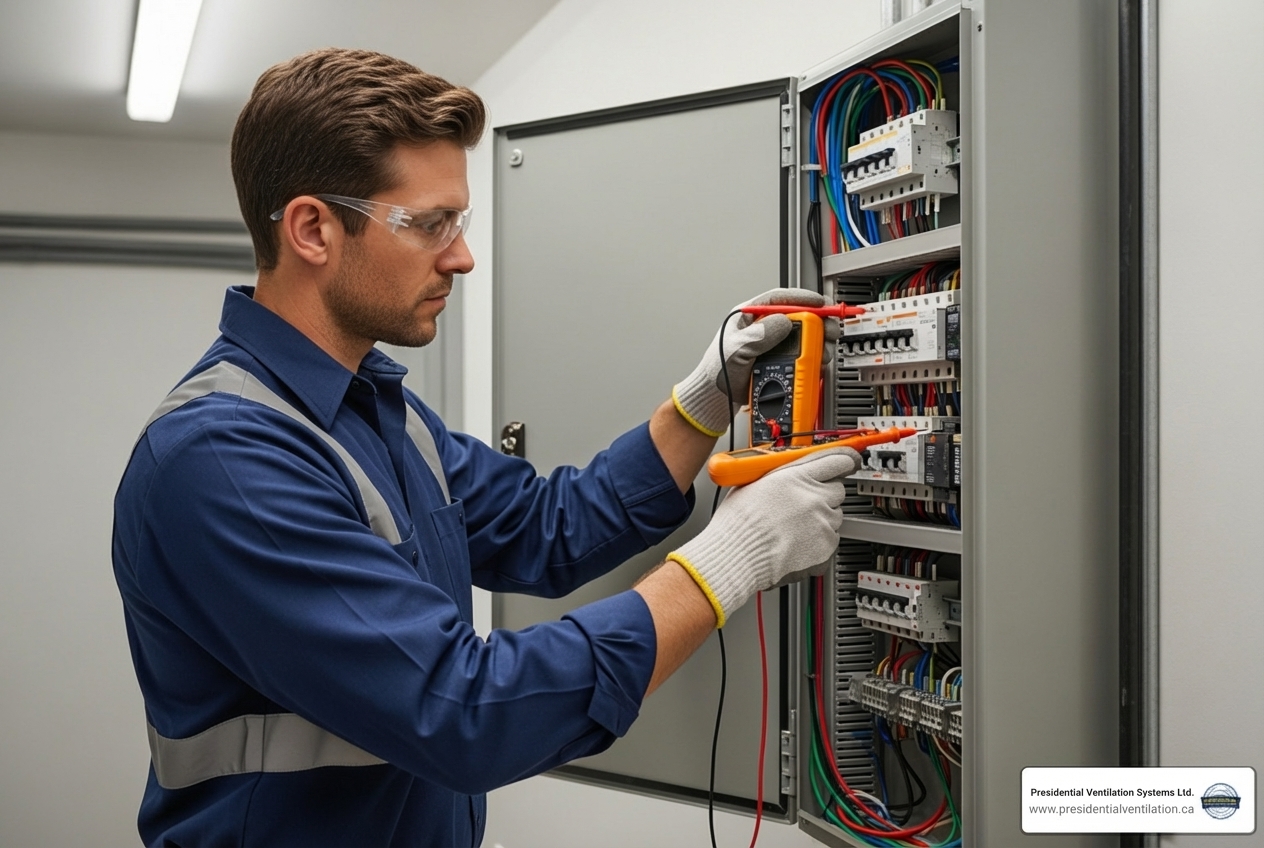

Finding the best electrical in Bedford, NS means looking for licensed professionals with strong safety records, positive reviews, and comprehensive service offerings. When searching for a top-rated electrician in Bedford, you should prioritize contractors with:
• A+ or A BBB ratings indicating proven reliability
• Full licensing and insurance for your protection
• Strong safety certifications like Certificate of Recognition (COR)
• Positive customer reviews on Google and Facebook
• Experience serving the Greater Halifax Area, including Bedford
• Emergency service availability for urgent electrical issues
• Specialized services like EV charger installation, panel upgrades, and heat pump hookups
Whether you need a panel upgrade, new wiring for a renovation, or specialized services like EV charger installation, choosing the right electrician protects your home and family. The electrical contractors serving Bedford typically offer both residential and commercial services, with many holding preferred contractor status with Nova Scotia Power and Efficiency NS partnerships.
For comprehensive HVAC and electrical services in Bedford, or to schedule an electrical service consultation, reach out to Presidential Ventilation Systems today.
Finding a reliable electrician is crucial for the safety and functionality of your home. This guide will walk you through what to look for, the services available, and the benefits of hiring a local expert in Bedford, NS.
When we're looking for the best electrical in Bedford, NS, we want to ensure we're partnering with professionals who not only deliver excellent service but also prioritize safety and customer satisfaction. It's not just about getting the job done; it's about getting it done right, safely, and efficiently.
The foundation of any reputable electrical service lies in its credentials. These aren't just bureaucratic checkboxes; they are indicators of a company's commitment to professionalism, safety, and quality.
• Licensed & Insured: This is non-negotiable. A licensed electrician has met the provincial standards for expertise and knowledge, ensuring they understand the complex electrical codes and safety regulations. Insurance protects you from liability in case of accidents or damage during the work. Always ask for proof of both licensing and comprehensive insurance before any work begins.
• Years of Experience: Experience speaks volumes in the electrical field. Our team, for instance, brings over 30 years' experience to every project, and many top-rated contractors in the Greater Halifax Area have been serving communities like Bedford since 2008, demonstrating a decade or more of proven service. This longevity often correlates with a deep understanding of local electrical systems and common issues.
• Positive BBB Rating: The Better Business Bureau (BBB) strives for an ethical marketplace where buyers and sellers trust each other. A strong BBB rating, ideally an A+ or A, indicates a company's commitment to resolving customer complaints and operating with integrity. Many reputable electrical contractors in the Bedford area are fully accredited by the BBB, showcasing their dedication to ethical business practices. You can often find a list of accredited electricians near Bedford, NS on the BBB website.
• Safety Certifications: Electrical work carries inherent risks, which is why safety certifications are paramount. Look for contractors who emphasize work-site safety and have a track record of no incidents or Workers’ Compensation Board claims since their inception. This commitment to safety protects not only their team but also your home and family.
• Construction Safety Nova Scotia (CSNS): This is an industry-founded and funded membership-based not-for-profit association dedicated to improving Occupational Health & Safety outcomes in the construction industry. When an electrical contractor is recognized by CSNS, it signals their active participation in and adherence to high safety standards within Nova Scotia's construction sector.
• Certificate of Recognition (COR): The COR program is a health and safety certification program for organizations in construction and related industries. Achieving COR certification means a company's safety program meets nationally established standards. This is a significant credential, demonstrating a proactive and comprehensive approach to safety management. You can learn more about COR certification through Construction Safety Nova Scotia.
Beyond formal credentials, the real-world experiences of other customers offer invaluable insight into a contractor's quality and reliability.
• Google Reviews: Online reviews are a cornerstone of reputation. Top-rated electricians often boast hundreds of positive Google Reviews, with many achieving 5-star ratings across platforms like Facebook and Google. These reviews provide unfiltered feedback on everything from professionalism and punctuality to the quality of workmanship and customer service.
• Customer Testimonials: Hearing directly from satisfied clients can paint a vivid picture of a company's service. We often hear anecdotes from customers praising the professionalism, fair pricing, and meticulous attention to detail of their chosen electricians. One homeowner might rave about how a complex wiring job was handled with care, ensuring liveable zones during a renovation, while another might highlight the clear explanations and problem-solving skills of the team.
• 100% Customer Satisfaction: This isn't just a slogan; it's a commitment. Reputable companies stand by their work, striving for complete customer satisfaction. This often translates into a 1-year warranty on services, giving you peace of mind long after the work is complete.
• Professional Staff: The electricians who enter your home should be courteous, respectful, and knowledgeable. Customers frequently highlight the importance of professional staff who communicate clearly, arrive on time, and leave the workspace clean. Our team prides itself on being professional and respectful of your home.
• High-Quality Work: The quality of the electrical work itself is paramount. This means thorough assessments, adherence to the highest standards, and attention to detail. Whether it's a simple repair or a complex installation, the work should be safe, durable, and meet all current electrical codes. For more on ensuring quality, you might find our Electrical Wiring Guide 2025 insightful.
The best electrical in Bedford, NS offers a comprehensive range of services to meet the diverse needs of homeowners and businesses. From routine maintenance to specialized installations, a top-rated electrician is equipped to handle nearly any electrical challenge.
The bread and butter of any electrical contractor involves a set of fundamental services that keep our homes and businesses powered safely and efficiently.
• Panel Upgrades: Your electrical panel is the heart of your home's electrical system. An outdated or undersized panel can lead to frequent circuit breaker trips, flickering lights, and even safety hazards. Upgrading your panel ensures your home can handle modern electrical demands. We specialize in Panel Upgrades to improve your home's capacity and safety.
• Service Upgrades: Similar to a panel upgrade, a service upgrade increases the total electrical capacity coming into your property. This is often necessary for older homes or when adding major appliances, hot tubs, or EV chargers. Our Electrical Service Upgrade solutions ensure your home is ready for anything.
• Home Wiring: Whether you're building a new home, undertaking a major renovation, or simply adding an extension, professional home wiring is crucial. This includes everything from installing new circuits to rewiring entire sections of your property, ensuring all connections are safe and up to code.
• Lighting Installation: From ambient lighting to task lighting, indoor and outdoor fixtures, and even smart lighting systems, electricians handle all aspects of lighting installation. This can transform the aesthetic and functionality of your space while improving energy efficiency.
• Troubleshooting & Repairs: Electrical issues can be frustrating and dangerous. Top electricians excel at diagnosing problems quickly and performing effective repairs, whether it's a faulty outlet, a mysterious power outage, or a buzzing breaker. Many also offer Commercial Electrical Repairs for businesses.
Beyond the basics, many leading electrical contractors in Bedford offer specialized services that cater to evolving technological and energy needs.
• EV Charger Installation: With the rise of electric vehicles, dedicated charging stations at home or work are becoming essential. Electricians can install Level 2 EV chargers, ensuring safe and efficient charging for your vehicle.
• Backup Generator Hookups: Power outages can be disruptive and even costly. Installing a backup generator provides peace of mind, automatically supplying power to your home or business during an outage. Our experts can help you choose the right size generator and ensure a seamless hookup.
• Solar & Green Energy Solutions: As we move towards more sustainable living, green energy solutions are gaining traction. Some electricians specialize in solar panel installations, energy storage systems, and other green energy technologies, helping you reduce your carbon footprint and energy bills. Many are also Efficiency NS Preferred Partners, meaning they are recognized for their expertise in energy-efficient installations.
• Heat Pump Electrical Hookups: Heat pumps are an increasingly popular and energy-efficient way to heat and cool homes in Nova Scotia. Proper electrical installation is vital for their optimal performance and safety. As experts in both HVAC and electrical, we ensure seamless Heat Pump Installation in Bedford NS, facilitating the transition from traditional heating systems like oil to more efficient options with our Oil to Heat Pump Bedford NS services.
Many homes in Bedford, particularly older ones, may still rely on outdated electrical systems. Upgrading these systems is not just about convenience; it's a critical safety measure and an investment in your home's future.
• Protection — Outdated Fuse Boxes: Fuses blow and need replacement — Modern Breaker Panels: Breakers trip and can be reset
• Capacity — Outdated Fuse Boxes: Lower amperage, limited for modern appliances — Modern Breaker Panels: Higher amperage, supports more devices
• Safety — Outdated Fuse Boxes: Risk of improper fuse replacement, fire hazard — Modern Breaker Panels: Designed for overload protection, safer
• Efficiency — Outdated Fuse Boxes: Less efficient, potential for power loss — Modern Breaker Panels: More efficient, stable power distribution
• Code Compliance — Outdated Fuse Boxes: May not meet current electrical codes — Modern Breaker Panels: Meets or exceeds current electrical codes
Safety Benefits: Modern breaker panels are designed with advanced safety features to prevent overloads and short circuits, significantly reducing the risk of electrical fires. If your panel is older than 20 years or still uses fuses, it might be time for an inspection.
Increased Capacity: Today's homes are filled with more electronics and high-power appliances than ever before. An outdated electrical system simply can't keep up, leading to frequent tripping breakers or insufficient power. Upgrading provides the necessary capacity for your current and future needs.
Code Compliance: Electrical codes are regularly updated to improve safety. An upgraded system ensures your home meets the latest standards, which is also important for insurance purposes and property value. For all your electrical needs, explore our comprehensive Electrical Services.
When seeking the best electrical in Bedford, NS, choosing a local electrician offers distinct advantages that contribute to a more personalized and efficient service experience.
Hiring a locally owned and operated electrical company means you're working with professionals who are not just service providers, but also neighbors.
• Familiarity with Bedford homes: Local electricians have an intimate understanding of the unique electrical systems and common issues found in Bedford homes, from older properties to new constructions. This familiarity allows for quicker diagnosis and more effective solutions, as they've likely encountered similar situations many times before. Our team serves Bedford, along with Halifax, Dartmouth, Lower Sackville, Middle Sackville, Upper Sackville, Clayton Park, Beaver Bank, Cole Harbour, Eastern Passage, Fall River, Tantallon, Timberlea, Lawrencetown, Waverley, Mount Uniacke, Indigo Shores, Lacasville, Prospect, Hubbards, Sambro, Herring Cove, Hatchet Lake, Williamswood, East Dover, Indian Harbour, Spryfield, Otter Lake, Fairview, Terence Bay, Porters Lake, Preston, Peggys Cove, Harrietsfield, and Woodlawn.
• Adherence to Nova Scotia Power standards: Reputable local electricians are often "Nova Scotia Power Preferred Contractors." This designation means they are recognized by the provincial utility for their commitment to quality work that meets specific standards, ensuring that any work done on your property is fully compliant with local regulations and utility requirements.
• Personalized Service: A local company often provides a more personalized approach. They value their community reputation and strive to build long-term relationships with clients. This means more attentive service, clear communication, and a genuine interest in your satisfaction. You're not just another job number; you're a valued member of the community.
• Building community trust: Supporting local businesses contributes to the economic health of Bedford. When you choose a local electrician, you're investing in your community. These companies are often deeply rooted in the area, contributing to local initiatives and maintaining a strong reputation built on trust and reliability.
• Faster Response Times: In an electrical emergency, every minute counts. Local electricians can often provide faster response times for urgent service calls, as they are already operating within the area. This quick response can prevent further damage and restore safety more swiftly.
• Understanding Local Codes: Electrical codes can vary slightly even within a region. Local electricians are well-versed in Bedford's specific building codes and regulations, ensuring all work is compliant and passes inspections without issues.
Beyond electrical services, our local expertise extends to HVAC Services in Bedford NS, offering comprehensive home comfort solutions.
We often get questions from homeowners in Bedford about their electrical systems. Here are some of the most common inquiries we address to help you make informed decisions about your home's electrical needs.
Yes, generally, most electrical work in Nova Scotia requires permits and inspections. This isn't just a formality; it's a critical step to ensure your electrical system is safe and compliant with the latest provincial regulations.
• Permit requirements: The type of permit needed depends on the scope of the work, whether it's a minor repair, a major renovation, or a new installation. Your chosen electrician should be knowledgeable about these requirements and handle the application process on your behalf.
• Nova Scotia regulations: All electrical work must adhere to the Nova Scotia Building Code and Electrical Code. These codes are in place to protect occupants and property from electrical hazards.
• Inspection process: Once the work is completed, a qualified electrical inspector will review the installation to ensure it meets all safety standards. This inspection is a crucial safeguard, providing an independent verification of the work's quality and safety.
• Ensuring code compliance: A reputable electrician will always ensure their work is fully compliant with current electrical codes, including handling all necessary permits and inspections. This ensures your home is safe and avoids potential issues with insurance or future home sales.
Recognizing the signs of an overloaded or outdated electrical system is key to preventing potential hazards and ensuring your home can meet its power demands.
• Flickering lights: If your lights frequently flicker or dim, especially when appliances turn on, it could indicate an insufficient power supply or an overloaded circuit.
• Tripping breakers: Circuit breakers are designed to trip when a circuit is overloaded. If this happens often, it's a clear sign your electrical system might be struggling to keep up. Older homes with fuse boxes that frequently blow fuses also indicate a need for an upgrade.
• Outdated panels: Electrical panels older than 20 years, especially those with fewer than 200 amps, may not be adequate for modern energy consumption.
• Major appliance installation: Adding high-power devices like central air conditioning, electric vehicle chargers, hot tubs, or heat pumps often necessitates an electrical service upgrade to ensure safe and efficient operation.
• Home renovations: Any significant renovation that adds new circuits, outlets, or changes the layout of your electrical system may require an upgrade to accommodate increased demand.
Improving your home's energy efficiency not only saves you money on utility bills but also contributes to a more sustainable environment. Many electrical upgrades and installations can significantly boost your home's energy performance.
• Heat pump benefits: Heat pumps are incredibly efficient for both heating and cooling your home. They can reduce your home heating bill by up to 60% compared to older oil tank systems, making them a smart investment for energy savings. Our team can help you explore options for Ducted Heating Systems in Bedford NS and Ducted AC Systems in Bedford NS that leverage heat pump technology.
• LED lighting retrofits: Replacing traditional incandescent or fluorescent lighting with LED alternatives can drastically cut down on energy consumption. LEDs are more efficient, last longer, and come in a wide range of styles to suit any aesthetic.
• Energy-saving solutions: Beyond heat pumps and LED lighting, electricians can implement various energy management solutions, such as smart thermostats, energy-efficient wiring, and power factor correction devices, all designed to optimize your home's energy use.
• Efficiency NS Preferred Partner: When choosing an electrician, look for those who are an "Efficiency NS Preferred Partner." This means they are recognized by Efficiency Nova Scotia for their expertise in installing energy-efficient products and services, ensuring you receive qualified advice and installations that can help you save energy and potentially qualify for rebates.
For ongoing efficiency, don't forget about maintenance for your energy-saving systems. For example, regular Ductless Heat Pump Maintenance in Bedford NS ensures optimal performance and longevity.
Choosing the right electrician ensures your home is safe, efficient, and up-to-date. By focusing on credentials, comprehensive services, and local expertise, you can make a confident decision. For professional and reliable electrical work, trust the experienced team at Presidential Ventilation. We are dedicated to providing the best electrical in Bedford, NS, and surrounding areas, ensuring your home's electrical systems are safe, reliable, and efficient.
For more information on our services or to schedule a consultation, visit our Electrical Services Bedford NS page.

Are you noticing weak airflow from your vents or rising energy bills, even though you change your air filter regularly? If you are researching why standard one-inch filters choke high-efficiency ducted heat pumps, you are likely dealing with a fundamental mismatch between modern HVAC technology and outdated filtration methods. Many homeowners upgrade to advanced, energy-efficient climate control systems but continue sliding the same basic disposable filters into the return grille, completely unaware that they are suffocating their equipment.
The core issue rarely stems from a mechanical defect in the heat pump itself. Instead, the typical pattern we see is a homeowner trying to improve their indoor air quality by purchasing a restrictive high-MERV 1-inch pleated filter from a big-box store. While these dense filters capture fine dust and allergens, they also act like a brick wall against the air trying to return to your system. This creates a severe bottleneck.
Proper filtration is a holistic airflow issue, not just a disposable product choice. You eventually reach a critical decision point: continue replacing 1-inch filters every single month while your system struggles to breathe, or upgrade the physical ductwork to accommodate a high-capacity filtration system that actually supports your equipment's performance.
Related resource: Learn more about how proper airflow supports our ducted heat pump systems.
To understand why your heat pump is struggling, you first need to understand a mechanical concept called static pressure. In simple terms, static pressure is the measurement of resistance to airflow within your ductwork. Every component in your HVAC system—from the sweeping curves of the sheet metal to the grilles in your floor—adds a certain amount of resistance. Your system's blower motor is engineered to overcome a very specific, calculated amount of this resistance.
Think of your heat pump's blower motor like your own lungs. If you go for a run while breathing normally, your lungs easily pull in the volume of air you need. Now, try running that same distance while breathing entirely through a narrow drinking straw. The intense strain you feel in your chest is exactly what your system's blower motor experiences when it faces high static pressure. It is forced to work exponentially harder just to pull the same volume of air, measured in cubic feet per minute (CFM), through the ductwork.
When you install a dense filter into a narrow slot, you drastically increase that resistance. If you need to order replacement heat pump filters, understanding how surface area dictates this pressure drop is critical to keeping your system healthy.
The fatal flaw of the high-MERV 1-inch pleated filter is its severe lack of surface area. MERV stands for Minimum Efficiency Reporting Value, which measures how effectively a filter traps microscopic particles. To achieve a high MERV rating, manufacturers pack the filter media tightly to catch more debris.
• Dense pleating: In a 1-inch space, the pleats are incredibly shallow and tightly packed together, leaving almost no open space for air to bypass the trapped dust.
• Rapid clogging: Because there is so little surface area, the face of the filter loads up with dust, pet dander, and hair almost immediately.
• Spiking pressure: Within just a few weeks of use, that 1-inch filter becomes severely clogged, causing the static pressure inside your ductwork to spike to unsafe levels.
Your heat pump requires a massive, continuous volume of air to transfer heat effectively. When that air is blocked by a small, dense filter, the entire thermodynamic process begins to break down.
The static pressure problem becomes even more destructive when we look at the specific technology inside modern high-efficiency heat pumps. Older furnaces used basic motors that simply moved less air when the filter got dirty. Modern systems use advanced ECM (Electronically Commutated Motors) that behave very differently when faced with a restriction.
Here is exactly how a high-MERV 1-inch pleated filter damages a modern ECM blower motor:
1. Sensing the restriction: ECM motors have built-in microprocessors programmed to maintain a precise, constant airflow (CFM). When the dense 1-inch filter restricts the air, the motor's sensors detect the drop in volume.
2. Ramping up RPMs: To compensate for the blockage and hit its programmed airflow target, the ECM automatically increases its speed and torque. It begins spinning faster and pulling more electricity to fight the resistance.
3. Constant maximum output: In Nova Scotia, heat pumps run almost continuously through freezing winters and humid summers. This near-constant operation means the blower motor is running at maximum RPMs year-round just to overcome the dense filter.
4. Overheating and failure: Electric motors are cooled by the air flowing over them. With restricted airflow and maximum electrical draw, the motor quickly overheats. Over time, this constant strain degrades the bearings and internal electronics, leading to premature motor failure.
Blower motor replacements are major, costly repairs. The most frustrating part for homeowners is that these failures are entirely preventable. By correcting the structural airflow design, you allow the ECM motor to operate at a low, quiet, and highly efficient speed exactly as the manufacturer intended.
The permanent solution to this airflow crisis is not found in the filter aisle of a hardware store. It requires a structural modification to your ductwork known as a 4-inch media cabinet. This is a dedicated, custom-fitted sheet-metal housing installed directly into the return air drop next to your indoor air handler.
Instead of a shallow 1-inch filter, this cabinet houses a massive, deeply pleated 4-inch filter. The difference in performance comes down to simple geometry. A 4-inch filter contains exponentially more physical filter media folded into those deep pleats. This massive increase in surface area means you can finally use a high-MERV filter to capture allergens without creating a restrictive wall. The air easily flows through the vast surface area, keeping static pressure low and protecting your ECM blower motor.
Because there is so much more material to hold dust and debris, a 4-inch media filter only needs to be replaced every 6 to 12 months, rather than every 30 days.
You cannot simply shove a 4-inch filter into a 1-inch slot, nor can you tape a larger box to the side of your system and expect it to work. Upgrading your filtration requires professional mechanical modification.
With our 30+ years Nova Scotia HVAC and sheet-metal expertise, we advocate for custom-fabricated media cabinets because aerodynamic flow is highly sensitive. The return air drop must be properly sized and transitioned. If the sheet metal is poorly designed, the air will create turbulence, bypassing the filter entirely or whistling through gaps. Custom sheet-metal fabrication ensures an airtight seal, preventing dirty basement or utility room air from being sucked into your pristine heating system. This commitment to proper mechanical design separates a long-lasting system from one plagued by constant breakdowns.

When a heat pump's airflow is choked, the consequences extend far beyond the mechanical room. Your central ductwork is the respiratory system of your entire home. If the air cannot move freely through the central air handler, the air in your living spaces quickly stagnates.
During the humid summer months, your heat pump removes moisture from the air by passing it over a cold indoor coil. If high static pressure slows that airflow to a crawl, the coil can actually freeze solid into a block of ice, shutting down your cooling completely. Even if it doesn't freeze, the weak airflow prevents the system from properly circulating and dehumidifying the distant rooms in your home, leaving bedrooms feeling sticky and uncomfortable.
In the winter, poor circulation prevents the warm air from reaching the furthest corners of your house, resulting in cold spots and uneven heating. Furthermore, your central heat pump often works in tandem with other indoor air quality equipment. For example, maintaining your HRV system is critical for fresh air exchange, but if your primary ductwork is choked by a restrictive filter, that fresh air cannot be properly distributed throughout the home. Maintaining clear, low-pressure airflow is the absolute foundation of a healthy, comfortable indoor environment.
When deciding how to handle your home's filtration, it helps to look at the hidden costs and daily frustrations of the standard 1-inch filter compared to the peace of mind that comes with a structural upgrade. Relying on 1-inch filters is an ongoing burden that actively puts your expensive heat pump at risk.
Most homeowners forget to change their 1-inch filter every 30 days. When life gets busy and that filter stays in place for 60 or 90 days, the static pressure reaches critical levels, causing severe wear and tear on the system's internal components. Positioning a 4-inch cabinet as a permanent upgrade is an investment in the heat pump's lifespan.
• Surface Area — High-MERV 1-Inch Pleated Filter: Extremely limited; pleats are shallow and tightly packed. — Custom 4-Inch Media Cabinet: Massive; deep pleats allow high volume of air to pass easily.
• Static Pressure — High-MERV 1-Inch Pleated Filter: High; severely restricts airflow and strains the ECM motor. — Custom 4-Inch Media Cabinet: Low; supports optimal CFM and allows the motor to run efficiently.
• Replacement Frequency — High-MERV 1-Inch Pleated Filter: Must be replaced every 30 days to prevent system damage. — Custom 4-Inch Media Cabinet: Only requires replacement every 6 to 12 months.
• System Protection — High-MERV 1-Inch Pleated Filter: Causes overheating, coil freezing, and premature breakdowns. — Custom 4-Inch Media Cabinet: Protects the blower motor and extends the lifespan of the heat pump.
• Installation — High-MERV 1-Inch Pleated Filter: Slides into standard, often leaky, factory filter slots. — Custom 4-Inch Media Cabinet: Requires professional sheet-metal fabrication for an airtight seal.
Addressing airflow is a critical part of comprehensive system care. We highly encourage homeowners to have their static pressure and ductwork evaluated during their next service visit. Incorporating this check into a preventative HVAC maintenance plan ensures your system is always breathing easily and operating at peak efficiency.
Weak airflow is most commonly caused by a clogged or highly restrictive air filter that creates high static pressure within the ductwork. When you use a dense filter, the system's blower motor cannot push air through the dense physical barrier, resulting in a very low volume of air making it to your room vents. Checking and replacing a dirty filter is the first step, but if the airflow remains weak, your ductwork may be undersized or you may need a deeper filter cabinet to reduce the resistance.
Yes, a restrictive filter forces the blower motor to overwork, which can lead to overheating, premature motor failure, and frozen indoor coils. Modern heat pumps rely on a specific, constant volume of air to transfer heat safely. When a high-MERV 1-inch pleated filter chokes that airflow, the internal components run hotter and harder than designed. This constant strain dramatically shortens the lifespan of the equipment, turning a simple maintenance oversight into a major mechanical failure.
Yes, 4-inch media cabinets provide exponentially more surface area, allowing for excellent indoor air quality filtration without choking the system. Because the filter media is folded deeply, air can pass through easily while still trapping microscopic dust and allergens. Beyond protecting your expensive heat pump from blower motor failure, they offer incredible convenience, as you only need to remember to change the filter once or twice a year instead of every single month.
You can use a high-MERV filter only if you have a media cabinet deep enough (like a 4-inch or 5-inch model) to handle the increased airflow resistance. We strongly warn against using high-MERV 1-inch filters, as they almost always cause unsafe static pressure levels that suffocate the system. If you want hospital-grade filtration or have severe allergies, you must upgrade the physical ductwork to accommodate a thicker filter so the system can still breathe.
For standard 1-inch filter slots, a MERV 8 filter is usually the maximum recommended rating to prevent severe airflow restriction and equipment issues. Anything higher in a 1-inch format becomes too dense. However, if you upgrade to a professionally installed 4-inch media cabinet, you can safely use MERV 11 or even MERV 13 filters without harming the equipment, giving you superior air cleaning and optimal system performance simultaneously.
In Nova Scotia, where heat pumps run year-round to combat freezing winters and humid summers, you should inspect a 4-inch filter every 6 months and replace it at least annually. Because your system rarely gets a break, it is filtering air constantly. Homes with multiple pets, recent renovations, or heavy dust accumulation may require more frequent changes, so pulling the filter out for a visual inspection at the change of seasons is a wise habit.
You do not have to settle for weak airflow, noisy vents, or the constant chore of replacing restrictive 1-inch filters every few weeks. Airflow issues can be permanently solved with the right mechanical modifications, ensuring your home stays perfectly comfortable without destroying your equipment in the process. Stop fighting with dense, undersized filters and take the steps necessary to protect your heat pump investment.
With our 30+ years Nova Scotia HVAC and sheet-metal expertise, our team can evaluate your system's static pressure and design a custom solution. Reach out to Presidential Ventilation Systems today to request a free estimate for a custom 4-inch media cabinet upgrade, and give your heat pump the clear, unrestricted airflow it needs to perform flawlessly for years to come.

The damp, biting cold of a Nova Scotia winter is already settling in, making a reliable heating system an absolute necessity for your home's safety. If you are dealing with a sudden, complete system failure, understanding exactly how we execute same-day heat pump replacements during freezing Maritime temperatures is critical. When a heat pump dies in January or February, waiting days for a replacement is simply not an option. You are immediately faced with the concrete problem of rapid home heat loss and the very real threat of frozen pipes. The critical decision point becomes finding a contractor capable of the specific staging and multi-trade team coordination required to rip out a dead system and install a new one before your home drops below freezing. If you are facing a sudden breakdown, learn more about our heat pump systems and ductless heat pump replacement solutions.
When your primary heating system fails in the middle of a freezing Nova Scotia winter, the clock immediately starts ticking. Nova Scotia's unique climate features high humidity combined with rapid, aggressive temperature fluctuations. This damp cold penetrates building materials much faster than dry cold, accelerating indoor heat loss. Understanding the physical realities of this heat loss explains why a rapid, same-day response is not just a convenience, but a structural necessity for your property.
Once a heat pump stops producing warm air, a standard home's internal temperature can plummet below 10 degrees Celsius within a mere 24 hours. As the ambient temperature inside the house drops, the risk profile shifts from personal discomfort to severe property damage. The primary danger zone involves your indoor plumbing infrastructure. Water lines running through exterior walls, basements, and crawlspaces are the first to freeze. When water freezes, it expands, causing copper and PEX pipes to split. The ensuing water damage from a burst pipe often requires extensive renovations, making the initial heating failure seem minor in comparison. The 24-hour window following a breakdown is the critical timeframe for taking decisive action.
Many homeowners attempt to bridge the gap during a heating failure by purchasing multiple temporary space heaters. While this might keep a single bedroom tolerable, it is an inadequate and highly expensive stopgap for whole-home heating. Space heaters cannot circulate warm air into the hidden cavities of your home where plumbing resides. Furthermore, running multiple high-wattage space heaters simultaneously overloads residential electrical panels, creating significant fire hazards and frequent breaker trips. Restoring your central or primary ductless heat is the only safe, effective way to protect your entire property.
• Portable Space Heaters — Coverage Area: Single small room only — Safety Risks: High fire risk, overloaded circuits — Effectiveness in Freezing Weather: Inadequate for protecting home plumbing
• Wood/Pellet Stoves — Coverage Area: Localized main living area — Safety Risks: Requires constant monitoring and fuel — Effectiveness in Freezing Weather: Leaves distant rooms and basements vulnerable
• New Heat Pump System — Coverage Area: Whole-home or multi-zone coverage — Safety Risks: Safe, dedicated electrical circuits — Effectiveness in Freezing Weather: Maintains consistent, safe ambient temperatures
Executing a true same-day replacement requires far more than just rushing a unit to your driveway. Modern heat pump installations are complex projects that demand both mechanical (HVAC) and electrical expertise. In our 30+ years of experience serving Nova Scotia, we have seen that relying on third-party electrical subcontractors is the number one cause of installation delays across the industry. When a company has to wait for a separate electrical contractor to fit your emergency into their schedule, a one-day job easily stretches into a three-day freezing ordeal.
The traditional multi-day wait for an electrician is entirely bypassed by our operational model. With approximately 70 employees and multiple skilled trades operating under one roof, we eliminate the scheduling bottlenecks that paralyze other contractors. When you call our team, you are not waiting for two different companies to coordinate their calendars. A single call dispatches a complete, unified team ready to handle every aspect of the project from start to finish.
Speed must never come at the expense of safety, especially when dealing with high-voltage electricity and pressurized refrigerants. Having in-house Red Seal HVAC and electrical tradespeople ensures that every phase of your emergency replacement meets strict Nova Scotia building codes. Licensed professionals guarantee that the work is done safely, legally, and flawlessly, maintaining the highest quality standards even under intense emergency time constraints.
• Unified Dispatch: HVAC technicians and electricians arrive together, eliminating standby time.
• Code Compliance: All electrical tie-ins and mechanical mountings are performed by Red Seal certified experts.
• Seamless Communication: In-house teams communicate directly, preventing the missteps common with outsourced labor.
• Guaranteed Accountability: One company handles the entire warranty and installation process, leaving no room for finger-pointing.
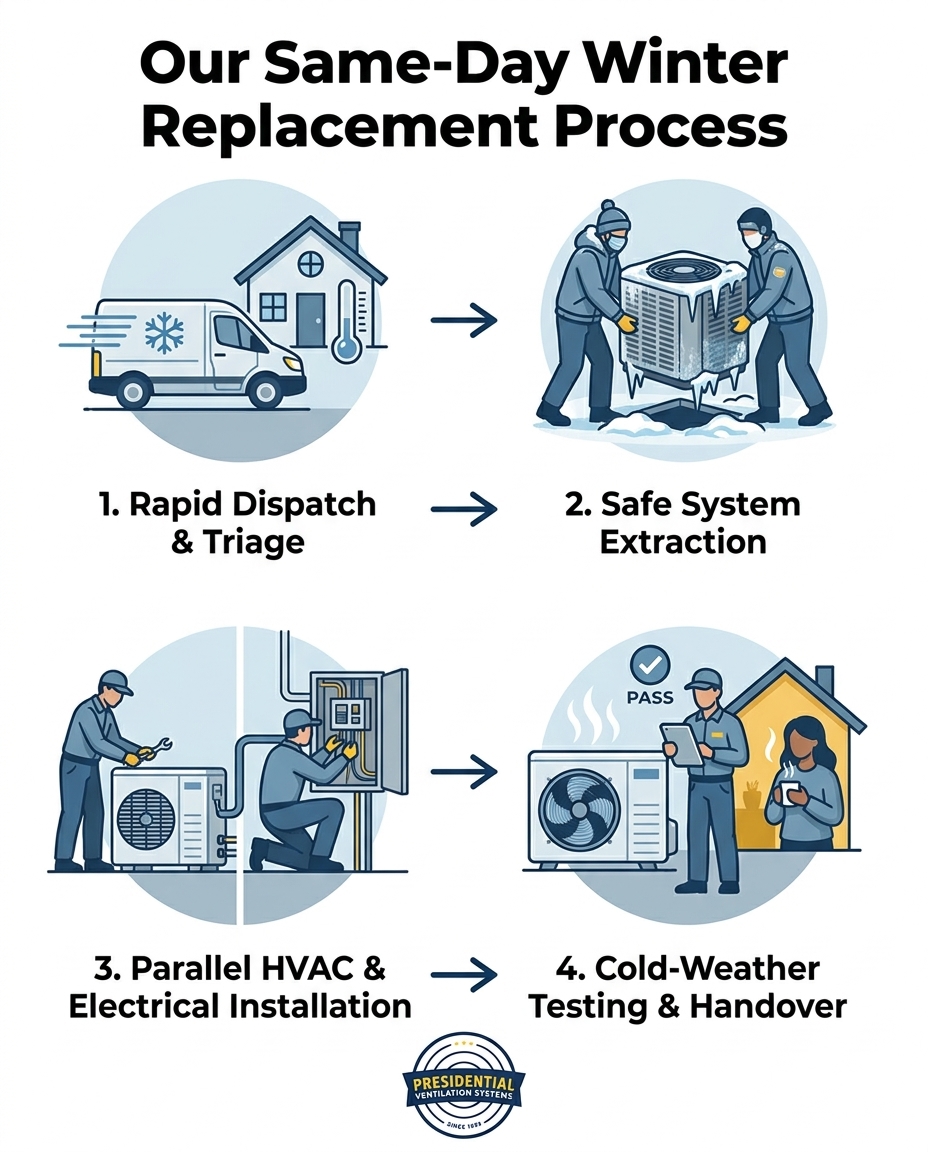
The moment an emergency call comes in, our methodology kicks into gear. True same-day replacement begins before the technicians even pull into your driveway. It requires precision staging, accurate diagnostics, and a warehouse infrastructure capable of supporting immediate deployment.
The first step is a rapid but thorough initial diagnostic phase. We must confirm that the system is truly dead and not simply in need of a 24/7 central heat pump repair. If a component like a compressor has catastrophically failed and replacement is the only safe, viable option, the technician immediately sizes the replacement unit accurately based on your home's specific heating load requirements.
While the technician is completing the assessment on-site, our warehouse logistics team is already in motion. Maintaining a robust local inventory is crucial. As a Daikin Comfort Pro, we have immediate access to premium Daikin and Lennox units. The warehouse team pulls the exact required unit, pre-stages the necessary materials—including insulated line sets, electrical whips, and mounting brackets—and loads the secondary dispatch vehicles.
1. Initial Diagnostic: Technician confirms catastrophic failure and rules out simple repairs.
2. System Sizing: Immediate calculation of the correct tonnage and BTUs for the replacement unit.
3. Inventory Pull: Warehouse team secures the specific heat pump model from local stock.
4. Material Staging: All required copper, wiring, and mounting hardware are loaded for immediate transport.
5. Simultaneous Dispatch: The installation crew, including both mechanical and electrical trades, is deployed to the home.
Removing the old unit safely is a critical phase of the operation. Working outdoors in ice, snow, and biting wind requires specific safety protocols. The extraction must be done swiftly to prepare the site for the new installation, but it must also adhere to strict environmental and safety regulations.
Environmental compliance is mandatory, regardless of the weather. Before any lines are cut, the old refrigerant must be safely recovered. Handling pressurized systems in the cold presents specific challenges, as refrigerant pressures drop significantly in freezing Maritime winter storms. Our technicians utilize specialized recovery machines designed to extract the chemical safely, ensuring nothing is vented into the atmosphere.
Once the system is depressurized, the physical removal begins. This involves removing outdated line sets, disconnecting old control wiring, and physically hauling away the dead compressor and indoor heads. The outdoor pad must be completely cleared of ice or snow buildup to ensure a level, stable foundation for the new equipment. The wall penetrations are also inspected and prepped, ensuring they are clear and ready to accept the new, properly insulated line sets without allowing winter drafts into the home.
The core of our same-day promise lies in the synchronized, parallel workflow of our multi-trade team. This is where the Presidential Advantage truly shines. While the HVAC technicians are managing the mechanical side of the installation, the electricians are simultaneously handling the electrical panel and high-voltage connections. One local homeowner reached out in the dead of winter when their primary heating system failed completely. Because we dispatched both mechanical and electrical teams simultaneously, we successfully completed the winter installation quickly and professionally within a single day, restoring heat before the home's plumbing was ever at risk.
The mechanical team begins by securing the new outdoor unit. In Nova Scotia, it is critical that the compressor is mounted on a stand above the anticipated snow line to prevent ice accumulation from blocking airflow during defrost cycles. Concurrently, the indoor heads are mounted, and the team begins flaring and connecting the new copper line sets. These lines must be heavily insulated to prevent heat loss as the refrigerant travels between the indoor and outdoor units.
While the mechanical connections are being made, our in-house Red Seal electricians are hard at work. They ensure the electrical panel can safely handle the load of the new system, wiring the dedicated circuits and installing the required outdoor disconnect switch. Nova Scotia building codes mandate strict electrical safety checks for heat pump installations. Because our electricians are on staff, this electrical tie-in happens exactly when the HVAC team needs it, cutting the standard installation time in half and preventing hours of idle waiting.
With the physical installation complete, the final phase is system commissioning. This is the rigorous testing process that ensures the new heat pump will perform flawlessly against the freezing Nova Scotia winter. We do not leave the property until we have verified that the home is actively warming up.
Before any refrigerant is released into the new lines, the system undergoes a high-pressure nitrogen test to check for microscopic leaks, followed by a deep vacuum process to remove all moisture from the copper piping. Once a perfect seal is confirmed, the system is charged. Cold-weather commissioning involves verifying the refrigerant charge in low ambient temperatures and manually triggering the defrost cycles to ensure the outdoor unit can effectively shed ice during winter storms.
The final step is handing the system over to you. The lead technician will walk you through the operation of your new heat pump, ensuring you are comfortable with the controls.
1. Thermostat Operation: Demonstrating how to set schedules, adjust temperatures, and use the remote controls effectively.
2. Airflow Direction: Explaining how to adjust the vanes for optimal winter heat distribution.
3. Winter Maintenance: Providing clear instructions on keeping the outdoor unit clear of snowdrifts and ice buildup.
4. Filter Cleaning: Showing you how to easily remove and wash the indoor filters to maintain efficiency.
5. Temperature Verification: Measuring the ambient air output to confirm the home is actively recovering its heat.
A sudden winter heat pump failure is an unexpected and stressful event. Beyond the physical cold, there is the immediate anxiety regarding the logistics of an unplanned replacement. While speed is the absolute priority to protect your home, we understand that navigating the administrative and financial aspects is just as important for your peace of mind.
Even in an emergency, homeowners should explore available provincial and federal rebate programs. High-efficiency systems often qualify for significant incentives. It is important to note that professional installation by a licensed contractor is strictly required for rebate eligibility. While programs and eligibility requirements can change frequently, our team will help you understand the current landscape and provide the necessary documentation to support your applications. Always confirm current programs with our office during your initial consultation.
To help manage the upfront investment of an unexpected winter breakdown, flexible payment options may be available. Utilizing emergency heat pump financing can ease the immediate financial burden, allowing you to install a reliable, high-efficiency system without draining your emergency savings all at once. Because financing terms and eligibility vary, we encourage you to speak directly with our team to confirm the options that best suit your situation.
Can a heat pump be replaced in the winter?
Yes, a heat pump can absolutely be replaced during the winter months. Professional HVAC teams utilize specialized equipment to safely recover refrigerant and perform installations even in sub-freezing temperatures. The key is working with a contractor who has the resources to execute the replacement quickly before the home loses too much heat.
How long does it take to replace a heat pump?
A standard heat pump replacement typically takes between 4 to 8 hours, depending on the complexity of the system and the weather conditions. When a contractor utilizes a parallel workflow with in-house mechanical and electrical teams, the process is highly streamlined. This coordination ensures the entire rip-and-replace process can be completed in a single day.
What happens if my heat pump dies in the winter?
If your heat pump dies in the winter, your home's internal temperature will begin dropping rapidly, putting your plumbing at severe risk of freezing and bursting. It is critical to contact an emergency HVAC provider immediately to assess the system. Relying on temporary space heaters is not a safe or effective long-term solution for protecting your property.
Can you install a mini split in the freezing cold?
Yes, ductless mini splits can be installed in freezing conditions by experienced technicians. The process requires careful handling of the copper line sets and specialized vacuum procedures to ensure no moisture is trapped in the system. Proper cold-weather commissioning is essential to verify that the unit is operating correctly before the technicians leave.
Do I need to hire a separate electrician for a heat pump replacement?
If you hire a multi-trade contractor with in-house Red Seal electricians, you do not need to hire a separate electrical company. This in-house capability is crucial during an emergency, as it eliminates the multi-day delays often caused by waiting for third-party subcontractors to arrive and wire the system.
A dead heating system doesn't have to mean days of freezing temperatures and the looming threat of burst pipes. When you have the right team on your side, restoring comfort and safety to your property is a streamlined, highly coordinated process. Our in-house roster of Red Seal HVAC and electrical experts ensures that how we execute same-day heat pump replacements during freezing Maritime temperatures remains the standard for reliability. We provide a clear, reassuring breakdown of the exact staging and team coordination process that proves a same-day replacement is safe, efficient, and handled entirely by a single multi-trade contractor. Contact Presidential Ventilation Systems today for an immediate assessment and a free estimate to secure your home's heat.